



Time to read: 2 min
Manufacturing is undergoing one of its most significant transformations in decades.
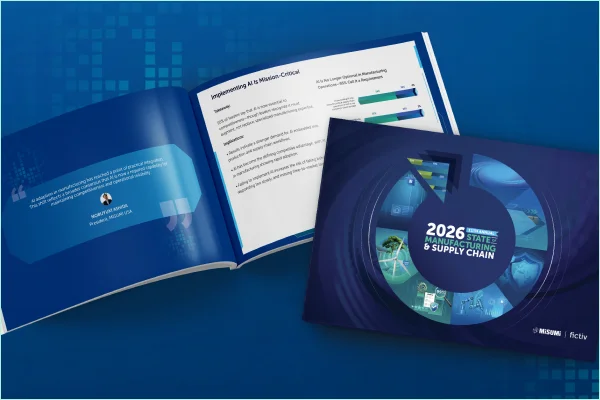
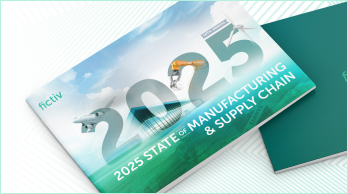
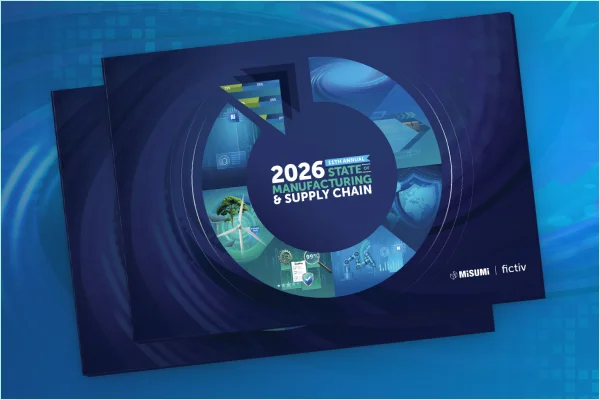
Today, Fictiv released its 11th annual 2026 State of Manufacturing & Supply Chain Report, capturing insights from industry leaders across MedTech, Climate Tech, EV, and Robotics. The findings point to an industry moving decisively toward AI-enabled systems, regionally resilient production strategies, and more integrated digital operations.
Here’s what’s shaping manufacturing in 2026.
Key Findings
AI Is Now Core Infrastructure
AI adoption has reached near-universal levels. 97% of companies report using AI across core manufacturing and supply chain workflows, with leaders describing it as essential to future success. Adoption is accelerating fastest in supply chain execution, quality management, and production planning—areas where speed and precision directly impact performance.
Regional Resilience Is the New Normal
In response to continued global volatility, companies are prioritizing on-shoring and near-shoring strategies. The U.S. has emerged as the top region for supplier expansion across industries.
Manufacturers are building flexible, multi-regional networks designed to adapt quickly to disruption rather than rely on single-region supply chains.
Tariff and Material Volatility are Forcing Structural Change
98% of leaders are actively mitigating tariff impacts, whether by switching suppliers, redesigning parts, or restructuring sourcing strategies. Rather than waiting out volatility, companies are making permanent adjustments to protect margins and continuity.
Engineering Bandwidth Is Reaching Capacity
Engineering bandwidth is under strain. 83% of engineers now spend more than four hours per week on procurement-related tasks, a sharp increase year over year.
As product complexity increases, freeing up engineering time is becoming a competitive necessity.
Digital Manufacturing Platforms Are Becoming Non-Negotiable
Belief in the importance of digital manufacturing platforms jumped to 97%, reinforcing a broad shift away from manual, fragmented supplier management.
Companies are moving toward integrated, AI-powered platforms that provide visibility, coordination, and real-time decision-making across the supply chain.
What This Means for 2026
Manufacturing is in the middle of a full-scale evolution.
To stay competitive, companies are:
- Investing in AI-driven tools to increase productivity and decision quality
- Building flexible, multi-regional manufacturing networks
- Expanding supplier ecosystems and automating sourcing workflows
- Reducing administrative burden on engineering teams
- Strengthening forecasting, visibility, and real-time supply chain data
The future belongs to manufacturers who can turn digitization and regionalization into real execution advantages.
How products are developed, sourced, produced, and delivered is changing. The companies that evolve smarter systems, resilient networks, and quality-first execution will be best positioned to move faster and stay agile in a world where speed is everything.
About the Research
This is Fictiv’s 11th annual State of Manufacturing & Supply Chain Report conducted with Dimensional Research. The report surveyed 321 qualified individuals at the director level or higher who work in engineering, supply chain, production manufacturing, R&D, or digital innovation roles. Most companies produce goods in Climate Tech, Electric Vehicles, Robotics, or MedTech industries. Download the full report here.