




High-Pressure Engineering in a Small Form Factor
The Breville Bambino Plus compresses key espresso machine architectures—thermal management, pump-driven pressure control, and automated milk texturing—into a compact footprint. At the $500 price point, it occupies the middle ground between entry-level (home) and professional-grade (fancy bistro).
After unboxing, we did what any sane engineering team would do: we pulled a double shot, steamed a silky latte (after several failed attempts because we are engineers and didn’t need instructions, of course), and then immediately reached for the Torx drivers. We were all hopped up on caffeine and desired to know how they achieved this level of thermal stability and pressure control in such a tight envelope.
The Bill of Materials (BOM) & Tooling Overview
Before we dive into the sub-assemblies, let’s talk high-level engineering and manufacturing processes involved. Our team identified a staggering array of custom tooling required for this build:
- ~15 Injection Molds: Complex geometries with integrated snap-fits.
- 10+ Progressive Stamping Tools: For the stainless chassis and drip tray.
- 5-7 Compression Tools: Primarily for high-temp internal seals.
- 5+ Die Casting Molds: For structural pump components and the portafilter core.
1. Exterior & First Impressions: The “Deco” Texture
The first thing that caught our eye wasn’t the polished stainless—it was the geometric deco texture on the outer enclosure. At first glance, you’d swear it was a high-quality decal or a post-process laser etch.
The Reality: That texture is “in the tool.” Integrating that level of uniform micro-detail directly into the mold requires incredible precision in the EDM (Electrical Discharge Machining) process used to create the tool cavity. It’s a high-CAPEX move that eliminates a secondary assembly step while significantly elevating the aesthetic.
2. Water Level Sensing: The Magnetic “Puck”
How do you track water levels without putting sensitive electronics in a wet, removable tank? Breville went with an elegant Hall Effect solution.
- The Component: A small, buoyant “hockey puck” lives inside the tank.
- The Logic: Inside that puck is a permanent magnet. As the water level drops, the magnet descends until it aligns with a Reed switch or Hall Effect sensor mounted behind the machine’s chassis wall.
- The Engineering Win: This keeps the tank 100% passive and “dumb,” reducing failure points and making the tank dishwasher-safe (well, theoretically) without risking a short circuit.
3. The Pump & Flow System: Double-Pump Architecture
Moving water at 9 bars of pressure (roughly 130 psi) is no light feat for a plastic-heavy consumer appliance. The Bambino Plus utilizes a clever dual-pump logic:
- The Transfer Pump: A low-pressure lift pump that moves water from the rear reservoir to the main floor. A water elevator if you will.
- The High-Pressure Pump: A vibratory pump that handles the heavy lifting for extraction and steam.
Material Science Note: The pump base unit features a yellowish, iridescent hue—classic zinc-dichromate plating over a die-cast housing. This provides excellent corrosion resistance. Interestingly, we found evidence of secondary post-cast CNC machining on the internal threads; casting can’t achieve the tolerances required for a leak-proof high-pressure hydraulic seal.
4. Manufacturing Complexity: The Portafilter
The portafilter is often an afterthought, but not here. We found a multi-process workflow for this single assembly:
- Core: Die-cast metal for thermal mass and structural rigidity.
- Finish: Electro-polished to a mirror sheen.
- Handle: High-durometer polymer injection molded directly over or pressed onto the tang.
- Thermal Insert: A plastic “creep-resistant” insert is snapped inside the basket to prevent the espresso from losing heat to the cold metal of the portafilter—a subtle but vital nod to fluid thermodynamics.
5. Design for Assembly (DFA): The “Self-Guiding” Chassis
The Bambino’s internal density is high, which usually makes assembly a nightmare. However, Breville utilized DFA principles to keep the line moving:
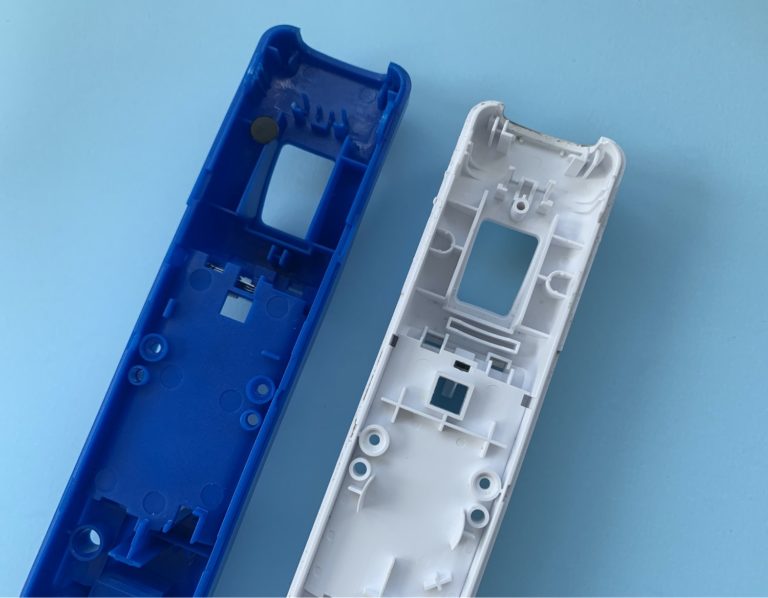
- Self-Guiding PCBs: The main control board sits in an injection-molded cradle with asymmetric locator pins. It is physically impossible to install the board backwards or upside down.
- Snap-Fit Logic: Rather than relying on 50 different screw sizes, much of the internal cable management and housing is secured via cantilever snaps, reducing the “part count” and assembly time.
The Engineering Takeaways
The Bambino Plus is a testament to intentional tooling investment. Breville didn’t take the easy path of using off-the-shelf enclosures. They invested in high-fidelity molds and multi-stage metal machining to create a product that feels “prosumer” while maintaining a consumer-grade assembly speed.
It’s a reminder that when you design with the manufacturing process in mind—whether it’s choosing die-casting for pressure or progressive stamping for aesthetics—you can deliver a premium experience without the premium price tag.
Have a complex assembly of your own? Get a project-level quote to get instant DFM feedback on your injection molding or CNC machining projects.