






Time to read: 7 min
Stamping is a family of metal manufacturing processes primarily used to produce high volumes of sheet metal parts quickly and cost-effectively. It relies on custom tooling—called dies— mounted in a stamping press to cut, bend, and form flat metal into finished components.
Once the tooling is built, a stamping press can produce dozens to hundreds of identical parts per minute, maintaining tight dimensional consistency over millions of cycles. While the upfront cost to create a die can be significant, that one-time expense is spread across large production runs, lowering the cost per part.
Because of this combination of speed, repeatability, and scale, metal stamping is widely used in industries such as automotive, electronics, appliances, and aerospace. In this guide, we’ll break down what metal stamping is, the different processes involved, how the tooling works, and how to design parts for reliable, high-volume production.
What Is Metal Stamping?
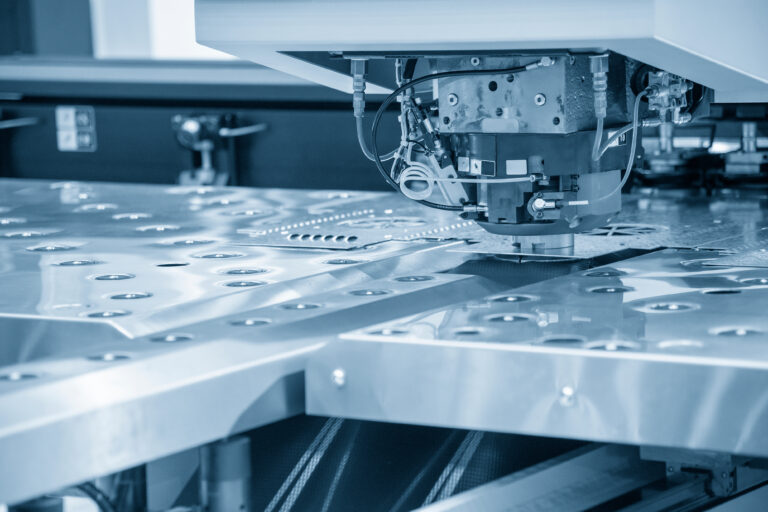
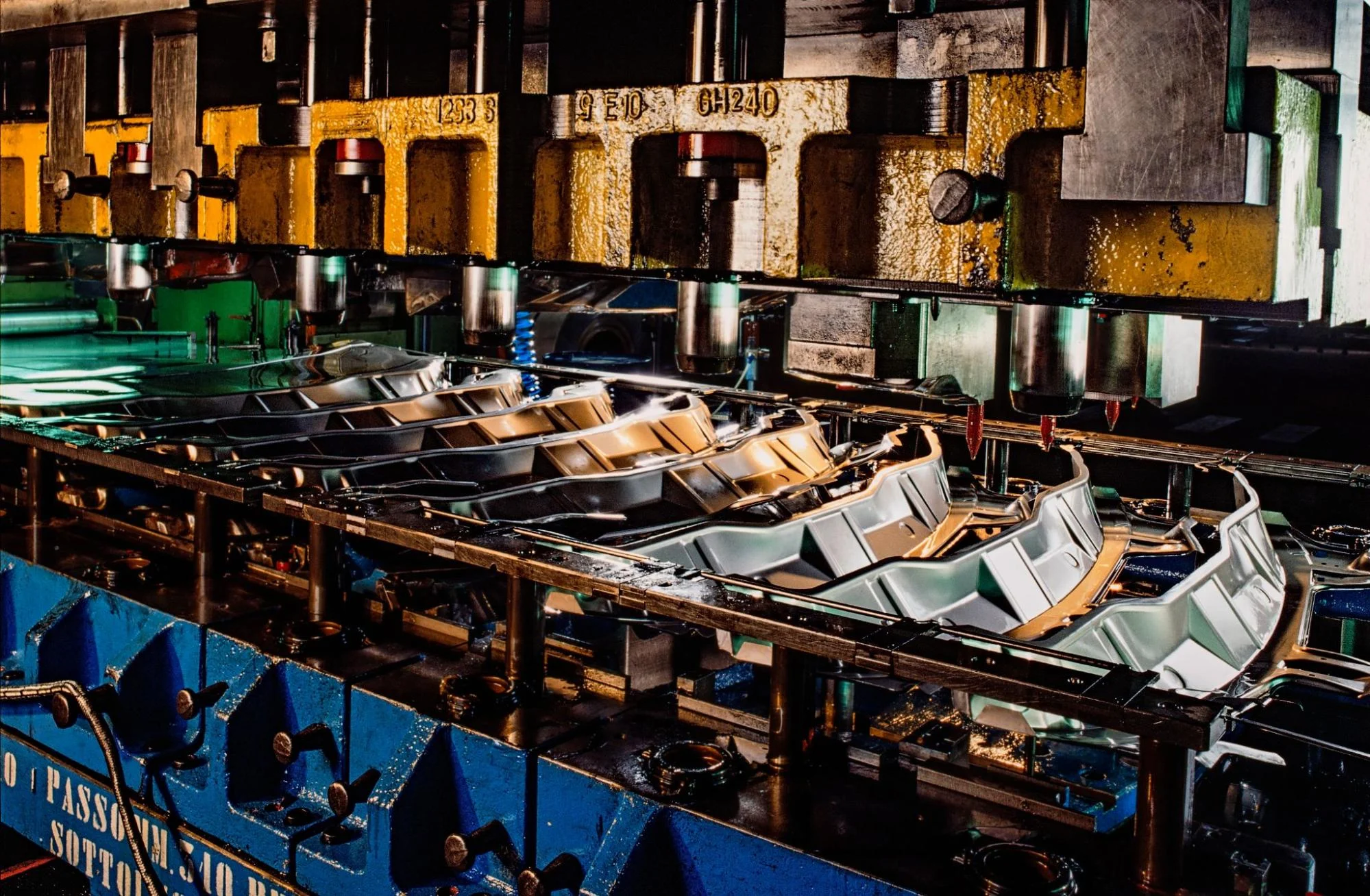
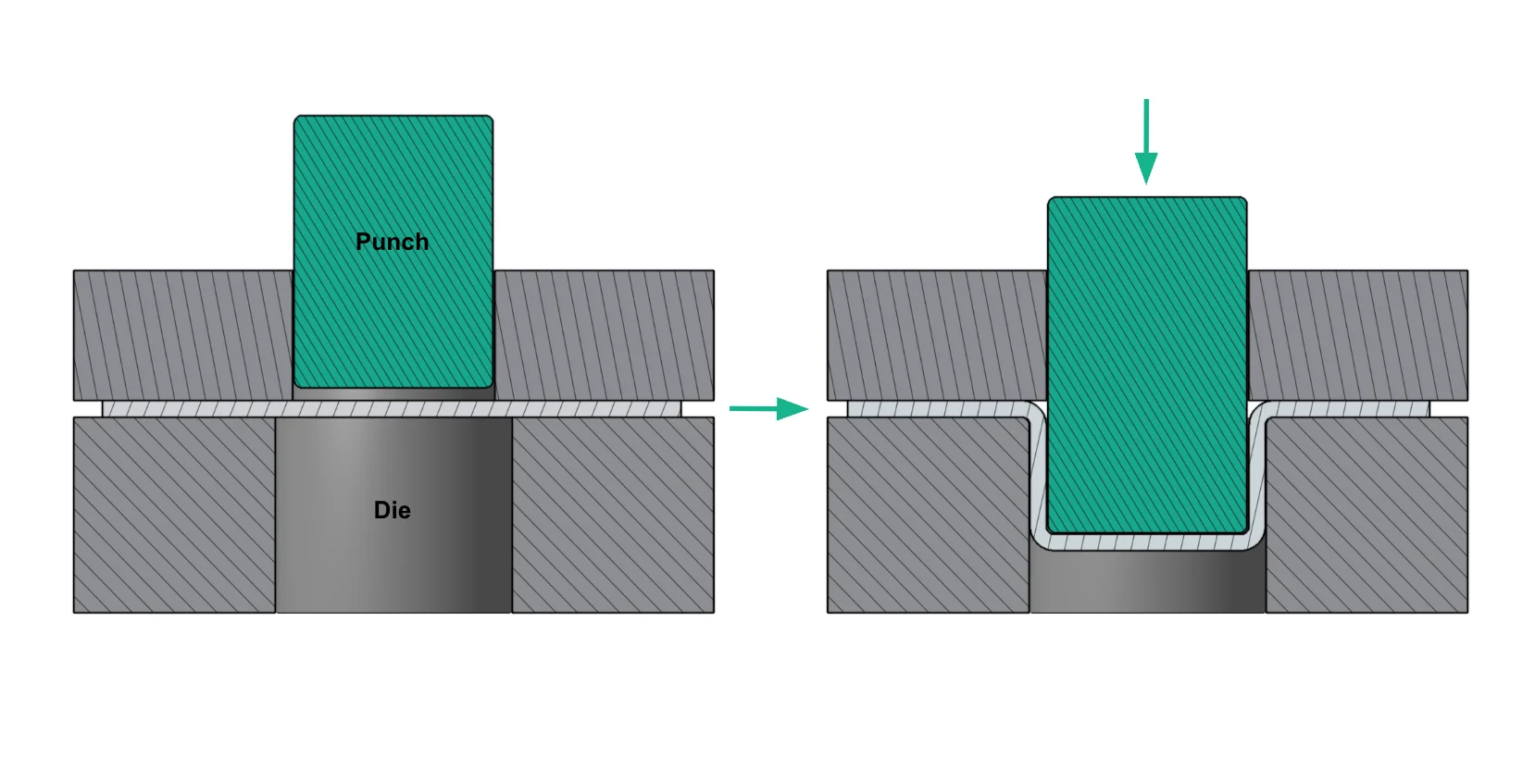
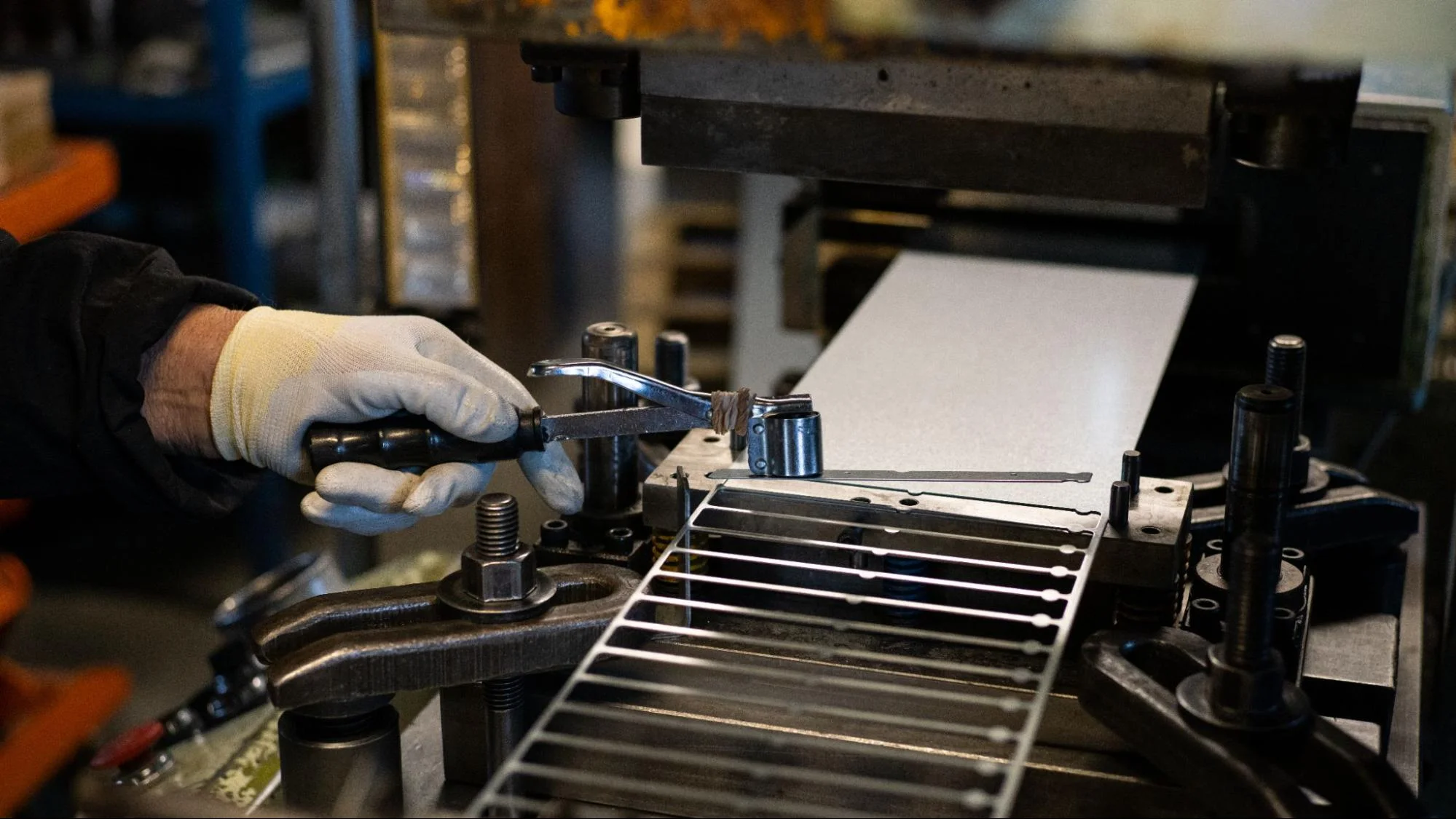
Metal stamping, or pressing, is a cold-forming process in which immense pressure is applied to flat sheet metal (coil or blanks) using a specialized tool called a die inside a stamping press. The press ram moves the upper die (containing the punch) down toward the lower die (die block), which forces the material to shear, bend, or stretch into the desired shape.
The type of process is generally categorized by its primary action:
- Blanking: Cutting the complete outer shape of the part from the sheet stock.
- Piercing/Punching: Cutting internal holes or features, with the slug being scrap.
- Forming: Permanently deforming the material without shearing, such as bending or drawing.
Stamping is further classified by production volume:
- Short-Run Stamping: Uses cheaper, temporary tooling (soft tooling) often combined with laser-cut blanks. This process is suitable for volumes below 5,000 units and is used primarily for prototyping and pilot runs.
- Production Stamping: Uses hardened steel dies (hard tooling) designed for millions of cycles, making low per-part cost feasible for mass production.
Types of Metal Stamping Processes
Stamping encompasses several distinct methods, determined by the part’s geometry and complexity. The types of metal stamping processes are described below.
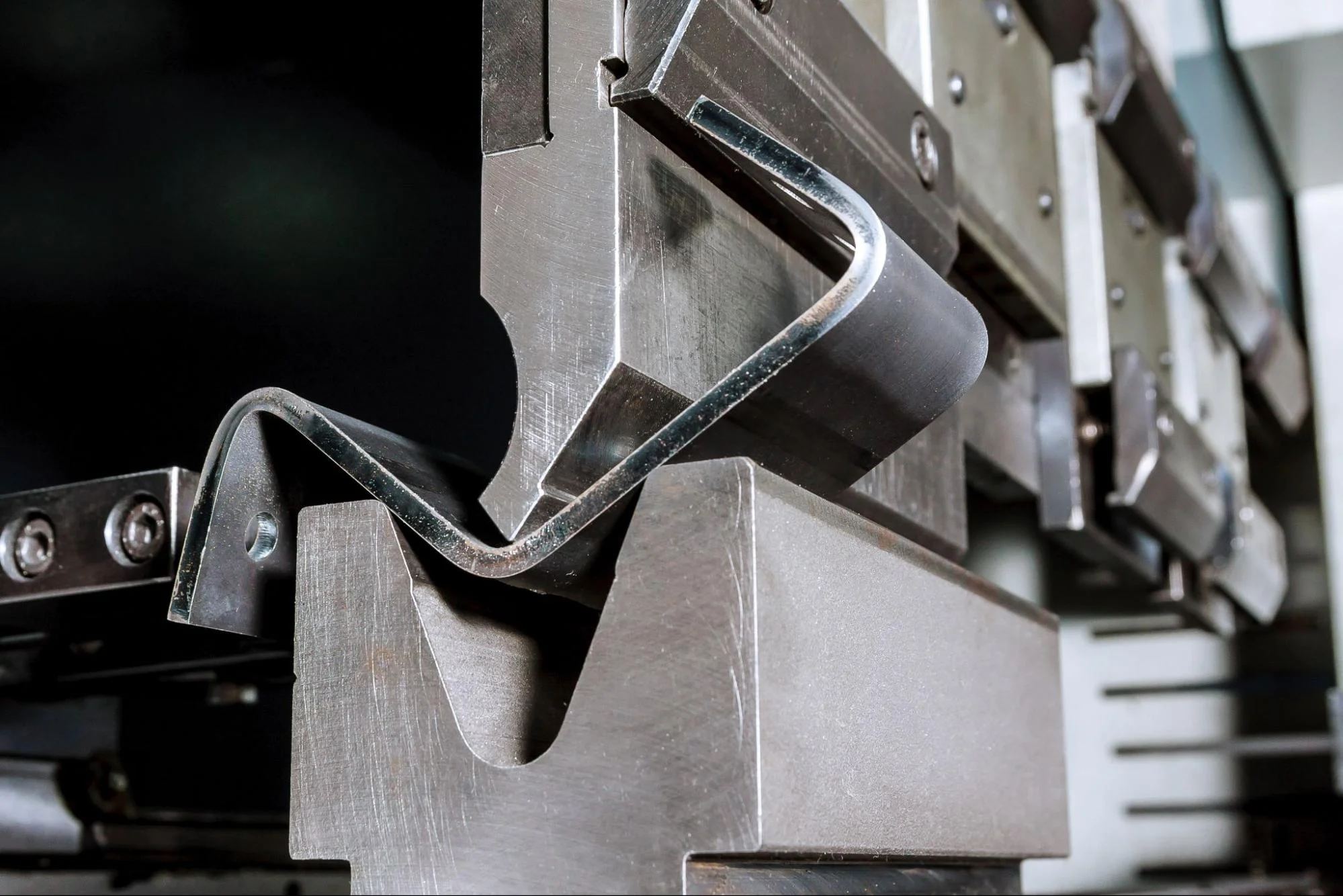
Bending & Forming
Bending deforms the material along a straight line. Engineers must account for springback, or the material’s tendency to partially return to its original shape, by designing the die to over-bend the part.
Embossing & Coining
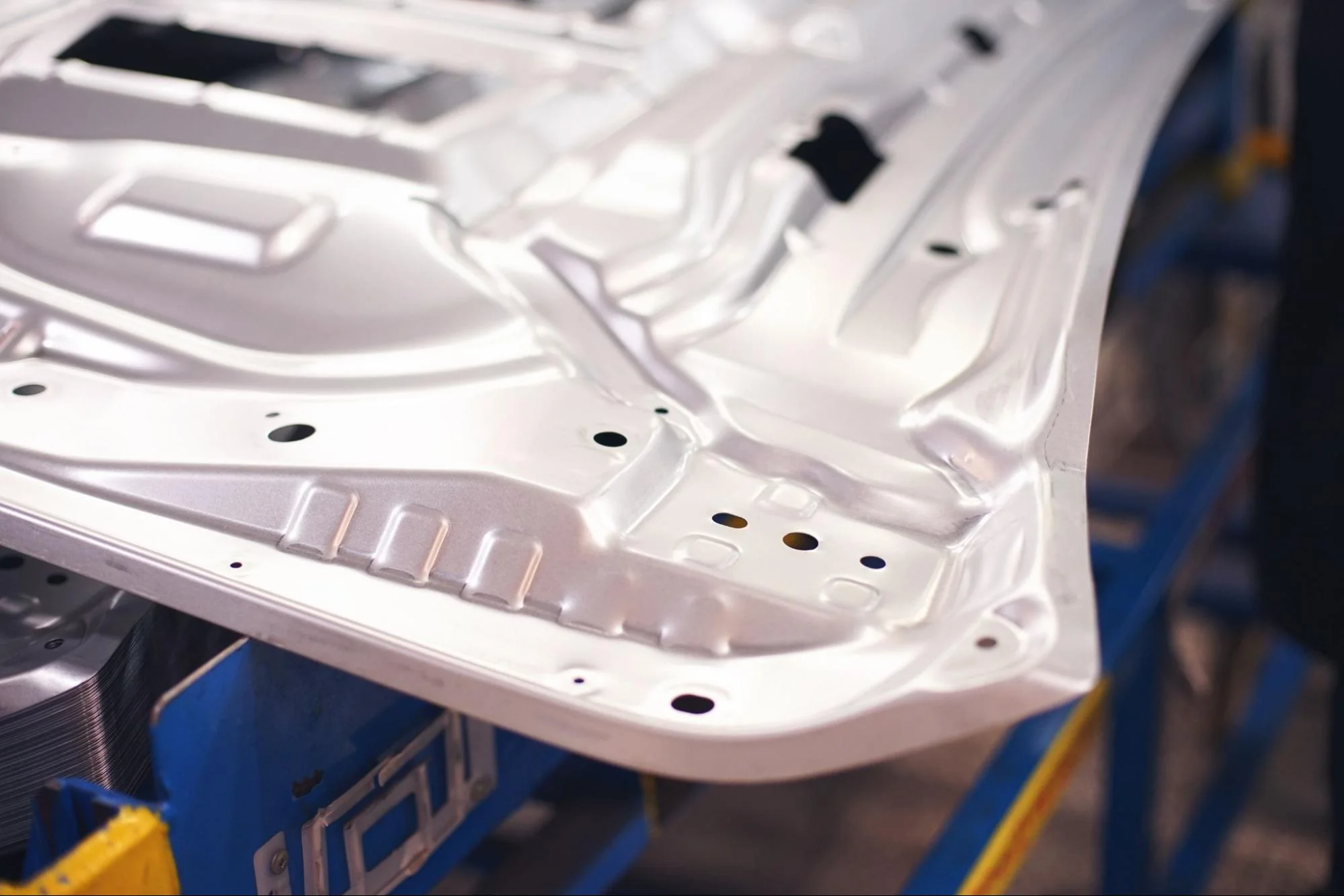
- Embossing creates raised or recessed features by stretching the material.
- Coining is a high-pressure forming method that compresses the material to achieve extreme dimensional accuracy, often resulting in a significant thickness change.
Fineblanking
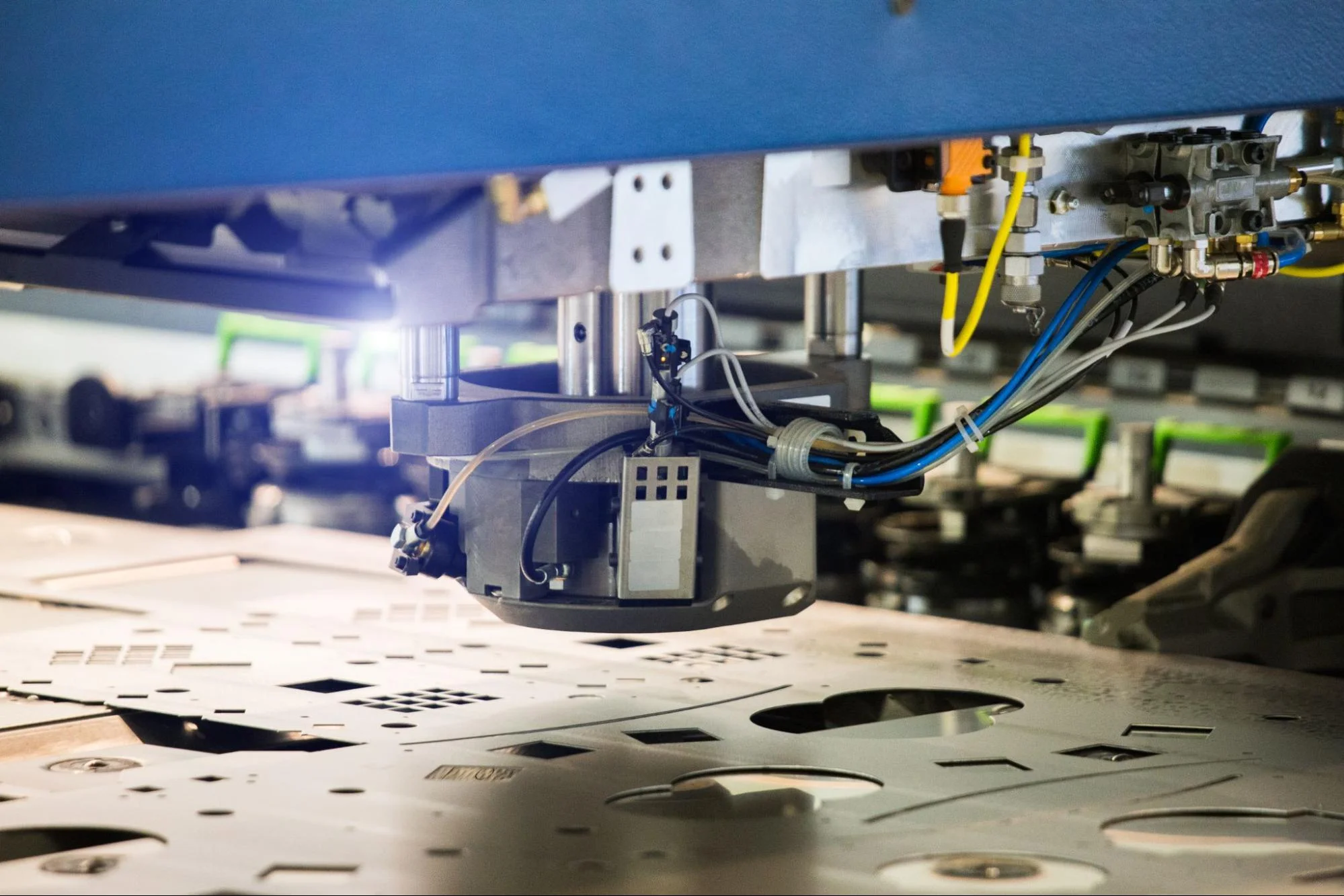
Fineblanking is a high-precision shearing technique that uses tight punch-to-die clearances and a specialized triple-action press to produce a smooth, fracture-free edge over the material thickness.
Deep Drawing
Deep drawing is used to create seamless, cup-shaped, or hollow parts. Deep parts require multiple draw stages and controlled material flow to prevent tearing or wrinkling.
Take a deeper dive into manufacturing methods with our Sheet Metal Manufacturing Guide.
What Tools Are Used for Metal Stamping?
The tooling, or die set, is the single largest capital investment in stamping and dictates the part’s final quality and cost. A stamping die consists of several crucial elements:
- Punch: The upper cutting or forming tool, attached to the ram.
- Die Block: The lower half, containing the cavity or cutting edge.
- Stripper Plate: Mechanically removes the part or the scrap web from the punch during the ram’s retraction.
- Pilots: Pins that enter pre-punched holes to ensure that strip material is perfectly indexed for subsequent operations.
Additionally, engineers must consider the die material, which is often composed of tool steel. Tool steel selection is based on wear resistance, required part volume, and material hardness:
- D2 Tool Steel: The industry standard for high-volume dies due to its exceptional wear resistance and longevity.
- A2 Tool Steel: Used for medium-volume runs and offers a good balance of toughness and wear resistance.
In addition to single-strike dies, options include:
- Progressive: The sheet metal strip passes through multiple stations, each performing a specific task.
- Compound: A single station performs multiple operations simultaneously.
- Transfer: An automated system or robotic arm transfers the part to various stations within the press.
Materials for Stamping
Stamping operations suit almost all sheet metal alloys—including cold-rolled (CRS), hot-rolled (HRS), and stainless steel, aluminum, brass, and copper—but are most efficient for thicknesses between 0.127 mm (0.005 in) and 6.35 mm (0.25 in).
Engineers need to consider the grain direction of sheet metal when stamping or forming. Bends made perpendicular to the grain are stronger and far less susceptible to cracking than bends made parallel to the grain. Critical bends must be aligned correctly in the strip layout.
Comparison of Different Sheet Metal Materials for Stamping
| Material | Formability | Springback | Notes |
| Cold Rolled Steel (CRS) | Excellent | Moderate | Highly versatile; good surface finish. |
| 304 Stainless Steel | Good | High | Excellent corrosion resistance; requires high force. |
| 5052-H32 Aluminum | Very Good | Low-Moderate | Lightweight; popular for enclosures and automotive. |
| Brass/Copper | Excellent | Low | Superior electrical/thermal conductivity; easily formed. |
For more tips on material selection, give our Materials.AI a try.
Design for Manufacturability (DFM) for Metal Stamping
DFM principles ensure that the part is optimized for the stamping process, which minimizes tool cost, cycle time, and defects. Below are some general DFM guidelines; however, please note that precise values may vary depending on the material type:
- Bend Radii: The internal bend radius (Ri) must be greater than or equal to 1.0 to 1.5 times the material thickness (T). Radii smaller than 1.0T stress the material excessively, potentially causing cracking and tool fatigue. (Exact values are also dependent on bend direction vs. grain direction.)
- Hole Size and Spacing:
- Minimum Web/Spacing: The material web between two features or between a feature and the edge should be at least 1.0 to 2.0 times the material thickness.
- Corner Design: All internal corners for notches or cutouts should have a radius of at least 0.5T to maximize die life and prevent stress risers in the part.
- Relief Features:
- Bend Relief: Must be added at the ends of any bend line near an edge. This prevents material bunching and tearing, ensuring the final flange height is accurate.
- Burr Direction: Specify the required burr orientation (up or down). The burr always forms on the side of the material facing the die block.
- Avoiding Distortion: For large, thin, flat areas, incorporate stiffening features like beads or ribs to prevent buckling (oil-canning) caused by internal stress relief.
Common Metal Stamping Defects (and How to Fix Them)
| Defect | Cause | Corrective Action |
| Cracking/Tearing | Bend radius too small; excessive material strain; bend parallel to grain. | Increase bend radius; use softer material; reorient part angle. |
| Wrinkling | Insufficient blankholder force (deep draw); excessive material flow. | Increase blankholder pressure; incorporate draw beads on the die. |
| Distortion/Warping | Uneven stress relief; unbalanced forming forces. | Add stiffening ribs; incorporate flattening/re-striking operations. |
| Springback | Material strength is inconsistent; die compensation is insufficient. | Over-bend the die angle (over-crown); use coining to set the bend permanently. |
| Burrs (Excessive) | Worn cutting edge; excessive punch-to-die clearance. | Sharpen/regrind tools; adjust clearance to spec. |
Tolerances in Metal Stamping
Standard blanking and forming operations typically achieve tolerances of ±0.005 inches (±0.127 mm). With specialized equipment like fineblanking and tight process control, critical features can be held to ±0.001 inches (±0.025 mm).
Stamping accuracy is affected by:
- Material Consistency: Inconsistent thickness or yield strength leads to variable springback.
- Tool Wear: Increasing the clearance between the punch and die reduces dimensional accuracy over the production run.
- Process Stability: Maintaining precise control over the press speed, alignment, and lubrication is vital.
When tighter tolerances are needed (±0.0005 in) or for specific surface quality, secondary operations are required:
- Sizing/Re-striking: A second press hit to set a critical dimension or angle precisely.
- CNC Machining: Used to machine high-precision bores or mounting faces.
Stamping provides highly repeatable, production-scale tolerances, though CNC machining offers superior absolute accuracy for single-part features.
Metal Stamping vs. Other Fabrication Processes
| Method | Volume | Complexity Range | Tooling Cost (NRE) | Material Type/Thickness |
| Stamping | High | Low to Medium | High | Thin to Medium Sheet |
| Laser Cutting + Bending | Low to Medium | Medium to High | Low | Thin to Medium Sheet |
| CNC Machining | Low to Medium | High | Minimal | Solid Block/Plate |
| Metal Casting | Medium to High | High to Very High | Very Low | Thick/Complex |
| MIM (Metal Injection Molding) | Very High | Very High | Very High | Small, Complex Parts |
When to Use (and Not Use) Metal Stamping
The selection process on whether to use metal stamping is governed by volume and geometry:
- Best Use Cases: High-volume production (>20,000 units/year), parts that can be reduced to a 2D blank, and thin-to-medium sheet materials.
- Avoid When: Prototypes or low-volume runs (where tooling costs are prohibitive), parts requiring extremely thick plate, or complex 3D features (internal undercuts) are best suited to casting or machining.
When it comes to new product introduction, a hybrid approach may be favored:
- Prototyping: Use laser cutting and press brake forming for quick, low-cost iterations.
- Pilot Production: Commission soft tooling for initial pilot runs (500–5,000 units).
- Mass Production: Invest in a high-volume, hardened progressive die only once the design is frozen and high-volume production is guaranteed.
Metal Stamping FAQ’s
What is metal stamping?
Metal stamping is a family of manufacturing processes that use dies and presses to cut, bend, or form flat sheet metal into finished parts. It is most commonly used for high-volume production due to its speed and repeatability.
What materials are commonly used in metal stamping?
Common materials for metal stamping include cold-rolled steel, stainless steel, aluminum alloys, copper, and brass. Material choice depends on required strength, formability, corrosion resistance, and cost.
What are the different types of metal stamping processes?
Metal stamping includes several processes such as blanking, piercing, bending, embossing, coining, deep drawing, and fineblanking. Many parts are produced using a combination of these operations within a single die.
What are the advantages of metal stamping for high-volume production?
Metal stamping offers high production speeds, excellent dimensional repeatability, and low per-part cost once tooling is in place. These advantages make it ideal for producing large quantities of consistent parts.
What are common defects in metal stamping and how are they prevented?
Common metal stamping defects include cracking, wrinkling, distortion, springback, and excessive burrs. These issues are typically prevented through proper material selection, adequate bend radii, correct punch-to-die clearance, well-designed tooling, and rework if necessary.
Designing for High-Volume Success With Metal Stamping
Metal stamping is an excellent solution for high-volume sheet metal production. A practical design strategy hinges on early DFM implementation, which involves controlling bend radii, adhering to minimum hole sizes, and strategically aligning parts with the material grain. By comparing the upfront tooling cost with the amortized unit cost, engineers can make informed decisions, ensuring the process yields highly repeatable, low-cost, quality parts that meet stringent industry demands.
Need production-ready sheet metal parts or help evaluating manufacturability? Fictiv provides fast quoting, expert DFM feedback, short-run prototypes, and high-quality production sheet metal services for all your design iterations. Upload your CAD to get started.