

Time to read: 7 min
How modern hardware teams build and formalize the processes behind complex programs
Stage gate product development is a structured approach that breaks hardware development into defined stages, each separated by decision “gates” where teams review design progress, trade-offs, test results, and risks before moving forward. This framework is widely used in engineering organizations to manage complexity, reduce risk, and align design, validation, and manufacturing.
Traditional stage gate frameworks developed in the 20th century were shaped by an era of slowly changing requirements, simpler integration, and longer development cycles. As systems became more complex and programs compressed their schedules, many teams adapted the model rather than replacing it. Some kept the sequential structure but added earlier architecture definition; others introduced iterative loops inside stages to handle uncertainty.
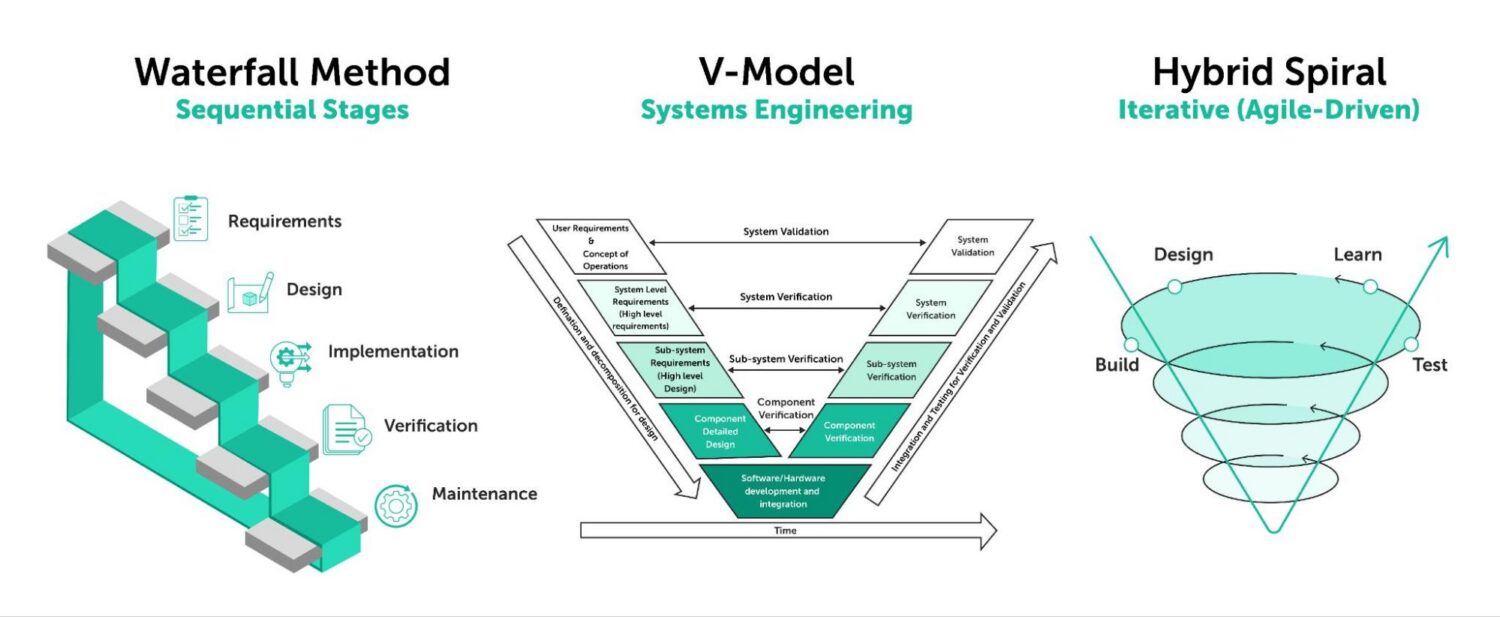
This guide explains the most common stage gate models—Waterfall, V-Model, and Agile-derived (hybrid) approaches—and how modern hardware teams apply them from early prototyping through production.
The Main Types of Stage Gate Product Development Process Models
For complex hardware programs across robotics, aerospace, automotive, and consumer hardware, the result is a broad set of process variants that all trace back to the same core idea: use defined stages and reviews to manage integration risk in physical systems—ensuring that mechanical, electrical, software, and manufacturing systems converge into a functioning product at the right time and cost.
What follows is necessarily selective. Thousands of variations exist, each shaped by an industry’s regulatory environment, risk tolerance, cost of change, and speed requirements. Even within the same sector, Company A’s “phase-gate” may look nothing like Company B’s, and a single organization can run several distinct flavors at once. Cataloging them all would require a textbook.
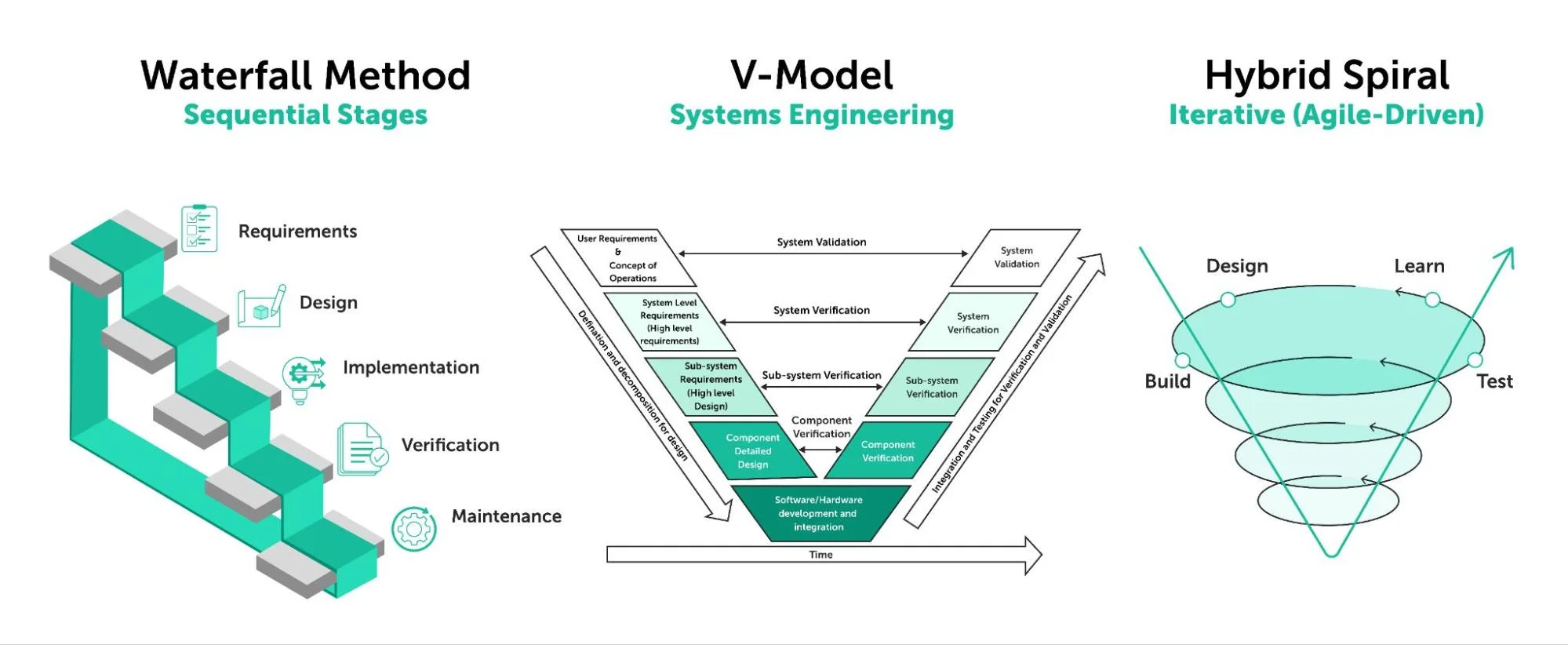
Instead, we look at three widely recognized archetypes that represent the major ways stage gate thinking is applied today:
- Waterfall: Sequential phases with major, infrequent milestone reviews
- V-Model: Systems engineering flow linking requirements to verification
- Hybrid (Agile-Derived): Short, iterative cycles with lightweight gates and periodic larger releases
These are not the only models, nor are they always used in pure form, but they capture the dominant frameworks used by modern engineering teams. Understanding where each excels and where it falls short helps teams align their processes with their technical, market, and regulatory constraints.
Waterfall Development Cycle
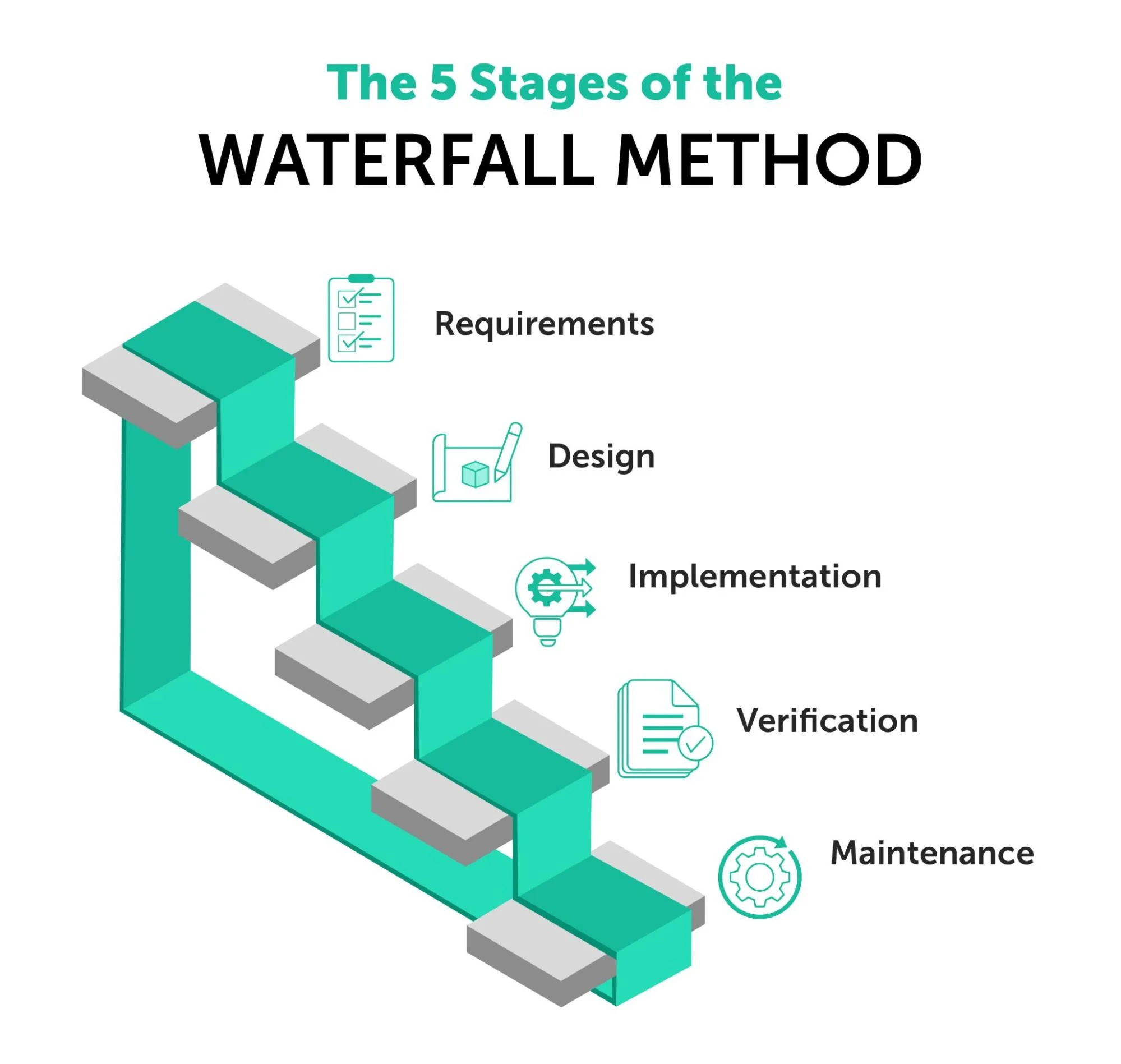
Waterfall is the earliest expression of stage gate thinking and follows a predominantly sequential progression from requirements → design → build → verification → launch.
Its clearest descendant in modern hardware development is the EVT–DVT–PVT build path, where each phase forces the team to mature the design and manufacturing process together and pass a formal gate before moving on.
- Engineering Validation Test (EVT): Integrate the full system in a production-intent form factor, select the design configuration, and uncover the complete issue list. Soft tools and engineering processes are still allowed.
- Design Validation Test (DVT): Validate that the chosen design meets all requirements across performance, environmental, reliability, and cosmetic tests, using production materials, hard tools, and documented manufacturing procedures.
- Production Validation Test (PVT): Validate the manufacturing line(s) at target speeds, confirm yields, train operators, and lock the process for ramp. Units can be sellable if quality requirements are met.
Most teams start with a prototype build (Proto)—a low-volume run used to test early concepts and validate key mechanisms—before the three formal gates above.
These validation steps help program management plan and evaluate trade-offs among risk, performance, cost, and schedule. Testing at each stage validates whether the design adheres to the original design intent and identifies where any changes are needed.
Most Used In: High-volume hardware and electronics programs, including consumer devices, IoT, robotics products, wearables, appliances, and industrial electronics. Any industry where manufacturing ramp drives the development cadence.
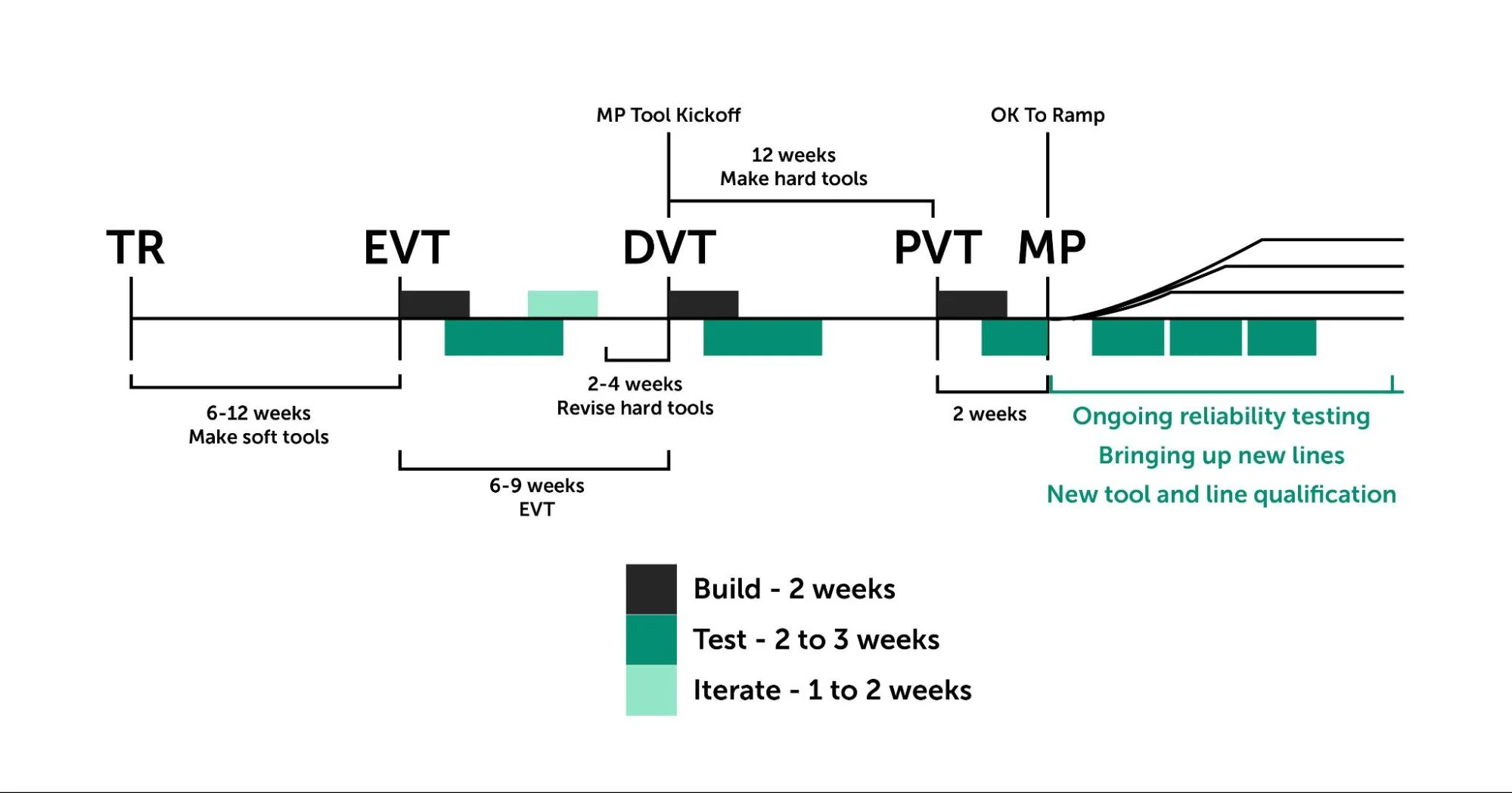
If you’re using injection molding for prototyping or production, use Fictiv’s Injection Molding Gantt Chart to align tooling and build timelines with your stage-gate milestones.
V-Model Development Cycle
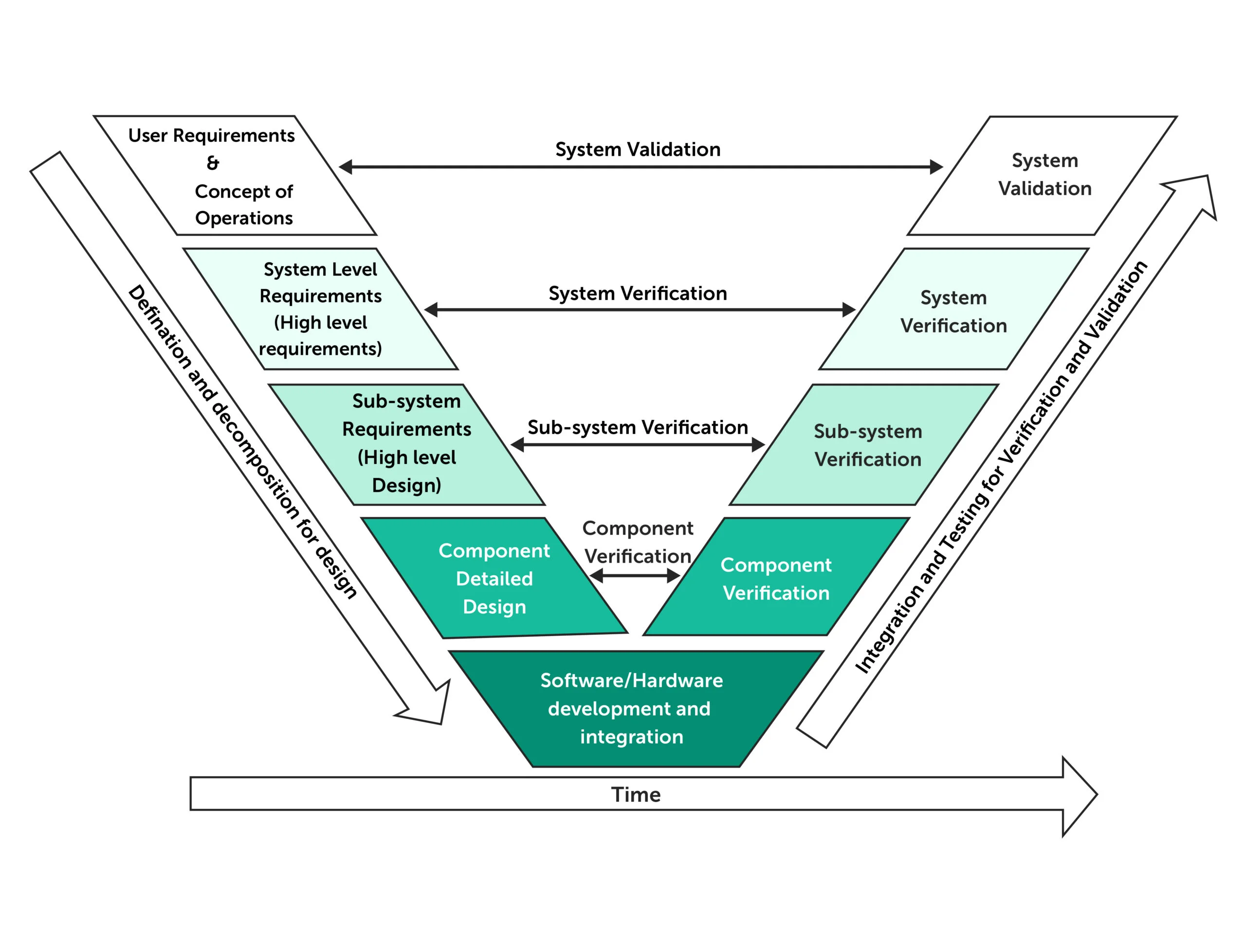
The V-Model is the systems engineering expression of stage gate thinking. Instead of a primarily linear sequence, it explicitly maps the relationship between requirements, architecture, implementation, and verification. This structure is especially critical in systems where subsystem interfaces must be defined early and validated rigorously to avoid late-stage integration failures
The left side of the V decomposes the problem, from system requirements down to subsystem specifications. The right side climbs back up, validating each layer and pairing every requirement with a corresponding test, analysis, or inspection.
What distinguishes the V-Model from a sequential development flow is traceability. Requirements are allocated to subsystems, linked to verification methods, and revisited during integration.
In safety-critical and regulated industries, the V-Model remains the dominant framework because its emphasis on requirements traceability and structured verification matches the rigor these programs demand.
Most Used In: Traditional aerospace and defense programs, automotive (ADAS, autonomy, functional-safety components), medical devices.
Hybrid Spiral (Agile-Derived) Development Cycle
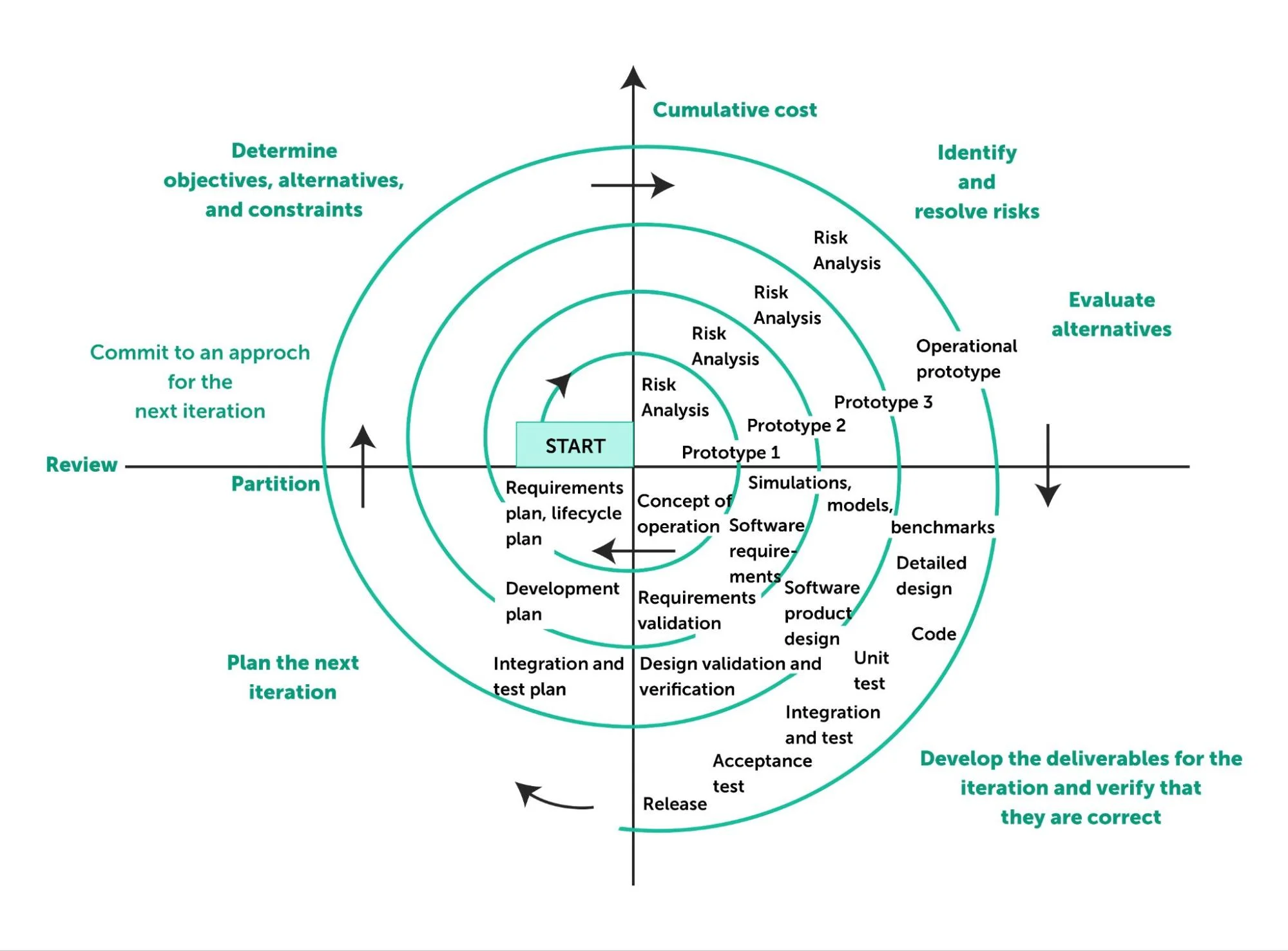
In engineering development, “agile” is less a standalone process and more a response to the limits of traditional stage gate thinking in environments where uncertainty is high and fast learning matters. Instead of committing to long sequential phases, teams work in short, bounded cycles designed to surface risks before they compound.
Each cycle (V0, V1, V2, and beyond) functions as a contained experiment where the goal isn’t to be right upfront, but to reduce risk and increase fidelity with each loop. Every iteration produces something concrete (subassemblies, test coupons, early prototypes) that generates data and informs the next decision.
One classic contrast illustrates this mindset shift.
The traditional aerospace development model (design → build → test) assumes early correctness, freezes architecture early, and verifies only after full integration.
SpaceX’s model (build → test → learn → redesign → test → scale) assumes early uncertainty, integrates from the start, and treats milestones as checkpoints—not destinations.
Where traditional development cycles emphasize specification maturity before major integration, agile-derived approaches deliberately front-load experimentation. Architecture is allowed to evolve, and requirements may be provisional.
Not all requirements flex equally: top-level mission outcomes (e.g., payload mass, range) are fixed anchors, while lower-level design parameters are tradeable as iterations inform the next architectural decision.
Iteration speed becomes the primary mechanism for reducing technical and integration risk. These cycles still have gates, but they’re lightweight and tied to learning objectives rather than formal maturity milestones.
In practice, most engineering teams adopt iterative loops early (when the cost of change is low) and transition into more structured stage gate processes as the design stabilizes, the supply chain locks, and verification requirements tighten. The result isn’t pure agile but a hybrid—with rapid iteration upstream and disciplined validation downstream.
Most Used In: Early-stage aerospace and space systems, advanced energy, and new material systems. Any domain with quickly evolving requirements where continuous integration is the safest (and potentially fastest) path to a viable architecture.
Practical Process Differences by Industry
| Industry | How Iteration Actually Works |
| Modern Aerospace & Defense, Energy Startups(SpaceX, Anduril, Relativity, Stoke, Varda) | Rapid build→test→fail→redesign loops; teams run iterative, spiral-based development anchored by test stands and owned production lines. Hardware is burned as learning material. |
| Legacy Automotive & Traditional Defense Primes(Boeing, Lockheed Martin, Ford, General Motors) | Highly controlled V-Model flows with frozen requirements, contractual baselines, locked interfaces, and certification-driven verification. |
| Consumer Hardware (Apple, Meta, Oura, WHOOP) | EVT→DVT→PVT with long component/tooling lead times, stable industrial design, and CM-driven constraints. Iteration cost skyrockets once tooling or supply chain engagement begins. |

What Each Stage Gate Model Is Good For (and Where It Breaks)
| Model | Where It Works | Where It Breaks |
| Waterfall | – Requirements are stable and well understood – Technologies, materials, and manufacturing processes are mature – High-volume programs where EVT–DVT–PVT provides needed structure for tooling, qualification, and ramp – Predictable execution is more important than architectural exploration | – Requirements shift or aren’t well defined – Architecture is uncertain or novel subsystems interact in unpredictable ways – Early integration issues force rework late in the cycle – Teams try to “freeze” designs prematurely to satisfy the process |
| V-Model | – Layered systems where requirements traceability and interface definition matter – Regulated or safety-critical industries (aerospace, defense, medical, automotive safety) – Programs where verification plans must be defined early and drive design maturity | – Architecture is evolving and assumptions are still being validated – Teams don’t have enough data to define requirements and verification methods upfront – Cross-functional coordination overhead becomes excessive when rapid learning is more valuable than documentation – Organizations lack the discipline to maintain requirements traceability |
| Hybrid (Agile Hardware) | – High uncertainty in physics, materials, system interactions, or architecture – Fast build–test cycles provide more insight than upfront analysis – Early prototypes and subsystem demos materially reduce risk – Ideal for early-stage aerospace/space systems, advanced energy, and novel materials | – Manufacturing and supply-chain commitments force design freeze and discipline – Teams stay in “perpetual iteration” instead of converging on a stable configuration – Doesn’t replace structured verification or production readiness |
Where Product Development Meets Manufacturing Reality
Stage gate frameworks—whether waterfall, V-Model, or agile-derived—exist to manage risk in the development of complex physical systems. But the effectiveness of any process depends on how well it connects engineering intent to manufacturing reality.
As hardware programs scale, the boundary between design, validation, and production becomes increasingly blurred. Teams that succeed pair disciplined development processes with manufacturing partners who can support rapid iteration early and controlled scale later—without disruptive transitions between phases.
Fictiv helps hardware teams bridge that gap with a unified manufacturing platform that supports prototype builds for validation, custom and off-the-shelf components, and production ramp-up within a single supply chain. Whether you’re exploring a new architecture or in the middle of EVT–DVT–PVT execution, the right manufacturing partner keeps pace with your process from prototyping to production.
Talk to a Manufacturing Expert
Get feedback on your development stage, build strategy, and scaling plan.
Get instant DFM feedback and pricing across prototyping and production processes.

This resource has been a collaboration with Hardware FYI.