




Time to read: 4 min
Quick Evaluation Tool for Process Selection
Compare die casting and CNC machining to determine the best process for your prototyping or production requirements.

Move faster with a partner built for regulated programs.
Upload your part and get a compliant quote—from a team with the systems, workflows, and experience to keep your program on schedule.
See what your part would costCNC vs Die Casting Scorecard
Score each category from 0–2 based on your part requirements.
| Category | 0 (CNC) | 1 (Neutral) | 2 (Casting) | Your Score |
|---|---|---|---|---|
| Production Volume | <1,000 | 1,000–5,000 | >5,000 | |
| Target Lead Time | <1 week | 1–4 weeks | 4+ weeks | |
| Target Cost / Part | CNC meets target | CNC slightly above target | CNC Exceeds target 30–50%+ | |
| Tooling Cost | <$5,000 | $5,000–$25,000 | >$25,000 | |
| Part Geometry | Simple | Moderate | Complex | |
| CNC Setups | 1–2 | 3 | 4+ | |
| Wall Thickness | >5mm | 2–5mm | <2mm | |
| Tolerances | Tight throughout (<±0.05–0.1 mm) | Mixed | Mostly general (≥±0.1–0.3 mm) |
Evaluate Both
0–5 → CNC Preferred
6–10 → Evaluate Both
11–16 → Die Casting Likely Best
The Low-Volume Injection Molding Guide
 Download Now

How the Scorecard Breaks Down
Production Volume
| Criteria | Score |
| < 1,000 units/year | 0 |
| 1,000–5,000 units/year | 1 |
| > 5,000 units/year | 2 |
Tooling amortization starts to become more justified at higher volumes.
Production Lead Time Requirement
| Criteria | Score |
| < 1 week (rapid prototyping) | 0 |
| 1–4 weeks | 1 |
| > 4 weeks acceptable OR high-volume production needed | 2 |
CNC is faster for initial speed and iteration, while casting wins for repeatability and throughput at scale.
Cost Target Per Unit (at scale)
| Criteria | Score |
| CNC price meets target | 0 |
| CNC price slightly above target | 1 |
| CNC exceeds target by 30–50%+ | 2 |
If CNC cost is >2–3X estimated casting cost at volume, casting is worth serious consideration.
Tooling Investment Willingness
| Criteria | Score |
| < $5,000 budget or no tooling investment desired | 0 |
| $5,000–$25,000 budget | 1 |
| > $25,000 budget for production tooling | 2 |
Typical ranges:
- Prototype/soft tooling (aluminum or soft steel): $5,000–$15,000
- Production die casting tooling (hardened steel): $20,000–$80,000+ depending on size/complexity
Willingness to invest in tooling is often the clearest indicator of readiness for casting.
Geometry Complexity
| Criteria | Score |
| Prismatic, simple features | 0 |
| Moderate complexity (pockets, light 3D surfacing) | 1 |
| Complex geometry (ribs, undercuts, organic shapes) | 2 |
Casting advantage: Geometric complexity becomes more cost-effective once tooling is in place.
Number of CNC Setups
| Criteria | Score |
| 1–2 setups | 0 |
| 3 setups | 1 |
| 4+ setups / complex fixturing | 2 |
More setups mean higher labor/cost and tolerance stack risk, which favors casting.
Wall Thickness & Material Efficiency
| Criteria | Score |
| Thick sections (> 5 mm), high material removal acceptable | 0 |
| Moderate walls (2–5 mm) | 1 |
| Thin walls (< 2–3 mm) or high scrap in CNC | 2 |
Thinner sections are better suited to casting, with less material waste.
Tolerances & Secondary Ops
| Criteria | Score |
| Tight tolerances throughout (<±0.05–0.1 mm) critical features | 0 |
| Mixed tolerances, localized tight features | 1 |
| Mostly general (≥±0.1–0.3 mm), limited machining needed for critical features | 2 |
Some cast parts may still require post-machining, but at high volumes, less is better.
Note: This scorecard is a starting point that focuses on cost, volume, and geometry. Final process selection should also consider material compatibility, mechanical properties, and quality factors such as porosity and surface finish.
Quick Decision Overlay
Strong Indicators for Die Casting
- High volume (>5,000-10,000 units)
- Complex geometry (ribs, undercuts, organic shapes)
- Multiple CNC setups (3-4+)
- Thin walls or high material waste
- Aggressively low cost targets
Strong Indicators for CNC
- Low volume or prototyping
- Tight tolerances across many features
- Simple geometry
- Frequent design changes
- Fast turnaround required (< 1 week)
Ready to scale production and lower your per-part costs? Check out our comprehensive Scaling CNC Machining to Casting Guide to learn how to seamlessly transition from machined prototypes to high-volume cast parts.

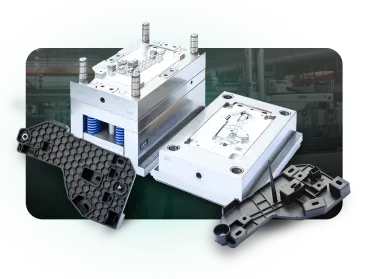
Die casting mold
Trigger Thresholds for Faster Qualification
If 2 or more are true, escalate to casting evaluation:
- Volume > 10,000 units
- 4+ CNC setups
- Thin walls (< 3 mm) or complex geometry
- CNC cost exceeds target by > 30–50%
Still not sure which process is right for your part?
Contact us to speak with a Fictiv manufacturing expert to review your design, compare CNC and die casting costs, and identify the best path to production.
Or upload your parts to get DFM feedback, pricing, and lead times to compare.

Injection Molding Design Guide
Download Now