




Time to read: 11 min
Gravity casting, commonly referred to as permanent mold casting, creates parts by filling reusable molds with gravity-fed molten metal. This process sits in a middle ground between sand casting and die casting in terms of tooling cost, surface finish, dimensional repeatability, and production efficiency.
It delivers better quality parts than sand casting without the volume requirements that make die casting profitable. The key is understanding when gravity casting is the best process fit, when it’s not, and what tradeoffs come along with it.
What Is Gravity Casting?
Gravity casting is a metal casting process in which molten metal fills a reusable mold under the force of gravity rather than externally applied pressure. It’s commonly used for aluminum components when engineers need stronger mechanical performance, better surface finish, and more repeatable dimensions than sand casting provides, but without the higher tooling cost and production intensity of high-pressure die casting.
The terms “gravity casting” and “permanent mold casting” are often used interchangeably, though the distinction is technically important to understand. Gravity casting describes how molten metal enters and fills the mold; permanent mold casting refers to the use of reusable metal tooling. In most industrial contexts, both terms usually describe the same process: gravity-fed metal poured into a reusable mold. In practice, gravity-fed expendable mold processes are typically associated with sand casting, while pressure-filled reusable molds are associated with die casting.
Types of Gravity Casting
Several casting processes rely primarily on gravity to fill the mold cavity, though they differ in tooling and mold materials.
The most common is permanent mold casting, where molten metal fills a reusable metal mold under gravity alone. Sand casting also relies on gravity-fed filling, but uses expendable sand molds instead of reusable tooling. Investment casting uses ceramic shell molds for highly detailed parts, and tilt-pour gravity casting rotates the mold during filling to improve flow control and reduce turbulence. In most manufacturing discussions, “gravity casting” refers to permanent mold casting.
How the Gravity Casting Process Works
Several pre-production and process control steps must be carefully managed to produce high-quality parts.
Mold and Gating System Design
Before metal is poured, the mold must be engineered for manufacturability. This includes designing the mold cavity, parting lines, venting, and the gating system— the sprue, runners, and gates that guide molten metal into the cavity. Good gating design controls metal flow, minimizes turbulence, reduces oxidation risk, and helps ensure the mold fills before solidification.
Mold Preheating and Coating
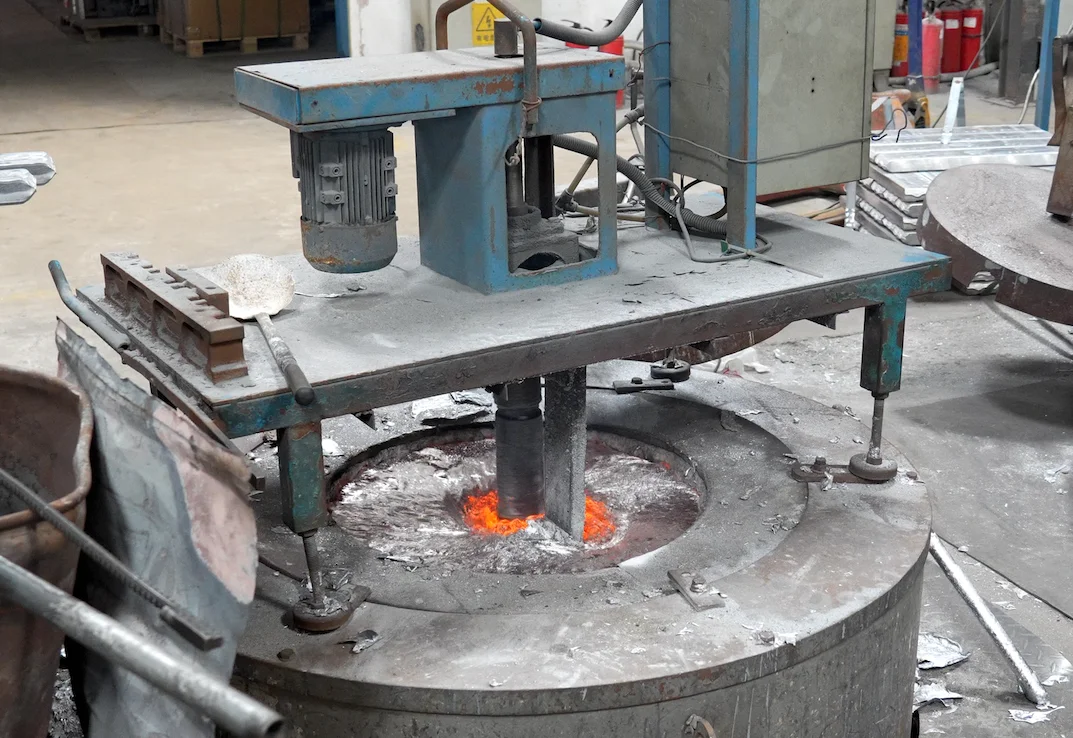
Reusable gravity casting molds, usually made from steel or cast iron, are preheated before production begins. Preheating raises the mold temperature to a controlled range, which reduces thermal shock, slows premature metal freezing during initial contact, and promotes more consistent mold filling, especially in thinner sections. After preheating, mold coatings or release agents, such as graphite or ceramic compounds, are applied to control heat transfer rates, improve surface finish, and facilitate easier part release.
Pouring Through the Sprue and Runner System
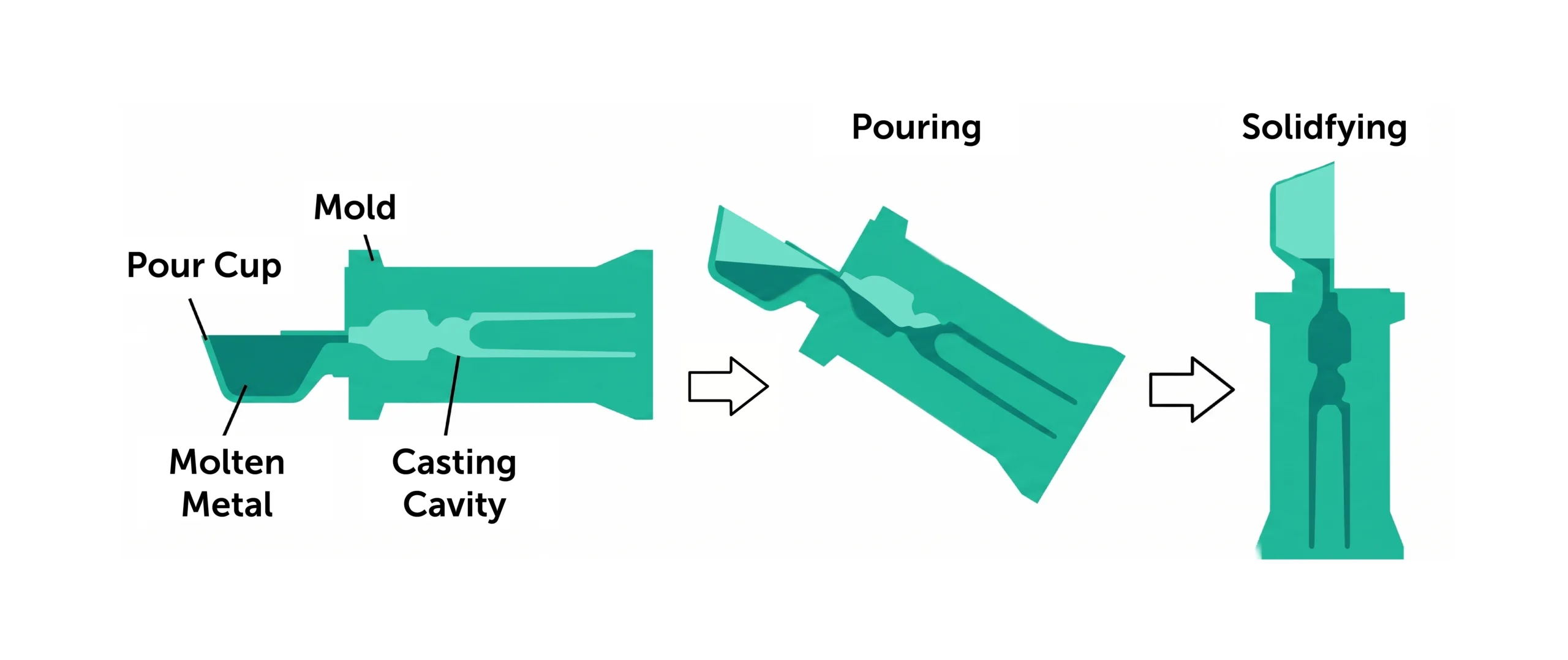
Molten metal is poured into the mold through the sprue, then travels through runners and gates into the cavity. Because gravity alone drives this movement, flow path design is especially important. Poorly designed runners or abrupt directional changes can create turbulence, trap oxides, or cause incomplete fills.
Controlled Solidification and Feeding
Once inside the cavity, the metal begins to cool and solidify. Metal molds extract heat faster than sand molds, which often improves grain structure and dimensional consistency. Solidification must also be managed so that shrinking metal continues to receive feed material from thicker sections or risers. If wall thickness changes too abruptly, or if gating and riser placement are poorly designed, shrinkage cavities, hot spots, or incomplete feeding can compromise part quality.
Materials Used in Gravity Casting
Aluminum alloys are the most common choice for gravity casting because they combine several process and performance advantages:
- Good fluidity, which helps molten metal fill permanent molds more reliably without extreme pressure
- High strength-to-weight ratio, making them attractive for automotive, industrial, and structural components
- Strong thermal conductivity, which supports controlled heat dissipation in finished parts and predictable solidification during casting
- Natural corrosion resistance in many service environments
Common gravity-cast aluminum alloys include A356, A357, and LM25, which are widely used in automotive and industrial applications.
While aluminum dominates most gravity casting applications, other alloys may be selected when specific performance requirements justify additional manufacturing complexity.
- Zinc-aluminum alloys: Can also be gravity cast for smaller precision components, offering good dimensional stability and wear resistance, though zinc is more commonly associated with die casting.
- Brass and copper alloys: May be selected for applications requiring higher thermal conductivity, corrosion resistance, or specialized performance characteristics, such as valve bodies, pump housings, marine hardware, or heat-transfer components.
- Magnesium alloys: Can provide additional weight-reduction advantages in aerospace and performance-driven applications, though they require more careful process control due to their higher chemical reactivity.
These alternative alloys are typically reserved for specialized applications where their performance benefits outweigh the increased tooling wear, tighter thermal control requirements, or added processing complexity compared with conventional aluminum gravity casting.
Advantages of Gravity Casting
Gravity casting is often selected when engineers need better part quality and more consistent mechanical performance.
- Improved mechanical properties: Permanent metal molds cool castings faster and more consistently than sand molds, which supports finer grain structures and reduced variability in mechanical properties when gating and section design are well executed.
- Better as-cast surface finish: Gravity-cast parts exhibit smoother surfaces and tighter dimensional consistency than sand-cast parts, as the reusable mold cavity is more precise and stable than expendable sand tooling.
- Reduced gas porosity risk: Because gravity casting doesn’t force molten metal into the cavity at high velocities, it reduces turbulence-related air entrapment and certain gas porosity mechanisms common in pressure-driven processes.
- Improved cycle-to-cycle consistency: Permanent molds provide a stable cavity geometry from part to part, which helps reduce dimensional variation caused by mold-to-mold differences.
- Strong fit for medium-volume production: Gravity casting becomes attractive when a part requires better repeatability, surface finish, and mechanical reliability than sand casting, but production volumes or geometry don’t justify the tooling cost of die casting.
- Core flexibility: Sand or metal cores can be used to create internal features, though core complexity and removal constraints still limit achievable geometry compared with some alternative casting methods.
Limitations of Gravity Casting
Like any manufacturing method, gravity casting occupies a specific niche rather than serving as a universal solution.
- Higher upfront tooling costs: Permanent molds require a greater initial investment because they are precision-machined, reusable tools rather than disposable forms.
- Less geometric complexity: Without externally applied pressure, gravity casting can struggle with extremely thin walls, intricate internal passages, or highly detailed features that die casting may fill more effectively.
- Slower production rates: Gravity-fed filling and cooling produce longer cycle times than high-pressure systems, which can limit competitiveness at very large production scales.
- Design discipline remains essential: Gravity casting offers real advantages, but it doesn’t eliminate the need for sound engineering. Wall transitions, gating layout, riser strategy, and thermal mass management still determine whether a design produces consistent, high-quality parts or avoidable defects.
Explore our guide to casting defects and prevention methods to learn how porosity, shrinkage, cold shuts, and other common defects affect casting quality and manufacturability.
Permanent Mold Casting vs. Other Casting Methods
Permanent mold casting, commonly referred to as gravity casting, occupies a specific position between several major casting methods.
Permanent Mold Casting vs. Die Casting
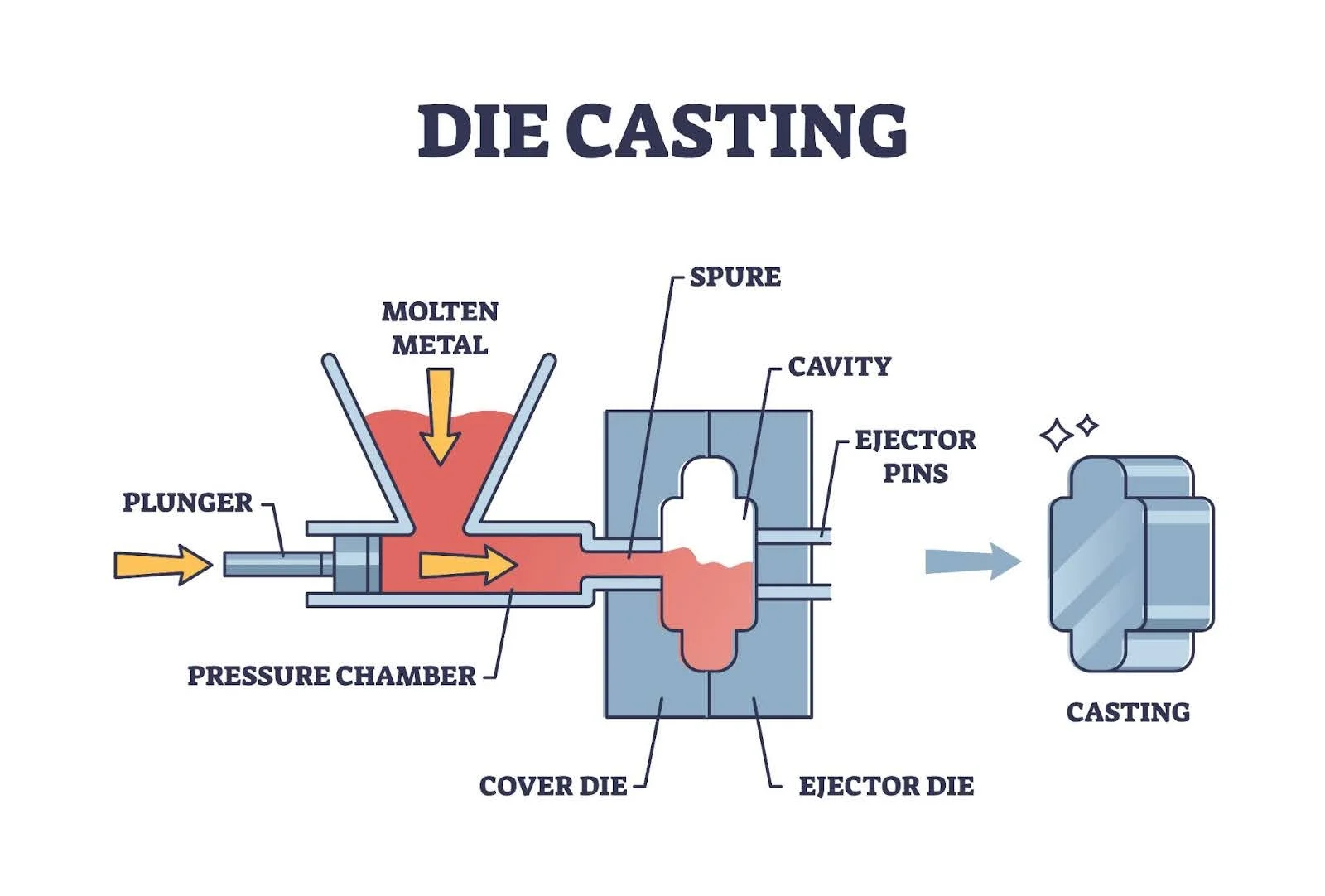
Die casting uses external pressure to force molten metal into steel molds at high speed, making it ideal for very large production volumes, thin walls, and complex geometries. Permanent mold casting fills reusable molds without external pressure, which reduces turbulence and the risk of gas entrapment—producing parts with lower porosity and improved heat-treatability. The trade-off is slower cycle time, thicker-section requirements, and less geometric complexity.
Permanent Mold Casting vs. Sand Casting
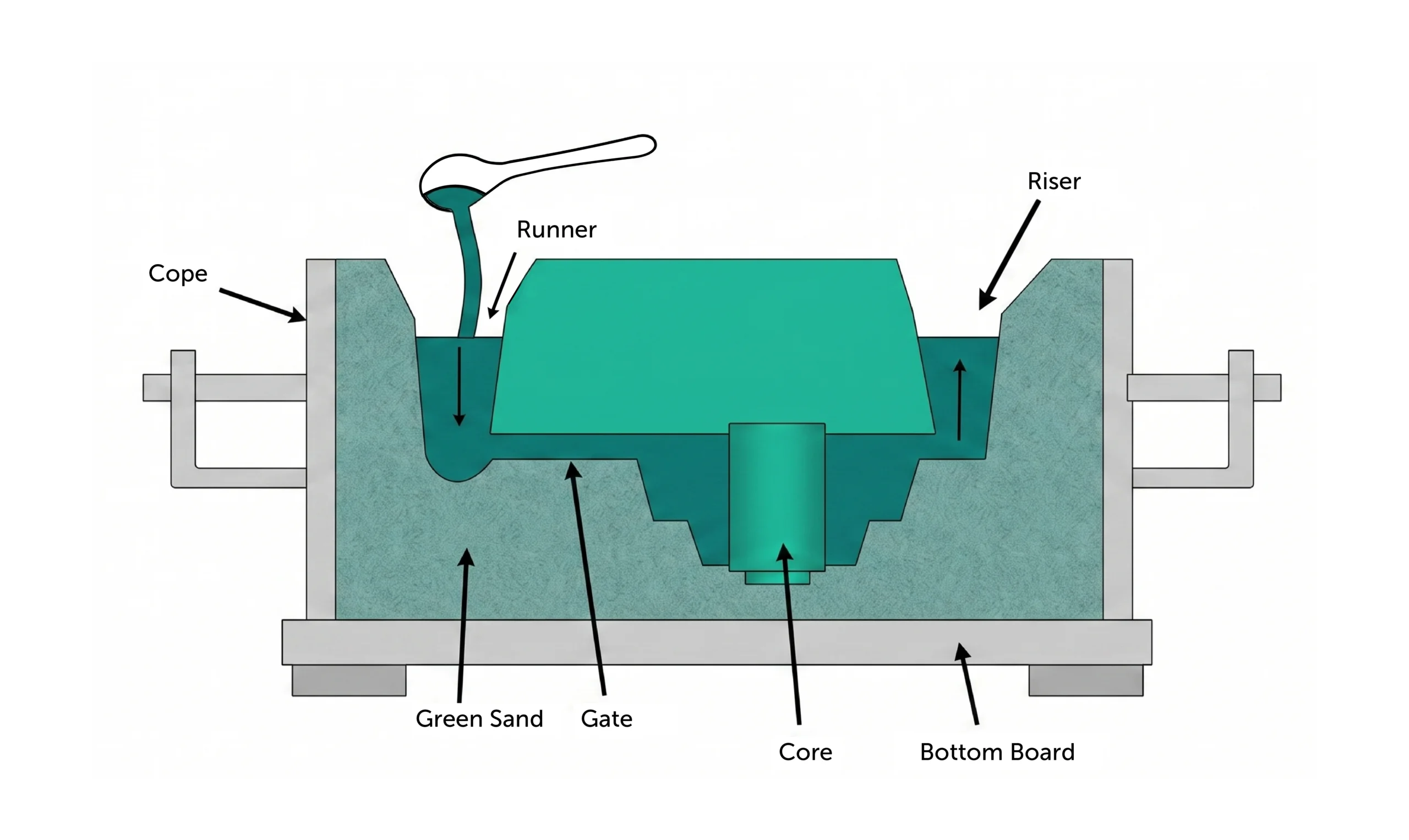
Sand casting uses expendable molds, which keep upfront tooling costs lower and allow greater flexibility for low-volume production or large parts. Permanent mold casting, by contrast, uses permanent molds that provide more stable cavity geometry from cycle to cycle. That stability improves as-cast surface finish, dimensional consistency, and mechanical property repeatability, though it comes with higher initial tooling investment.
Permanent Mold Casting vs. Investment Casting (Lost Wax Casting)
Investment casting uses disposable ceramic molds formed from wax patterns, allowing precise detail, fine surface finishes, and complex geometries. However, that precision often comes with longer lead times and higher costs due to pattern creation and shell-building. Permanent mold casting sacrifices some geometric freedom in exchange for faster repeat production and lower per-part costs at medium volumes.

Casting Process Comparison
| Casting Process | Typical Production Volume | Typical Dimensional Tolerance Capability (dependent on feature size) | Typical Surface Finish | Tooling Cost |
| Sand Casting | Low to Med (100–1,000) | Fair (±0.5–3 mm) | Rough (6–25 µm) | Low |
| Investment Casting | Med (500–5,000) | Excellent (±0.1 mm) for Small Features | Smooth (1.5–6 µm) | Moderate |
| Gravity Casting (Permanent Mold) | Med to High (1,000–10,000) | Good (±0.3 mm) | Smooth(3–12 µm) | Moderate to High |
| Die Casting | High (5,000+) | Very Good (±0.1–0.2 mm) | Very Smooth (1–3 µm) | High |
When to Use Permanent Mold Casting
Permanent mold casting is typically the best choice when:
- Parts require better mechanical properties than sand casting can reliably provide
- Production volumes are too high for sand casting but too low to justify die casting tooling
- Lower porosity and improved heat-treatability are important
- Aluminum components require consistent dimensional repeatability
- Surface finish requirements exceed what sand molds can economically achieve
Permanent mold casting is especially common for:
- Automotive housings
- Pump bodies
- Structural aluminum components
- Industrial brackets and enclosures
- Medium-volume aerospace hardware
Where Gravity Casting Fits in Manufacturing Strategy
Gravity casting is rarely selected in isolation—it’s usually chosen relative to other manufacturing options. In practice, it fills the gap between low-cost, lower-precision processes like sand casting and high-speed, high-investment processes like die casting.
For engineering teams, the decision often comes down to balancing:
- Production volume
- Tooling investment
- Mechanical performance
- Dimensional consistency
Gravity casting becomes most attractive when a part requires stronger repeatability and surface quality than sand casting can economically provide, but production volumes are still too low to justify the tooling cost and throughput expectations of die casting.
Moving from CNC prototypes to production-volume casting? Evaluate options and ensure your parts are optimized for the transition by reading our Scaling CNC Machining to Casting Transition Guide.
Gravity Casting Design Guidelines
Successful gravity casting begins with part and mold design decisions that support smooth filling, controlled solidification, and reliable mold release. Key design considerations include:
- Wall thickness management: Sections with major thickness variation cool at different rates, which can create shrinkage, hot spots, or internal stresses. Aim for as much wall thickness uniformity as practical, with gradual transitions where thickness changes are necessary.
- Draft angles for mold release: Permanent molds require sufficient draft so castings can eject cleanly without damaging the part or tooling. Vertical surfaces should include sufficient draft appropriate to alloy, geometry, and mold design.
- Fillets and radii: Sharp corners disrupt molten metal flow and create localized stress concentrations. Rounded transitions improve filling, reduce defect risk, and support better long-term part durability.
- Solidification strategy: Gravity casting design should intentionally control where the metal freezes first and last. Proper gating, risers, and section transitions help ensure shrinkage occurs in controlled locations rather than inside critical features.
Many gravity casting design principles also apply to die casting. Explore our die casting design guide to learn more about wall thickness, draft angles, fillets, and designing parts for manufacturability.
Cost and Lead Time Considerations
Gravity casting’s moderate tooling cost and lead time position it as a practical middle ground between lower-cost sand casting and higher-cost die casting.
- Tooling cost: Higher than sand casting because permanent molds must be machined and maintained, but generally lower than die casting tooling.
- Per-part economics: At low volumes, sand casting may remain more economical because tooling costs stay minimal. At medium volumes, gravity casting often becomes more cost-effective by improving repeatability and reducing variation. At very high volumes, die casting can achieve lower per-part costs through extreme throughput.
- Lead time: Permanent mold development takes longer upfront than sand casting pattern preparation. Once the mold is built, reusing the same cavity improves consistency and reduces mold-to-mold variation across production.
When Is Gravity Casting the Right Choice?
Gravity casting is best understood as a practical compromise in producing metal parts. It won’t match die casting for speed or sand casting for low upfront cost, but it does offer a stable combination of mechanical performance, repeatability, and medium-volume economics.
For engineers and sourcing teams, gravity casting often makes the most sense when a part requires better-than-sand-casting quality and lower-than-die-casting complexity at volumes substantial enough to justify reusable tooling. It’s often a great choice for teams that need durable, consistent metal parts without paying for capabilities they don’t actually need.
Platforms like Fictiv can help teams evaluate those trade-offs early by combining supplier access with design-for-manufacturability guidance, making the path from prototype to production more predictable.
Contact our team to discuss gravity casting and other specialized casting processes, or upload your CAD for a die casting quote through the Fictiv platform.
Gravity Casting FAQs
What metals are commonly used in gravity casting?
Gravity casting is most commonly used with aluminum alloys because they offer good fluidity, strong strength-to-weight performance, and reliable corrosion resistance. Common alloys include A356 and A357, which are widely used in automotive, aerospace, and industrial components. Magnesium, zinc, and copper alloys can also be gravity cast, though they are typically reserved for more specialized applications due to higher processing complexity and tooling demands.
Is gravity casting the same as die casting?
No. While both processes use reusable metal molds, gravity casting fills the mold using gravity alone, whereas die casting uses high pressure to force molten metal into the cavity. Gravity casting generally produces parts with lower porosity and better heat-treatment potential, while die casting is better suited for extremely high production volumes, thin walls, and highly complex geometries.
What are the main limitations of gravity casting?
Gravity casting is less effective for extremely thin walls, intricate internal passages, and highly detailed geometries that may require pressure-assisted filling. It also involves higher upfront tooling costs than sand casting because the molds are reusable precision tools. In addition, production rates are typically slower than high-pressure die casting, which can limit cost competitiveness at very large production volumes.
Can gravity cast parts be heat-treated?
Yes. Gravity-cast aluminum parts are often well-suited for heat treatment because the process generally produces lower gas entrapment and porosity than high-pressure die casting. This can reduce the risk of blistering or internal defects during thermal processing, making gravity casting a strong option for applications requiring improved mechanical performance.