





Time to read: 5 min
Export controls can feel complex, intimidating, and easy to get wrong—especially for teams building advanced hardware in aerospace and other regulated industries. But export control confusion doesn’t need to slow your program down.
This article explains how export controls work and how Fictiv supports your export-controlled projects. It covers what’s supported under the EAR and what isn’t under ITAR, and how to move forward with confidence—without unnecessary friction or compliance risk.
Why Export Control Matters in Manufacturing
Export control regulations exist to protect national security and sensitive technologies. While they’re often associated with shipping finished products overseas, export controls can apply much earlier—including during design and manufacturing for prototyping. This means export control considerations can affect how and where parts are quoted, reviewed, and produced.
If you’re producing parts related to areas like:
- Aerospace and propulsion
- Defense-adjacent or dual-use systems
- Electronics and semiconductors
- Sensors, lasers, and navigation systems
- Advanced materials or materials processing
…there’s a strong chance export controls are relevant to your work.
That’s why your manufacturing partner matters. A compliant process protects not only your organization, but also your program timelines and intellectual property.
ITAR vs. EAR: The Most Important Difference
Most U.S. export-controlled hardware and technical data falls under ITAR or EAR.
Understanding which one applies to your project is the first—and most important—step.
ITAR: What Fictiv Does Not Support
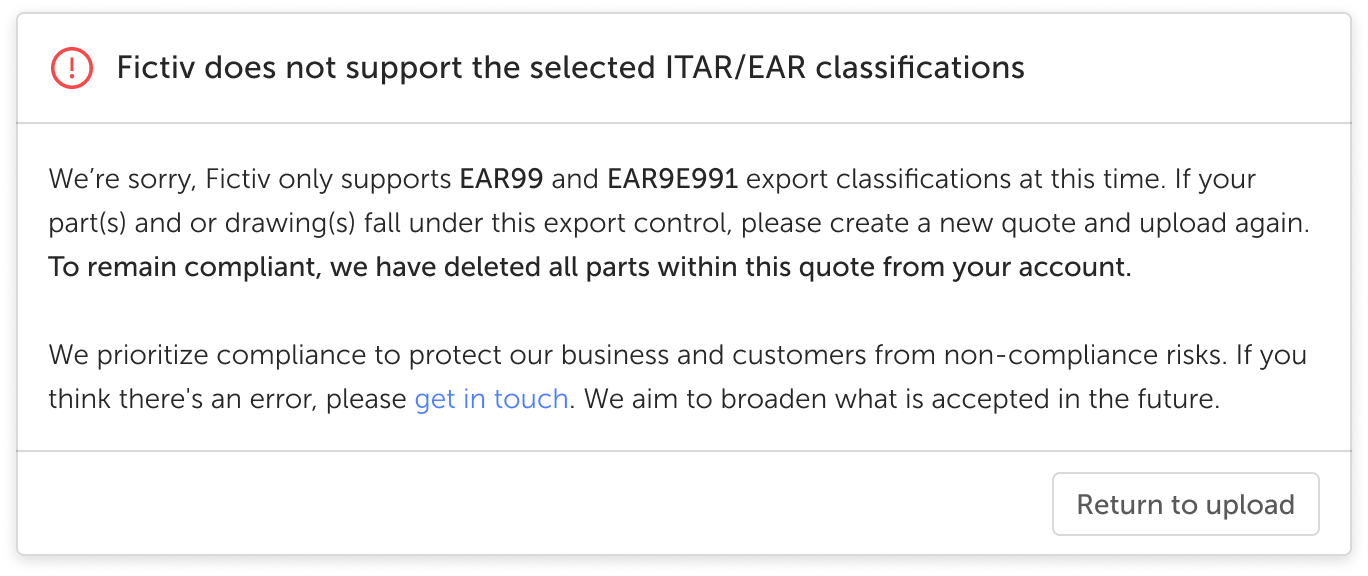
The International Traffic in Arms Regulations (ITAR) govern defense-related articles, services, and technical data.
To be clear and upfront:
Fictiv does not support ITAR-regulated manufacturing, including the processing or handling of:
- ITAR-controlled parts
- ITAR-controlled technical data
- ITAR-related RFQs
None of these are permitted on the Fictiv platform.
This boundary ensures we maintain a secure, compliant manufacturing environment and sets clear expectations before any designs are uploaded or reviewed.
If your project falls under ITAR, you’ll need to work with a manufacturing partner specifically authorized to support that work.
EAR: What Fictiv Does Support
Most commercial and dual-use products fall under the U.S. Export Administration Regulations (EAR) rather than ITAR.
Fictiv supports many EAR-governed manufacturing applications—but not all EAR classifications follow the same path.
There are two primary categories to understand:
- EAR99/EAR 9E991 (self-serve)
- ECCN-classified EAR items (sales engagement required)
EAR99/EAR 9E991 Manufacturing: Self-Serve and Fast
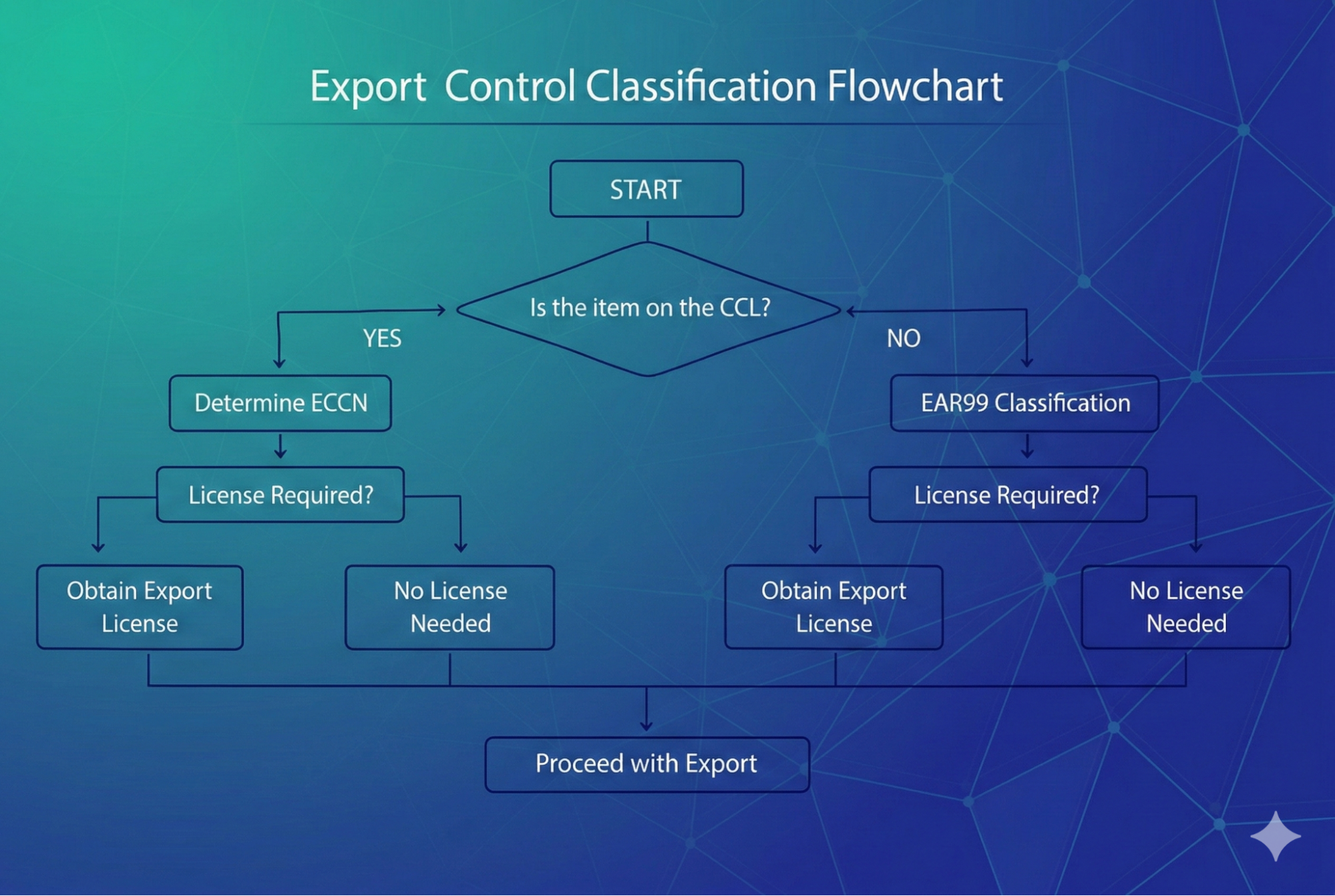
EAR99 items are subject to the EAR but do not require a specific Export Control Classification Number (ECCN).
- EAR99 items are subject to the EAR but are not listed on the Commerce Control List (CCL).
- Many common commercial parts fall into this category.
- Restrictions may still apply depending on destination, end user, and end use.
By contrast, items classified under EAR 9E991 do have a specific ECCN and are listed on the CCL.
- 9E991 generally covers certain technology related to aerospace and propulsion that is controlled for Anti-Terrorism (AT) reasons.
- While many exports of 9E991 items may not require a license, licensing requirements can still apply based on destination, end user, or end use
- Additional restrictions may apply to embargoed or sanctioned countries.
What this means at Fictiv
If your part is classified as EAR99 or EAR 9E991, you can:
- Upload designs directly to Fictiv.com
- Request quotes through our platform
- Move forward and transact on the Fictiv platform
This path is designed to be fast, flexible, and low-friction, while still maintaining responsible compliance practices.
If you already know your part is EAR99 or EAR 9E991, you can get started immediately.
Note: Customers are responsible for determining export classification; Fictiv may request information as part of our review.
ECCN & Other EAR Applications: When to Talk to Sales
Some EAR-regulated items do require additional oversight because they are considered dual-use or more sensitive in nature. These items are assigned an Export Control Classification Number (ECCN).
Examples include certain products related to:
- Commercial satellites (e.g., ECCN 9A515)
- Advanced navigation or avionics
- Sensors, lasers, and information security technologies
What this means at Fictiv
Fictiv can support most ECCN-classified EAR applications – subject to review and approval. This review process is standard for regulated manufacturing and helps ensure compliance before production begins.
Important to note:
- These RFQs cannot be initiated directly on the platform
- Engagement happens off-platform to ensure compliance
- Early validation helps prevent delays, rework, or compliance issues later
This process protects both your organization and ours—and helps ensure your project moves forward the right way.
How to Know Which Export Control Category Your Part Falls Into
Not sure whether your part is EAR99 or ECCN-classified? The table below provides a general overview for initial evaluation.
Typical Export Control Classifications by Part Type
Disclaimer: This table is illustrative for general guidance only and not a classification tool. Final classification depends on technical parameters + end use/end user/destination.
| Type of Part | Typical Use Case | Typical Classification | What This Means at Fictiv |
| Custom brackets, housings, enclosures | Commercial equipment, industrial machinery | EAR99 / EAR 9E991 | Can be quoted and manufactured directly on the Fictiv platform |
| CNC-machined mechanical components (non-sensitive) | General aerospace ground equipment, factory automation | EAR99 / EAR 9E991 | Self-serve RFQ supported |
| Sheet metal panels or frames | Commercial electronics, racks, non-defense systems | EAR99 / EAR 9E991 | No additional ECCN review required (EAR99/EAR 9E991 are supported self-serve) |
| Injection-molded plastic parts | Consumer, medical, or commercial products | EAR99 / EAR 9E991 | Platform-ready manufacturing |
| Standard/off-the-shelf (OTS) hardware | Catalog hardware such as fasteners and linear actuators suitable for integration with custom parts | Likely EAR99 / EAR 9E991 | Components sourced via Misumi retain the manufacturer’s export classification, where available. |
| Commercial satellite structural components | Space systems, non-military satellites | ECCN (e.g., 9A515) | Must be reviewed and approved by Fictiv Sales before manufacturing |
| Precision navigation or avionics housings | Aerospace or advanced mobility platforms | ECCN | Sales engagement required; off-platform validation |
| Sensor or laser component housings | Optical, sensing, or measurement systems | ECCN | EAR-supported, but requires compliance review |
| Electronics enclosures for encrypted or secure systems | Information security or telecom infrastructure | ECCN | Not self-serve; Sales review required |
| Dual-use aerospace or propulsion subcomponents | Civil aviation with potential military application | ECCN | Supported after export control validation |
| Defense-specific or weapons-related components | Military or defense programs | Likely ITAR or ECCN-controlled | ❌ Not supported by Fictiv |
For formal classification, the U.S. Commerce Department’s Commerce Control List (CCL) outlines controlled items under the EAR.
That said, export classification isn’t always straightforward—especially for complex assemblies or novel technologies.
Engaging with Fictiv before submitting a regulated RFQ can save significant time and prevent unnecessary back-and-forth. As for classifying your project, we can’t make the final determination for you, but if you know how it’s classified, we can help you understand how to quote it—talk to us.
Why Companies Trust Fictiv With Regulated Manufacturing
Export control isn’t just about following rules—it’s about choosing a partner you can trust with critical programs.
Teams in regulated industries work with Fictiv because export compliance is built into how we operate, not bolted on after the fact. We combine:
- Secure-by-design systems that protect sensitive design data
- Controlled access and review workflows for EAR-regulated projects
- Clear escalation paths for ECCN-classified work—before production begins
- Proven experience supporting complex manufacturing across aerospace, electronics, and emerging technologies
The result: compliant manufacturing without unnecessary delays, rework, or guesswork—so your program keeps moving forward with confidence.
Start Export-Controlled Manufacturing the Right Way
To recap:
- ITAR-regulated projects: Not supported
- EAR99/EAR 9E991 projects: Self-serve on Fictiv.com
- ECCN-classified EAR items: We can support most—engage with our sales team for validation
If you’re building advanced hardware and want to ensure a smooth, compliant manufacturing process, taking the right path from the start makes all the difference.
Ready to move forward?
- Start an EAR99 or EAR 9E991 RFQ on our platform
- Or contact our sales team to discuss EAR-regulated manufacturing
Export control complications don’t have to hold up your projects—with the right partner, it can be simple, secure, and scalable.
Get a free manufacturing quote today or email sales@fictiv.com to start a conversation.