





Time to read: 10 min
Single sourcing a mechanical bill of materials (BOM) means managing both custom and standard parts through one coordinated manufacturing partner instead of splitting them across multiple suppliers. For hardware teams, this can reduce procurement complexity, improve tolerance coordination, speed up iteration, and create a cleaner path from prototyping to production. This guide explains when to use standard vs custom parts, how those choices affect BOM strategy, and how to consolidate sourcing across your full mechanical BOM.
If you’ve ever managed a mechanical bill of materials (BOM), you know it can get complicated fast—especially when balancing custom and standard parts. Tracking parts is only a fraction of the challenge; BOM complexity also impacts both engineering and procurement. Each additional supplier, custom component, or interface increases risk, slows iteration, and complicates assembly.
Early decisions about which components to standardize, customize, or consolidate shape engineering timelines, procurement complexity, tolerance stack-up risk, costs, and long-term scalability. When your mechanical BOM slows you down, the root cause can often be traced back to those early design choices: what to buy off the shelf, what to make custom, and how it all fits together.

What Makes Up a Mechanical BOM—and Why Custom vs. Standard Part Decisions Matter
A mechanical BOM includes a complete list of custom and standard components required to manufacture and assemble a mechanical system. BOMs are used as the primary resource to communicate all required components of an end product to stakeholders. This could include everyone from the designers to the part suppliers to the manufacturing team.
BOMs should contain enough information about each component to avoid ambiguity. This can include part numbers, quantities, materials, and revision levels. Additional details that are critical, such as materials, acceptable tolerances, and finishes, may also be included, especially for custom components that require more precise definition (though that information usually lives on the 2D engineering drawings).
BOMs reflect decisions about custom vs. standard parts, and it is very important to note the effects these choices may have on the different stages of product development.
- In engineering validation testing (EVT), speed and learning are often prioritized, which may lead teams to use custom prototype parts or quickly modified components to validate concepts.
- In design validation testing (DVT), the focus shifts toward validating performance using hardware that closely resembles the intended production design.
- By production validation testing (PVT), the emphasis is on producing the final design with production tooling at volume.
Custom components that enabled rapid iteration in EVT may require additional supplier qualification, tooling, or process validation before PVT, whereas standard components are typically easier to scale because they’re already qualified and available off the shelf.
This illustrates the importance of considering the entire product development lifecycle—along with DFM and other DFX principles—early in the design process when determining what the BOM will contain.
What Are Mechanical Components?
Mechanical components are the physical building blocks of a finished product. They carry loads, enable motion, seal and protect, and provide interfaces for the other mechanical and non-mechanical parts (electrical, sensing, electronics, etc.) that make up a finished assembly. These mechanical components can be standard (off-the-shelf) or custom-designed, depending on the requirements of the final product.
What Makes a Mechanical Component “Standard”?
Standard mechanical components come in predefined sizes, meaning they are built to established specifications. Their properties and performance characteristics are known, and these parts are usually easy to source since they are typically stocked by multiple suppliers.
Standard components aren’t designed for any one particular finished product. They can be used across a variety of products and generally fall into two categories: off-the-shelf (or fixed) standard components, and configurable components. Off-the-shelf mechanical components have fixed features and are used as is, without any modifications.
Configurable Standard Components
Configurable standard components follow a standard design but allow limited variation within predefined, selectable options, such as sizes, materials, or finishes. Designers choose from approved options rather than creating a fully custom part.
Typical configurable features include:
- Length or thickness
- Diameter or cross-section
- Hole patterns or mounting interfaces
- Material or surface finish
- Shaft ends, keyways, or threads
These variations are typically offered as predefined catalog options, with each configuration assigned its own part number rather than being modified after purchase.
Common Examples of Standard/Configurable Components
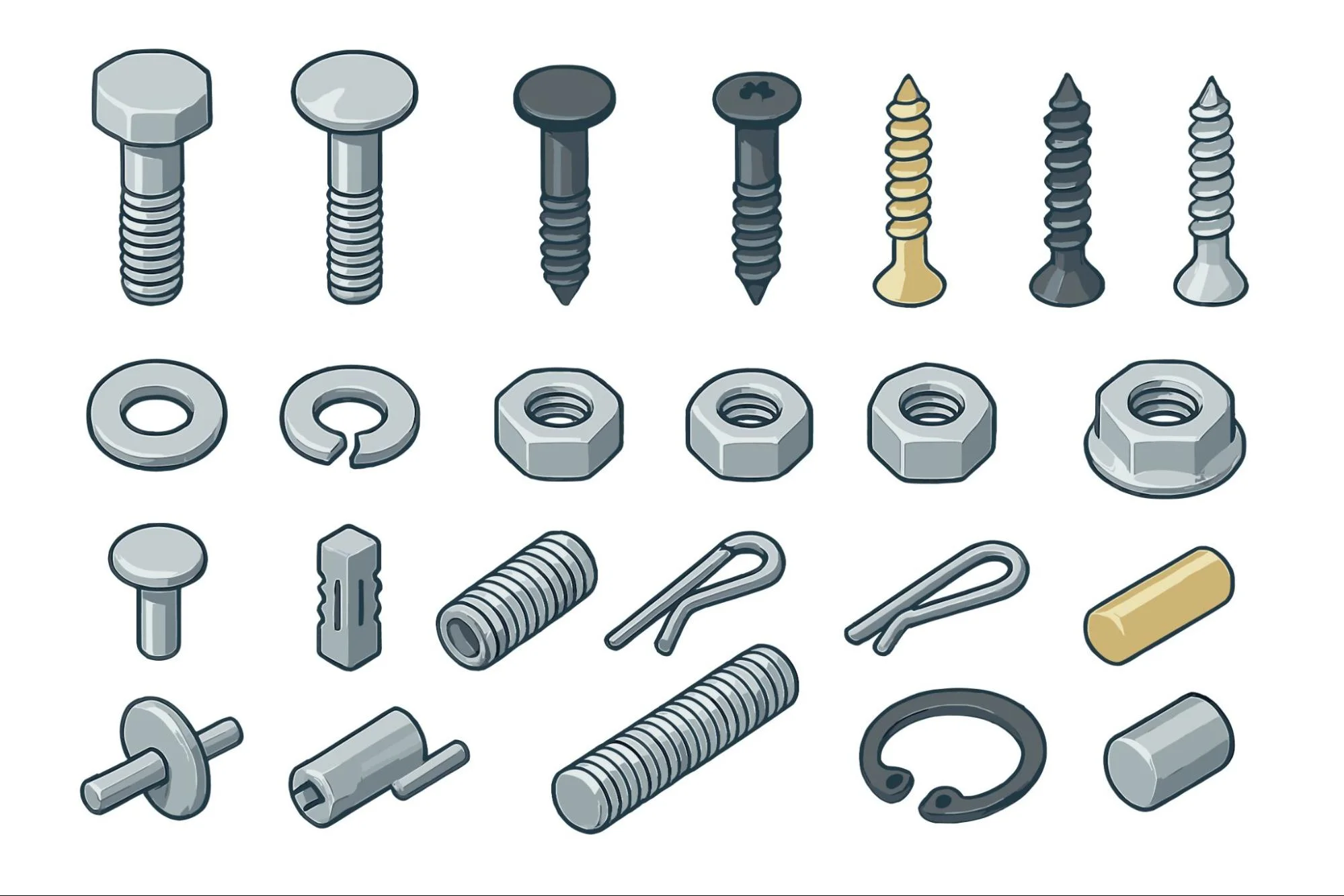
Standard off-the-shelf parts that are frequently used include:
- Screws
- Bolts
- Nuts
- Washers
- Springs
- Pins
- Hinges
- O-rings
- Gaskets
- Brackets
- Shafts
- Bearings
- Extrusions
- Machine Keys
- Jig & Drill Bushings
- Clevis Pins
- Cantilever Shafts
When Standard Parts Make BOM Sourcing Easier
Standard parts are usually best when they don’t define the core function of the system. Using standard parts offers a number of advantages:
- Multiple sourcing options: Standard parts are usually available from multiple suppliers, which reduces single-supplier dependency and supply chain risk while also allowing for cost savings by selecting the most competitive vendor.
- Shorter lead times: Sourcing lead times are typically lower for standard parts than for custom parts, making it easier to ramp production up or down as needed.
- Proven performance: These parts are typically widely used across industries, meaning their design and performance have been tested, validated, and documented in a number of service environments.
- Less documentation overhead: While each part still requires a part number and listing, supplier-provided drawings and specifications reduce the need to create and maintain detailed part documentation internally. This lowers engineering overhead and reduces revision complexity as product designs evolve.
Standard mechanical components integrate well into assemblies largely because so much of the uncertainty has already been engineered out of them. Their dimensions and fits have defined tolerances and documented manufacturing capability, allowing designers to model interfaces with confidence and validate worst-case conditions.
The behavior of standard parts is also well understood: published load ratings and operating limits make it clear what the part can handle, so it can be treated as a dependable building block rather than a design variable. On top of that, these components come with supplier-backed reliability data and warranties, so designers can count on consistency from prototype through production.
When Custom Parts Improve BOM Performance
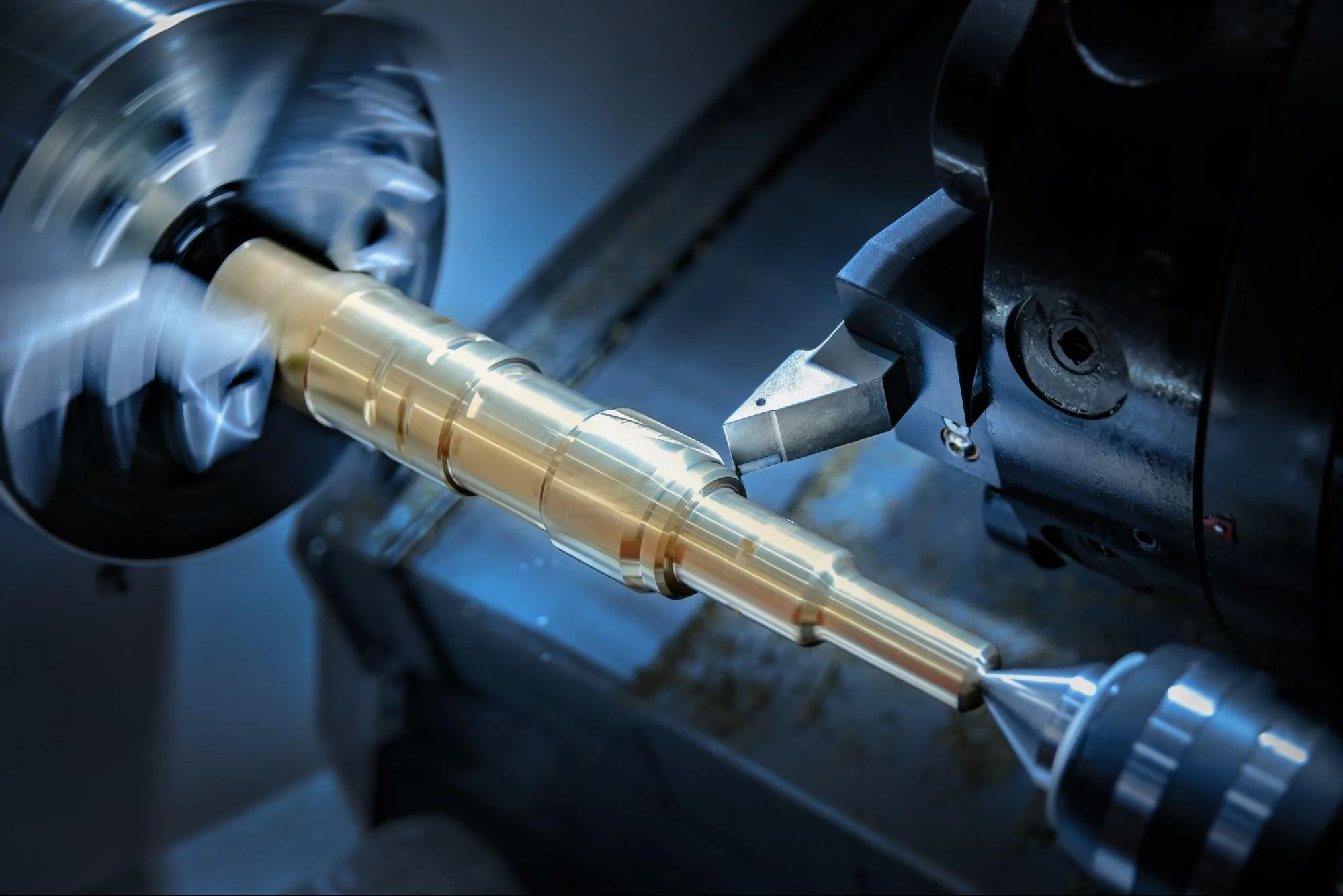
Custom parts allow you to tailor a component to the specific needs of your product or application. They enable performance enhancements that standard components may not be able to match—allowing the overall design to be optimized for weight, strength, or other performance metrics.
Custom components can also integrate multiple functions, rather than serving as a single, standalone part. A well-designed custom part can replace multiple standard parts or enable integration of other components in ways that standard parts can’t.
Custom parts should be used when:
- They can be made as a single part number to replace a subassembly made of multiple standard components.
- Replacing multiple standard parts with a single custom part reduces costs.
- DVT, EVT, and PVT are considered from the start, and custom parts won’t cause scaling issues in later stages of product development.
- Custom parts are required to implement the desired features in a unique, high-quality product.
How to Decide What to Standardize, Customize, or Consolidate
Choosing between standard and custom parts isn’t just a design decision—it’s a BOM strategy decision that affects sourcing complexity, cost, and scalability.
A simple way to approach this is to evaluate each component based on function, differentiation, and lifecycle impact:
Use standard parts when:
- The component does not define your product’s core functionality
- Proven, off-the-shelf solutions meet performance requirements
- You want to minimize lead time, cost, and documentation overhead
- Multi-sourcing flexibility is important
Use custom parts when:
- The component enables unique product functionality or differentiation
- You can consolidate multiple parts or assemblies into a single component
- Performance requirements (weight, strength, integration) exceed standard options
- You are designing for long-term optimization at scale
Consolidate sourcing when:
- Interfaces between parts are causing tolerance or fit issues
- Supplier coordination is slowing down iteration cycles
- BOM complexity is increasing procurement overhead
- You need a smoother transition from prototype to production
In practice, most successful hardware teams use a hybrid approach: standard parts where possible, custom parts where necessary, and a consolidated sourcing strategy to manage both efficiently.
What Is a Single-Source BOM Strategy?
A single-source BOM strategy means sourcing both custom-manufactured and standard components through one coordinated manufacturing partner. This approach can reduce supplier complexity, improve interface alignment, speed iteration, and create a smoother transition from prototype to production.
What a Single-Source BOM Partner Provides
A full-BOM manufacturing partner supports the entire mechanical bill of materials, supplying both custom-manufactured parts and standard components through a single, coordinated sourcing experience. Rather than treating custom and standard parts as separate procurement problems, this model brings them together.
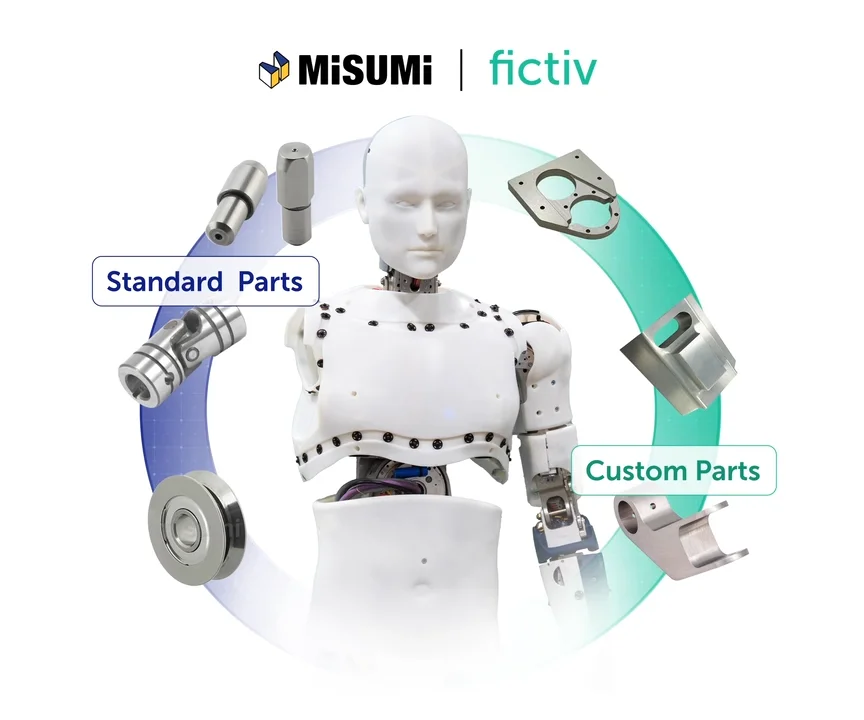
With Fictiv and MISUMI, engineers can access both custom manufacturing and configurable standard components through a coordinated sourcing approach. MISUMI provides reliable catalog components, while Fictiv delivers diversified custom manufacturing, DFM feedback, and global production capacity. Together, these complementary capabilities help teams simplify supplier management and accelerate product development.
Benefits of Sourcing Your Entire BOM Through a Single Partner
Sourcing your entire BOM from a single, trusted supplier has significant advantages:
- Fewer tolerance mismatches: When both standard and custom components are sourced together, interfaces can be evaluated as part of the full assembly rather than in isolation. This reduces tolerance stack-up issues and lowers the risk of late-stage rework or design changes.
- Faster iteration loops: With one partner overseeing the full BOM, quoting is faster, design changes propagate more smoothly, and iteration loops shorten. Engineers can make updates without re-triggering multiple supplier conversations—which is especially valuable during EVT and DVT when designs are still evolving.
- Cleaner handoff from design to production: As products move toward production, consolidation creates a cleaner handoff from design to manufacturing. CAD models, BOMs, and manufacturing plans stay synchronized, reducing translation errors and smoothing the transition from prototype builds to production runs.
- Reduced supply chain risk and total BOM cost: Managing fragmented suppliers introduces hidden costs—from inconsistent quality standards and expediting fees to duplicated logistics, audits, and administrative overhead. Consolidating your BOM under a coordinated partner improves cost transparency, reduces coordination complexity, and helps control total landed cost across both custom and standard components.
How to Evaluate a Single-Source BOM Manufacturing Partner
Moving to a single-BOM partner can dramatically simplify sourcing and execution, but this decision still warrants careful consideration.
Choosing one trusted partner means your primary supplier understands your product, your requirements, and your constraints at every stage. Instead of re-explaining designs and expectations to multiple suppliers, you build continuity from the prototype phase right through to production. That said, consolidating responsibility also means placing more faith in one organization’s ability to deliver consistently, which is why it’s so critical to select the right partner.
Here are a few things to consider when choosing your BOM partner:
Risk Mitigation
Single-partner strategies reduce coordination overhead but introduce greater exposure to production and financial risk if that partner experiences capacity constraints, supply disruptions, or quality issues. The right BOM partner avoids these potential challenges through diversified manufacturing capacity, redundancy across regions, and proactive communication with customers and suppliers. Before committing to a sourcing partner, it’s important to understand how your partner manages risk and what safeguards are in place to maintain continuity of supply and production.
It’s also worth distinguishing between single sourcing (strategically choosing one primary supplier) and sole sourcing (where only one supplier exists). A well-structured single-BOM strategy should still include contingency planning and second-source validation for critical components.
Supplier Fit
A strong single-BOM partner should demonstrate deep manufacturing expertise and a proven track record for producing both custom and standard components. Years in business can signal adequate experience, but equally important is transparency—how DFM feedback is handled, how part quality is controlled, and how changes are managed as designs evolve. Clear, responsive communication is essential, especially as products move quickly through testing stages (EVT, DVT, PVT) and into production.
Service Agreement
Clear contract terms covering quality standards, pricing, lead times, and regulatory compliance set expectations on both sides and prevent friction down the line.

How to Transition to a Single Source BOM Strategy
Transitioning from multiple suppliers to a single-partner strategy takes careful planning to mitigate risk. Here are a few pointers to ensure a successful transition:
Audit Your Existing BOM
Before considering the supplier, review the BOM itself. How many parts are standard vs. custom? Which suppliers provide what components? Are there any known vulnerabilities, such as long lead times or quality issues, that need to be addressed?
Lock Interfaces Early
Interfaces define how parts and sub-components connect to each other. When the design of an interface changes, it affects at least the two connected components, often with downstream effects as well.
Locking interface designs early in the development process makes it much easier to change or consolidate suppliers later, as long as their parts are compatible. This approach is preferable to locking in suppliers early in the process, which can force constraints into your design if interfaces are tailored too closely to one supplier’s components.
Evaluate Suppliers
When evaluating potential suppliers, it’s important to consider more than just the price. Look at factors like supplier reputation, production capacity, financial stability, certifications and support, and service agreement terms. A single-partner BOM strategy is a long-term partnership—use your due diligence and choose wisely.
Consult Your Chosen Partner
Once you’ve evaluated or chosen a sourcing partner for the components in your BOM, have them review it critically. They can help identify opportunities to simplify or standardize components, find cost savings by using alternative parts, or reduce BOM complexity using multi-function or custom components.
Transition Gradually
The transition to a single supplier doesn’t have to happen all at once. Start by reducing overall supplier count, gradually sourcing more parts from your chosen partner. Low-risk and non-critical standard parts are good candidates to transition first, especially those that can be sourced quickly if something goes wrong. Phasing out any suppliers that have caused past problems is another good strategy.
Have a Backup
Single-partner BOM strategies carry one main risk: potential dependency on a single supplier. You can mitigate this by implementing sourcing backup strategies—like building up a surplus of components in case of long lead times, qualifying alternate suppliers for critical parts, or maintaining second-source tooling where appropriate. Keep in mind that a “single supplier” often has sub-suppliers or their own manufacturing partners.
Evaluate Performance
When making the transition, be sure to regularly monitor and evaluate the performance of the new partnership. Look at metrics like cost and quality to ensure that the relationship with the chosen partner is working as intended.
Make Your BOM a Competitive Advantage
A company’s BOM isn’t often seen as a source of competitive advantage, but disciplined component decisions can create one. Smart decisions about component sourcing, especially choosing between custom and standard parts, can reduce cost and lead times while simplifying design, workflow, and manufacturing of the final product.
Even the best BOM can stall if sourcing is fragmented. Working with a single full-BOM partner consolidates custom and standard components, mitigates tolerance mismatches, accelerates iteration cycles, and creates a clean handoff from design to production.
Fictiv, now part of the MISUMI Group, provides that unified approach. Through our platform, teams can access custom manufacturing via a network of vetted partners alongside configurable and standard components—simplifying sourcing without sacrificing engineering control.
Talk to Fictiv about consolidating your mechanical BOM. Upload your CAD files to get a quote and evaluate where standardization, consolidation, or custom optimization could reduce cost, simplify assembly, and shorten lead times.