



Time to read: 7 min
When designing a product, consider all factors that will contribute to its success throughout the development process. For most companies, this involves making the best quality product at the lowest possible cost.
Design for Excellence (DFX) is a modern product development approach and an umbrella term encompassing several design strategies focused on optimizing design and manufacturing processes. DFX helps manufacturing teams make smarter decisions to enhance product quality, reduce costs, and boost performance throughout the product life cycle.
This article explores the core principles of DFX and how digital manufacturing supports its successful application.

What Is DFX (Design for Excellence)?
DFX is a holistic and systematic approach to product design that prioritizes key aspects of the design and manufacturing process, including manufacturability, cost, reliability, sustainability, and serviceability. It is an integrated methodology that ensures products are designed with quality, efficient manufacturing, and long-term performance in mind. Companies that adopt a comprehensive DFX strategy can quickly scale products to mass production and achieve long-term success.
DFX evolved from traditional design practices, incorporating concepts aligned with lean manufacturing and Industry 4.0. By implementing this approach early in the design phase, companies can identify potential inefficiencies, reduce waste, and enhance scalability. This proactive approach not only improves product performance but also streamlines production workflows, making it easier to adapt to changing market demands and technological advancements.
Digital manufacturing technologies—such as CAD/CAM, physical, thermal, and manufacturing simulation software, rapid prototyping, automated quotations, and DFM feedback—play a crucial role in implementing DFX principles. By applying DFX principles alongside digital manufacturing, companies can proactively address design challenges, streamline production, and minimize waste, thereby reducing costs and improving product outcomes.
If you want to scale your products from prototyping to production with DFX factors in mind, create a free account with Fictiv and upload your part files to get started!
Key DFX Methodologies and Their Benefits
Design for Excellence combines 6 individually developed methods that focus on improving specific aspects of product design and manufacturing operations. Fictiv utilizes these methods to help manufacturers refine and optimize their product design, manufacturing processes, material usage, costs, and more. The various Design for Excellence methodologies and their benefits are:
Design for Manufacturability (DFM)
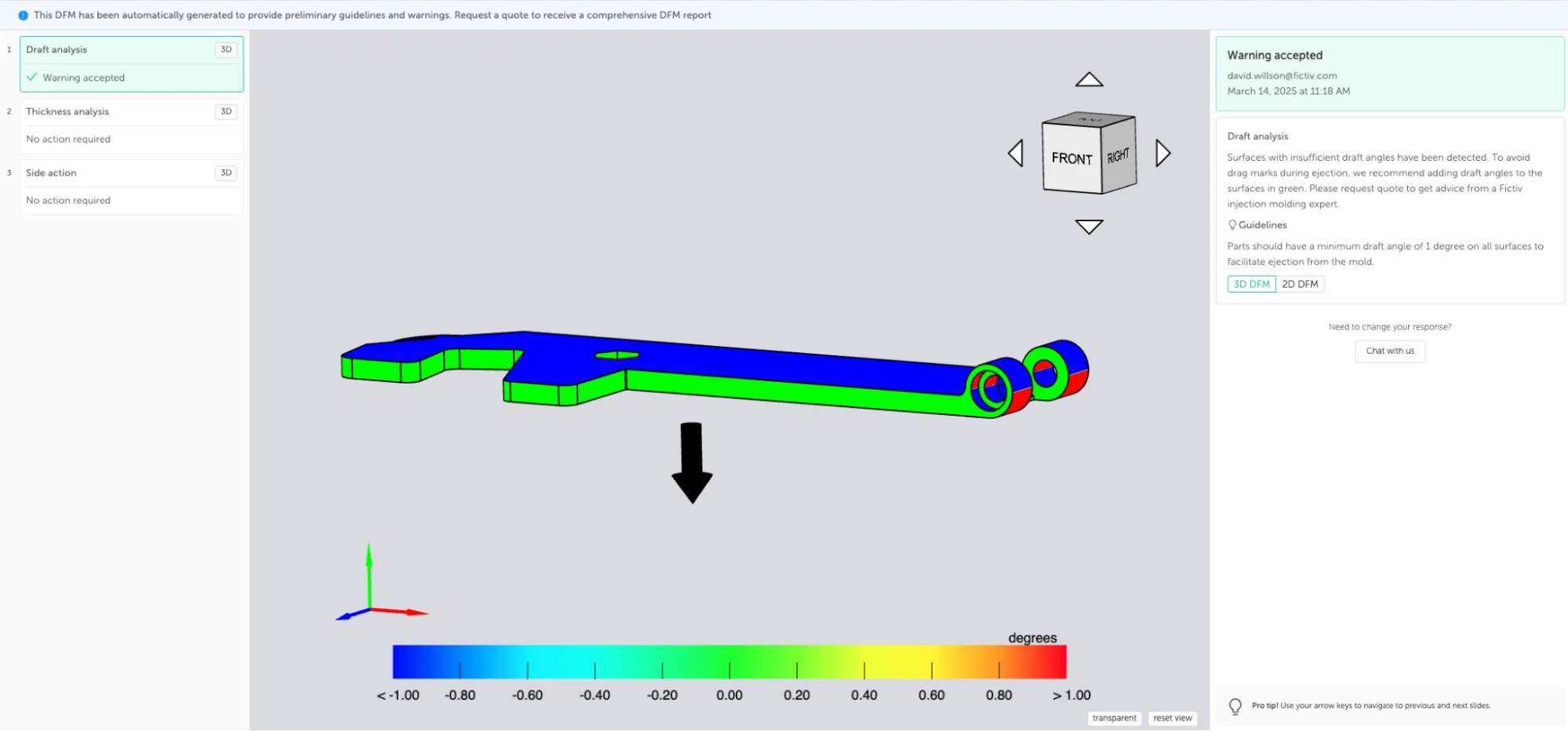
Design for Manufacturing (DFM) ensures that products can be efficiently manufactured at scale by optimizing design features to reduce material waste, tooling costs, and overall complexity. Engineers focus on refining part geometries to improve machinability and manufacturability across required production processes, including CNC machining, casting, injection molding, sheet metal fabrication, and 3D printing. DFM strategies such as minimizing undercuts, geometrical tolerancing, and selecting appropriate materials enhance efficiency and reduce production bottlenecks.
Fictiv offers instant DFM feedback through the quoting platform and expert advice on best practices through design feedback.
Design for Assembly (DFA)
Design for Assembly (DFA) focuses on simplifying product assembly by minimizing the number of components and designing for ease of assembly. This methodology helps reduce part counts, lowering labor costs for assembly and improving production speed. Common DFA strategies include replacing screws with snap-fit features, designing modular components that can fulfill multiple functions and fit within different products for streamlined assembly, and standardizing parts to reduce complexity.
Fictiv aids in DFA implementation in the 3D modeling and drafting processes. By offering rapid prototyping services, Fictiv allows engineers to iterate and validate assembly-friendly designs suitable for mass manufacturing, while also ensuring compatibility with global supply chains.
Download our free DFA checklist to learn more.
Design for Reliability (DFR)
Design for Reliability ensures that products maintain required performance levels throughout their planned design life, thus minimizing failures and warranty costs. Selecting high-quality materials that balance cost and quality while simultaneously resisting wear and environmental stressors is a key component of DFR. Fictiv engineers also conduct rigorous, accelerated thermal, mechanical stress, and corrosion testing during the design phase to validate product longevity.

Design for Cost (DFC)
DFC aims to reduce overall production costs while maintaining high product quality by identifying cost-saving opportunities in materials, manufacturing techniques, and logistics. Strategies include substituting reinforced polymers for expensive metals, designing for efficient material usage, and leveraging standard off-the-shelf components instead of custom-machined parts. This method, when applied to existing products, is often referred to as “costing down” your bill of materials.

Design for Sustainability (DFS)
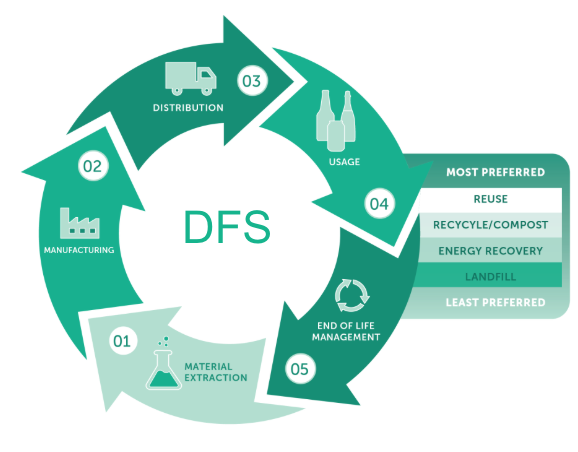
DFS is typically applied when eco-friendly manufacturing practices are desired. DFS emphasizes environmentally friendly design by proposing sustainable materials and optimizing processes to minimize waste. Engineers focus on selecting recyclable or bio-based materials, reducing excess material use, and designing for energy-efficient manufacturing. Weight-reduction design strategies also help reduce material consumption without compromising structural integrity.

Design for Testing (DFT) and Design for Serviceability
DFT ensures that products can be easily tested for defects before full-scale production, while Design for Serviceability focuses on making products easier to repair and maintain. Engineers incorporate test points, modular components, and standardized fasteners to simplify quality assurance and servicing. For example, in printed circuit board design, integrated test points allow for quick diagnostics, while modular component layouts facilitate part replacement in consumer electronics.
How DFX Improves Manufacturing Efficiency in Key Production Processes
Design for Excellence methodologies have been employed in numerous manufacturing sectors. Within those sectors, manufacturers who have adopted DFX have greatly benefited by reducing costs, optimizing lead times, minimizing time to market, and more. Some of the ways DFX improves manufacturing efficiency in different production processes are:
- DFX for Injection Molding:
- DFM benefits injection molding processes by identifying potential changes that can reduce wall thickness variations, thus improving mold flow.
- DFA can be used to evaluate options for minimizing the number of components in multi-part assemblies, simplifying production.
- DFS (Design for Sustainability) emphasizes environmentally friendly practices and materials by suggesting recyclable thermoplastic materials.
- DFX for Casting (Die Casting and Urethane Casting):
- DFM can help to optimize gating and venting to ensure smoother material flow, preventing defects and inconsistencies in the final product.
- DFC assists the designer in using and applying additive tooling and practices to reduce die costs and enable more cost-efficient mold creation without compromising precision.
- DFR offers manufacturers the opportunity to stress test to ensure durability against thermal fatigue.
- DFX for Sheet Metal Fabrication:
- DFM can improve the manufacturability of sheet metal components by simplifying bending processes to enable efficient forming and maximizing workpiece deformation during each stamping operation.
- DFC helps optimize material utilization by determining the most efficient part layout on a blank.
- Suggesting standardized fasteners for easier repairs enhances serviceability.
- DFX for 3D Printing:
- DFM helps optimize print orientation and layer alignment to enhance structural strength and maximize durability.
- DFC assists in selecting cost-effective materials for low-volume production, balancing performance with affordability.
- DFS employs lattice structures to minimize material use while maintaining mechanical integrity, supporting sustainable manufacturing, and lightweight yet strong designs.
- DFX for CNC Machining:
- DFM calculates ways to reduce tight tolerances in key locations and streamline and optimize machining processes.
- DFC produces optimal machining sequences to minimize tool changes, thus reducing cycle times and improving production efficiency.
- DFR enhances product longevity by recommending mechanically and thermally resilient, corrosion-resistant metals that ensure long-term durability across various environments.
The Role of Digital Manufacturing in DFX
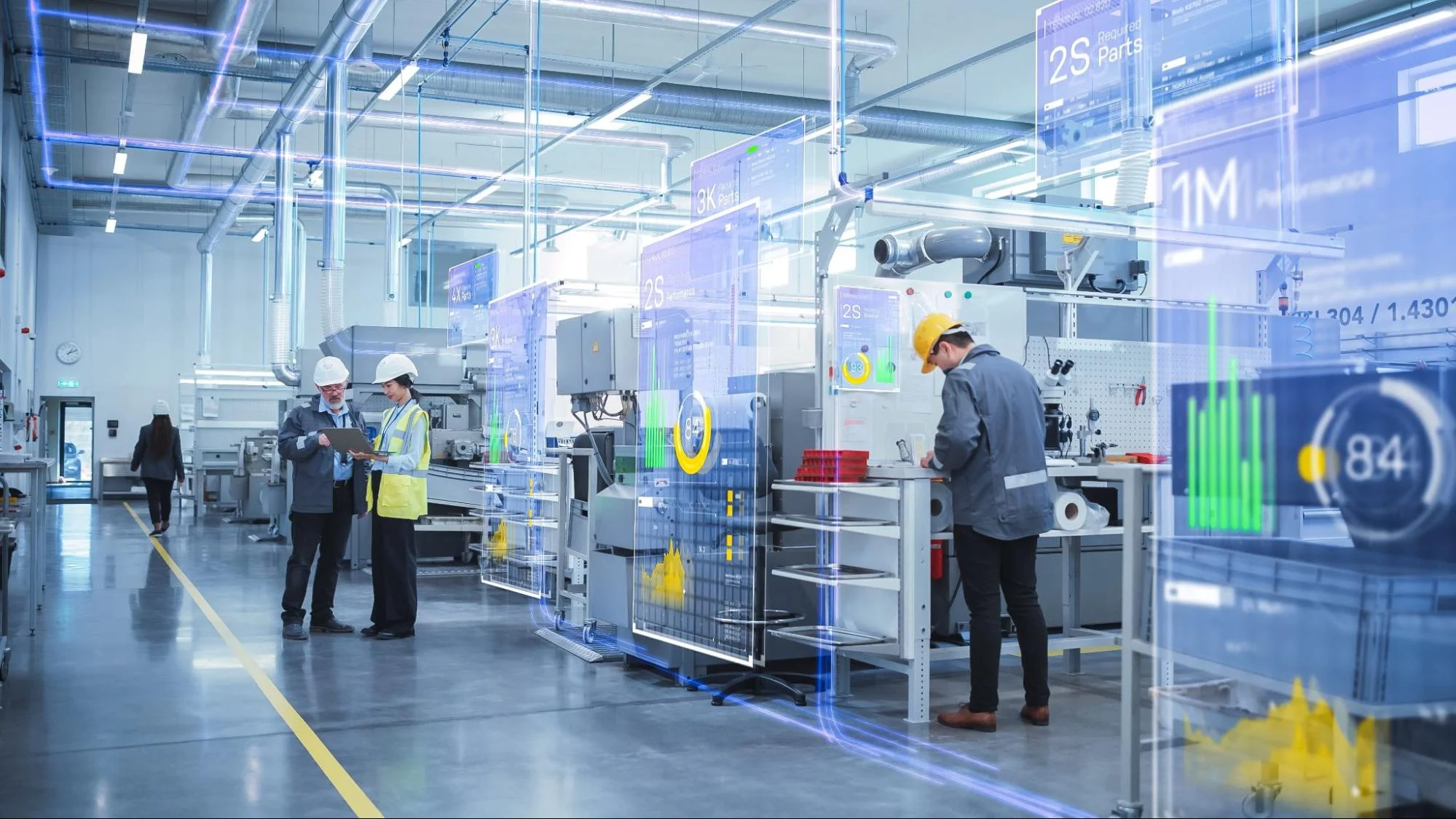
he integration of digital manufacturing with practices like cloud-based platforms, AI-driven design analysis, and on-demand prototyping further enhances the benefits of DFX implementation. This suite of technologies enables engineers to optimize product designs more efficiently, reduce costly design errors, ensure manufacturability without traditional “cut-and-try” iterations, and achieve a fully verified design before full-scale production begins.
Digital platforms allow real-time updates and quick DFM feedback loops on product designs. This facilitates seamless collaboration among designers, manufacturers, and suppliers and reduces the number of iterations needed before the product is ready for series manufacture. AI-driven tools analyze designs for potential manufacturing issues and suggest improvements instantly, enabling engineers to make data-driven decisions that improve quality and efficiency.
On-demand prototyping is a crucial element of digital manufacturing. It allows for the rapid validation of design changes through 3D printing, CNC machining, and other quick-turn fabrication methods. This capability significantly shortens development cycles and enables companies to test and refine their products before committing to large-scale production.
Additionally, digital manufacturing platforms provide instant quoting and cost analysis, helping organizations make informed financial decisions and compare different manufacturing approaches. By integrating these digital tools, companies can enhance their DFX strategies, leading to more cost-effective, reliable, and sustainable product designs.
Why DFX Matters in Product Development and How Fictiv Helps
DFX (Design for Excellence) is a critical element of modern product development. It enables early optimization of manufacturability, cost-efficiency, reliability, and sustainability in product designs. By leveraging digital manufacturing services like Fictiv, organizations can accelerate DFX adoption to optimize product designs for superior performance and market competitiveness.
| DFX Principle | How Fictiv Helps |
| Design for Manufacturing | Instant DFM checks, expert reviews, tolerance guides |
| Design for Assembly | Additive part consolidation, assembly-friendly feedback |
| Design for Cost | Real-time cost estimation and process comparisons |
| Design for Reliability | Process-specific guidance, high-quality builds |
| Design for Sustainability | Less waste with on-demand manufacturing, eco-friendly material options, localized manufacturing |
| Design for Testing | Prototyping and production-representative parts that enable functional testing and fixture validation |
| Design for Serviceability | DFM feedback and quick-turn builds to help teams evaluate access, disassembly, and repairability |
Ready to take your product designs to the next level? Sign up with Fictiv today to access powerful DFX tools, expert guidance, and a seamless digital manufacturing platform that simplifies prototyping and production.
Whether you’re refining early-stage concepts or scaling for mass production, Fictiv helps you move faster, smarter, and more sustainably—easily turning great ideas into market-ready products.