





Time to read: 7 min
Ejection of molded parts is a fundamental step in the injection molding process. Proper ejection system design is essential for preventing injection molding defects such as drag lines, rib cracking, whitening, and deformation.
Injection pushes molten plastic into the mold.
Ejection pushes the part out of the tool after solidification and mold opening.
Learn more with our Injection Molding Design Guide.
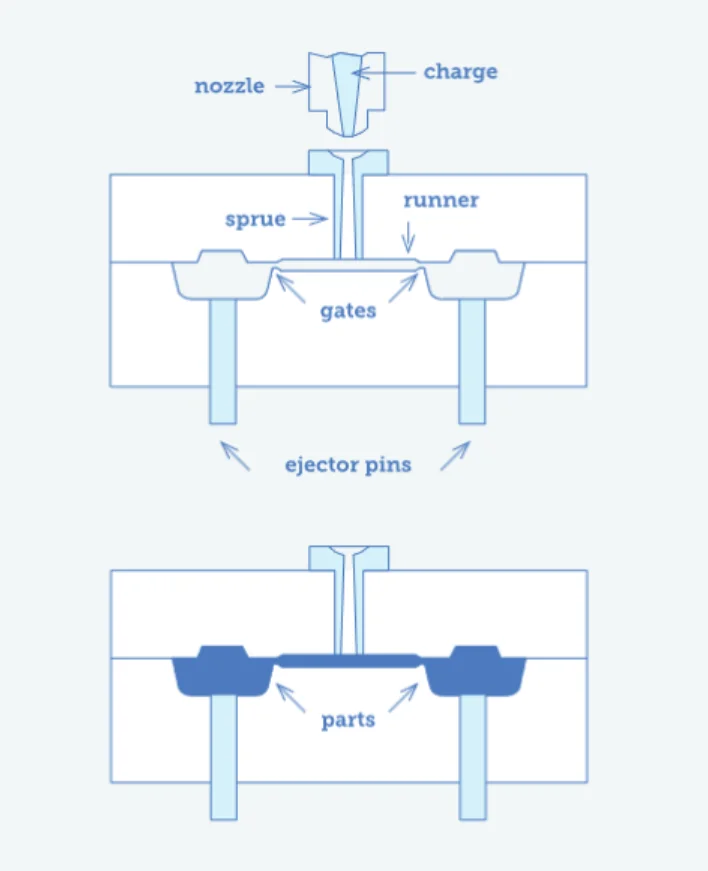
This article will further discuss how injection molding ejection systems work, their types, design guidelines, and the common problems encountered.
How Injection Molding Ejection Systems Work
After the material has solidified—whether a polymer, elastomer, or other injectable material —and the mold opens, the injection molding machine’s ejection unit pushes the ejector plate forward. All ejector elements move as a unified group unless the mold incorporates multi-stage ejection.
Effective ejection depends primarily on four conditions:
- Sufficient cooling to ensure the part maintains structural integrity during ejection.
- Correct timing so ejection does not begin before the part has achieved sufficient stiffness and dimensional stability.
- Balanced force distribution across the backside or contact surfaces of the molded part to prevent localized stresses, which can cause cracking or whitening.
- Mold opening distance must be sufficient before ejection.
Once the part fully clears the core, return pins bring the ejection system back to its starting position before the next mold closing event.
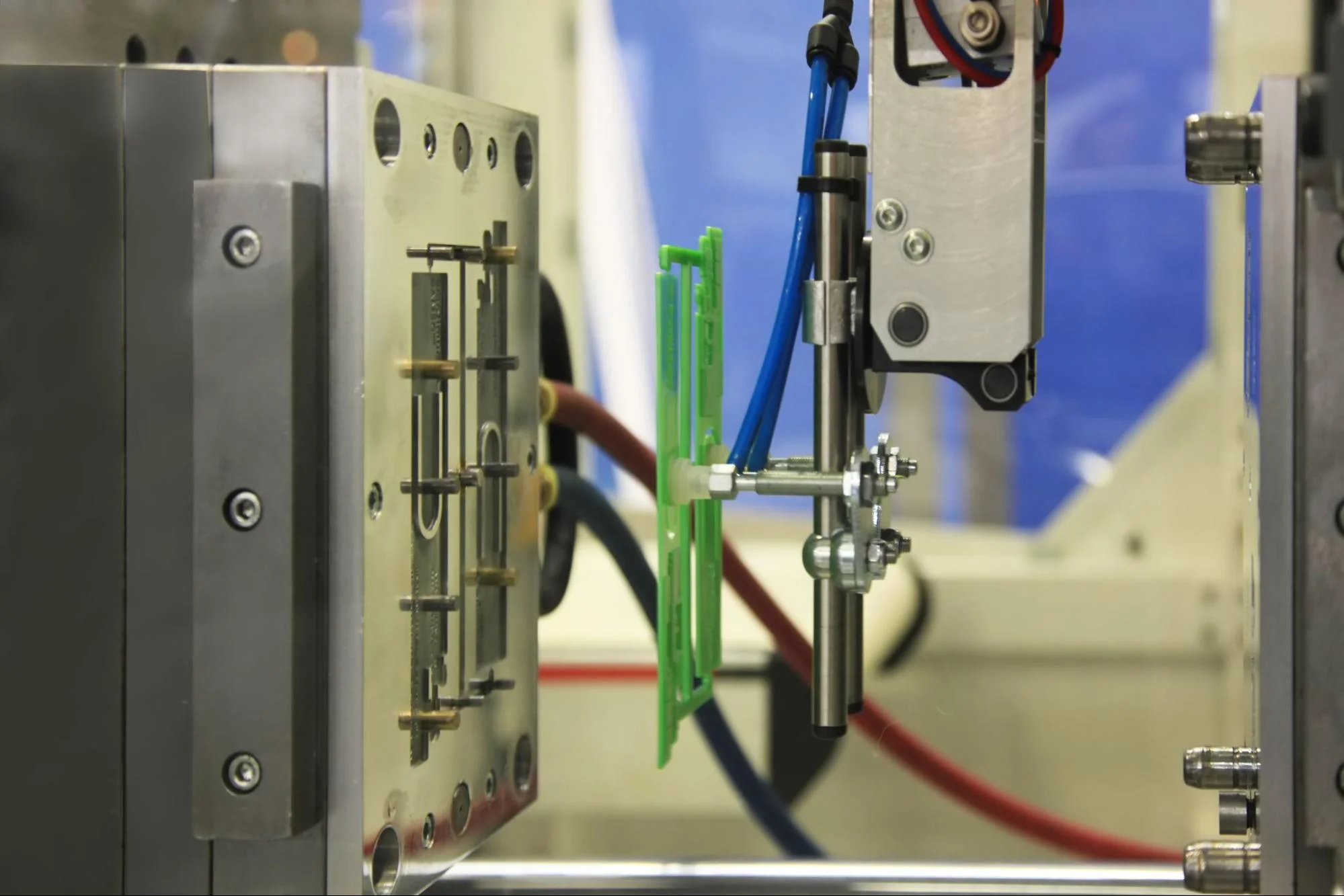
Ejection pin retraction for the FictivMade phone stand tool
Core Components of an Injection Molding Ejection System
Component | Function | Design Considerations |
Ejector Pins | Apply localized force at contact points to push the part off the core. Not all molds use pins, but in most multi-pin systems the pins are driven together by an ejector plate. | Must be precisely aligned to avoid galling between the pin shank and its guide bore; witness marks at the points of contact must be acceptable. |
Ejector Plate | Drives multiple ejector pins simultaneously in a single, unified stroke, ensuring synchronized part ejection in molds that use an array of pins. | The plate and all pins it drives must remain mutually parallel to avoid binding during travel. |
Return Pins | Reset the ejector system by pushing the ejector plate and pins back to their ready position after each ejection cycle. | Ensure the system fully retracts before mold closing to prevent damage. |
Ejector Sleeves | Apply distributed pressure around cylindrical cores. | Ideal for bosses; requires an accurate fit to prevent flash. |
Stripper Plate | Applies uniform pressure across large areas. | Best for flat or fragile parts; adds mechanical complexity. |
Air Valves / Air Assist | Break adhesion or vacuum via directed airflow; often supplemental rather than primary. | Requires controlled venting paths to prevent flash. |
Types of Injection Molding Ejection Systems
In most molds, ejector plates driving multiple pins are the dominant ejection method. Individual, stand-alone pins without a plate are far less common. However, no single mechanism is suitable for every part geometry, so tooling engineers select an ejection approach based on the part’s shape, draft, surface finish, and structural requirements.
Comparison of Commonly Used Molding Ejection Systems
Ejection Type | Mechanism | Best Applications | Advantages | Limitations |
Ejector Plate with Pins | A plate drives multiple pins in a coordinated, unified motion | Most general-purpose molded parts | Highly reliable; synchronizes multiple pins; adaptable to many geometries | Witness marks possible; requires proper alignment |
Individual Ejector Pins | Single pins actuated independently or in small groups | Localized features or simple molds | Simple design, low cost | Less common; requires precise alignment; can leave visible marks |
Ejector Sleeves | Hollow sleeve pushes around a core | Bosses, deep cylindrical features | Even pressure around cores | Requires tight tolerances to avoid flash |
Stripper Plate | A plate applies pressure to an entire surface | Flat or fragile parts | Minimizes localized stresses | Mechanically complex |
Air Ejection | Air pressure breaks adhesion or vacuum | Delicate, textured, or polish-critical parts | No mechanical marks | Requires proper venting paths |
Blade Ejectors | Thin blades push narrow ribs | Thin ribs or tight spaces | Prevents rib distortion | Fragile, limited load capacity |
Valve Gate Ejection (Integrated) | Actuation integrated with valve gate mechanism | High-precision, gate-critical parts | Smooth release | Higher tooling cost. Typically supplemental to pin or plate ejection. |
Key Design Considerations for Reliable Mold Ejection
Pin Placement
Pins should be distributed on the backside or non-cosmetic surfaces of the molded part to mitigate high-friction zones, such as deep cores, tall ribs, textured regions, or features with minimal draft. The goal is uniform pressure during ejection. Engineers may cluster pins or limit pin count when constrained by geometry or restricted access, but ideally, placement remains balanced.
Pin Diameter
Common ejection pin diameters range from 3–8 mm (1/8–5/16 in), depending on molded part mass and expected load. Small pins risk bending under load or piercing/deforming thin sections of the molded part, although micro-pins may be used in fine-feature tooling. Larger pins distribute force over a broader area and reduce pressure per pin, but both small and large pins can leave witness marks if they contact cosmetic surfaces.
Draft Angle
Draft angle is the primary factor affecting how easily a part releases from the mold. Even a 1-degree draft significantly reduces friction. Textured surfaces require additional draft because the “peaks” in the texture mechanically interlock with the mold surface.
Surface Finish
Highly polished mold surfaces minimize friction and allow ejection pins or other ejection mechanisms to release the part predictably. Rougher finishes require additional draft and broader ejection support. Failing to specify or finalize surface finish early in the design process often leads to sticking, drag, and cosmetic defects.
Surface texture strongly influences friction between the part and the mold during ejection. Higher friction increases resistance to part release, particularly on textured or cosmetic surfaces.
Practical draft-angle guidelines for various surface finishes:
- High gloss: 0.5°–1°
- Light texture: 1°–2°
- Medium texture: 2°–3°
- Heavy texture: 3°–5° or more
Avoid placing ejector pins on cosmetic surfaces whenever possible. If unavoidable, they can be visually minimized by hiding them under labels or in shallow recesses.
Venting and Vacuum Breaks
Trapped air can create strong suction forces between the part and the mold during ejection. Small vents or air-assist features near deep cores or broad surfaces, where issues are most common, help break the vacuum lock without compromising cavity integrity. Porous steel inserts are an advanced solution.
Thermal Management
Cooling uniformity is critical for predictable part release. When one region of the part cools faster than another, differential shrinkage increases grip on the core. Cooling channels within the mold’s core and cavity blocks help maintain uniform temperatures and reduce variability in ejection force. Core steel selection (e.g., H13 vs. P20) also affects thermal response and ejection consistency.
Common Mold Ejection Problems and Remedies
Correct ejection system design prevents rework, protects mold surfaces, and ensures dimensional stability. Most problems are linked to pin placement, draft angle, uniform cooling, and surface finish.
Common Ejection Defects, Likely Causes, and Recommended Fixes
| Defect | Likely Cause | Recommended Fix |
| Pin Marks | Excessive ejection force or undersized pins | Increase the number or diameter of pins; redistribute pins to ensure even pressure |
| Part Sticking | Insufficient draft angle; uneven cooling; trapped air (vacuum) | Increase draft angle; add vents or air assist; ensure uniform cooling across the cavity |
| Cracking or Stress Whitening | Uneven ejection force or premature ejection | Use a stripper plate or redistribute pins for uniform pressure; extend cooling time if necessary |
| Pin Galling | Misaligned pins; worn surfaces; lubrication breakdown | Ensure precise alignment; improve surface finish; maintain proper lubrication |
| Deformation or Drag | Ejection before part fully cools; uneven thermal profile | Extend cooling time; improve thermal management; verify part geometry and uniformity |
| Surface Drag / Scratches | High friction surfaces; textured areas | Increase draft angle; polish mold surfaces; apply air assist to reduce adhesion |
| Warpage | Uneven ejection or localized pressure | Adjust pin placement for uniform force distribution; optimize cooling to minimize shrinkage gradients |
Integrating Ejection Into Injection Molding Design for Manufacturability (DFM)
Part-release considerations must be addressed early, before geometry is locked, because ejection affects core shape, parting line decisions, and allowable feature complexity.
DFM guidance includes:
- Maintaining uniform wall thickness to reduce shrinkage gradients
- Applying draft angles early rather than as a late-stage fix
- Using flow and cooling simulations to identify areas likely to experience high friction due to shrinkage, cooling imbalance, or complex geometry
- Coordinating with tooling engineers on ejector-pin access, meaning the mold must have physical space and clear approach paths for pins, sleeves, or plates to contact and push the part without colliding with cores or slides
A well-integrated design and manufacturing process reduces tooling rework and shortens the path to first saleable parts.
Advanced Ejection Technologies and Cycle Time Optimization
Modern tooling incorporates several systems that enhance release consistency:
- Hydraulic ejection for large or deep components
- Multi-stage ejection for parts that grip different mold regions with varying intensity
- Gas or air assist to reduce friction on delicate or highly textured geometries
- Ejection systems with integrated cooling to stabilize shrinkage during release
These technologies are compatible with conventional ejector-pin systems and can be used to supplement them. While they improve reliability, they also increase cost, complexity, and maintenance requirements.
Fast ejection shortens cycle time, but overly rapid movement can crack thin walls or buckle flexible features. At the same time, ejection that is too slow results in avoidable delays or drag marks if the part remains in contact with the core for too long.
In multi-cavity molds, well-synchronized automated systems balance these competing risks by coordinating pin speed, stroke distance, and timing across all cavities. When properly tuned, these systems can reduce cycle time by up to 10-20 percent while maintaining safe part release.
Ejection FAQs
What is an ejection system in injection molding?
An ejection system is the mechanism in an injection mold that pushes the cooled plastic part off the core after the mold opens. It ensures reliable part release without damage or distortion.
How do ejection systems work?
After the part solidifies and the mold opens, the molding machine advances the ejector mechanism to apply a controlled force that separates the part from the mold core. The system then retracts before the next molding cycle begins.
What are the main types of ejection systems?
Common ejection systems include ejector pins, ejector sleeves, stripper plates, blade ejectors, and air-assist ejection. The choice depends on part geometry, surface finish, draft angle, and structural requirements.
How do you design ejector pin placement?
Ejector pins should be placed on non-cosmetic surfaces if possible and distributed evenly to apply balanced force during part release. Proper placement avoids high-stress areas, thin walls, and features with minimal draft.
What causes parts to stick in the mold?
Parts stick due to insufficient draft, uneven cooling, high surface friction, or vacuum formation between the part and the mold. Improving draft angles, venting, and cooling uniformity helps prevent sticking and simplifies ejection.
From Design Insight to Manufacturing Action
A well-engineered ejection system ensures stable dimensions, protects surface integrity, and enables consistent production cycles. From pin placement and draft angle to advanced air-assist and multi-stage sequencing, thoughtful ejection design is central to reliable performance in injection molding.
If you need support optimizing your tooling or resolving ejection-related defects, Fictiv provides DFM reviews, precision tooling, and production-grade molding services.
Upload your CAD model to start your next project with confidence.