








Time to read: 8 min
How important is it to reduce jetting? (No—we’re not talking about private planes and celebrities.)
Anyone who works with injection molding knows how crucial it is to maintain dimensional tolerances. But even after all that hard work, parts can still be rejected if they look bad. Jetting defects can occur even with the most advanced machinery, ruining entire production batches over cosmetic issues. Among injection molding defects, jetting stands out as one of the most visually disruptive and technically challenging to fix.
This article won’t cover celebrity fuel usage, but it will explain what jetting is in injection molding, what causes it, how to identify it, and how to prevent the defects it creates.
What Is Jetting in Injection Molding?
Jetting defects occur when molten plastic shoots into the mold in a high-pressure stream rather than filling the mold gradually with a consistent flow. This creates a worm-like trail that solidifies prematurely on what will be the surface of the finished part. While often viewed as a cosmetic flaw, jetting can also compromise the structural integrity of a molded part by creating localized stress points that significantly weaken it.
Under normal conditions, molten plastic enters a mold cavity and immediately encounters resistance from the mold walls. This resistance creates “fountain flow,” where the plastic expands outward from the center of the flow front (the “fountain”), touches the walls, and fills the cavity from the outside in. The “fountain” occurs because the material bulges out of the front of the flow front, while material in contact with the mold walls flows more slowly due to friction.
A jetting defect occurs when the melt velocity is too high or the gate is poorly positioned. This causes the plastic to “jet” into the open space of the cavity, without the advancing melt front remaining in continuous contact with a wall. Because the plastic isn’t in contact with the cool mold surface, it doesn’t slow down. It forms a thin strand of semi-solidified resin that is later surrounded by, but not wholly fused with, the rest of the incoming melt. This phenomenon can create weak interfaces similar to internal weld or knit lines, resulting in localized stress concentrations.
What Jetting Looks Like in Injection Molded Plastic Parts
Identifying jetting defects is straightforward because of their distinct, irregular appearance. The list below describes what jetting looks like in plastic injection-molded parts:
- Wavy, Worm-Like Lines: The most common sign is a serpentine trail of plastic that resembles a worm in the defect area.
- Surface Streaks: Surface streaks appear as imperfections that reflect light differently from the rest of the part, or shadows radiating from the gate.
- Ropy Texture: In clear or translucent parts, jetting can appear as a 3D internal structure resembling a tangled cord.
- Localized Gloss/Dullness: Because the jetted material cools at a different rate than the surrounding melt, the surface finish often appears inconsistent, with dull and shiny spots.
- Proximity to the Gate: Jetting almost always originates at or very near the gate, though the “tail” of the jet can extend far into the part.
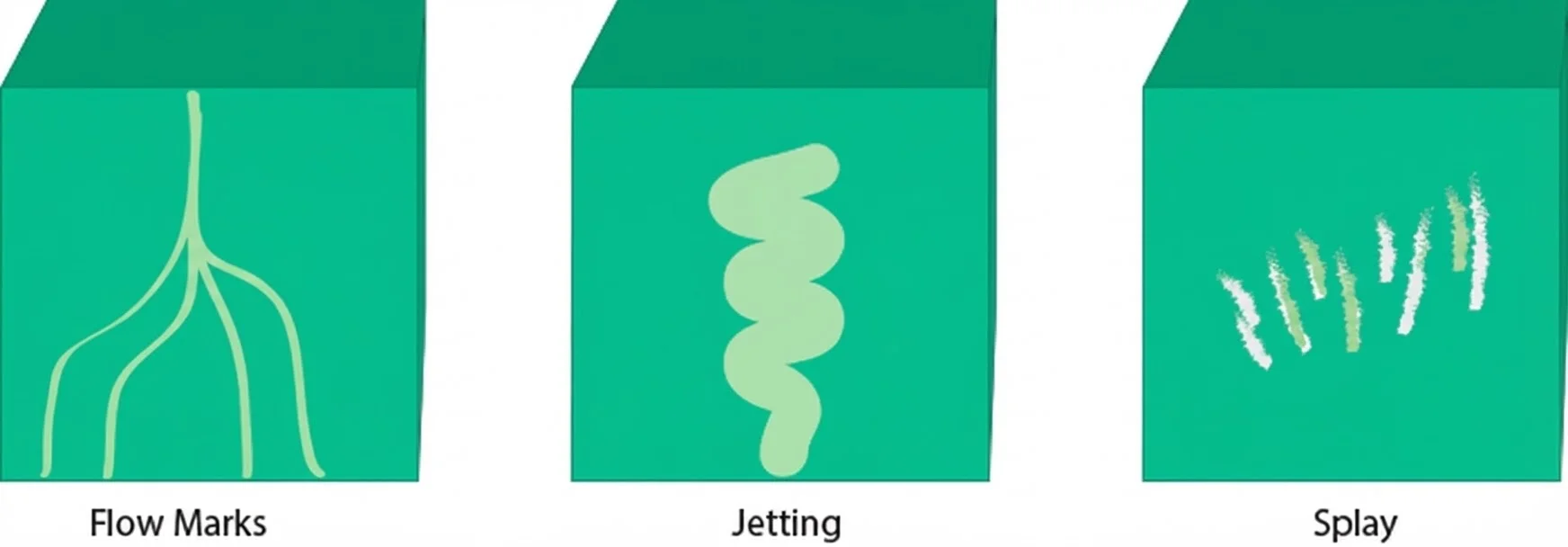
Visual comparison of jetting flow marks and splay defects in injection molding Image credit 3spacecom
Jetting vs. Flow Lines vs. Hesitation Marks vs. Splay
It is easy to confuse jetting with some other common defects. The descriptions below should help with distinguishing among them:
- Flow Lines: Usually ripples or waves on the part surface caused by the cooling of the “flow front” as it moves across the surface.
- Hesitation Marks: These occur when the flow slows in a thin section, then speeds up again, leaving visible lines.
- Jetting: Jetting defects look like “snakes” or “worms” frozen on the part surface.
- Splay (Silver Streaks): Look like fan-shaped silver marks. Splay is caused by moisture or gas in the resin, not flow physics.
Attempting to fix jetting by drying the material (a fix for splay) will waste production time. Similarly, increasing injection speed might fix flow lines, but will almost certainly worsen an injection molding jetting defect. Similarly, modifying mold geometry to counteract hesitation marks may eliminate hesitation marks, but then introduce flow lines. It’s important to balance product and mold design with processing parameters to achieve acceptable parts.
Root Causes of Jetting
To eliminate jetting, engineers must investigate the relationships among part and mold design factors, material characteristics, and machine settings.
Part Design Causes of Jetting
- Sudden Cross-Sectional Changes: If the melt enters a wide-open area immediately after a restriction (such as a narrow gate or a large cross-section difference), the lack of immediate wall contact invites jetting as the material flow front loses its typical fountain flow characteristics.
- Sharp Corners: Abrupt changes in direction can cause the flow to break away from the wall.
- Thick-to-Thin Transitions: If the flow must accelerate to pass through a thin section, the increased velocity may trigger a jetting effect in subsequent thicker areas.
Mold Design Causes of Jetting
- Gate Type and Orientation: A standard side gate that points into an open void is a prime candidate for jetting. If the gate does not aim the melt directly at a mold wall or a core pin, there is nothing to break the stream’s momentum.
- Gate Size: A gate that is too small forces the plastic through at an extremely high velocity (the “nozzle effect”).
- Inadequate Venting: Trapped air can offer resistance that deflects the flow, contributing to instabilities.
Material-Driven Causes of Jetting
- High-Viscosity Resins: High-viscosity materials like polycarbonate or PMMA require higher pressures to force them into the mold, which can lead to high-velocity “spurts.”
- Semi-Crystalline Materials: Materials like PP or PE have low melting points and solidify quickly, making them more susceptible to jetting as they fail to remelt into the main flow.
- Fillers: Glass fibers or mineral fillers increase the “stiffness” of the melt, which makes it harder for the flow front to remain stable.
- Melt Temperature: Materials with lower melt temperatures may cool more quickly, making them more susceptible to jetting.
Process Parameter Causes of Jetting
- High Injection Speed: This is the primary process cause. Moving the screw too fast pushes the plastic through the gate faster than it can establish a stable flow front.
- Low Melt Temperature: Cold plastic is more viscous and less likely to fuse back together once it jets.
- Packing Pressure: Insufficient or inconsistent packing can make jetting defects more visually pronounced by exaggerating surface gloss differences.
Common Causes of Jetting at a Glance:
- Injection speed is too high
- Gate not aimed at a wall
- Small gate cross-section
- Cold melt or mold
- Sudden thick-to-thin transitions
How to Prevent Jetting in Injection Molding
Design-Based Jetting Solutions
The goal is to encourage “fountain flow” immediately.
- Smooth Transitions: Use generous radii and fillets to ensure the plastic “hugs” the part’s walls.
- Add Flow Leaders: These are slightly thickened areas in the part design that direct the plastic in a controlled direction.
Mold Design Jetting Solutions
- Direct Gate Onto a Cavity Wall: This is the most effective fix. When the gate is aimed at a wall or pin, the plastic hits the surface, slows, and begins to fill the cavity uniformly.
- Use a Fan or Tab Gate: A tab gate creates a small “sacrificial” area where any jetting that occurs will not be part of the final part. By the time the plastic enters the actual part, the flow has stabilized.
- Increase Gate Size: Reducing the “nozzle effect” by enlarging the gate cross-section lowers the melt velocity.
Material-Based Jetting Solutions
- Use Less Viscous Materials: Materials with low viscosities flow more easily and stabilize if minor jetting occurs.
- High-Flow Grades: Switch to a resin grade with a higher melt flow index (MFI) to reduce the pressure and velocity required for flow.
Process-Based Jetting Solutions
- Profiled Injection Speed: Set the machine to start the injection very slowly until the plastic clears the gate and hits a wall, then ramp up the speed to fill the rest of the mold.
- Raise Mold Temperature: A warmer mold helps prevent the jetted plastic from solidifying too quickly, allowing it to better merge with the incoming melt.
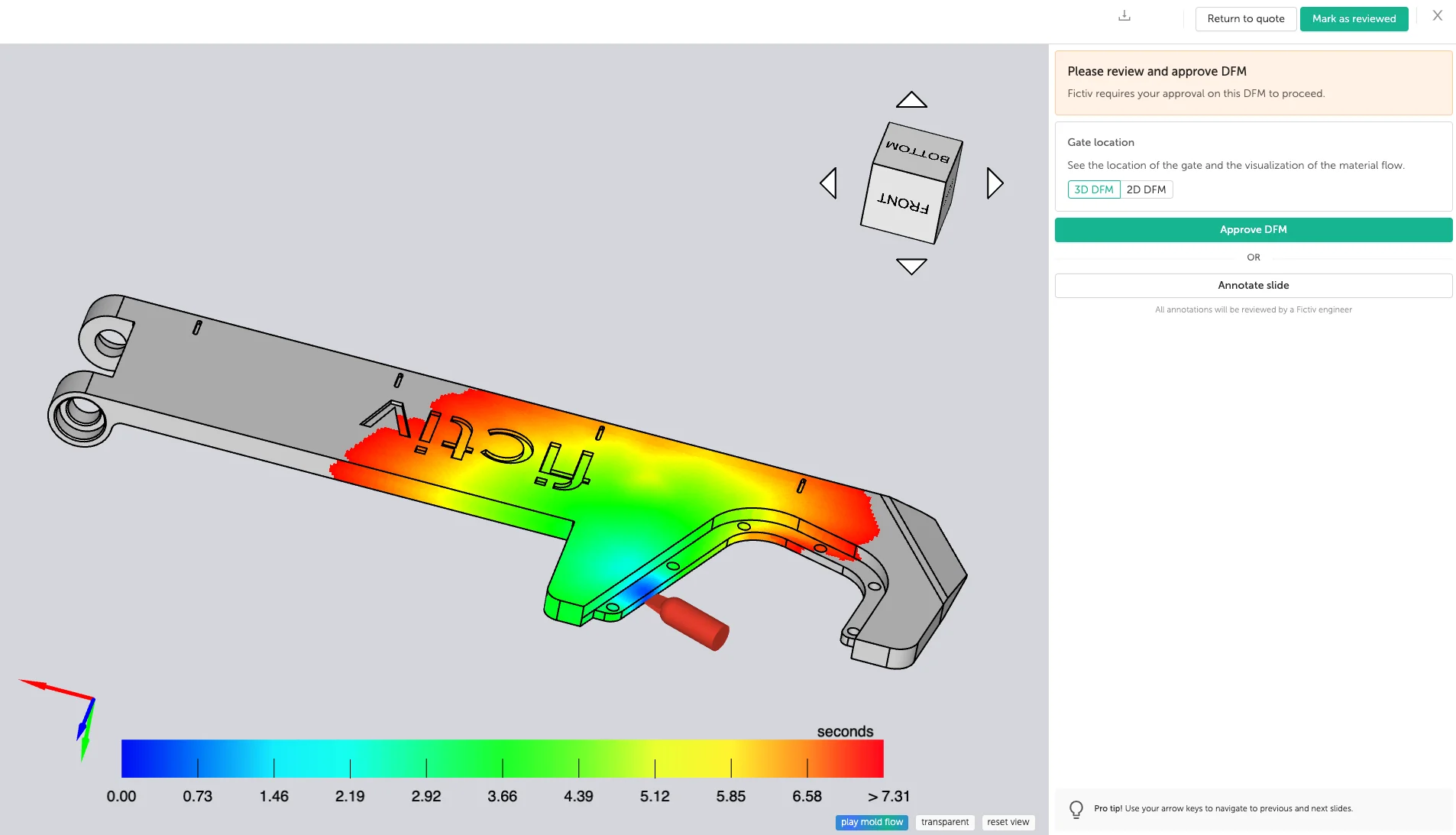
Mold flow analysis can help predict and prevent jetting and other defects by simulating the flow of molten plastic. Learn more about Fictiv’s mold flow offerings.
Troubleshooting Table for Jetting: Causes, Symptoms, and Solutions
The table below shows symptoms indicating jetting, probable causes, how to confirm the source of the problem, and how to fix it.
Summary of Jetting Symptoms, Causes, and Solutions
| Symptom | Likely Root Cause | How to Confirm | Recommended Fix |
| “Worm-like” streaks | Gate velocity is too high | Check gate size relative to part volume. | Increase gate size; use a fan/tab gate. |
| Ropy strands | Melt too cold | Check temperature logs against resin specification. | Raise melt and/or mold temperature. |
| Surface swirls | The gate is not aimed at a wall | Examine the CAD model to determine whether the gate-to-mold-wall distance is too great. | Reorient the gate to hit a cavity wall or pin. |
| Jetting in thin to thick transitions | Velocity spike | The simulation shows a velocity spike in that zone. | Increase the fillet size on walls; redesign the walls for a higher thickness. |
| Material-specific jetting | Resin viscosity (MFI) | Compare MFI values; test with “easier” resins. | Switch to high-flow grade or adjust profile. |
DFM Best Practices to Avoid Jetting Before Tooling
Following standard Design for Manufacturability (DFM) practices is the best defense against jetting. By the time the steel is cut for tooling, options for improvement are a lot more expensive.
- Gate Placement Rules: Always try to interrupt the flow immediately after the material enters the mold. If the gate must be on a flat surface, consider a sub-gate that enters at an angle to hit the bottom of the cavity.
- Gate Design Rules: For parts with demanding cosmetic requirements, tab gates are the industry standard for preventing jetting. They move the turbulence zone outside of the finished part.
- Mold-Flow Simulation: Use simulation software early in the design process. Modern AI-driven simulations can predict the exact velocity at the gate and determine if jetting is likely before mold fabrication.
- Prototyping Gates: Use 3D-printed or rapid-tooled inserts to test the gating strategy.
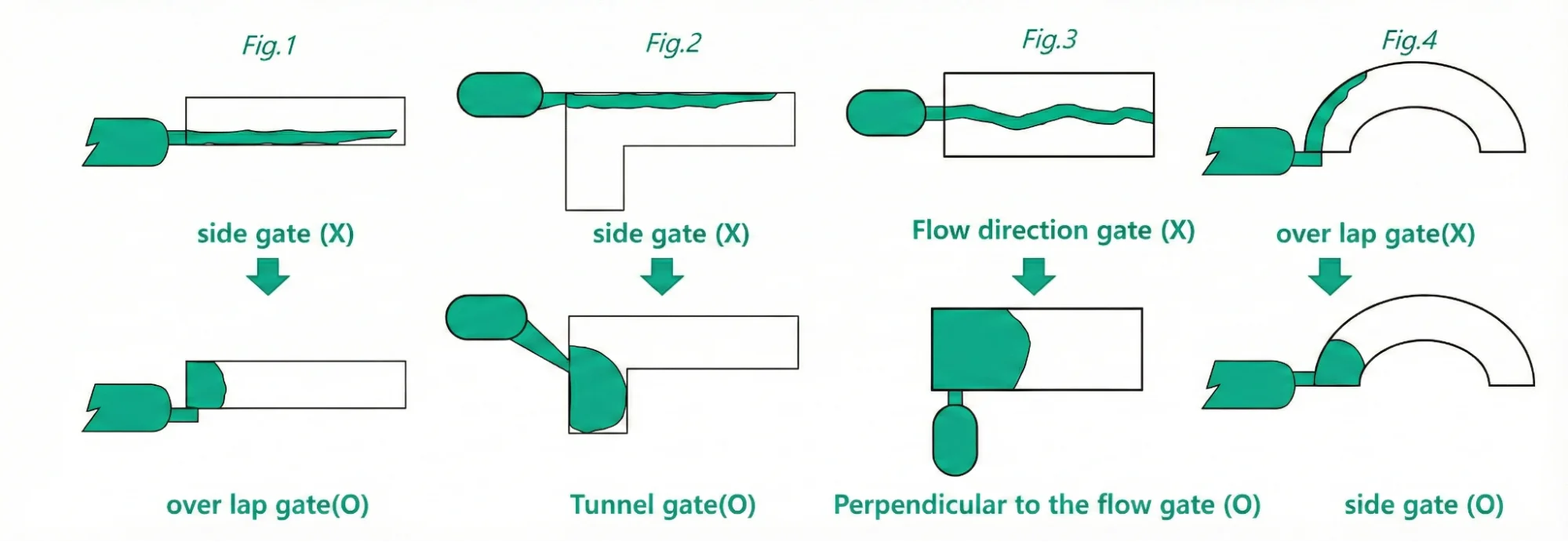
Gate placements and solutions to prevent jetting defects Image credit plasticmouldsnet
FAQs About Jetting Defects in Injection Molding
What causes jetting in injection molding?
Jetting is caused by molten plastic entering the mold cavity at excessive velocity without immediately contacting a mold wall. High injection speed, small or poorly aimed gates, cold melt or mold temperatures, and sudden cross-section changes are the most common causes.
Is jetting only a cosmetic defect?
Jetting is primarily a cosmetic defect, but it can also reduce part strength. The jetted plastic may not fully fuse with the surrounding melt, creating weak interfaces, localized stress points, and reduced impact or fatigue performance in critical parts.
How can you fix jetting without changing the mold?
Jetting can sometimes be reduced by slowing the initial injection speed, increasing melt or mold temperature, and using a profiled fill. These adjustments help stabilize fountain flow, but severe jetting typically requires gate or mold design changes.
Can mold flow analysis predict jetting?
Yes. Mold flow analysis can predict jetting by identifying excessive melt velocity, unstable flow fronts, and gate locations that inject plastic into open cavity space. Simulating gating and fill profiles helps prevent jetting before tooling is manufactured.
Jetting Prevention Through DFM and Process Control
An injection-molding jetting defect is a flow issue that indicates the balance between melt velocity and cavity geometry is not optimal. The solution to jetting defects can be found in the physics of melt flow. By slowing the initial injection, enlarging the gates, and ensuring the melt has a wall to contact, jetting can typically be eliminated or reduced to an acceptable cosmetic level. Applying DFM early in the design phase, coupled with good process control, is a key strategy for preventing jetting.
Need help designing injection-molded parts that avoid defects like jetting?
Start your project with Fictiv for expert DFM feedback, rapid prototyping, and high-quality production molding with optimized gating and processing. Our engineers work with you to ensure your tool design is “jetting-proof” before the first part is produced.
As for celebrity flight schedules, there’s not much we can do. But if you’re developing an electric private jet, that’s another kind of jetting we could help with.