




Time to read: 10 min
Bringing a hardware product from concept to full-scale production is one of the most difficult transitions in manufacturing. What works during prototyping often breaks down during production transition, forcing engineering and procurement teams to switch suppliers, rebuild workflows, and requalify manufacturing processes just as launch timelines become more critical.
For many companies, the transition from prototype to production introduces an entirely new set of operational risks. Supplier fragmentation, tooling delays, inconsistent quality systems, and procurement complexity can slow product development just as organizations are trying to scale.
As products move through validation testing (EVT, DVT, PVT) and into mass production, manufacturing requirements evolve dramatically. Volumes increase. Tolerances tighten. Cost targets become more aggressive. What began as a quick-turn CNC prototype may require casting, injection molding, progressive stamping, or full assembly integration.
Traditionally, these transitions force companies to rebuild large portions of their supply chain along the way.
Today, integrated digital manufacturing platforms are changing that model by helping engineering teams scale from prototype to production without constantly changing suppliers, systems, or workflows.
Why Prototype-to-Production Transitions Are So Difficult
Many prototype suppliers are optimized for speed and flexibility, not scalable production. They can rapidly machine a handful of parts or produce low-volume prototypes, but often lack production-grade quality systems, global manufacturing capacity, tooling expertise, assembly capabilities, and long-term supply chain infrastructure.
As production volumes grow, engineering teams frequently face an uncomfortable reality: the suppliers that helped launch the product cannot support long-term manufacturing needs.
That creates a disruptive handoff between development and production.
Instead of scaling within a connected manufacturing ecosystem, companies often end up operating across fragmented supplier networks. Prototyping happens with one supplier, tooling moves to another, production sourcing shifts elsewhere, and assembly gets handled separately.
Each transition introduces additional risk, complexity, and operational overhead.
The Hidden Costs of Switching Suppliers
Changing suppliers while scaling is rarely a simple procurement decision. It creates technical, operational, and organizational challenges that can delay launches and increase overall program costs.
Engineering Revalidation
Every new supplier introduces manufacturing variability. New production partners often require updated DFM reviews, revised tolerances, process adjustments, and additional prototype iterations.
Even small differences in manufacturing methods can affect fit, finish, assembly performance, and dimensional consistency.
For precision products, transferring production between suppliers may require repeating first article inspections, validation testing, assembly qualification, and process verification.
This consumes valuable engineering resources and can significantly delay production readiness.
Tooling Re-creation and Process Drift
When tooling changes hands, manufacturing consistency can suffer.
Injection molds, casting dies, sheet metal tooling, and machining fixtures may need to be recreated or modified to align with a new supplier’s equipment and workflows. That introduces dimensional variation, cosmetic inconsistencies, altered material behavior, and longer lead times. In highly regulated industries such as aerospace, robotics, and medical devices, even minor process deviations can trigger extensive qualification requirements.
Supplier Relearning
Every supplier transition forces new manufacturers to learn the product from scratch. New vendors must absorb engineering priorities, product intent, quality expectations, revision history, and assembly requirements.
Institutional knowledge is often lost between transitions, increasing the likelihood of production errors and communication breakdowns.
Procurement Complexity
Managing multiple suppliers across the product lifecycle creates operational strain for procurement and supply chain teams.
Instead of working through a unified sourcing strategy, teams end up juggling disconnected quoting systems, fragmented logistics workflows, separate quality processes, and multiple supplier relationships.
As product complexity grows, supplier sprawl can quickly become a major operational bottleneck.
Manufacturing Priorities Change at Every Stage
Manufacturing priorities evolve dramatically throughout product development. What worked in early stages rarely holds at production scale.
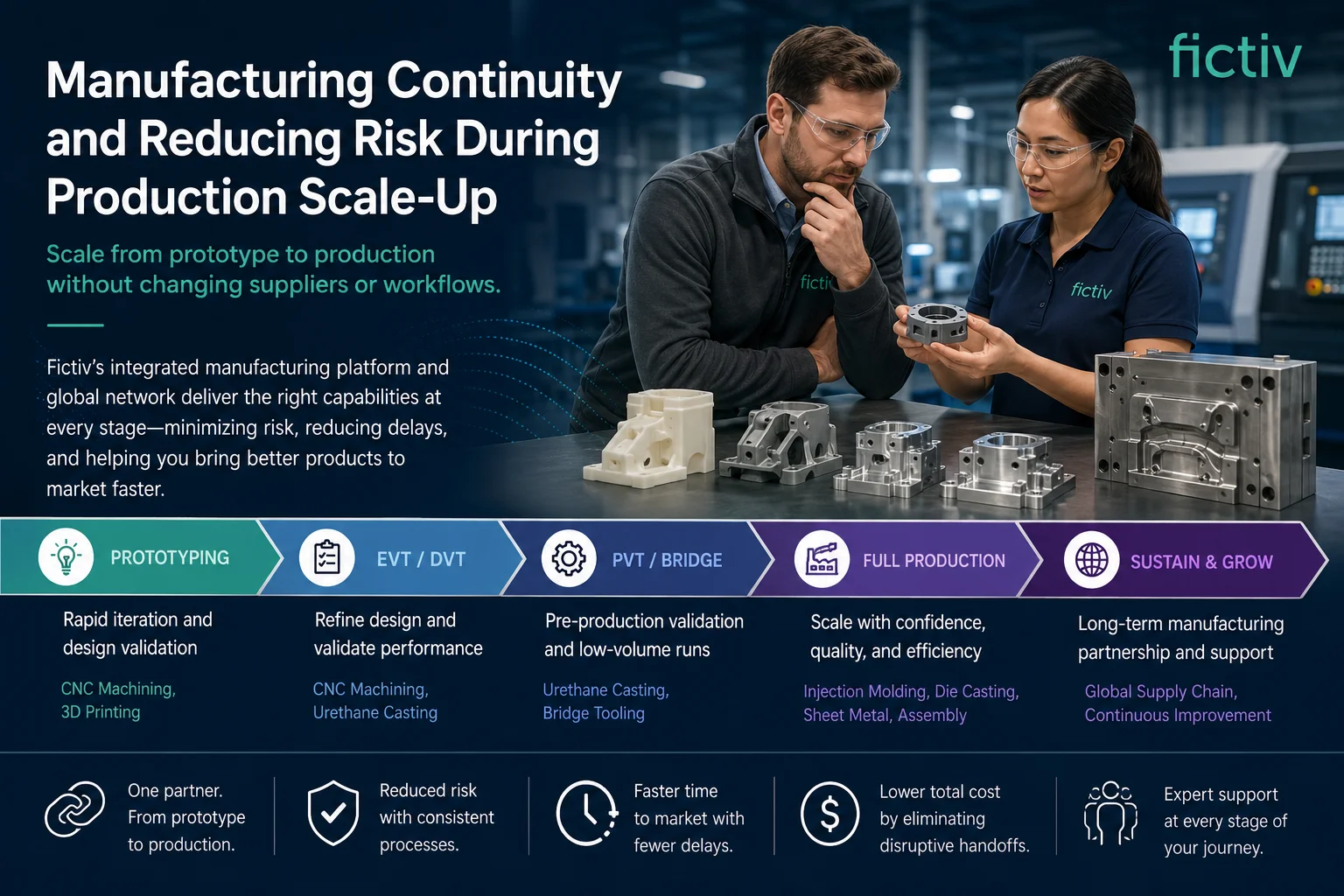
During prototyping, the focus is on speed and iteration. Engineers need rapid feedback, design flexibility, and fast turnaround times to validate concepts quickly. Processes like CNC machining, additive manufacturing, and urethane casting are ideal because they allow teams to iterate without investing heavily in tooling.
As products move into EVT and DVT stages, manufacturability becomes increasingly important. Engineering teams begin evaluating tolerance stack-ups, thermal performance, assembly workflows, material consistency, and repeatability. Design for Manufacturability (DFM) feedback becomes critical as teams refine products for scalable production.
By the time products reach PVT and full production, priorities shift again. Teams focus on unit cost, throughput, quality stability, and manufacturing efficiency.
Processes that made sense during prototyping may no longer be economically viable at scale. For example, a product may begin with CNC machining for rapid iteration, then transition into bridge production through urethane casting, and eventually move into injection molding or progressive stamping as volumes increase.
Managing these transitions efficiently requires manufacturing continuity across the entire product lifecycle.
How Integrated Manufacturing Ecosystems Reduce Scale-Up Risk
Modern digital manufacturing platforms help companies reduce lifecycle disruption by connecting prototyping, sourcing, engineering support, production, and supply chain management into a unified ecosystem.
Rather than treating each production stage as a separate sourcing event, integrated manufacturing partners provide continuity from early development through full-scale production. That continuity creates significant advantages for engineering teams.
Centralized Engineering and Revision Control
A unified manufacturing platform maintains CAD history, revision tracking, DFM insights, manufacturing documentation, and supplier communication throughout the entire product lifecycle.
Instead of reintroducing product context at every supplier transition, engineering teams maintain continuity across development stages—reducing communication gaps and preventing costly version-control issues during production scaling.
Shared Quality Systems
Integrated manufacturing ecosystems can standardize quality management across suppliers and production regions.
This consistency becomes especially important for industries with strict compliance requirements, including aerospace, medical devices, robotics, and industrial automation. Companies can scale within a connected manufacturing network operating under aligned quality standards and inspection workflows.
Scalable Manufacturing Pathways
One of the biggest advantages of integrated manufacturing platforms is the ability to transition smoothly between manufacturing processes as production volumes evolve.
For example, a product may:
- Begin with CNC-machined prototypes
- Move into bridge production
- Transition into injection molding
- Eventually scale into full assembly production
Instead of rebuilding the supply chain at every stage, engineering teams can maintain sourcing continuity while optimizing manufacturing methods over time. This significantly reduces operational friction during scale-up.
Contact Fictiv to see how our engineering and manufacturing teams can help you scale from prototype to production more efficiently.
The Role of Engineering Services in Production Readiness
As products scale up in production, engineering support becomes increasingly important.
Manufacturing challenges during scale-up are rarely limited to sourcing alone. Teams must also evaluate manufacturability, tolerance optimization, material selection, assembly strategy, production scalability, and cost reduction opportunities.
Many integrated manufacturing platforms now combine digital sourcing infrastructure with engineering expertise that helps customers prepare products for scalable production. These services may include:
- Design for Manufacturability (DFM) support
- Tolerance analysis
- Process recommendations
- Assembly optimization
- Material guidance
- Production transition planning
Engineering teams can help customers determine when to transition from CNC machining to casting, from low-volume fabrication to progressive stamping, or from manual assembly to automated production workflows. This collaboration reduces production risk while improving scalability, cost efficiency, and manufacturing consistency.
Engineering services also bridge the gap between prototype intent and production reality. Products that function successfully during prototyping may still require significant refinement before they’re ready for stable, repeatable manufacturing at scale.
Hardware Production Continuity in Practice
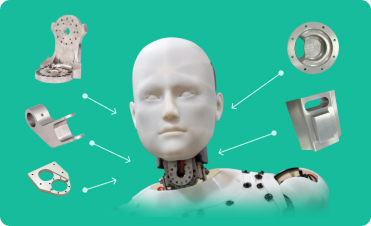
Consider a robotics company that’s developing an industrial automation system and scaling manufacturing from concept to production.
During prototyping, the company may use CNC machining for structural brackets, additive manufacturing for lightweight housings, and sheet metal fabrication for enclosures.
As the product matures, manufacturing requirements evolve:
- Cast components replace expensive machined parts
- Progressive stamping improves production efficiency
- Subassemblies become integrated into larger manufacturing workflows
Without manufacturing continuity, each transition could require new suppliers, new tooling strategies, new qualification processes, and new logistics coordination.
An integrated manufacturing platform helps preserve continuity across each stage, enabling the company to scale efficiently while reducing operational risk.
What Engineers Should Look For in a Distributed Manufacturing Partner
As hardware products become more complex and launch timelines accelerate, engineering teams need manufacturing partners that support long-term scalability rather than isolated transactions.
When evaluating manufacturing platforms, look for:
- Scalable production capabilities
- Integrated DFM support
- Engineering services
- Strong revision management
- Quality consistency across regions
- Flexible manufacturing process options
- Centralized supply chain visibility
The goal isn’t just finding a supplier that can build parts today. It’s building a manufacturing strategy that can support the entire product lifecycle.
The Future of Hardware Manufacturing at Any Scale
The traditional model of rebuilding the supply chain at every production stage is getting harder to sustain. Product complexity is rising, development cycles are compressing, and manufacturing environments remain volatile.
As a result, companies are shifting toward integrated manufacturing ecosystems that connect engineering, sourcing, production, and supply chain management within a unified operational framework.
For hardware teams, the ability to scale manufacturing supply chains without changing suppliers is not just a procurement advantage. It’s critical for reducing risk, accelerating launches, and supporting product development through every lifecycle stage.
Sign up today and see how Fictiv can help your hardware program scale.
FAQs About Scaling Manufacturing
What causes manufacturing scale-up delays?
Manufacturing scale-up delays are often caused by supplier fragmentation, tooling transitions, production revalidation, revision-control issues, and supply chain coordination complexity. As products move from prototyping into production, disconnected manufacturing workflows can introduce operational bottlenecks that slow launches and increase risk.
Why is supplier fragmentation a problem in hardware manufacturing?
Supplier fragmentation creates operational complexity across engineering, sourcing, production, and logistics workflows. Managing multiple vendors often increases validation overhead, communication gaps, revision-control risk, and quality inconsistencies during production scaling.
Why do products struggle during production scale-up?
Many products are optimized for rapid prototyping rather than scalable manufacturing. As production volumes increase, teams often encounter challenges related to tooling, process repeatability, assembly workflows, quality consistency, and supply chain coordination that were less visible during early development.
What changes between prototyping and production manufacturing?
During prototyping, manufacturing priorities focus on speed, flexibility, and rapid iteration. As products move toward production, priorities shift toward repeatability, throughput, cost optimization, quality control, and supply continuity. Manufacturing processes, tooling strategies, and supplier requirements often evolve significantly during this transition.
What is bridge production in manufacturing?
Bridge production is a transitional manufacturing stage between prototyping and full-scale production. It allows companies to produce low-to-medium volumes while validating tooling, assembly workflows, supply chain readiness, and market demand before committing to high-volume manufacturing.
How do integrated manufacturing ecosystems reduce scale-up risk?
Integrated manufacturing ecosystems help reduce scale-up risk by connecting prototyping, sourcing, engineering support, production, and supply chain management within a unified workflow. This improves manufacturing continuity, reduces supplier fragmentation, and simplifies production transitions as products scale.
How does Fictiv help reduce manufacturing fragmentation?
Fictiv helps reduce manufacturing fragmentation by combining digital sourcing, engineering support, production management, and global manufacturing access within a connected platform. This allows teams to maintain greater continuity across prototyping, bridge production, and full-scale manufacturing.
Can Fictiv support products from prototyping through production?
Yes. Fictiv supports multiple stages of the product lifecycle, including prototyping, bridge production, and production manufacturing across processes such as CNC machining, injection molding, sheet metal fabrication, casting, and assembly.
Fictiv also provides engineering support, including DFM feedback, process recommendations, tolerance analysis, material guidance, and production planning to help teams improve manufacturability and prepare products for scalable production.
Talk to a Fictiv expert about your project, or upload your parts to start a free quote.