





Time to read: 4 min
U.S. manufacturing output hits $2.91 trillion. Now it needs 3.8 million more workers.
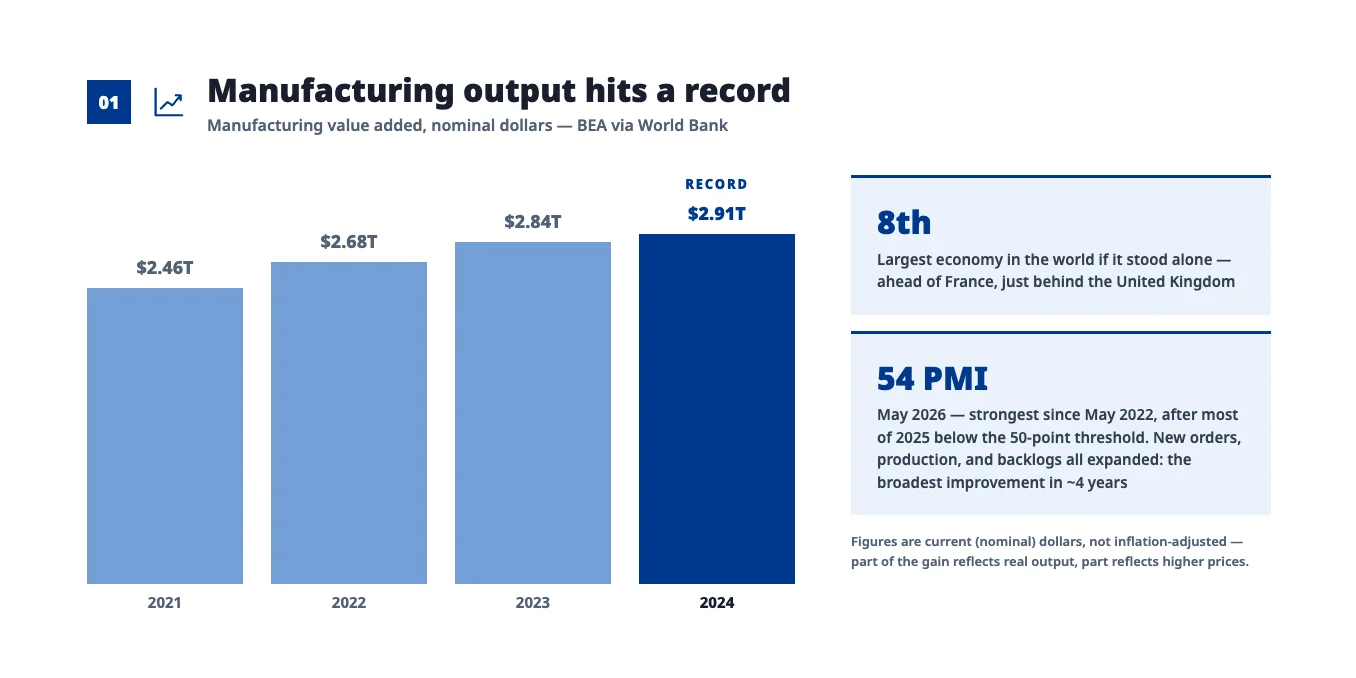
If American manufacturing were a standalone economy, it would be the 8th largest in the world — ahead of France, just behind the United Kingdom. In 2024, U.S. manufacturing value added reached $2.91 trillion, an all-time record in nominal dollars. And the momentum hasn’t stopped: the ISM Manufacturing PMI hit 54 in May 2026, its strongest reading since 2022, with new orders, production, and backlogs all expanding at once — the broadest improvement in roughly four years.
But underneath the record numbers sits a constraint that no amount of capital can buy its way out of: American manufacturers will need 3.8 million new workers by 2033 — and without intervention, half of those roles could go unfilled.
Here’s the full picture, in the numbers that matter.
A Record Year for Output
Manufacturing value added has climbed every year since 2021 — from $2.46 trillion to the 2024 record. These are nominal (current-dollar) figures, so part of the gain reflects higher prices, but the trendline is unambiguous: American factories are producing more value than at any point in history.
U.S. Manufacturing Value Added
Source: BEA via World Bank
The Factory Construction Boom
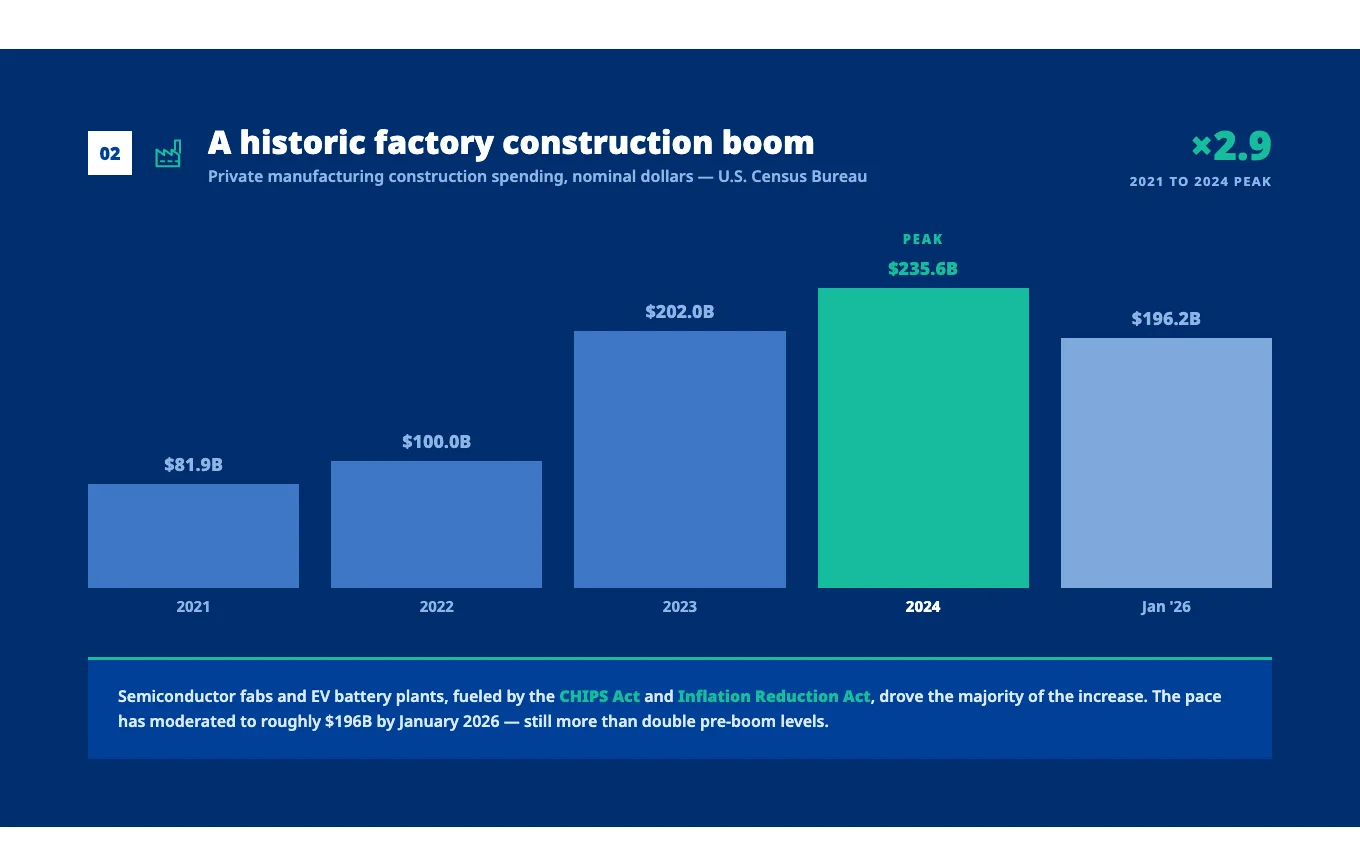
Private factory construction spending peaked at $235.6 billion in 2024 — nearly triple the 2021 average of $81.9 billion. Semiconductor fabs and EV battery plants, fueled by the CHIPS Act and the Inflation Reduction Act, drove the majority of the increase. Even after moderating to roughly $196 billion by January 2026, spending remains more than double pre-boom levels.
Private Manufacturing Construction Spending
Source: U.S. Census Bureau
The World is Betting on American Manufacturing
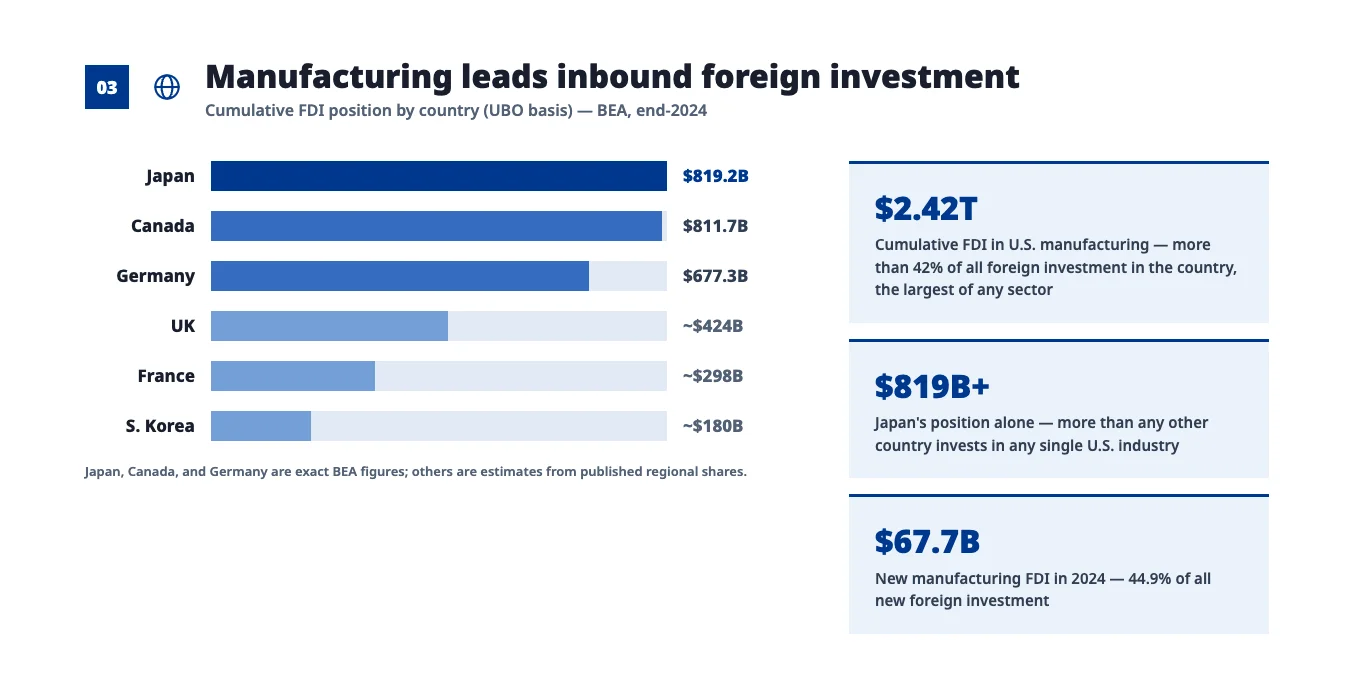
Manufacturing is the single largest sector for foreign direct investment in the United States: $2.42 trillion at the end of 2024, more than 42% of all FDI. Japan leads with an $819.2 billion position — more than any other country invests in any single U.S. industry. In 2024 alone, new manufacturing FDI totaled $67.7 billion, nearly 45% of all new foreign investment.
Top Investors In U.S. Manufacturing
Source: BEA, end-2024 · UK figure estimated from published regional shares
A Decade of Reshoring Momentum
More than 2 million reshoring and FDI jobs have been announced since 2010, including a record 364,000 in 2022. Roughly 1.7 million of those jobs have already been filled as of 2025. And the work coming back isn’t yesterday’s manufacturing: 88% of 2024 announcements were in high or medium-high tech industries such as semiconductors, electronics, and EVs.
The Gap That Will Define the Decade
All of that investment is now bumping into a problem it can’t buy its way out of. Per the Manufacturing Institute and Deloitte, U.S. manufacturers will need 3.8 million new workers by 2033. Some 2.8 million of that need is expected to come from retirements alone — replacing the workforce, not just expanding it. Without intervention, 1.9 million of those roles could go unfilled.
3.8M Total Workers Needed 2024–2033
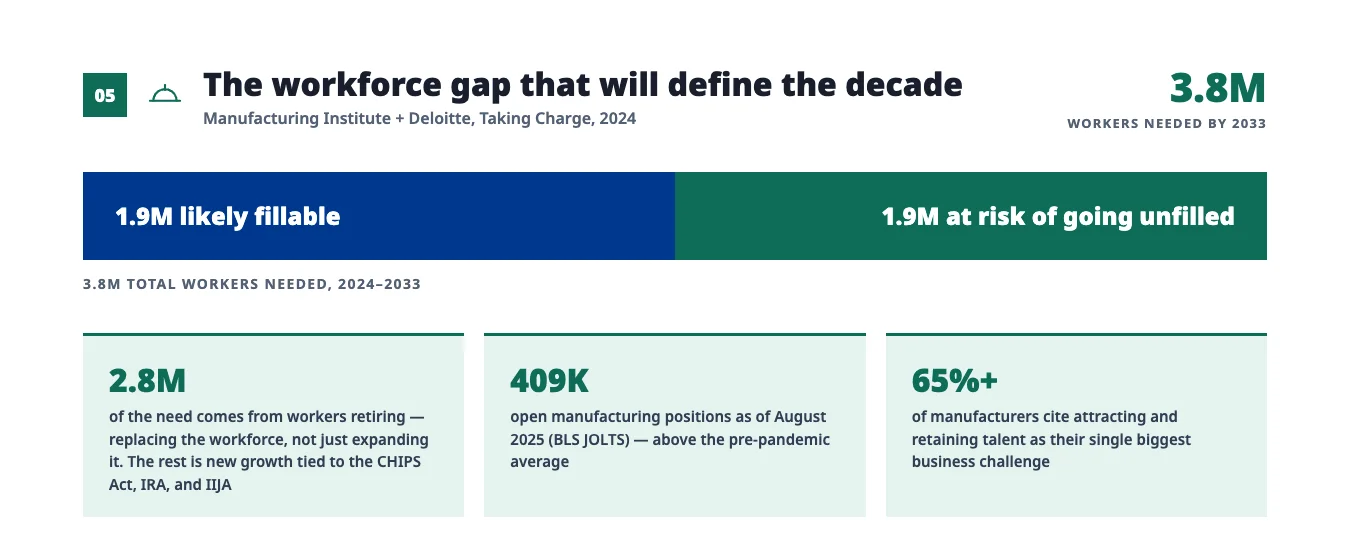
Source: Manufacturing Institute + Deloitte, Taking Charge, 2024
The pressure is already visible: 409,000 manufacturing positions sit open right now (BLS JOLTS, August 2025), and 65% of manufacturers say attracting and retaining talent is their #1 business challenge — ahead of supply chain, costs, and demand.
A Workforce Already Responding
The next generation is showing up. Enrollment at high-vocational community colleges is up nearly 20% since Spring 2020, and undergraduate certificate programs have grown four consecutive years — up 28.5% versus 2019. Students are choosing faster, skills-focused pathways into the trades. But total enrollment remains under one million nationwide — a fraction of what the industry must recruit and train by 2033. The pipeline is moving in the right direction; it needs to move faster, and reach deeper into advanced, specialized skills that take years to build domestically but already exist abroad.
The Legislative Response: H.R. 9097
That’s the thinking behind the American Manufacturing Revitalization Exchange Program Act of 2026 (H.R. 9097), introduced by Rep. Bill Huizenga (R-MI). The bill would place American workers and students in allied nations — like Japan, Germany, and South Korea, the three largest sources of manufacturing FDI — for 6–12 months of hands-on training in robotics, semiconductors, and automotive manufacturing. Participants receive a full stipend covering housing, travel, healthcare, visa fees, and training materials, and earn industry-recognized credentials on completion. The knowledge comes home to U.S. factory floors.
“The next constraint isn’t capital. It’s having enough people with the right advanced skills to run these new facilities at full capacity. H.R. 9097 builds directly on that momentum — sending workers to learn from the countries that have spent decades perfecting advanced manufacturing training, and bringing that expertise home.”
— Dave Evans, President and CEO, MISUMI Americas; CEO, Fictiv
The bill is supported by the National Association of Manufacturers, the Manufacturing Institute, United Steelworkers, IEEE-USA, BMW Group, the American Automotive Policy Council, LIFT, the Alliance for International Exchange, Automation Alley, and the Additive Manufacturing Coalition. It is pending before the House Committee on Foreign Affairs.
The Bottom Line
Record output. Record investment. One constraint: people. As Filip Aronshtein, co-founder and CEO of Dirac, puts it: “You can ship machines across an ocean, but you can’t ship know-how. That has to be learned, captured, and passed down.”
American manufacturing has the orders, the factories, and the capital. The next decade will be decided by how fast it can build the workforce to match.
Read the full data report: The Rise of U.S. Manufacturing
Sources: BEA via World Bank · ISM May 2026 PMI Report · U.S. Census Bureau · BEA Direct Investment by Country and Industry 2024 · Reshoring Initiative Annual Reports · Manufacturing Institute + Deloitte, Taking Charge 2024 · BLS JOLTS August 2025 · National Student Clearinghouse Research Center · H.R. 9097, 119th Congress
Get a free quote for domestic manufacturing on the Fictiv platform