




Time to read: 11 min
The electric vertical takeoff and landing (eVTOL) industry has moved quickly from concept development to aircraft certification and early commercial operations. As development teams transition from prototype builds to scalable production, manufacturing decisions become increasingly important. These aircraft systems must meet demanding requirements for weight, safety, certification, reliability, and production efficiency.
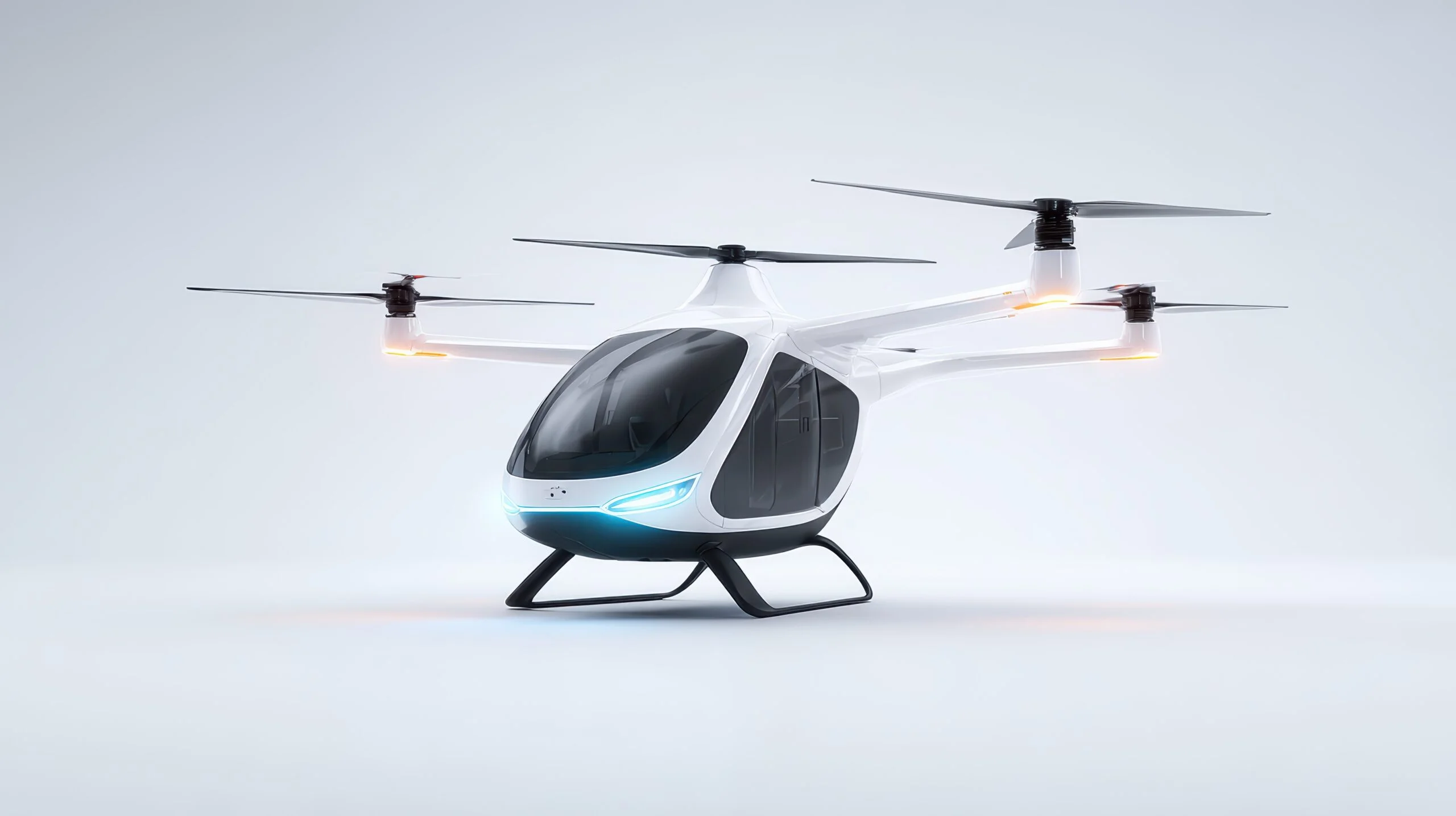
Component Categories Used in eVTOL Aircraft
Many eVTOL aircraft components are developed as custom parts, while others can be sourced as commercially available hardware for aerospace applications.
Strategic Sourcing Matrix for eVTOL Components
| Component Category | Typically Custom? | Common Manufacturing Processes |
| Airframe structures (bulkheads, spars, frames) | Yes | 5-axis CNC machining, composite layup |
| Battery enclosures and thermal management components | Yes | CNC machining, sheet metal fabrication, aluminum extrusions |
| Electric propulsion housings and mounts | Yes | CNC machining, precision casting |
| Landing gear components | Yes | CNC machining, sheet metal fabrication, forging |
| Avionics housings | Varies | CNC machining, injection molding |
| Fasteners and structural hardware | No | Cold heading, thread rolling, heat treatment, surface coating (NAS/MS standards) |
| Bearings, bushings, and rod ends | No | Precision machining, grinding, heat treatment (qualified commercial off-the-shelf (COTS) aerospace components) |
| Electrical connectors and wiring harnesses | No | Connector molding, crimping, cable assembly (aerospace-qualified standards) |
| Avionics and sensors | No | Electronic assembly, PCB manufacturing, environmental qualification testing (commercial off-the-shelf (COTS), DO-160 qualified) |
| Interior and passenger compartment components | Varies | Injection molding, composite fabrication |
Standard Components Commonly Used in eVTOL Aircraft
Most eVTOL manufacturers rely on qualified off-the-shelf hardware for several component categories.
Aerospace-Qualified Fasteners and Hardware
Design engineers typically use standard aerospace fasteners unless a specific application requires a custom solution. National Aerospace Standard (NAS) and Military Standard (MS) fastening hardware (such as bolts, rivets, inserts, and self-clinching hardware) are backed up by extensive fatigue data, material traceability records, and documented performance in aerospace applications.
Standard hardware can simplify certification because its materials, manufacturing processes, and performance characteristics are already documented. Custom fasteners are not recommended as they’re more likely to require additional design, testing, and qualification work. Standard systems also incorporate established corrosion-control measures and validated fit-and-tolerance requirements for mating components.
Bearings, Bushings, and Motion Components
Standard commercial bearings, bushings, rod ends, and other motion-control components are supported by published load ratings, fatigue life data, and supplier qualification documentation. Custom solutions may be necessary for unusual packaging or operating requirements, but commercial off-the-shelf (COTS) components are often preferred for their predictable lead times, second-source availability, and established qualification records.
Electrical Connectors and Avionics Systems
Wiring harnesses, connectors, sensors, GPS systems, and flight-control hardware are commonly sourced as COTS components. Aerospace-qualified connectors are often tested to RTCA DO-160 environmental standards, which cover vibration, temperature, humidity, electromagnetic interference (EMI), and other operating conditions.
A similar approach is often used for avionics. Custom flight-control systems can introduce significant development and certification requirements under standards such as DO-178C, while established COTS platforms may offer a more straightforward path to qualification and long-term support.
Custom-Manufactured eVTOL Aircraft Components
Many of the custom-engineered components in an eVTOL aircraft are found in areas where structural performance, thermal management, packaging constraints, or aerodynamic requirements are highly specific to the platform. While some commercially available components satisfy these requirements, aircraft manufacturers develop custom solutions when off-the-shelf options cannot meet design objectives efficiently.
Structural Airframe Components
Battery weight is a major driver of structural design in eVTOL aircraft. Meeting strength, stiffness, and fatigue-life requirements is essential, but every kilogram added to the airframe can reduce payload capacity or operational range. As a result, structural components such as bulkheads, frames, spars, brackets, and load-transfer fittings (components that distribute forces between structural members) are often designed specifically for the aircraft platform.
Battery Enclosures and Thermal Management Components
Battery thermal management is one of the most demanding engineering challenges in electric aviation. Although simulation and thermal analysis tools provide valuable insights during development, predicting real-world battery behavior is difficult because thermal performance depends on factors including operating conditions, charging cycles, environmental temperatures, airflow patterns, manufacturing variation, and potential fault scenarios.
An enclosure that simply houses battery cells is not sufficient. The system must remove heat during normal operation, help prevent thermal runaway propagation (TRP) between cells during failure events, and provide structural support while minimizing overall weight.
Custom battery-management components may include cooling plates, fluid manifolds, cell trays, and protective enclosures. In many designs, a single component performs multiple functions. For example, a cooling plate may also contribute to structural support, while a fluid manifold may incorporate both internal flow channels and mounting features.
Electric Propulsion System Components
Distributed electric propulsion, using multiple motors and rotors positioned across the airframe, is a defining feature of many eVTOL configurations. While this approach offers aerodynamic and operational advantages, it also creates demanding requirements for propulsion-system components.
Motor housings, rotor mounts, propeller hubs, and gearbox housings are frequently designed specifically for each aircraft platform. Motor air gaps can range from 0.5 to 1.5 mm, while rotor balance requirements are strict due to the effects of excessive vibration on performance, passenger comfort, component life, and long-term airframe durability.
Material selection varies by application. Aluminum alloys are commonly used for motor housings because of their strength-to-weight ratio and thermal conductivity. Titanium is often selected for highly loaded fittings, while advanced polymers are used where electrical isolation, corrosion resistance, or weight reduction are priorities.
How to Decide Between Custom and Standard eVTOL Components
The decision to include a custom component in an eVTOL bill of materials rather than a standard one isn’t arbitrary. Making the right choice early in the product development phase is what keeps a program on schedule.
Performance and Weight Requirements
If the performance envelope, range, payload, acoustic signature, or thermal duty cycle demands a component that doesn’t exist in a catalog, that part must be custom-designed. If a standard component meets the requirements with a safety margin, it can be used. The engineering hours saved on standard parts can go toward the parts that need them.
Certification Considerations
In the eVTOL sector, certification is a primary gatekeeper to commercial viability. Every custom part requires its own qualification record, including structural analysis, test data, material traceability, and manufacturing process documentation. Standard components certified under established aerospace standards often arrive with much of this documentation already available, which can reduce downstream certification workload.
Under the European Union Aviation Safety Agency (EASA) Special Condition for VTOL (SC-VTOL) rules and the Federal Aviation Administration (FAA) Special Class certification framework or power-lift certification rules in the United States, aircraft certification relies heavily on demonstrating compliance through documented analysis, testing, and supplier qualification.
Changing a component late in the design or verification phase can still introduce significant rework, regardless of direction. Replacing a custom component with a standard one may require re-evaluation of interfaces, loads, and system behavior. Conversely, replacing a selected standard component with a custom alternative typically has a larger impact since it may require additional testing and analysis to re-establish compliance. In both cases, late-stage changes can trigger partial requalification of the affected system and updates to the associated certification documentation.
Supply Chain Scalability
Single-source custom components carry real production schedule risk. The specialty materials specified for custom parts can come with long lead times. If production volume capacity can’t be expanded fast enough, a second source may be needed—and qualifying new sources takes time many programs can’t absorb
Standard components reduce these risks. They can be obtained from multiple qualified distributors with predictable lead times, and offer plenty of production capacity when additional manufacturing volume is needed.
Manufacturing Processes for eVTOL Components
The right choice for a given part depends on its geometric complexity, tolerance requirements, materials, and the program’s position in its development cycle (prototype vs. series production, for example).
CNC Machining
5-axis CNC machining can handle complex organic aircraft geometries, tight tolerances, and a range of materials and finishes from prototype through low-volume production.
Sheet Metal Fabrication
Sheet metal fabrication processes such as laser cutting, forming, and welding are suited to manufacturing of battery enclosures, covers, brackets, and lightweight structural assemblies. The process enables fast design iteration at a reasonable cost, which matters when the enclosure geometry is still evolving.
Injection Molding
Injection molding is commonly used for interior components, polymer housings, and other plastic parts produced at production-scale volumes. Bridge tooling can support earlier development phases before investment in full production tooling is justified by anticipated manufacturing volumes.
Additive Manufacturing / 3D Printing
Additive manufacturing, or 3D printing, is particularly valuable for rapid design iteration and components that would otherwise require multiple parts and assembly steps using conventional manufacturing methods. Additive manufacturing enables intricate, lightweight topologies like lattice-filled brackets and internal cooling geometries.
However, 3DP/AM introduces unique airworthiness hurdles. Process qualification—specifically for powder-bed fusion (PBF) or DMLS—is more intensive than conventional machining. For flight-critical structural components, manufacturers must demonstrate material consistency across build plates, validate residual stress levels, and perform rigorous non-destructive inspection (NDI) to satisfy certification authorities.
Composite Fabrication
Carbon fiber-reinforced polymer (CFRP) and other composite materials are used where high stiffness and low weight are priorities—including eVTOL airframe structures, rotor blades, fairings, and interior panels.
Composite layup processes—including prepreg layup with autoclave cure and resin transfer molding (RTM/VARTM)—allow fiber orientation and laminate thickness to be tailored to specific load paths, which is especially valuable in weight-critical applications
Choosing the Right Manufacturing Partner for eVTOL Components
Manufacturing considerations are most effective when incorporated early in the design process, while component geometries, material selections, tolerances, and production strategies can still be adjusted with less impact. Early collaboration between engineering and manufacturing teams can help mitigate manufacturability concerns and avoid costly redesigns later in development.
When evaluating a manufacturing partner, look for AS9100-certified quality, strong design-for-manufacturability (DFM) capabilities, and experience supporting multiple manufacturing processes under a coordinated supply chain strategy.
Fictiv provides CNC machining, sheet metal fabrication, and injection molding services through a single manufacturing platform. Its global supply chain network supports both rapid prototyping and production-scale manufacturing, allowing teams to move from development to production without transitioning between multiple suppliers.
Start a free manufacturing quote for your eVTOL aircraft components.
eVTOL Manufacturing FAQs
What is the difference between custom and standard components in eVTOL aircraft?
The distinction is primarily driven by the performance-to-certification trade-off. Custom components are essential where structural, thermal, or aerodynamic requirements exceed the design envelope of catalog items (e.g., motor housings, load-bearing bulkheads). Standard components (NAS/MS hardware, COTS avionics) are used wherever possible to leverage existing qualification records, thereby reducing the certification burden and supply chain volatility.
Why is battery thermal management so challenging in eVTOL aircraft?
Battery thermal management is a physics challenge requiring high-precision thermal dissipation and fault containment. The system must manage extreme heat flux during charging and discharge cycles, facilitate structural rigidity, and — critically — mitigate thermal runaway propagation (TRP). This is rarely achievable with generic off-the-shelf housings, necessitating custom cooling plates and manifolds that often serve as both structural and thermal interfaces.
How do eVTOL manufacturers approach certification for custom components?
Each custom part requires its own qualification record, including structural analysis, material traceability, test data, and manufacturing process documentation. Under EASA SC-VTOL and the FAA’s applicable certification framework — either the Special Class basis under 14 CFR Part 21.17(b) for earlier programs, or the powered-lift category rules finalized in October 2023 under 14 CFR Parts 21, 27, and 29 for newer ones — compliance must be demonstrated through documented analysis and testing. Using standard aerospace components where possible reduces this workload, since much of the qualification documentation already exists.
What manufacturing processes are most commonly used for eVTOL components?
The most common processes are 5-axis CNC machining for structural and propulsion components, sheet metal fabrication for enclosures and brackets, injection molding for interior and polymer parts, additive manufacturing (3D printing) for complex geometries and rapid iteration, and composite layup for weight-critical structural panels and rotor blades. Most programs use a combination across the bill of materials depending on geometry, material, and production volume requirements.
When should eVTOL engineers engage a manufacturing partner?
Manufacturing input is most valuable at the Preliminary Design Review (PDR) stage, while geometries, tolerances, and material selections can still be adjusted without triggering downstream certification rework. Integrating DFM input while the design is still malleable allows for optimization of draft angles, wall thicknesses, and tolerances. Engaging after the design is frozen risks costly rework, as any change to geometry or material properties may require re-validation of the entire structural or thermal model.