




Time to read: 14 min
Artificial Intelligence is no longer on the horizon for mechanical engineers—it’s already on our desktops, inside our CAD tools, and embedded in robotics on the factory floor. When I started working as a mechanical engineer 15 years ago, I didn’t think much about AI someday reshaping my job. Now the question has shifted from will AI change engineering to how fast and how deeply.
The current wave goes beyond the AI-assisted suggestions of a few years ago. We’re now seeing agentic AI—systems designed to execute multi-step engineering workflows autonomously, from design generation to simulation to release preparation, rather than simply responding to individual prompts. The concept is genuinely promising, though real-world deployment in engineering contexts remains early and uneven.
According to Fictiv’s 2026 State of Manufacturing Report, 95% of manufacturing and supply chain leaders say AI is now essential to their company’s future success—and 97% report it is already embedded in core workflows. The gap isn’t whether to adopt AI—it’s how to integrate it effectively enough to see meaningful returns. It starts with fragmented engineering data scattered across disconnected systems, which is consistently the binding constraint, ahead of model capability.

AI in mechanical engineering refers to the application of machine learning, generative algorithms, and autonomous workflow systems for design, simulation, manufacturing, and supply chain tasks—augmenting engineers’ ability to iterate faster, optimize more thoroughly, and reduce time-to-production. This article examines where AI is already delivering value in this field, as well as its limits and what mechanical engineers need to know about it.
How AI Accelerates Ideation and Brainstorming
The ideation phase is where AI offers significant advantages. It can synthesize vast amounts of prior work in seconds, surface relevant existing designs, generate concepts, and model trade-offs that would take engineers days to evaluate manually.
General Guidance and Problem Solving
AI can analyze engineering challenges by processing large datasets and proposing optimized solution paths—for example, helping a team designing a turbine blade rapidly evaluate stress distribution, aerodynamics, and candidate materials in parallel rather than sequentially.
Research and Competitive Benchmarking
Tools like Google Scholar, Semantic Scholar, and PatSnap, when paired with AI, can quickly surface comparable mechanisms, academic papers, and patent landscapes. A team designing a new robotic arm, for instance, can benchmark against existing systems from Boston Dynamics, ABB, or Fanuc—avoiding redundant work and finding genuine gaps in the market faster.
AI is also proving genuinely useful for navigating international standards and industry regulations—particularly when working in an unfamiliar sector. Rather than manually trawling through standards documentation, engineers can use AI to quickly surface applicable rules, tolerances, and industry guidelines for a given application, then verify and apply them with domain judgment. This is especially valuable on cross-industry projects where the relevant standards aren’t second nature.
AI/LLM Collaboration Tools
General-purpose models like Claude, ChatGPT, Google Gemini, and purpose-built engineering platforms like Colab and Draft have matured considerably. Important note: engineers must treat AI-generated outputs critically. These models can produce plausible suggestions that may be technically flawed, especially when design constraints are underspecified. For a full breakdown of which tools are worth integrating into your workflow today, see The Top AI Tools for Mechanical Engineers.
Ready to move from brainstorm to build? Upload your parts to Fictiv’s platform for AI-assisted instant quoting and DFM feedback.
AI in Mechanical Design and CAD
Generative Design
Generative design has moved from novelty to practical workflow tool. By rapidly iterating through thousands of design configurations against constraints like weight, load, material, and environmental conditions, AI enables engineers to explore solutions that would be difficult to conceive manually—particularly for lightweighting and topology optimization.
CAD platforms increasingly offer text-to-CAD and sketch-to-CAD capabilities, helping bridge the gap between concept and 3D model. That said, manual CAD still outperforms AI-driven methods for complex or highly detailed components requiring precision that current generative tools can’t reliably match. Current AI systems struggle with robust 3D geometric understanding—reasoning about how parts interface with surrounding components, whether assemblies are accessible for tooling, and how geometry distributes loads within a larger structure.
Machine Learning In CAD Tools
AI-powered CAD tools—including Onshape, SolidWorks, Autodesk Fusion 360, and Siemens NX—incorporate machine learning to assist with design refinement, flaw detection, and structural validation. Siemens NX introduced AI copilots in 2025 that help engineers navigate complex assemblies, automate repetitive tasks, and surface commands faster in large enterprise environments. SolidWorks followed with AI companions aimed at accelerating in-tool workflows. Both are still early-stage features, and real-world adoption and productivity impact vary considerably depending on the use case and team.
The potential payoff of these tools includes faster design iteration, reduced material waste, and earlier detection of issues that might otherwise surface only during prototyping—though engineers should expect to evaluate any AI-assisted output carefully rather than accept it at face value.
Automation, Simulation, and the Agentic Shift
One of the more closely watched developments in engineering AI is the emergence of agentic workflows—systems designed to orchestrate multi-step tasks like running simulations, interpreting results, flagging anomalies, and preparing design reviews, with engineers supervising rather than executing each step. The vision is compelling: AI that handles the procedural heavy lifting while engineers focus on judgment and decisions.
In practice, this is still largely aspirational for most engineering teams. Some research environments and early adopters are running limited agentic workflows in controlled contexts, but fully autonomous simulation interpretation and design review preparation aren’t reliably production-ready yet. Outputs need careful human validation, and the failure modes—confidently wrong results, missed constraints, context blind spots—can be subtle. Analysts point to the 2030s as the more realistic horizon for widespread deployment of end-to-end agentic engineering cycles.
For now, the practical shift is modest but meaningful: AI tools that reduce manual repetition in simulation setup, flag potential issues earlier, and help engineers move through design iterations faster—with a human in the loop at every consequential step.
AI in Manufacturing and Automation
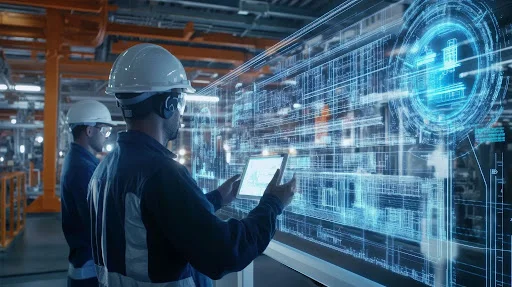
AI’s footprint on the factory floor continues to expand. One important nuance: the most immediate AI impact isn’t necessarily just on the factory floor itself—it’s happening earlier in the product lifecycle, inside quoting, DFM analysis, sourcing, and production planning.
For a bigger picture of how this plays out end-to-end, see How AI-Powered Digital Manufacturing Platforms Help Engineers Move Faster and Fictiv’s deeper dive on AI as a digital manufacturing catalyst.
CNC Machining and 3D Printing
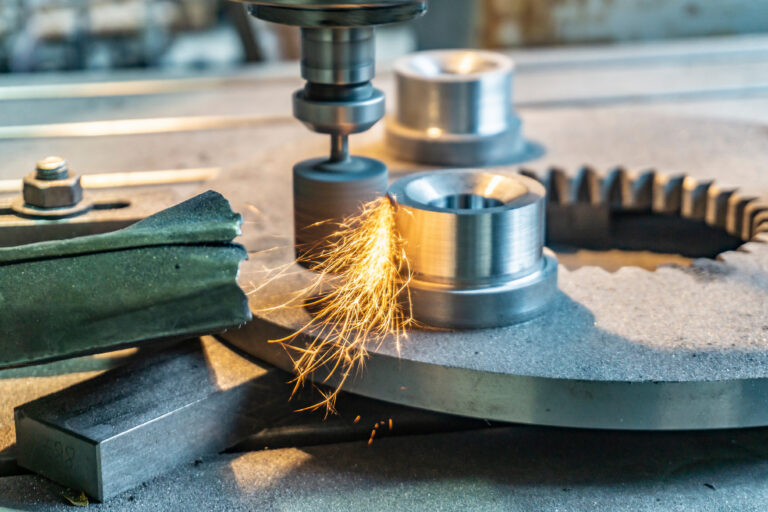
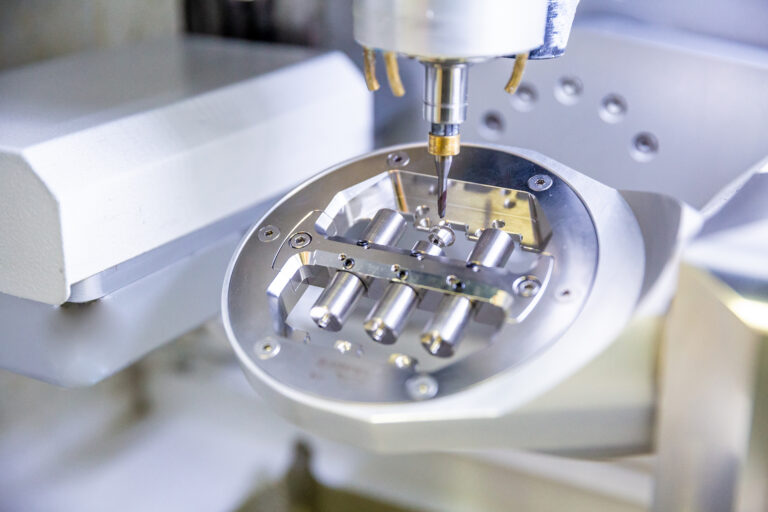
In CNC machining, AI optimizes toolpaths to reduce waste and improve precision. In 3D printing, AI predicts material behavior and enhances accuracy, contributing to higher-quality output. AI-powered computer vision systems now inspect parts for defects in real time, reducing production errors at speeds no human QC team could match. For more on this intersection, see 5 Ways AI Is Impacting 3D Printing.
Predictive Maintenance
Machine learning algorithms analyzing sensor data from manufacturing equipment can detect early signs of failure before they cause downtime. This capability has moved from pilot to standard practice at many facilities. The result: more effective preventive maintenance schedules, lower unplanned downtime costs, and reduced disruption to production programs.
Supply Chain Optimization
AI helps reduce supply chain disruptions by forecasting demand, identifying bottlenecks, and recommending real-time inventory adjustments. AI-driven robotics further enhances assembly-line efficiency, reducing dependence on human labor for repetitive or hazardous tasks while freeing skilled workers for higher-complexity roles.
Digital Twins
Digital twin technology—virtual replicas of physical production systems—allows manufacturers to simulate different scenarios, test new strategies, and optimize workflows without disrupting live operations. Gartner has flagged AI agents combined with digital twins as a trend worth watching on the path toward more autonomous manufacturing. However, widespread implementation remains a longer-term prospect that requires significant infrastructure investment and integration work. For teams that do have the infrastructure in place, digital twins can be genuinely powerful: validating performance before a single physical part is made, catching design issues early, and compressing development timelines.
Will AI Replace Mechanical Engineers?
AI will not replace mechanical engineers—and that conclusion is becoming more confident, not less, even as AI capabilities grow.
While AI augments the parts of engineering work that are well-defined and data-rich, human judgment remains essential for everything that isn’t. Specifically:
- AI can suggest designs; it cannot judge their real-world feasibility or spot an assembly challenge a factory line will struggle with.
- AI can run simulations; engineers must interpret results in context and make decisions under uncertainty.
- AI-generated outputs require human validation—especially as regulations, safety requirements, and cross-disciplinary constraints introduce variables that models can’t fully capture.
Generative outputs can produce geometries that look optimized on screen but are impossible to machine or assemble; AI recommendations can miss tolerance stack-ups, material sourcing constraints, or process-specific design rules that experienced engineers catch immediately. For a frank look at where today’s tools still break down in practice, see AI Tools in Mechanical Engineering: Where They Fall Short.
New roles are emerging alongside these tools: AI-assisted design specialists, simulation engineers who configure and interpret agentic workflows, and smart manufacturing engineers who bridge the digital and physical. And it’s worth noting that AI is creating entirely new categories of mechanical engineering work, not just reshaping existing ones. The rapid build-out of AI data centers has generated significant demand for engineers working on custom hardware, thermal management systems, GPU cluster enclosures, and power distribution infrastructure—complex, precision-driven work that requires deep domain expertise. Human expertise isn’t being replaced; it’s being redirected, and in some cases, it’s being called upon in entirely new directions.
Today’s engineers will spend less time on foundational execution and more time orchestrating AI tools, designing system architecture, and owning the quality of what gets shipped. The core skill becomes systems thinking, not just technical execution.
Benefits and Limitations of AI in Mechanical Engineering
| Category | Benefits | Limitations |
|---|---|---|
| Ideation | Accelerates brainstorming, surfaces relevant prior art, compares technologies | Lacks human intuition for creative leaps and feasibility judgment |
| Generative Design | Optimizes structures against weight, material, and load constraints | Can produce impractical or overly complex geometries needing human refinement |
| Simulation & Analysis | Rapid virtual testing and stress analysis | Engineers must still interpret results and make decisions |
| Manufacturing & Automation | Optimizes CNC toolpaths, print accuracy, assembly efficiency | Cannot fully replace skilled human oversight in production |
| Predictive Maintenance | Detects equipment failures before they cause downtime | Depends on high-quality sensor data and historical records |
| Supply Chain | Forecasts demand, reduces waste, manages inventory dynamically | Can struggle with unprecedented disruptions (geopolitical, natural) |
| Digital Twins | Real-time performance monitoring and pre-production scenario testing | Requires significant computing resources and system integration |
| Materials Research / Selection | Accelerates candidate identification against multi-variable constraints simultaneously | Dependent on underlying database completeness and requires human verification |
| Agentic Workflows | Orchestrates multi-step tasks with minimal intervention | Requires careful guardrail design; outputs must be thoroughly validated |
| Job Impact | Frees engineers for higher-value, creative, and strategic work | Requires significant upskilling in AI tools, data analysis, and prompt engineering |
The Future of AI in Hardware Development
AI-Driven Materials Research
AI is accelerating materials science by analyzing vast datasets to identify optimal material compositions—potentially surfacing combinations that human researchers might not explore for years. Fictiv’s own Materials.AI tool is one example of how this is already becoming accessible to working engineers.
Robotics Integration
Robotics is another domain where AI is rapidly expanding what’s possible. AI-powered robots handle repetitive production tasks with precision and speed, while adapting in real time to changes on the line—improving flexibility in a way that rigid automation cannot. This frees engineers and skilled technicians for the complex problem-solving that genuinely requires human judgment.
Physics-Aware Generative Models
At the leading edge, companies like NVIDIA are developing generative models that natively understand mechanical forces, material properties, and structural behavior—rather than treating them as external constraints. If this approach matures, it could address one of the core reliability problems with current generative design tools. It’s still research-stage for most applications, but it’s a direction worth tracking.
What Engineers Should Do Now with AI
The engineers who will thrive in this environment are those who actively integrate AI tools rather than waiting for the landscape to settle. Practically, that means:
- Start with targeted tasks: pick one high-friction task—generative design, simulation review, part search, or material research—and introduce an AI tool to address it.
- Build your knowledge base: document what works and what doesn’t as you go. That context becomes a durable asset.
- Use structured outputs to pressure-test ideas: asking AI to generate a datasheet or specification document for a design concept forces more systematic thinking and often surfaces gaps or contradictions in the design logic earlier than freeform iteration would.
- Develop adjacent skills: prompt engineering, data analysis, and basic machine learning fluency are increasingly part of the mechanical engineer’s toolkit.
- Keep validation central: AI accelerates the work; engineers remain accountable for whether it’s right.
The Role of AI in Modern Mechanical Engineering
AI is transforming mechanical engineering—but not by replacing engineers. It’s shifting where human effort and judgment are most needed, and creating real advantages for those who learn to work alongside it effectively. The tools are here now: the question is how deliberately you integrate them.
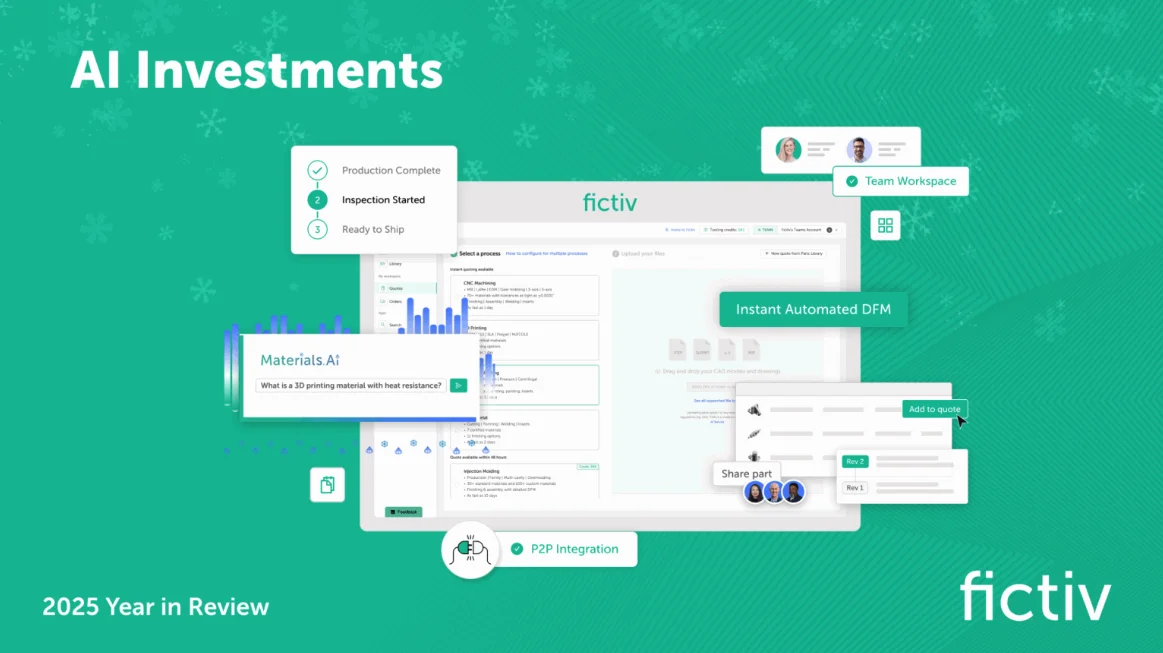
Fictiv’s platform is built with embedded AI that removes friction from the engineering workflow without removing engineers from the loop. Upload a CAD file and get instant quotes with automated DFM feedback that flags wall thickness issues, undercuts, and manufacturability problems before ordering—the kind of early-cycle catch that can save weeks. With 43M+ parts manufactured and a 95.4% quality success rate across CNC machining, injection molding, sheet metal, and 3D printing, Fictiv handles the execution, so your team can stay focused on the engineering.
Talk to a Fictiv expert about your project, or upload your parts to start a free quote.
FAQs About AI in Mechanical Engineering
Will AI replace mechanical engineers?
No—at least not in any foreseeable future. AI automates well-defined, data-rich tasks like simulation, toolpath optimization, and design iteration, but it cannot replicate the engineering judgment required to assess real-world feasibility, navigate physical constraints, or make decisions under uncertainty. If anything, demand for mechanical engineers is growing in new areas like AI data center hardware design, where the infrastructure powering AI systems requires deep domain expertise to build.
What are the most useful AI tools for mechanical engineers right now?
The most widely adopted tools fall into a few categories: general-purpose LLMs like Claude, ChatGPT, and Gemini for research, documentation, and problem-solving; AI-enhanced CAD platforms like Siemens NX, SolidWorks, and Autodesk Fusion 360 for design refinement and flaw detection; and generative design tools for topology optimization and lightweighting. For a full breakdown, see The Top AI Tools for Mechanical Engineers.
What is agentic AI and how does it apply to mechanical engineering?
Agentic AI refers to systems that can execute multi-step workflows autonomously—not just respond to a single prompt. In engineering, this means an AI system can run a simulation, interpret the results, flag anomalies, and prepare a design review summary, all under human supervision. This is a significant shift from earlier AI tools with potential to compress design-simulate-review cycles in product development.
Where does AI still fall short in mechanical engineering?
The limitations are real and worth understanding before over-relying on AI outputs. Generative design tools can produce geometries that look optimal on screen but are impossible to machine or assemble. AI can miss tolerance stack-ups, material sourcing constraints, and process-specific design rules that experienced engineers catch instinctively. Human validation remains essential at every stage. For specific failure cases, see AI Tools in Mechanical Engineering: Where They Fall Short.
How should mechanical engineers start integrating AI into their workflow?
The most effective approach is to start narrow rather than trying to overhaul your entire workflow at once. Pick one high-friction task—generative design exploration, simulation review, material research, or part sourcing—and introduce a single AI tool to address it. Document what works and what doesn’t as you go. Over time, build familiarity with prompt engineering and data analysis, since those skills increasingly determine how much value engineers get out of AI tools.