




Time to read: 6 min
Laser welding is a precision joining process that uses a focused laser beam to fuse metals with minimal heat input, high accuracy, and excellent repeatability.
The adoption of laser welding has grown slowly and steadily since its first commercial applications in the early 1970s for thin-walled aerospace components, and continues to grow today. This has been driven by the pursuit of high-speed, low-distortion, accurate joining techniques compatible with a high level of automation.
Purchasing a laser welder alone does not ensure successful implementation. Process improvements require a deep understanding of the technology’s capabilities and limitations, along with investment in joint design, part fit-up, fixturing, process development, and operator training.
This article explains what laser welding is, how it works, its advantages and limitations, and the materials best suited for laser welding applications. No villain sharks fitted with laser beams here—just fast, low-distortion welding.
What Is Laser Welding And How Does It Work?
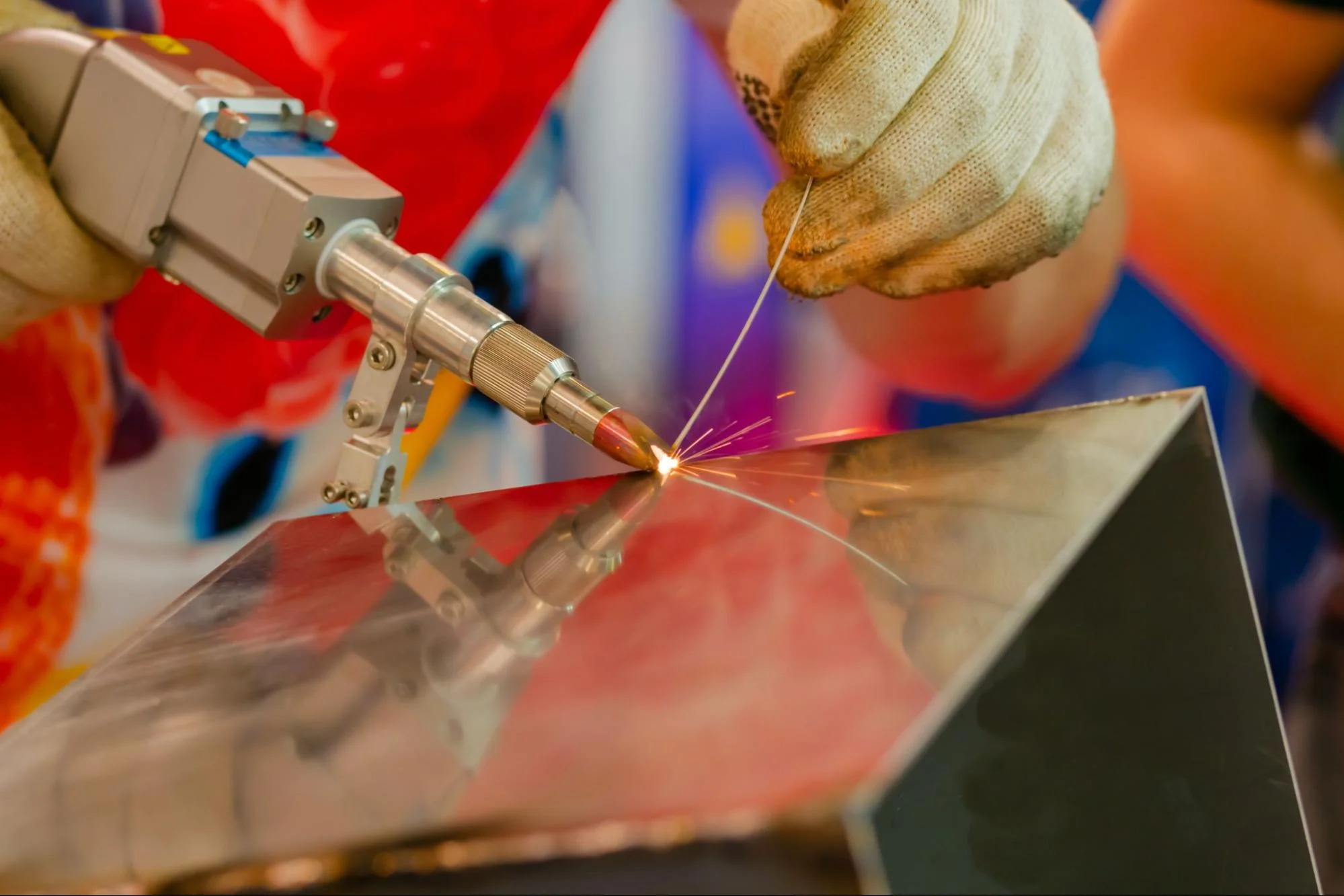
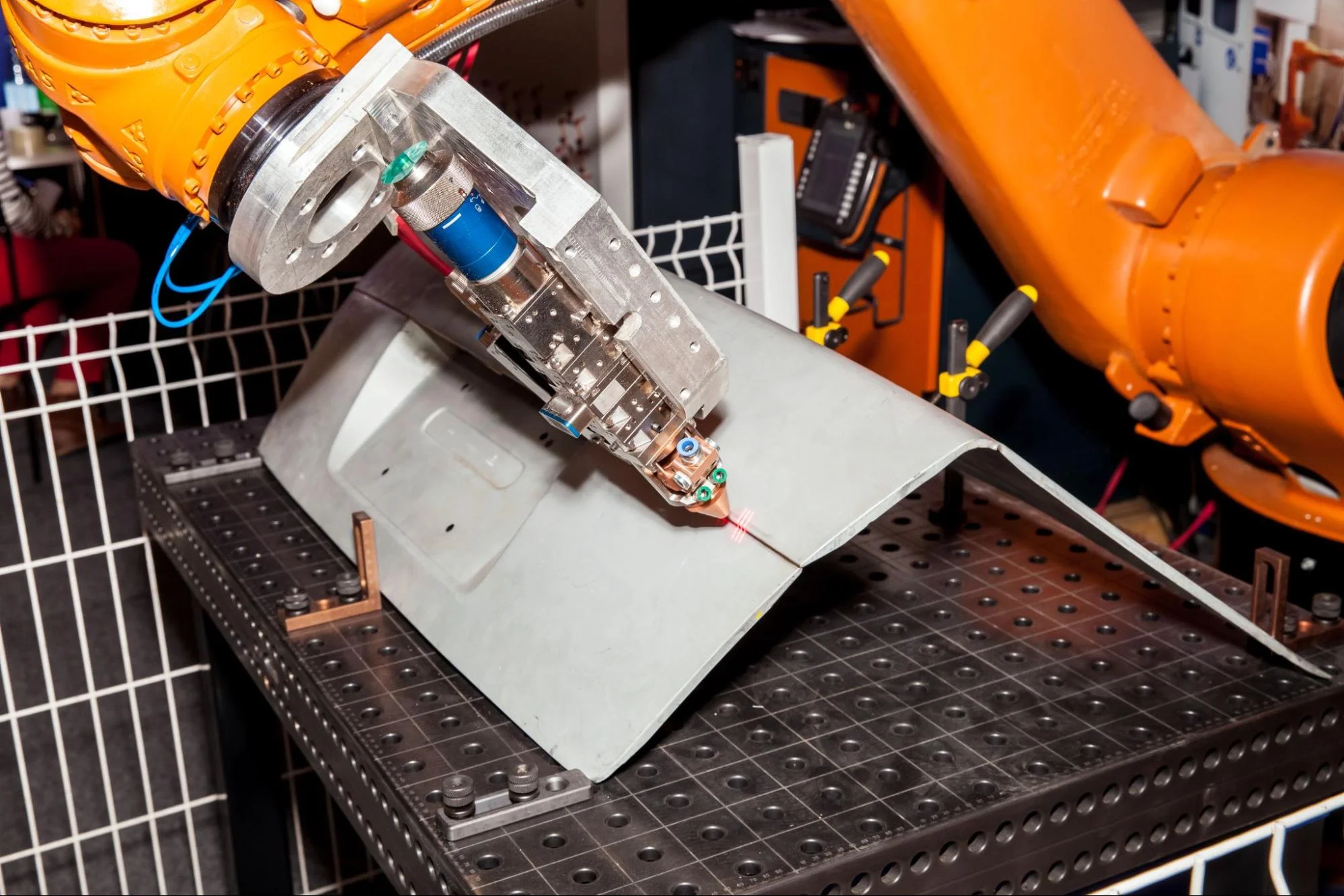
Laser welding is a non-contact fusion process that uses a tightly focused, high-power-density beam of coherent, monochromatic light to heat and melt the materials in a weld joint. Laser welding is fast and accurate because computers can combine the mechanical motion of the head with the optical redirection of the beam using mirrors and optical fiber routing. This is one of many welding options to consider in sheet metal fabrication and assembly.
A practical laser welding system integrates several key components:
- Laser Source: Creates the laser beam.
- Beam Delivery: In fiber lasers, the beam travels through a flexible fiber-optic cable to the welding gun. The fiber output is collimated and focused by a lens assembly at the weld gun. For non‑fiber lasers, the beam is routed to the welding gun using mirrors and articulated optics. Focusing is performed with lens- or mirror‑based optics during delivery.
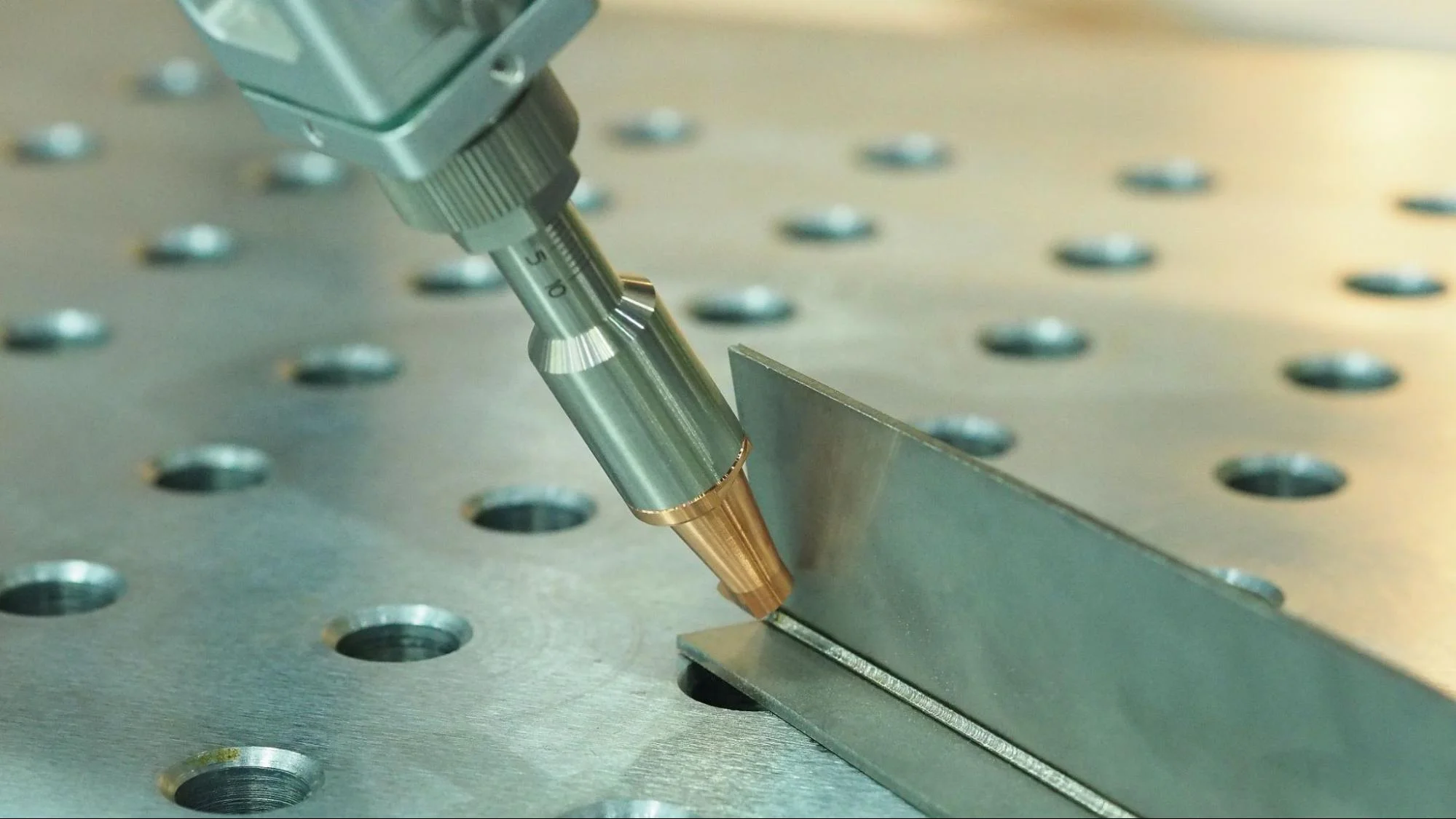
- Focusing Optics: These lenses are located in the welding head and focus the beam to a spot size of 0.1-1.0 mm, achieving the high power density required.
- Process Control: Real-time monitoring (pyrometers and cameras) combined with closed‑loop control and data systems to keep the weld consistent for quality control.
- Cover Gases: This would involve protective gases (Argon or Helium) to prevent oxidation of the molten weld pool.
- Motion System: The robot or CNC stage provides accurate, fast motion of the laser beam with respect to the workpieces being joined.
The two primary laser welding operational modes are:
- Conduction Mode Welding: The energy density is sufficient to melt the material, but not sufficient to vaporize it. These welds are wide, shallow, smooth, and suitable for fillet welds, thin sheets, and welds that must meet a cosmetic requirement.
- Keyhole Mode Welding: Occurs at higher power density, where localized vaporization creates a stable vapor-filled cavity (“keyhole”) surrounded by molten metal. As the laser traverses the joint, the keyhole moves with it, enabling deep, narrow weld penetration in a single pass.
Types of Laser Welding Systems and Equipment
Laser welding systems are often categorized by their beam delivery methods and operational modes, which directly impact flexibility, integration, and application suitability.
Types of Laser Welding by Operational Mode
| System | Features | Applications |
| Fiber Laser | High beam quality; solid‑state fiber delivery; high efficiency | Automotive body panels: stainless steel, aluminum; high‑speed production |
| CO₂ lasers | Gas laser; free‑space optics common | Thick‑section cutting/welding historically, some plastics processing |
| Pulsed Laser | Short, high‑peak pulses; controlled heat input | Spot welding, jewelry, electronics, thin‑sheet lap welds |
| Continuous Wave Laser | Steady output for continuous energy delivery | Deep‑penetration welding, seam welding, and high‑speed production |
| Micro Laser Welding Machine | Very small spot sizes; often pulsed | Medical devices, microelectronics, watchmaking |
Materials Suitable for Laser Welding
High-quality laser welds can be produced using many, but not all, metals. This is because the metallurgical properties of the material being used, as well as the laser beam wavelength, strongly influence the success or failure of the welding process.
Below are some materials suitable for laser welding:
- Carbon & Stainless Steels: Exhibit good beam absorption and weldability, especially with fiber lasers, and low propensity to solidification cracking. Austenitic stainless steel grades, e.g., types 304 & 316, can be welded with minimal distortion.
- Aluminum & Aluminum Alloys: Challenging, but possible to laser weld with proper conditions. High reflectivity, high thermal conductivity, and susceptibility to porosity due to hydrogen and hot cracking (in 6xxx series) make welding it very challenging. Porosity is primarily driven by differences in hydrogen solubility between solid and liquid aluminum, while hot cracking is influenced by alloy chemistry and the solidification range. Measures include the use of high-brightness laser systems (fiber/ disk), proper cleaning, and sometimes specialized filler wires.
- Titanium: A very good candidate for laser welding because of its low thermal conductivity. An inert shield gas must be used to avoid weld embrittlement. Welding this material often requires trailing and underside shielding.
- Copper & Brass: These materials have both high reflectivity and high heat conductivity. This makes it hard to laser weld. New high-power, high-brightness lasers in the green and blue wavelength ranges are emerging to combat this problem.
Advantages of Laser Welding
- Low Heat Input & Minimal Distortion: High energy density leads to an extremely small heat-affected zone (HAZ). This is extremely important for precision and thin-walled components, where distortion cannot be tolerated.
- High Speed & Throughput: Travel speeds may be much higher than for TIG or MIG welding, particularly when thin-gauge materials are involved, thereby offering higher productivity.
- Deep Penetration & Single-Pass Welds: High-depth/width ratios can be achieved in keyhole welding mode, allowing a thick section of material to be welded in a single pass.
- Process & Flexibility: Requires no electrode replacement or use of force to make contact. The beam can be sent to a long-distance, remote-controlled robot and can also be oriented in any manner
- Highly Suitable for Automation: The process is inherently digital and programmable, making it a perfect fit for Industry 4.0.
- Precision and Aesthetic Welds: Laser welding yields a narrow, defined bead width and a smooth finish. There is no need for a cleaning process.
Limitations and Tradeoffs of Laser Welding
- Capital Cost: The initial investment for a high-power laser system with robotics, safety enclosures, etc., is considerably higher than that for traditional arc welding workstations.
- Very Tight Fit-Up & Tolerance Requirements: The single biggest source of failure in new system implementations is failure to meet joint fit-up and tolerance requirements.
- Limited Gap-Bridging Ability: The method lacks gap-bridging ability without the addition of filler wire. This is not as much of a problem in MIG or stick welding.
- Reflectivity & Material Sensitivity: Performance is impacted by highly reflective metals (aluminum, copper), and some alloys can suffer damage (cracking, porosity) without careful process setup.
- Safety & Infrastructure: Requires safety enclosures due to its invisible, dangerous laser radiation. May also require additional power and cooling facilities
Laser Welding vs. Other Welding Methods
To help with optimizing the choice of joining method for a particular project, the table below compares laser welding to other key alternatives:
| Characteristic | Laser Welding | TIG Gas Tungsten Arc Welding (GTAW) | MIG Gas Metal Arc Welding (GMAW) | Resistance Spot Welding |
| Total Heat Input | Very Low | Low-Medium | Medium-High | Localized (Very High) |
| Distortion | Minimal | Low | Medium | Low (but forms a local indentation) |
| Speed | Very High | Slow | Medium | High |
| Fit-Up Tolerance | Very Demanding | Forgiving | Forgiving | Demanding (surface contact) |
| Gap Bridging | Very Poor | Excellent | Excellent | N/A |
| Automation Suitability | Excellent | Good | Good | Excellent |
| Operating Cost | Medium (Power Efficient) | Low | Medium | Low-Medium |
| Capital Cost | Very High | Low | Low | Medium |
| Best For | High-speed, thin-section, precision, automated long seams, low distortion | High-integrity, code-quality welds, all positions, exotic metals, one-off jobs | High-deposition rate, general fabrication, forgiving fit-ups | High-volume sheet metal assembly (e.g., automotive bodies) |
Laser Welding Design Guidelines for Manufacturability
Laser welding design guidelines provide the process information needed to achieve weld joints that fully leverage the precision of the laser beam. Some of the elements of these guidelines include:
- Joint Design: Proper joint design is critical for strength and aesthetics.
- Fit-Up & Tolerances: Incorporate self-locating features (pins, steps, tongue-and-groove) in the design to aid assembly.
- Fixturing: The fixtures for components to be laser-welded should be rigid and accurately position all components. It may clamp the workpieces together immediately adjacent to the weld seam to minimize the possibility of gaps.
- Start/Stop Locations: Plan weld paths for beam ramp-in/out of the part or on a run-on/run-off tab to avoid defects in critical locations.
Learn more about designing for weld manufacturability in our sheet metal welding guide.
Laser Welding Services in Digital & Scalable Manufacturing
Laser welding is a native digital process. Beam power, speed, and path are all software-defined, enabling:
- Rapid Prototyping & Changeover: New weld programs can be uploaded in seconds, which is beneficial for high-mix, low-volume manufacturing.
- Industry 4.0 Integration: Easy to integrate with Manufacturing Execution System (MES)/Enterprise Resource Planning (ERP) systems. Process data can be recorded for each weld to create a digital twin.
- Scalability: Production volume will scale predictably.
When Laser Welding Is the Right Choice
Laser welding is not a default choice; it is a strategic one. Consider it seriously when your project checklist includes:
- Thin materials
- Minimal distortion required
- High production volumes
- Tight joint geometry
- Autogenous weld required
Traditional methods, such as TIG or MIG, are still more practical and cost-effective for one-off repairs. When the conditions are right, laser welding becomes an indispensable tool for achieving manufacturing excellence.
Do you design precision metal assemblies requiring clean, low-distortion welds?
Fictiv helps teams prototype and produce high-quality metal components while selecting the right joining methods—from laser welding to mechanical fastening—backed by expert DFM insights. Upload your CAD model to get started for free.