


Time to read: 17 min
Picking a metal for a custom part is one of the most critical decisions you’ll make in the design process. Get it right, and your part performs as expected, machines or forms cleanly, and ships on time. Get it wrong, and you’re looking at cracked bends, corroded hardware, blown budgets, or a part that’s simply over-engineered for the job.
Many material reference guides are written for metallurgists, not the engineers actually specifying parts. This guide covers the most commonly manufactured metals. It skips the crystal structures and precipitation chemistry, focusing instead on what you actually need to make a good call: how each alloy behaves, where it wins, and where it will get you into trouble.
Pick the wrong alloy and you’ll find out at the worst possible time—when a bend cracks, a surface pits, or a quote comes back twice what you expected. Making smart decisions means matching the alloy’s mechanical properties, machinability, and formability to the part’s actual service conditions and manufacturing process.
➡️ Download the full eBook PDF for more charts, diagrams, and material details.
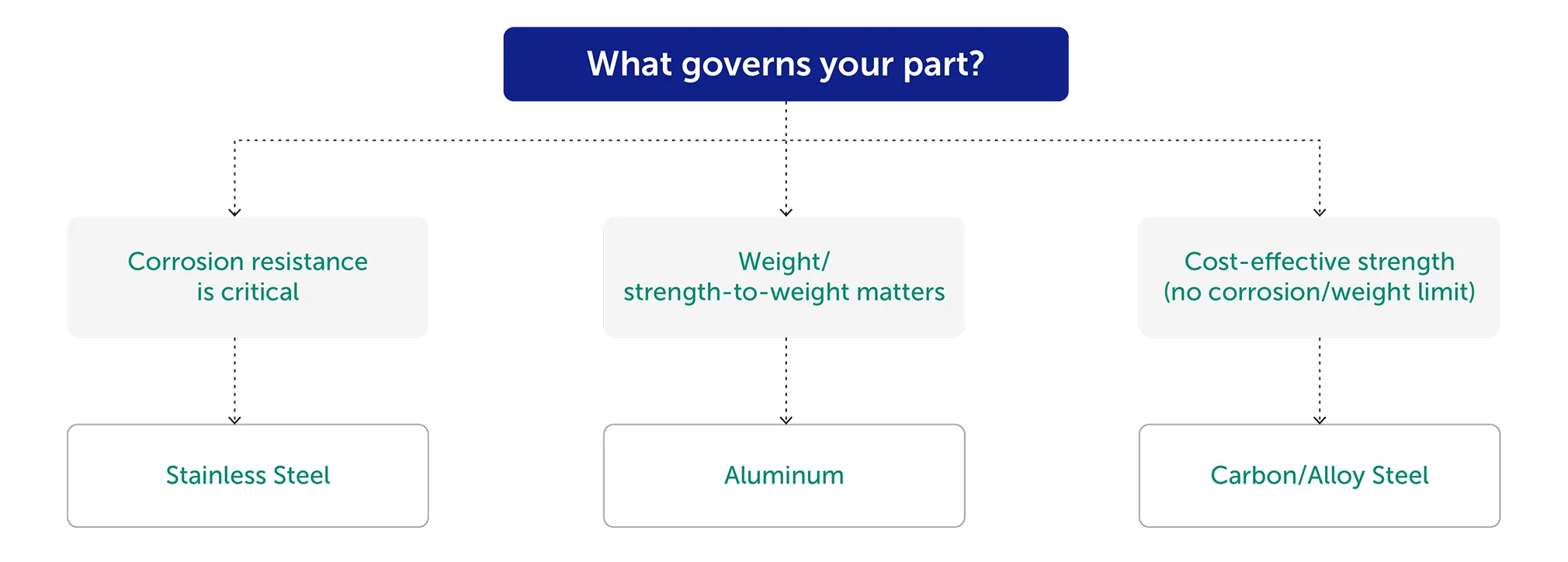
Decision tree for selecting a material family for sheet metal and CNC machining parts. See the comparison tables below for specific alloys and tempers.
How to Think About Material Selection
Before comparing alloys, it helps to know which properties actually govern your decision. Most parts are driven by two or three of the following:
Strength – how much load the part can carry before it permanently bends (yield strength) or breaks (ultimate tensile strength). If your part just needs to resist deforming under load, yield strength is your number.
Stiffness – how much a part deflects under load, independent of whether it breaks. This is a different question from strength, and it’s easy to conflate the two. A thin steel bracket can be plenty strong but still flex more than you’d like.
Weight – technically a measure of density, weight matters most when you’re comparing materials on a strength- or stiffness-per-pound basis, not just strength alone.
Corrosion resistance – how the material holds up in its service environment. This is highly dependent on context. A material that’s fine for indoor use may fail if used outdoors or near saltwater. Corrosion is the gradual breakdown of a metal caused by chemical and electrochemical reactions with its environment.
Machinability or formability – how efficiently the material can be cut on a CNC mill/lathe or bent and formed as sheet metal. This drives cost and lead time directly.
Weldability – whether the alloy can be joined without cracking or losing significant strength in the heat-affected zone.
Fatigue resistance – how well the part holds up under repeated loading cycles. A part can be well within its yield strength on any given cycle and still crack after enough repetitions.
Fracture toughness – how much a material resists sudden, brittle failure when a small crack or flaw is already present. Two materials can have identical yield strength and behave completely differently once a crack starts. A tougher material deforms around the flaw, while a more brittle one can snap catastrophically at a fraction of its rated strength.
Cost – both raw material cost and the cost of processing (a “cheap” material that machines slowly or scraps parts isn’t as cheap as it sounds).
➡️ Identify which of these factors matter most for your part, then use the alloy breakdowns below to zero in on a candidate.
Decoding Temper and Condition Codes
Throughout this guide you’ll see codes like 6061-T6, 5052-H32, or 17-4 PH H900. These aren’t arbitrary labels — they describe exactly how the material was processed, and that processing can matter as much as the alloy itself. Specifying an alloy without a temper or condition is an incomplete spec.
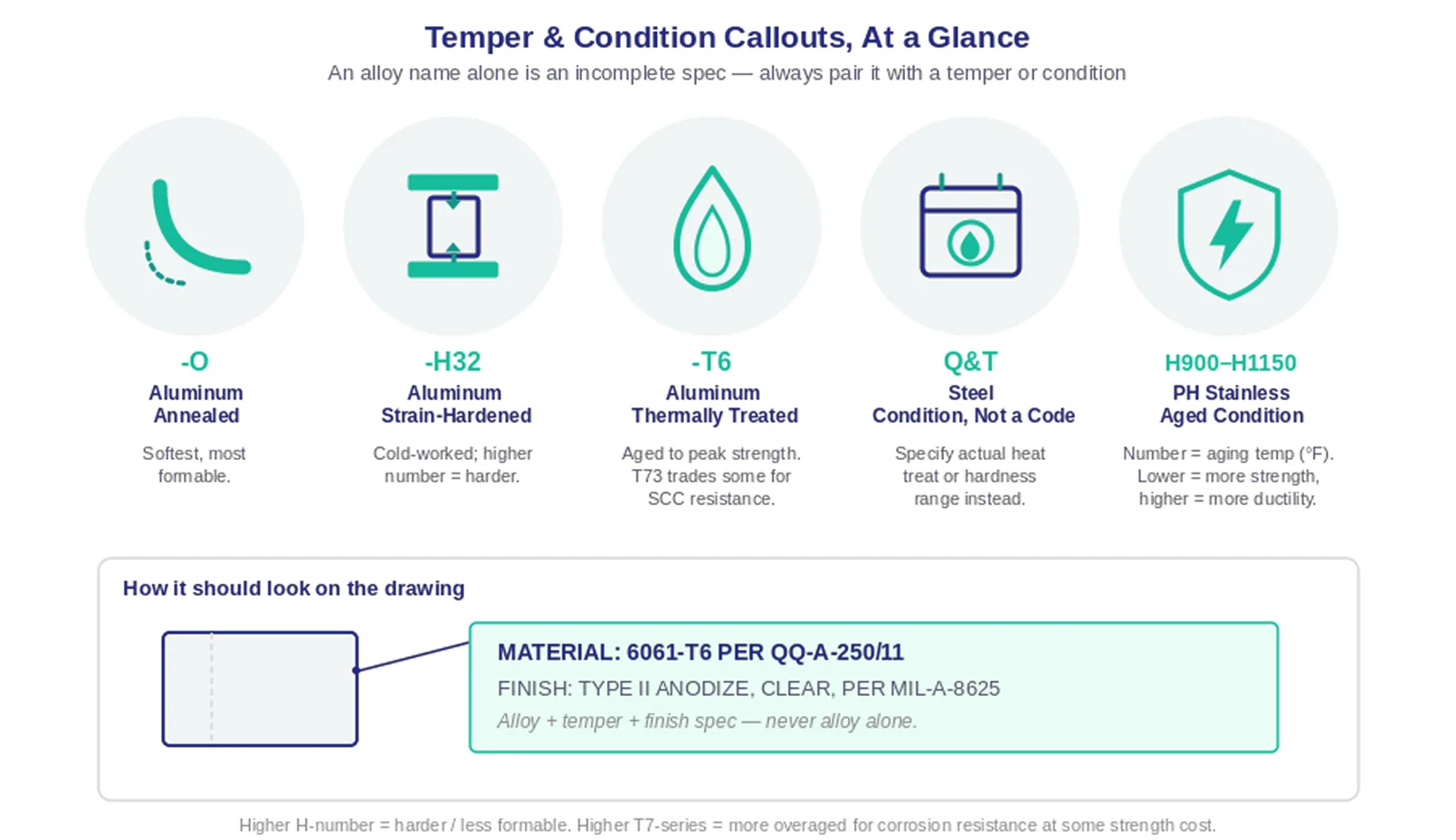
Aluminum (O / H / T):
O = annealed — softest and most formable
H = strain-hardened by cold work (H32 is roughly quarter-hard); a higher second digit means harder and less formable
T = thermally treated: T6 is aged to peak strength, T3/T4 are naturally aged and softer, and T7-series tempers are deliberately overaged to trade some strength for better corrosion resistance
Steel (condition, not a short code): steel is typically specified as annealed, normalized, or quenched & tempered (Q&T) at a stated tempering temperature, rather than with a compact alphanumeric code — you specify the actual heat treatment or resulting hardness range.
Precipitation-hardening stainless (H + number): the number roughly tracks the aging temperature in °F. H900 is aged at 900°F for maximum strength; H1150 is aged at 1150°F for lower strength but meaningfully better ductility and toughness. Lower number means higher strength; higher number means tougher and more ductile.
The takeaway: “6061” or “17-4 PH” alone doesn’t tell your supplier what mechanical properties you’re expecting. The temper or condition is half the specification.
Aluminum Alloys
Aluminum alloys are roughly a third as dense as steel, machine quickly, and (in the right alloys) resist corrosion well without any coating. They’re the default choice for weight-sensitive, moderately-loaded parts.
Quick aluminum picks:
| Requirement | Alloy |
| Good all-around: corrosion resistance, weldability, machinability | 6061-T6 |
| Maximum strength (and can skip welding) | 7075-T6 |
| Sheet metal forming | 5052-H32 |
| Fatigue/crack resistance in thin structural sections | 2024-T3 |
| Heat exchangers, HVAC, brazed assemblies, light formed parts | 3003-H14 |
6061-T6 — The default structural aluminum
6061 is the alloy most people mean when they say “aluminum.” Excellent corrosion resistance, anodizes cleanly, and it’s one of the most weldable heat-treatable aluminum alloys available. It anodizes cleanly and machines beautifully — fast cutting speeds, clean chips, great surface finish.
| 6061-T6 is a poor choice for bending. Minimum bend radius is 4–6× material thickness. Order O (annealed) temper, form, then heat-treat to T6 after bending — or switch to 5052. |
7075-T6 — Maximum strength, with trade-offs
7075 is about 85% stronger than 6061 (UTS ~572 MPa / 83 ksi), but that strength comes with real costs. It can’t be conventionally welded, it’s nearly impossible to bend in T6 temper, and it’s susceptible to stress corrosion cracking (SCC) — a failure mode where the material cracks under sustained tensile stress in humid or salty environments, sometimes with no visible warning. If your part will see sustained load in a humid or coastal environment, specify the T73 or T7351 temper instead, which trades about 10-15% strength for meaningfully better SCC resistance.
| 7075 is not stiffer than 6061 — elastic modulus is nearly identical. If the part is flexing too much, switching to 7075 won’t help. You need a geometry change or different material family. |
2024-T3 — Best fracture toughness
2024 trades some strength for much better fracture toughness and fatigue resistance than 7075 — this is why aircraft designers use 2024 for lower wing skins and fuselage frames (where damage tolerance matters) and reserve 7075 for upper wing skins (where raw strength matters). The catch: 2024 has poor bare corrosion resistance and typically needs a cladding layer or coating for wet service.
3003-H14 — Best for light, formed parts
3003 is the alloy to reach for when 5052 is more than the job needs. Manganese (~1.2%) gives it a modest strength bump over commercially pure aluminum — about 152 MPa (22 ksi) UTS in H14 temper — but the real reason it shows up constantly is formability and brazeability. 3003 draws, spins, and bends cleanly and bonds reliably in torch and furnace brazing operations. This is why it’s the dominant alloy for heat exchanger fin stock, HVAC coils, and refrigeration tubing.
5052-H32 — Best for sheet metal
5052 isn’t heat-treatable, which caps its strength at a modest ~228 MPa (33 ksi) UTS — but it’s the best-forming, best-corroding aluminum sheet alloy available, including in marine environments. If your part is a formed sheet metal enclosure, tank, or bracket and doesn’t need extreme strength, this is almost always the right call.
Aluminum alloys comparison at a glance
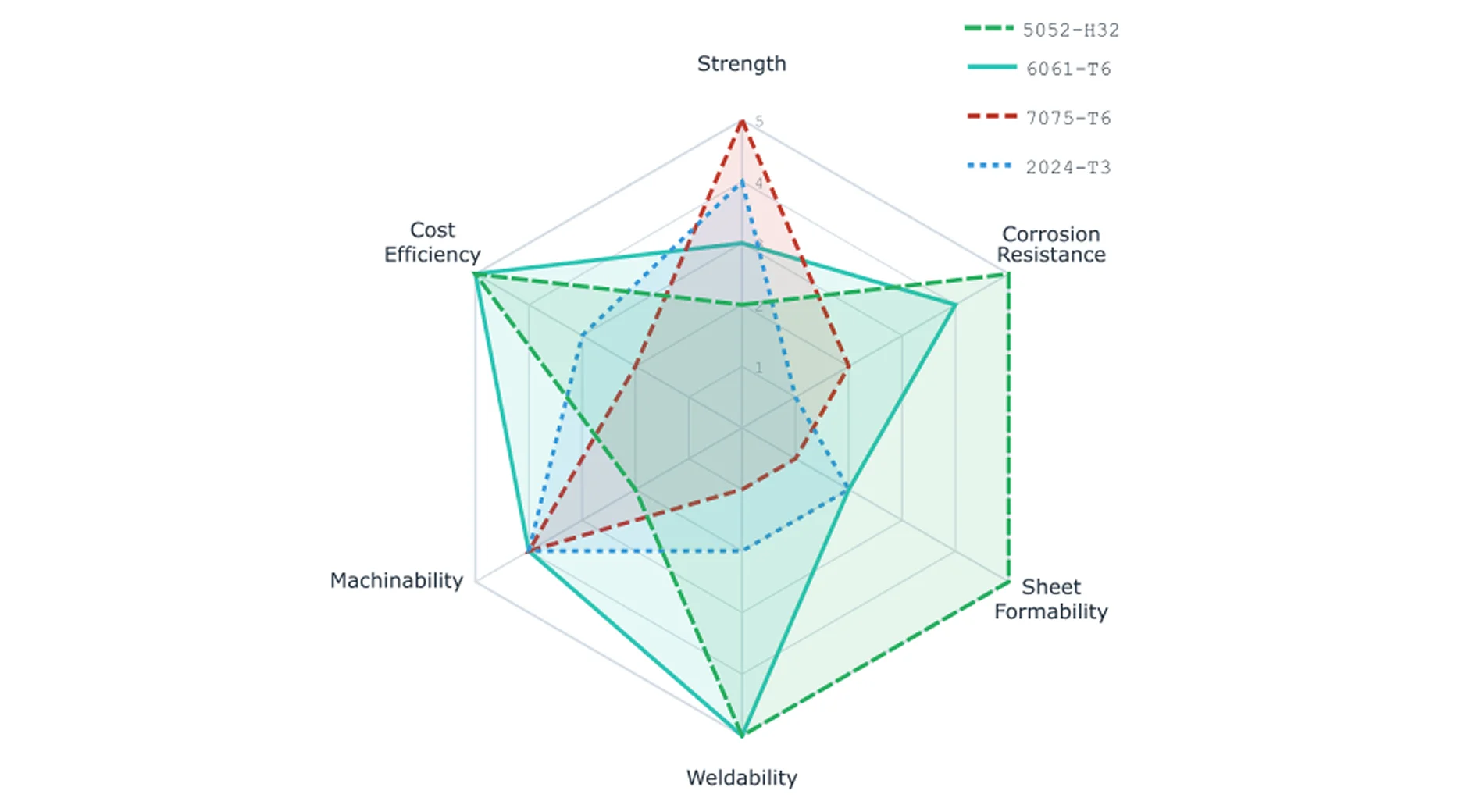
Trade-off profile for the four main aluminum alloys with each axis scored 1–5 relative to the aluminum family.
Stainless Steels
Stainless steels resist corrosion because chromium (at least ~10.5% by weight) forms a thin, self-healing oxide layer on the surface. Beyond that, the three grades below cover almost every use case you’ll encounter.
Quick stainless picks:
| Requirement | Grade |
| General corrosion resistance, food-safe, medical | 304 |
| Chloride exposure — coastal air, cleaning chemicals, brines | 316 |
| High strength plus decent corrosion resistance | 17-4 PH |
304 — The default stainless
304 is the workhorse. It features excellent resistance to atmospheric and freshwater corrosion and is food-safe, widely available, and reasonably priced for stainless. Its main quirk is that it work-hardens fast during machining. Dwelling the tool in one spot hardens the surface and accelerates wear, so consistent feed and sharp tools matter more than with most materials.
316 — For chlorides and coastal environments
316 is chemically identical to 304 except for an added 2–3% molybdenum, which meaningfully improves resistance to pitting and crevice corrosion in chloride environments — at roughly a 20–30% cost premium. Rule of thumb: if the part will ever see salt water, de-icing salt, coastal air, or harsh cleaning chemicals, specify 316. If it’s staying dry, indoors, or in fresh water, 304 is sufficient and cheaper.
| Neither 304 nor 316 is seawater-proof. Natural seawater is ~19,000 ppm chloride — about 20× higher than 316’s reliable range (~1,000 ppm). For sustained seawater immersion, consider 904L, duplex stainless steel (2205/2507), or nickel alloys. |
17-4 PH — High strength stainless
17-4 PH is a precipitation-hardening stainless that reaches much higher strength than 304 or 316 (up to ~1,310 MPa / 190 ksi in the H900 condition) while retaining reasonable corrosion resistance. And unlike 304/316, it doesn’t work-harden aggressively, so it machines well. The trade-off is that the highest-strength condition (H900) is more susceptible to hydrogen embrittlement and stress corrosion cracking. For load-bearing parts, most engineering guidance recommends aging to at least the H1025 condition rather than pushing for maximum hardness.
Stainless comparison at a glance
| Property | 304 | 316 | 17-4 PH (H1025) |
| UTS (min.) | 515 MPa (75 ksi) | 515 MPa (75 ksi) | 1,070 MPa (155 ksi) |
| Chloride resistance | Fair | Good | Fair |
| Machinability | Fair (work-hardens) | Fair (work-hardens) | Good |
| Weldability | Good (use 304L) | Good (use 316L) | Fair, with post-weld aging |
| Relative cost | $ | $$–$$$ | $$$ |
Carbon and Alloy Steels
If you don’t need corrosion resistance and want maximum strength per dollar, plain carbon and low-alloy steels are hard to beat.
Quick picks:
| Requirement | Grade |
| General fabrication, welding, low cost | 1018 |
| Moderate strength, heat-treatable | 1045 |
| High strength (up to ~1,570 MPa), moderate section size | 4140 |
| High strength in large cross-sections, best toughness | 4340 |
| Thin-gauge Sheet metal steel part (not bar stock) | A1008 |
| Mid-gauge sheet, where cold-rolling isn’t economical | A1011 |
| Thicker plate or structural sections, beyond sheet gauge | A36 |
1018 — The low-cost workhorse
1018 is a low-carbon steel: easy to weld, easy to machine, and cheap. However, it can’t be significantly hardened by heat treatment because there isn’t enough carbon in it. If you need a hard wear surface, it can still be case-hardened (carburized) for a hard skin over a tough core.
1045 — A step up in strength
1045 has enough carbon to respond meaningfully to quench-and-temper heat treatment, giving you a useful strength range. But it doesn’t have the alloy content for good hardenability in thicker sections, and welding requires more care (preheat is recommended for most thicknesses due to the carbon content).
4140 — High strength, moderate section sizes
4140 adds chromium and molybdenum, which dramatically improves hardenability — meaning it can be heat-treated to high strength through thicker sections than 1045 can (up to roughly 2 inches in diameter). It’s a genuine workhorse for tooling, high-strength shafts, and structural components north of 800 MPa. One practical note: trying to machine it at full hardness is slow and hard on tooling. Plan to machine it in the annealed condition, then heat-treat, then finish-grind.
4340 — For big parts and tough environments
4340 adds nickel on top of the chromium-molybdenum recipe in 4140, which further improves hardenability (through-hardens up to ~5 inches diameter). It also gives noticeably better toughness — its ability to absorb impact without cracking. 4340 costs more and machines slightly slower than 4140. But for large, highly loaded, or impact-critical parts, it’s the better choice.
A1008 / A1011 — Sheet steel, not bar stock
Sheet steel doesn’t get an AISI grade number like bar stock does. It gets an ASTM specification tied to how it was rolled, and which one you want is mostly a function of thickness:
- A1008 (cold-rolled sheet) — thinnest gauges, tightest tolerance, cleanest surface finish.
- A1011 (hot-rolled sheet) — mid gauges, where cold-rolling isn’t economical; slightly rougher surface, wider tolerance.
Within A1008 or A1011, CS Type B is the default general-formability callout with no guaranteed minimum strength. SS Grade 30 and up guarantees a minimum yield strength (the grade number ≈ minimum yield in ksi) for parts that need one specified.
A36 — The cheapest, weldable structural steel
A36 is a low-carbon structural steel available in the same round-bar and plate forms as 1018. But where 1018’s tighter, more consistent composition buys clean machining, A36 trades that away for cost and weldability. It’s not a machining-first choice. Looser composition control and a rougher as-rolled surface mean noticeably more labor to hit the finish 1018 delivers, so reach for A36 when the part is welded or bolted together rather than machined to a tight tolerance. Yield strength runs a guaranteed 250 MPa (36 ksi) minimum (hence the name) with UTS typically 400–550 MPa (58–80 ksi). A36 welds by any common process without the preheat care 1018 sometimes needs.
Titanium, Brass, Copper, Bronze, Magnesium, and Zinc
Aluminum, stainless, and steel cover most parts. A smaller set of applications call for something else entirely — usually because of weight, conductivity, or corrosion demands the first three families can’t quite meet. Download the full eBook for more detail on these specialty materials.
Quick specialty metal picks:
| Need | Metal |
| Aerospace/medical-grade strength-to-weight and corrosion resistance beyond aluminum | Ti-6Al-4V |
| Electrical connector or fitting that needs to machine easily | C360 brass |
| Maximum electrical or thermal conductivity, and machining time isn’t the constraint | C110 copper |
| Bearing/bushing wear resistance, or a weldable marine-grade copper alloy | Bronze (C932 machined / C655 formed) |
| Lightest possible structural part (with fire-safety caveats in the shop) | AZ31B magnesium |
| High-volume, complex-geometry part better suited to die casting than machining | Zamak 3 zinc |
Designing for Machinability and Formability
A material choice that’s mechanically perfect but difficult to manufacture will cost you in lead time and price.
A few practical rules:
Machining, from easiest to hardest:
Aluminum alloys (6061, 7075, 2024) > mild steel (1018) > alloy steel (4140, 4340) > stainless (304, 316).
Pro-tip: Aluminum cuts at 3–10× the speed of steel
Stainless is the slowest and least forgiving — it work-hardens under the tool, so consistent feed rates and flood coolant matter more than usual.
Heat-treatable alloys should be machined soft, then hardened
For 4140, 4340, and similar steels, the standard sequence is: rough-machine in the annealed condition, heat-treat, then finish-grind. Machining at full hardness burns through tooling and risks part quality.
Bending has a temper problem
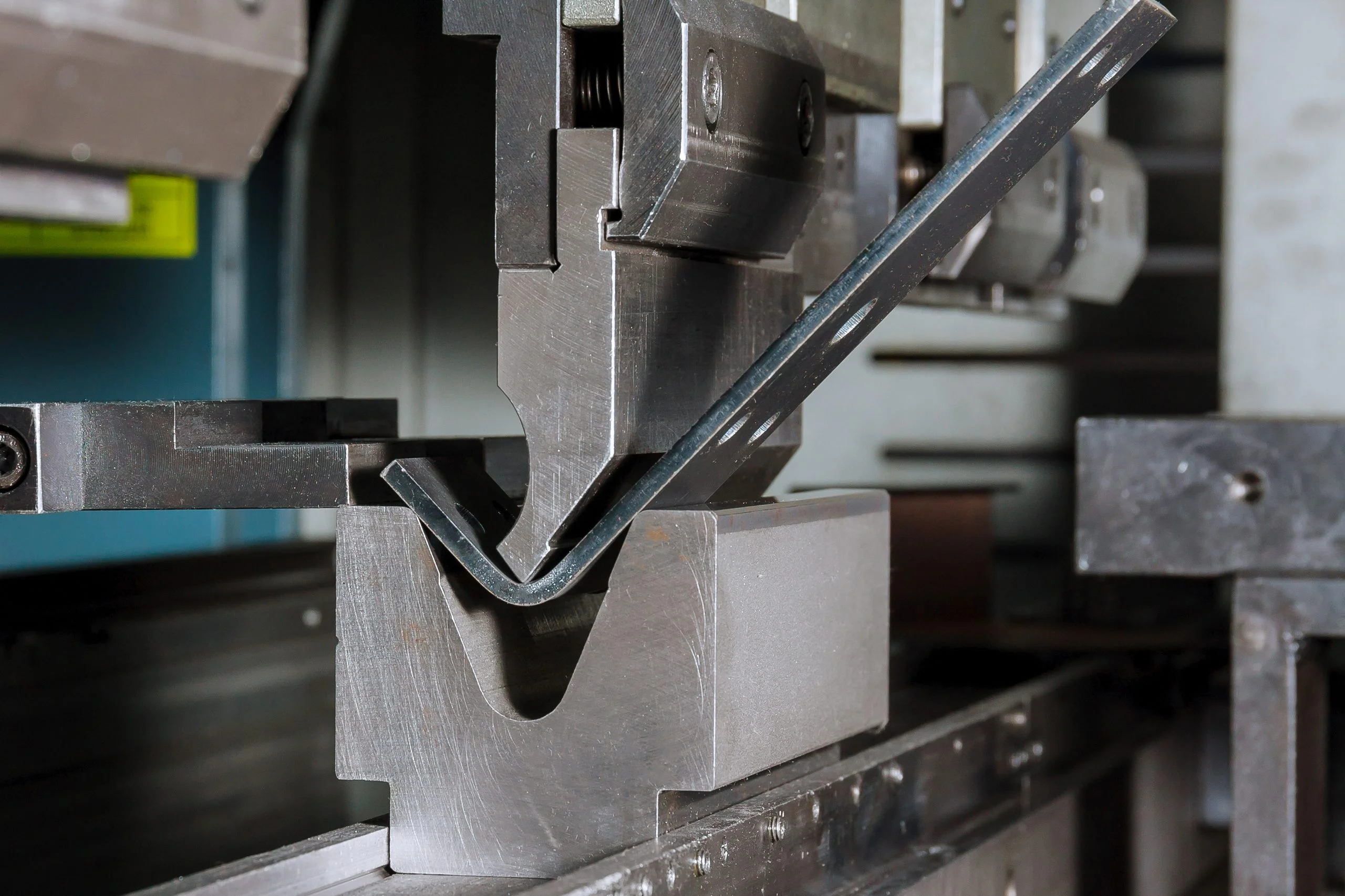
Heat-treated aluminum in its strongest temper (6061-T6, 7075-T6) is nearly impossible to bend tightly — minimum bend radii run 4–8x material thickness. If your design needs both strength and a tight bend, either order the material in the annealed (O) temper and heat-treat after forming, or switch to a non-heat-treatable alloy like 5052.
Grain direction matters most for stiff tempers
Grain direction affects cracking risk during sheet metal bending, particularly in aluminum. Orienting the bend line perpendicular to the rolling direction (across the grain) generally reduces cracking risk.
Non-heat-treated alloys like 5052 are more ductile and more tolerant of a bend that goes with the grain, but across-the-grain is still the better choice when the geometry allows it. If a bend must run parallel to the rolling direction (with the grain), consider opening up the radius or forming in the O temper and heat-treating afterward.
The minimum acceptable bend radius depends on alloy, temper, thickness, and grain orientation, so specify rolling direction on your engineering drawings whenever bend performance is critical.
Springback is real and material-dependent
Higher-strength materials and thinner sheet spring back more after bending. 7075 and high-strength stainless spring back the most; 6061-O and 1018 spring back the least. If you’re getting a formed part made, expect a tooling iteration or two to dial in the final angle. This is normal, not a sign something went wrong.
Stainless needs different machining habits than steel
Never let the tool dwell in one spot — it hardens the surface instantly. Use sharp, high-positive-rake tooling and flood coolant, and expect roughly 55–65% of the cutting speed you’d use on mild steel.
Worked Examples
Seeing the framework applied to real constraints makes it easier to use than reading the rules in isolation. The following three examples include one from each branch of the decision tree: cost-effective strength, weight/strength, and corrosion resistance.
A quadcopter arm, machined from a block, that needs to survive hard landings
Weight is the primary driver, so this starts in the aluminum branch. It’s machined, not formed, so tight bend radii aren’t a factor. It ships as a finished part rather than a welded assembly, so weldability isn’t the deciding factor, either.
What actually matters is that a scratch or ding from a rough landing shouldn’t turn into a propagating crack — that’s a fracture toughness and fatigue question, not a peak-strength one. That points to 2024-T3 over 7075-T6, even though 7075 is the “stronger” alloy on paper.
A cleat or hinge fitting mounted on a boat deck, exposed to continuous salt spray
This starts in the corrosion branch because it sees chloride exposure. Does it also need very high strength? No — it’s a clamping fitting, not a structural spar, so ultimate strength isn’t the constraint.
That lands on 316 rather than 304 (which would pit in salt spray over time) or 17-4 PH (more strength than the application calls for, at a cost and machinability penalty that doesn’t buy anything here).
A fixture base plate for a vibration test rig, built in volume, that needs to resist wear at the clamping points over years of use
No corrosion exposure (indoor lab use) and weight isn’t a constraint (it’s bolted to a benchtop), so this is a steel, cost-driven part. It doesn’t need aerospace-grade strength, but repeated clamping cycles mean it benefits from some heat-treatable hardness at the wear points rather than staying dead soft.
That points to 1045 over 1018 — enough hardenability to resist wear, without paying for 4140’s alloy content when nothing in the application asks for it.
In each case, the “obvious” or highest-spec alloy wasn’t the right answer — the constraint that actually governs the part was.
Putting It Together
Most material decisions boil down to answering a handful of questions: Does this part need to survive a corrosive environment? Does it need to be bent, welded, or machined from a solid block? Is weight or cost the bigger constraint? Once you know the answers, the right alloy from the tables above is usually obvious.
For anything safety-critical, or where you’re pushing a material near its limits (high-strength tempers, chloride exposure, cyclic loading), loop in an engineer to verify against the actual mill certification for your material lot. Handbook values are a great starting point for selection, but they’re not a substitute for verified data on safety-critical parts.
Still not sure which alloy is right for your part? Fictiv’s platform runs DFM checks on every quote and integrates Materials AI for material selection. Our manufacturing engineers weigh in directly on complex parts — helping you catch issues and weigh trade-offs between strength, cost, and lead time before you commit to a material.
➡️ Upload your part to get an instant quote, or reach out to our team to talk through your specific application.
Talk to a Fictiv expert about your project, or upload your parts to start a free quote.
FAQs About CNC and Sheet Metal Alloys
Can I bend 6061-T6 without cracking it?
Not tightly. In T6 temper, minimum bend radius runs 4–6x material thickness, and even then tight bends risk cracking. Order 6061 in the O (annealed) temper, form it, then heat-treat to T6 — or switch to 5052 if the part doesn’t need 6061’s strength.
Is 316 stainless safe to use in seawater?
For occasional splash or spray, yes. For sustained immersion, no — natural seawater’s chloride content is roughly 20x higher than the range where 316 reliably resists pitting. For direct, prolonged seawater immersion, ask about higher-alloy options like 904L or duplex stainless.
What’s the real difference between 4140 and 4340?
4340 adds nickel, which improves hardenability (it through-hardens in much larger sections) and toughness. Use 4140 for moderate section sizes; use 4340 when a part needs strength in a large cross-section or extra impact resistance.
Can 17-4 PH be welded?
Yes — by TIG/MIG — but post-weld aging is required to restore properties. Do not leave structural joints in the as-welded condition.
Why does my supplier ask which temper I want for 6061?
Because “6061” alone specifies the alloy, not the mechanical properties. T6 is aged to peak strength; O is annealed and soft. Each temper has different strength, hardness, and formability. Specifying an alloy without a temper is an incomplete spec.
Does anodizing weaken aluminum parts?
Type II anodizing has a small effect on fatigue life because the brittle oxide layer can initiate cracks. Type III (hard anodize) has a greater effect and generally isn’t recommended for fatigue-critical, cyclically loaded parts without a prior fatigue analysis.