







Time to read: 9 min
In an idealized manufacturing ecosystem, operations would carry zero inventory liabilities. Vital industrial automation components would materialize on the factory floor the exact millisecond a running asset failed, entirely eliminating storage overhead while sustaining peak Overall Equipment Effectiveness (OEE).
In reality, relying on an unmitigated Just-in-Time (JIT) model for high-velocity production lines is a massive operational gamble. If a proprietary custom bracket, specialized proximity switch, or custom-wound servo motor fails, and your replacement component is delayed at a regional distribution hub, a “lean” configuration instantly transforms into thousands of dollars of lost revenue per minute.
For companies scaling maintenance, repair, and operations (MRO), optimization lies in a hybrid approach that balances the cost-reduction principles of JIT with the risk-mitigation metrics of strategic safety stock.

This technical guide breaks down how procurement and engineering teams can design a resilient framework for MRO inventory management services, optimize spare MRO parts procurement, and use modern digital manufacturing to keep lines humming without bloating the balance sheet.
What is the Difference Between JIT and Safety Stock in MRO?
To balance a manufacturing budget, procurement and engineering teams must understand the foundational push-and-pull between two contrasting inventory philosophies: Just-in-Time (JIT) and Safety Stock. While both aim to keep factory floors operational, they solve different sides of the supply chain equation.
Just-in-Time (JIT) MRO Inventory: JIT is a lean procurement strategy where MRO components are ordered and delivered to a facility only as demand dictates. The primary objective of JIT is to minimize on-site warehousing footprints, reduce physical inventory holding costs, and optimize cash flow.
Safety Stock MRO Inventory: Safety Stock is a risk-mitigation inventory strategy where a predetermined buffer of spare parts is permanently maintained on-site. The primary objective is to safeguard line uptime against unexpected machinery breakdowns, sudden consumption spikes, or volatile supplier lead-time delays.
Efficiency vs. Insulation
The core difference between the two models boils down to what you are optimizing for:
JIT optimizes for Capital Efficiency. It assumes a highly predictable supply chain where standard, readily available catalog parts can be summoned on demand.
Safety Stock optimizes for Risk Insulation. It assumes supply chain volatility and protects against single points of failure—critical parts that, if missing during a breakdown, will freeze operations instantly.
A solid MRO supplier strategy never forces a choice between the two. Instead, it deploys a hybrid matrix using high-velocity JIT channels for standard commodity parts while keeping dedicated safety stock for long-lead operational lifelines.

The Core Dilemma: Carrying Costs vs. Stockout Costs
Every piece of hardware sitting on a shelf represents locked-up working capital. Beyond the initial purchase price, maintaining an on-site MRO storeroom incurs a carrying cost (typically 20% to 30% of the inventory’s total value annually) driven by space overhead, tracking labor, insurance, and component obsolescence.
On the other hand, the cost of a stockout for a critical component can be catastrophic.
To find the optimal baseline for your inventory strategy, your procurement team must continuously balance these two competing financial forces using a foundational risk-assessment equation:
Downtime Exposure ($) = Hourly Downtime Cost x Lead Time (in Hours)
When the risk factor exceeds the annual carrying cost of the component, holding physical safety stock is mathematically justified. When the risk factor is low, the component is a prime candidate for JIT.
The MRO Criticality Matrix: Categorizing Your Spares
You can’t apply a blanket JIT or safety stock strategy to your entire Bill of Materials (BOM). To build an efficient ecosystem for MRO supply chain management, components must be classified into a quadrant system based on two primary operational variables: Lead Time/Sourcing Difficulty and Operational Criticality.
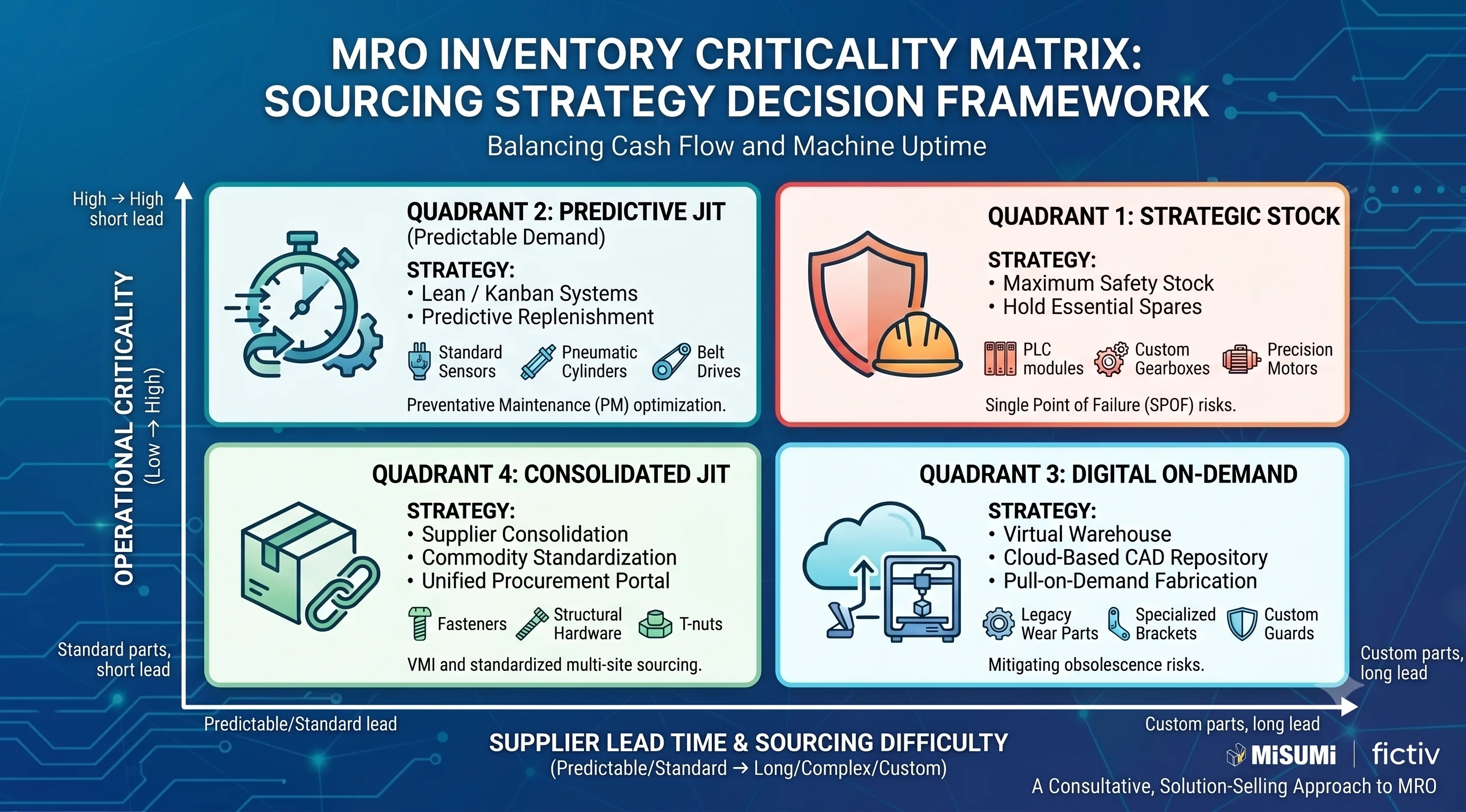
Quadrant 1: High Criticality / Long Lead Time (Strategic Stock)
Component Examples: Main PLC modules, specialized servo motors, custom-machined index tables, proprietary gearboxes.
Strategy: Maximum Safety Stock. These are your single points of failure. Partner with a verified critical spare parts supplier to keep these units in stock on your local shelves, pre-configured and ready for immediate hot-swapping.
Quadrant 2: High Criticality / Short Lead Time (Predictive JIT)
Component Examples: Standard inductive proximity sensors, pneumatic cylinders, modular limit switches, V-belts.
Strategy: Predictive JIT / Kanban. Because these parts are readily available from an industrial spare parts supplier with overnight delivery, you can maintain minimal on-site stock. Use automated reorder points based on consumption rates.
Quadrant 3: Low Criticality / Long Lead Time (Digital On-Demand)
Component Examples: Legacy wear plates, custom structural brackets, specialized safety guards.
Strategy: Virtual Warehousing & Digital Inventory. Storing components for years on a shelf wastes valuable floor space and risks material degradation. The modern alternative is to optimize the procurement of spare MRO parts by preserving verified, production-ready CAD models within a digital manufacturing ecosystem. When an automated inspection or preventative maintenance cycle flags a wear threshold, the digital twin file is pulled and fabricated on demand—arriving precisely when the scheduled replacement window opens.
Quadrant 4: Low Criticality / Short Lead Time (Consolidated JIT)
Component Examples: Structural aluminum extrusions, T-nuts, generic fasteners, fluid power fittings.
Strategy: Pure JIT / Vendor-Managed Inventory (VMI). Consolidate these parts into a single supplier’s digital portal to automate replenishment and strip out administrative overhead.
Calculating the Sweet Spot: The Safety Stock Formula
For your Quadrant 1 and Quadrant 2 components, guessing how many spares to keep on hand is an invitation for operational failure. Engineering and procurement should collaborate to calculate precise safety stock levels using historical lead times and usage data:
Safety Stock = (Maximum Lead Time x Maximum Daily Usage) – (Avg Lead Time x Avg Daily Usage)
Example Scenario: A specialized linear actuator configuration has an average vendor lead time of 5 days, but severe global supply chain disruptions can push it to 12. Your multi-site facility uses an average of 2 actuators per day across all active lines, but during a major deployment or high-wear season, consumption can spike to 5 per day.
Safety Stock = (12 x 5) – (5 x 2) = 60 – 10 = 50
By keeping 50 units in reserve, the plant completely insulates itself from worst-case lead-time spikes without hoarding hundreds of unnecessary components.
Eliminating the Panic Metric: Avoiding Emergency Sourcing
When an asset fails and the required replacement part is nowhere to be found on-site, procurement teams enter panic-buying mode. Relying on an unvetted emergency spare parts broker or a generic discontinued industrial parts supplier frequently leads to inflated premiums, unverified part conditions, and erratic delivery dates.
True JIT efficiency means establishing a pre-negotiated, digitally integrated pipeline with a reliable partner before failure ever occurs. This turns your purchasing flow from an emergency rescue operation into a streamlined, predictable transaction.
Executing Agile MRO Sourcing via MISUMI x Fictiv
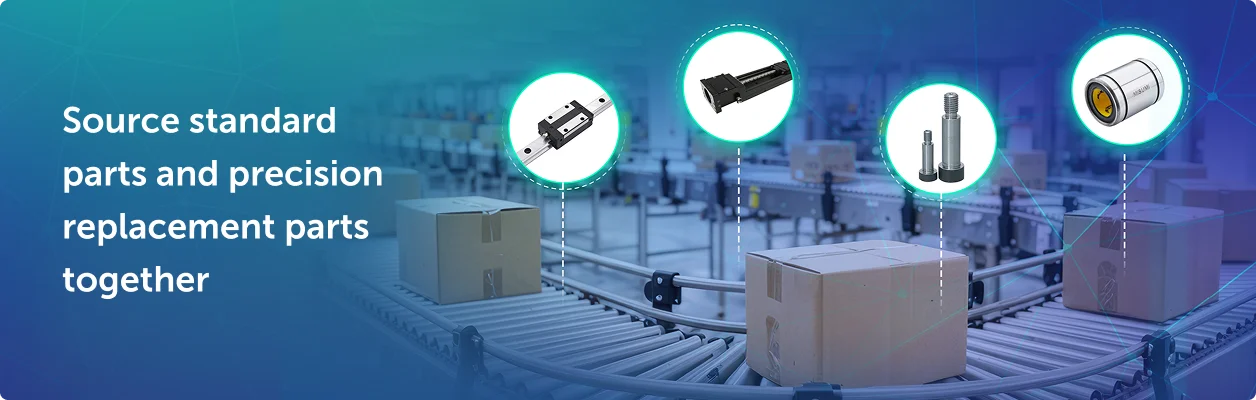
The most effective way to shrink your physical inventory footprint without increasing your downtime risk is to compress your supplier’s manufacturing and shipping lead times. The co-branded ecosystem of MISUMI and Fictiv provides the exact framework needed to make a hybrid JIT strategy work at scale.
Compressing Standard Lead Times (MISUMI): MISUMI’s ability to instantly configure standard automation components (like shafts, blocks, and pins) to precise millimeter increments provides the ultimate backbone for Quadrant 2 JIT strategies. Engineers get exact-fit parts, and procurement can rely on a massive, highly synchronized MRO distribution network that delivers configured components with remarkable speed.
Compressing Custom Lead Times (Fictiv): For Quadrant 3 components where parts are complex, custom, or obsolete, Fictiv’s cloud-driven digital manufacturing ecosystem acts as a virtual warehouse. Instead of storing physical steel and aluminum brackets that might rust on a shelf for five years, you store the digital twin file. When a replacement is needed, Fictiv’s advanced automated quoting and global network of highly vetted manufacturing partners deliver high-precision CNC-machined or 3D-printed parts on demand with a fast turnaround.
By integrating MISUMI’s component configuration capabilities with Fictiv’s agile manufacturing engine, you can scale operations confidently, reduce physical warehouse overhead, optimize cash flow, and ensure your factory floor is always protected by a reliable, high-velocity supply chain.
Optimize Your Multi-Site MRO Supply Chain
Stop letting single points of failure dictate your plant’s profitability. Speak with an industrial MRO supplier specialist today to transition from a reactive break-fix model to an optimized, hybrid JIT sourcing framework.
Build Your Virtual Spare Parts Warehouse
Don’t let physical storage overhead drain your working capital. Gain instant access to a massive catalog of configurable automation components and on-demand custom manufacturing.
Frequently Asked Questions (FAQs) About MRO Inventory Management
What is the main difference between JIT and safety stock in MRO inventory management?
Just-in-Time (JIT) is a lean strategy where parts are ordered and delivered only as they are needed for maintenance or planned replacements, minimizing warehousing overhead. Safety stock is a risk-mitigation strategy where an explicit buffer of critical spares is held on-site to protect against unpredictable machine breakdowns or supply chain delays. An optimized MRO strategy uses a hybrid approach, applying JIT to high-availability parts and safety stock to single points of failure.
How do you determine which factory automation parts should be kept as safety stock versus JIT?
Parts should be categorized using an MRO Criticality Matrix based on two factors: operational criticality (how fast the line stops if the part fails) and supplier lead time (how hard it is to get a replacement). High-criticality, long-lead items (like custom gearboxes or PLCs) must be kept as physical safety stock. Low-criticality or highly standardized items (like generic fasteners or standard proximity sensors) are ideal candidates for JIT.
What are the hidden carrying costs of an unoptimized MRO storeroom?
Holding physical inventory isn’t free. On average, the annual carrying cost of an MRO storeroom is 20% to 30% of its total inventory value. These hidden expenses include:
- Storage footprint overhead (rent, climate control, lighting).
- Labor and tracking software required to audit and manage the stock.
- Depreciation and obsolescence (parts degrading over time or becoming useless when machinery is upgraded).
Can a digital manufacturing ecosystem completely replace physical spare parts inventory?
Not completely, but it can drastically reduce it for low-wear or custom legacy components. By keeping a “digital twin” catalog (verified CAD files) with a digital manufacturing partner like Fictiv, you eliminate the need to pre-fabricate and store bulky or expensive custom brackets, guards, and plates. When a PM cycle indicates that a part is nearing its end of life, the digital file can be pulled and manufactured on demand, arriving just before the replacement is scheduled.
How does multi-site component standardization lower inventory procurement costs?
When multiple manufacturing facilities standardize their automation components, it creates inventory interoperability. Instead of three different plants holding three separate, expensive safety stocks for slightly different actuator brands, they share a single, pre-approved component matrix. If Plant A has an emergency stockout, they can hot-swap a part overnight from Plant B’s inventory, reducing total corporate capital lockup while maximizing collective uptime.