





As part of MISUMI’s continued investment in digital manufacturing, meviy’s custom quoting and sourcing capabilities are being consolidated into Fictiv, now a MISUMI company.
This article is designed to help you understand workflow differences and transfer your existing meviy parts to Fictiv so you can continue working with minimal disruption.
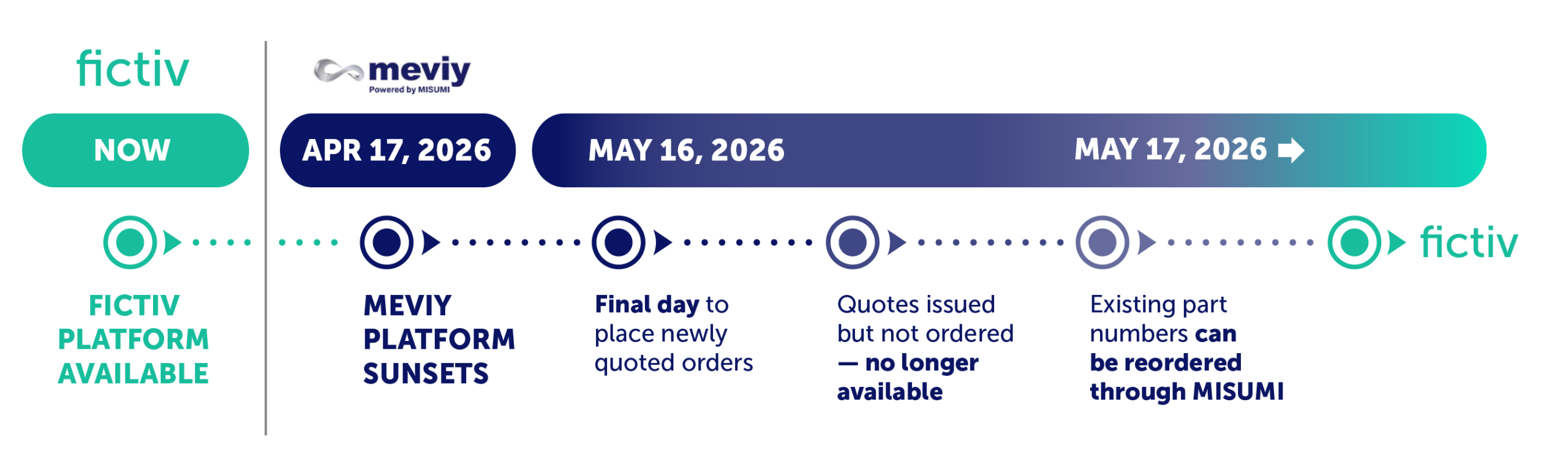
Key dates for the meviy transition
- Standalone meviy service ends: April 17, 2026
- Final day to place newly quoted orders on meviy: May 16, 2026
- On May 16, 2026, all part numbers issued by US-meviy that have not been ordered will be deleted from the product system, making them inaccessible.
- After May 16, 2026, existing part numbers previously ordered can be reordered through MISUMI.
- Fictiv platform: Available now
Until May 16, 2026, newly quoted orders can still be placed through meviy. After that, only previously ordered part numbers can be reordered—new projects and future workflows should be transitioned to Fictiv.
Preparing for the transition
To ensure continuity, download your 2D drawings from meviy before April 17 to retain your design documentation. The meviy interface will be disabled after that date, though support will remain available through May 16 if you need assistance.
You do not need to migrate all existing parts at once—many customers continue reordering existing parts through MISUMI while using Fictiv for new or updated designs. As you transition, review your active and upcoming projects and begin uploading new designs to Fictiv as soon as possible.
Watch the video on how to download your 2D drawings on meviy for step-by-step guidance.
Getting started with Fictiv
If you have used meviy before, the transition to Fictiv will feel familiar. The core workflow of uploading a CAD file, receiving an instant quote, reviewing DFM feedback, and placing an order remains the same.
Fictiv extends this workflow across more processes, regions, and production stages, allowing you to manage more of your manufacturing needs within a single platform. The enhanced offering is live now. meviy will be shut down on April 17, 2026.
To get started on Fictiv:
- Go to Fictiv.com
- Create your account
- Upload a CAD file to receive a quote
- Review pricing, lead times, and DFM feedback
- Place your order
Fictiv provides an AI-powered quoting experience similar to meviy, with expanded capabilities and global sourcing options.
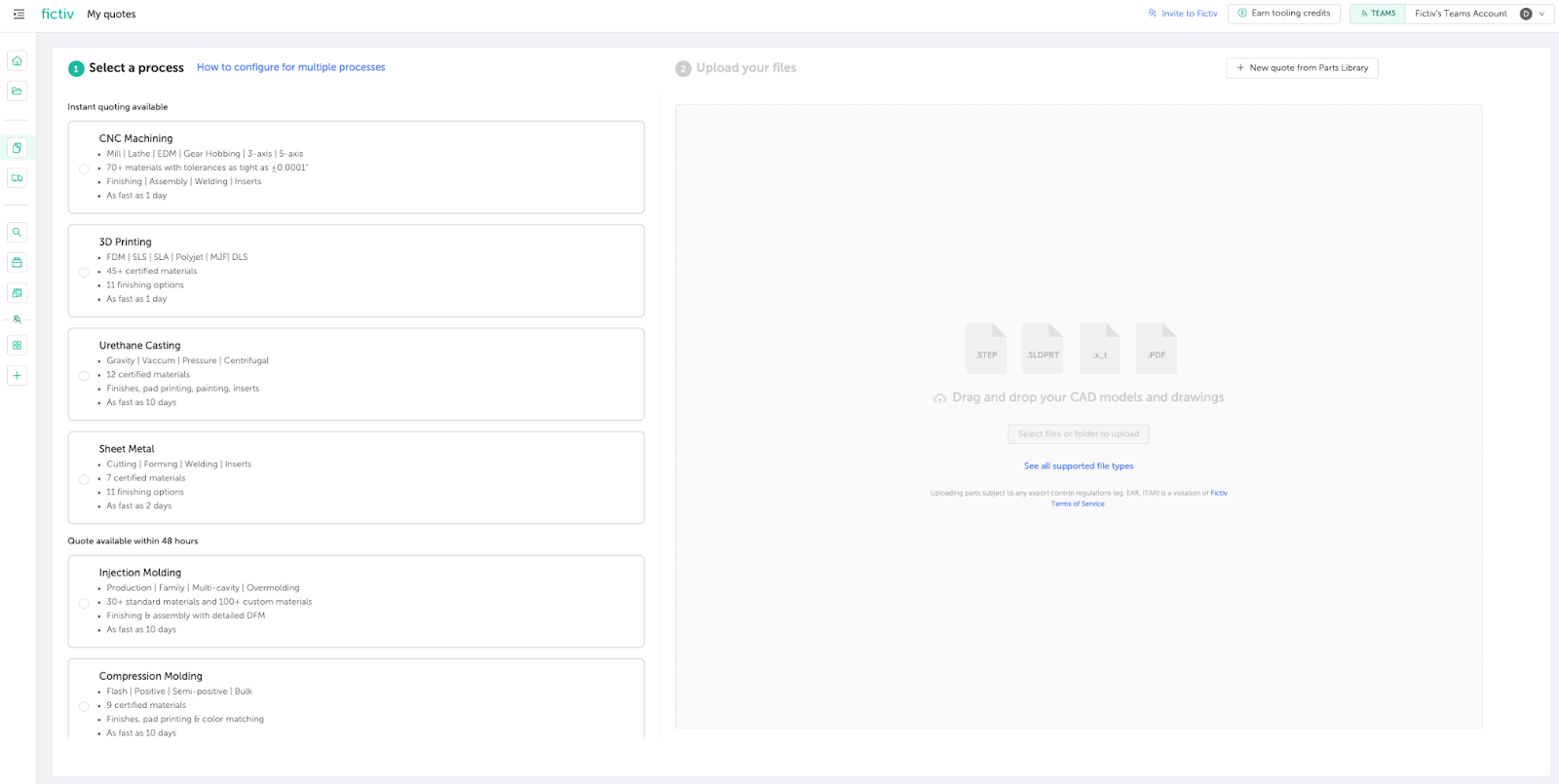
Getting an instant quote from a CAD file
With meviy, you uploaded a CAD file to receive instant pricing and manufacturability feedback.
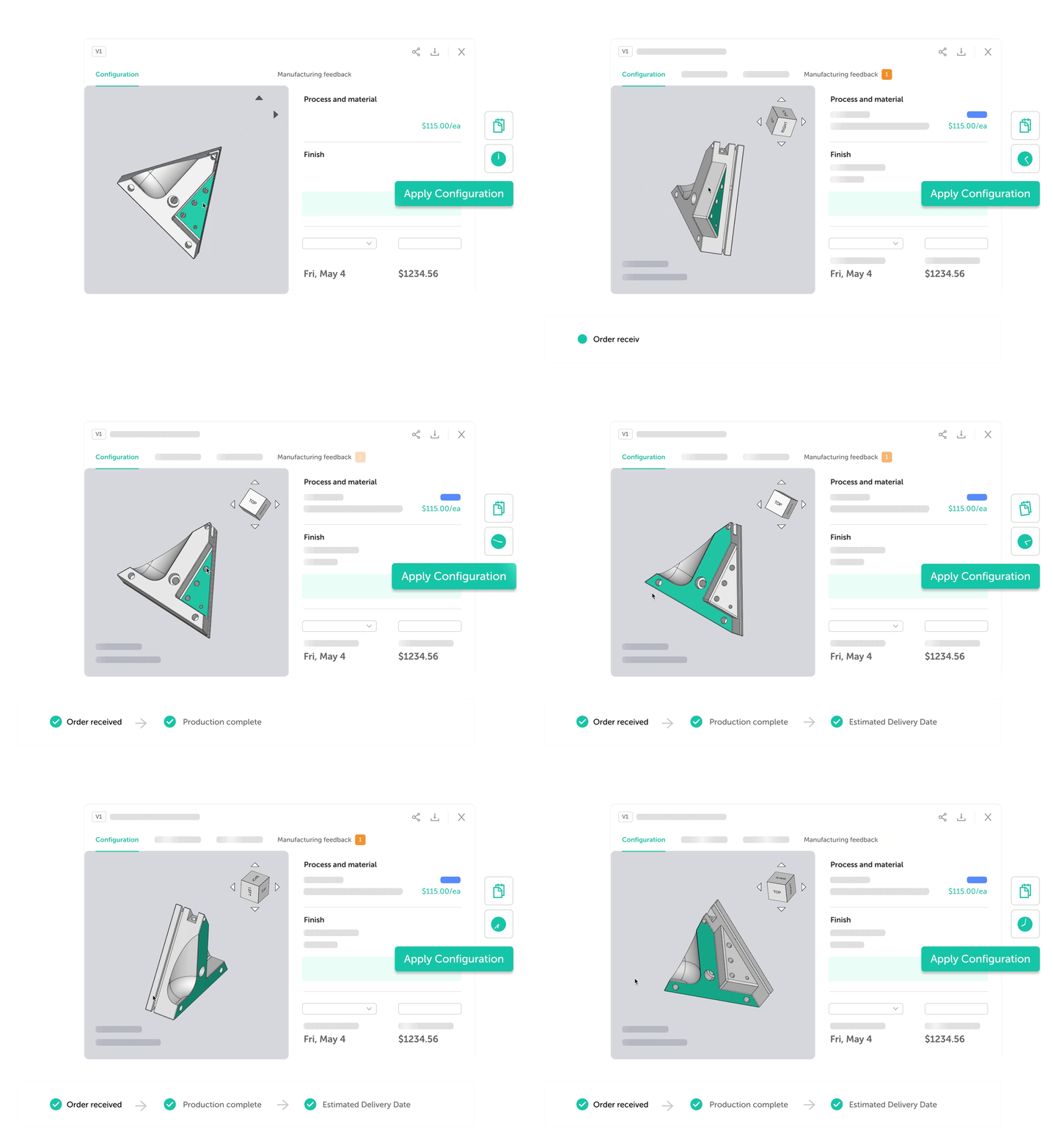
With Fictiv, upload your CAD files to receive instant pricing, lead time options, and automated DFM feedback. You can add and adjust materials, finishes, threads, and quantities in real time within the quote interface.
The core workflow remains the same, with expanded capabilities, additional configurability, and full support from prototype to production.
Working with 2D drawings
With meviy, quotes were based solely on 3D CAD data, and 2D drawings could be downloaded for recordkeeping and reuse.
With Fictiv, you have the option to upload 2D drawings along with your CAD files during the quoting process. We recommend including drawings to communicate critical specifications such as tolerances, finishes, threads, and notes to manufacturing partners. While the Fictiv platform does offer drawing annotation, we advise defining specific tolerances in your exported drawing associated with the 3D file.
The workflow for 3D files remains largely the same, with the additional option of using 2D drawings as a source of truth for manufacturing requirements during quoting. Standard threads can be configured in the Fictiv platform during quoting, and custom or non-standard threads can be included in a 2D drawing. You can also retain and manage your documentation within your project workspace for future reference and reorders.
Defining tolerances
With meviy, tolerances were typically defined directly within the 3D model, without the option to provide a separate 2D drawing for additional specification.
With Fictiv, you can define tolerances in multiple ways. If you upload a 2D drawing for an instant quote, you can specify only critical tolerances and annotate key features while allowing non-critical dimensions to follow standard defaults.
If no drawing is provided, tolerances are applied automatically based on ISO 2768-m (medium) general tolerance standards—which provide a broad default tolerance range—unless tighter tolerances are specified. This gives you flexibility to control cost and manufacturability by tightening only the features that matter, rather than applying unnecessary precision across the entire part.
Ordering CNC-machined parts
With meviy, CNC machining was available with limited regional sourcing.
With Fictiv, upload your CAD file and select CNC Machining. You gain access to CNC milling and turning, complex geometries, with tolerances down to ±5 microns, and four global regions. Same basic process; faster lead times, expanded precision, and more sourcing flexibility.
Sourcing sheet metal parts
With meviy, sheet metal fabrication was available through the quoting interface.
With Fictiv, upload your design and select Sheet Metal. You can configure materials, thickness (metric or gauge), finishes, and forming options. DFM feedback is provided for bends, holes, and tolerances.
Ordering 3D printed parts
meviy did not offer additive manufacturing or 3D printing capabilities.
With Fictiv, you can choose from FDM/FFF, SLS, SLA, PolyJet, and MJF technologies, and compare materials and finishes directly within the quoting interface. This expands your available options while maintaining a familiar quoting process.
Ordering injection molded parts
With meviy, injection molding capabilities were unavailable.
With Fictiv, upload your CAD file and select Injection Molding to receive an instant quote or RFQ that includes tooling and part pricing. You can configure materials, quantities, finishes, and production volumes directly within the platform, with DFM feedback focused on moldability and tooling considerations.
Moving from prototype to production
meviy was optimized for low-volume production.
Fictiv allows you to manage the full product lifecycle within the platform and use the same part to scale from prototype to bridge production to full production. Additional processes include injection molding with auto-quoting, die casting, urethane casting, and assembly services.
Managing multiple parts or projects
With meviy, quoting was typically done per individual part.
With Fictiv, you can upload and manage multiple parts within a single workspace. You can track quotes, orders, and production status, and collaborate across teams with shared project-level visibility.
Improving manufacturability
With meviy, manufacturability checks were more limited.
Fictiv provides real-time DFM feedback during quoting, with the option for additional review from Fictiv engineers. This helps you identify and resolve any issues before placing an order.
Reordering parts
With meviy, you reordered using saved part numbers.
With Fictiv, you can reorder directly from your quote or order history, and adjust quantities or specifications as needed.
Existing meviy part numbers can still be reordered through MISUMI, but new work should be transitioned to Fictiv.
Understanding differences in workflow, pricing, and lead times
As you transition from meviy to Fictiv, you may notice some differences in how quoting, pricing, and sourcing are structured. The guidance below can help you adapt your workflows.
Workflow differences
meviy is structured around a quoting-to-catalog model, where uploaded CAD models are converted into standardized MISUMI part numbers for integration into ERP and procurement systems.
Fictiv is designed around a project-based sourcing workflow. Instead of generating catalog part numbers, you upload designs, configure requirements, and manage quotes and orders within a centralized workspace.
meviy was optimized for lower-complexity parts (e.g., parts requiring fewer setups), while Fictiv supports a wider range of geometries and manufacturing complexity (e.g., 5-axis parts and spline surfaces). As part complexity increases, you may see differences in how parts are quoted and reviewed.
If you rely on standardized part reuse, you can achieve a similar outcome in Fictiv by maintaining consistent file naming, version control, and reordering from your quote or order history.
Pricing for low quantities
Some customers may observe higher pricing in the Fictiv platform for very low quantities (e.g., under 5), depending on the process, geometry, and material.
To optimize cost, consider:
- Adjusting material selection (for example, 1018 steel instead of 1045 steel)
- Increasing quantity to distribute setup costs
- Reviewing DFM feedback to simplify machining complexity
- Exploring alternate processes if applicable
Material substitutions such as 1018 steel may result in cost differences of approximately ±10%, depending on the application.
Material availability and equivalents
Material naming and availability may differ by region. For example:
- 1045 steel is a common U.S. specification
- Equivalent materials (such as #45 steel in China) may be available or becoming available depending on region
Selecting regionally common materials can help reduce cost and improve lead times.
Lead time and sourcing regions
meviy’s sourcing has primarily been fulfilled from Japan. When comparing lead times and pricing, the most equivalent comparison on Fictiv is to select overseas manufacturing regions.
Fictiv offers sourcing across the U.S., Mexico, China, and India. Choosing an overseas region can often provide more competitive pricing and lead times comparable to previous meviy orders.
Available capabilities on Fictiv
Fictiv supports all core meviy workflows and includes expanded capabilities:
- CNC machining, including 5-axis and turning
- 3D printing (SLS, SLA, MJF, PolyJet, FDM)
- Sheet metal fabrication
- Injection molding and compression molding
- Die casting and urethane casting
- Welding and assembly
- Supply chain and production management
Get started by signing up with Fictiv and uploading your CAD files.
Need more help?
If you need help transitioning to Fictiv or reviewing these new capabilities for your projects, contact us—we’ll walk you through it one-on-one.