



Time to read: 8 min
One of the biggest misconceptions about AI in manufacturing is that its primary purpose is factory automation. In practice, the most immediate impact of AI is happening much earlier in the product lifecycle—inside engineering, sourcing, manufacturability analysis, and production planning workflows.
For many engineering teams, the term “AI-powered manufacturing” still feels abstract. Most conversations around AI focus on futuristic automation, robotics, or fully autonomous factories. In reality, AI’s biggest impact is much more practical: helping engineers move from design to production faster, with fewer bottlenecks, less sourcing friction, and better manufacturing outcomes.
To move past the buzzword, these platforms are driven by a hybrid of machine learning models and rule-based algorithms to simplify sourcing and accelerate design for manufacturing.
AI Isn’t Replacing Engineering—It’s Becoming Infrastructure
AI-driven digital manufacturing platforms are increasingly functioning as engineering infrastructure. They connect design, manufacturability analysis, sourcing, quoting, production planning, and supply chain coordination into unified workflows.
Instead of replacing engineering expertise, these systems reduce repetitive operational bottlenecks that slow product development. Engineers still define product architecture, material requirements, tolerances, and performance objectives. AI accelerates the path from those decisions to manufacturable, production-ready outcomes.
As hardware development becomes more complex and launch timelines continue to compress, that infrastructure layer is becoming increasingly important.
Engineering teams are expected to iterate quickly, manage compressed launch timelines, navigate global supply chain volatility, and scale products efficiently from prototype to production. At the same time, manufacturing workflows remain highly fragmented across CAD tools, suppliers, quoting systems, spreadsheets, and disconnected procurement processes.
That fragmentation creates friction throughout product development. Engineers spend valuable time waiting for quotes, reviewing manufacturability feedback, coordinating suppliers, and resolving production issues that often could have been identified earlier in the design cycle.
AI-driven digital manufacturing platforms solve those problems by connecting engineering, sourcing, manufacturability analysis, and production execution into a unified workflow.
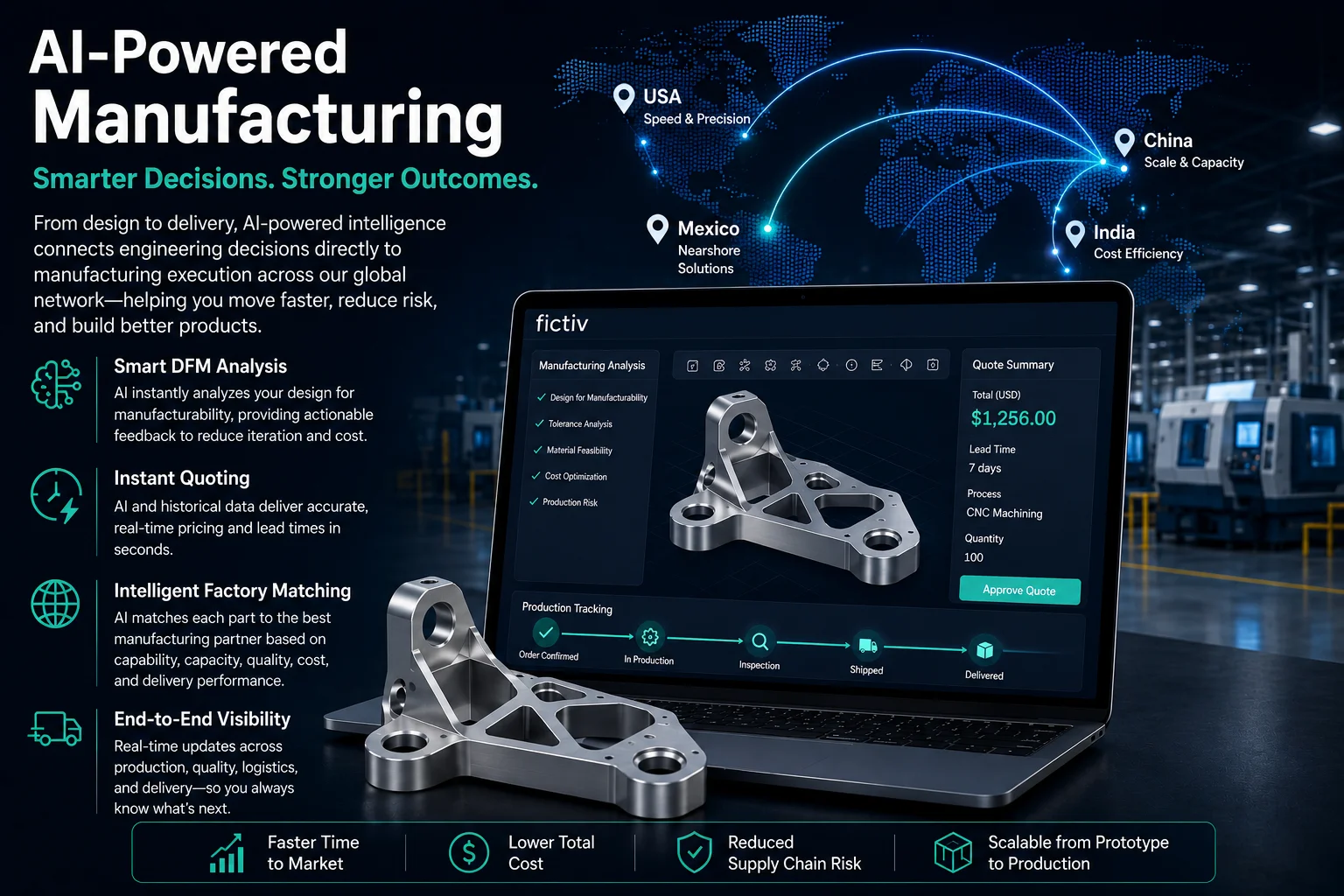
Why Traditional Manufacturing Workflows Slow Engineering Teams Down
Most engineering organizations still operate across disconnected systems and supplier networks. A typical workflow may involve separate CAD environments, manual DFM reviews, email-based supplier communication, disconnected quoting tools, and limited visibility into manufacturing constraints.
As designs evolve, teams burn time coordinating logistics—managing supplier feedback, chasing manufacturability revisions, confirming material selections, and waiting on procurement approvals.
The result is a development process filled with delays:
- Quoting cycles that take days or weeks
- Late-stage manufacturability surprises
- Supplier inconsistencies
- Revision-control issues
- Production bottlenecks that slow launches
AI-driven manufacturing platforms reduce that friction by connecting engineering decisions directly to manufacturing intelligence and supply chain execution.
What Makes a Manufacturing Platform “AI-Driven”?
An AI-driven manufacturing platform is much more than an online quoting portal. The most advanced systems use machine learning, manufacturing data, automation, and real-time analysis to improve engineering workflows throughout the product lifecycle.
Rather than relying entirely on manual supplier review, these platforms can automatically analyze manufacturability, recommend materials, flag production risks, and accelerate sourcing decisions.
The point isn’t to replace engineering expertise. It’s to eliminate repetitive workflow bottlenecks so engineers can spend more time building products and less time managing manufacturing logistics.
How AI Improves Material Selection
One of the earliest and most important engineering decisions is material selection. Engineers must balance strength, weight, machinability, thermal resistance, chemical compatibility, cost, and production scalability.
Traditionally, that process requires extensive manual research and supplier consultation.

AI-powered tools like Materials.AI simplify that workflow by allowing engineers to define either mechanical property requirements or intended application goals. The system can recommend ranked material options while highlighting trade-offs between performance, manufacturability, lead time, and cost.
For example, a robotics engineer designing an end effector may need a material that offers high stiffness, lightweight performance, dimensional stability, and wear resistance.
Instead of manually comparing dozens of materials across multiple supplier databases, AI-driven systems can quickly surface viable options and explain why certain materials may be better suited for the intended operating environment—reducing the likelihood of costly downstream redesigns
How AI-Driven DFM Analysis Accelerates Product Development
Design for Manufacturability (DFM) has traditionally been one of the slowest parts of hardware development. Engineers often wait days for suppliers to review part geometry and identify manufacturing risks.
AI-driven DFM analysis changes that workflow entirely. Modern digital manufacturing platforms now provide real-time manufacturability feedback for CNC machining, 3D printing, injection molding, casting, sheet metal fabrication, and more.
As engineers upload CAD models, automated DFM systems can immediately detect issues such as:
- Unmachinable features
- Excessive tolerances
- Wall thickness inconsistencies
- Undercuts
- Inaccessible tool paths
- Tooling concerns
This allows engineers to identify problems much earlier in the design cycle, when changes are faster and less expensive to implement.
For injection molding specifically, automated DFM tools can evaluate draft angles, sink risk, rib geometry, gate placement, and tooling complexity—resulting in stronger production readiness before tooling even begins.
AI-Powered Instant Quoting Accelerates Product Development
AI-driven instant quoting engines are taking manufacturing from a sequential workflow into a continuous engineering feedback loop. Engineers can evaluate manufacturability, cost, lead time, and process tradeoffs while designs are still evolving, instead of waiting for suppliers to weigh in.
Using historical manufacturing data, production simulations, process intelligence, and real-time manufacturing capacity information, modern platforms can generate quick pricing and lead-time estimates for CNC machining, injection molding, sheet metal fabrication, and casting.
A great example of impact is instant injection molding quoting, which historically required lengthy tooling reviews and extensive supplier consultation. AI-powered quoting systems now slash quote timelines from weeks to seconds.
Instead of treating manufacturing feedback as a late-stage activity, engineers can evaluate production trade-offs continuously throughout development. Teams can compare materials, geometries, manufacturing processes, and production volumes in real time while optimizing designs for manufacturability and cost.
Automated 2D Engineering Drawing Generation and Analysis
Even as manufacturing becomes increasingly digital, 2D drawings remain essential for many production programs.
Engineering drawings often contain critical information, including tolerance callouts, inspection notes, finishing requirements, material specifications, and assembly instructions. Manual review and interpretation of these details create a major operational load, especially for high-mix manufacturing environments.
2D drawing automation tools help streamline the process by programmatically extracting text and automating:
- Automated Tolerance Detection: Scanning and extracting complex tolerance requirements directly from the drawing text and symbols.
- Auto-Configuration: Automatically applying those extracted drawing requirements directly to the digital manufacturing quote to reduce manual data entry.
- Drawing and Configuration Reconciliation: Programmatically cross-referencing the 2D drawing against the 3D CAD model to flag mismatches in revisions, thread counts, or geometries before production begins.
- Engineering drawing annotations: Capturing critical manufacturing notes, finishing requirements, and inspection points to ensure absolute quoting accuracy.
For complex assemblies, that translates directly to faster manufacturing readiness and more consistent output across suppliers.
Intelligent Factory Matching Across Global Manufacturing Networks
While modern manufacturing is increasingly global, managing distributed supplier networks can quickly become operationally overwhelming. One of the most valuable applications of AI in manufacturing is intelligent factory matching.
Rather than manually routing RFQs across disconnected suppliers, AI-driven platforms can automatically evaluate manufacturing requirements and select the most appropriate production center from a global manufacturing network across the United States, Mexico, India, and China.
Beyond factory selection, AI-driven manufacturing platforms can also automate production scheduling and coordination with manufacturing partners. Using real-time capacity, lead time, logistics, and supplier performance data, these systems can dynamically route jobs to the manufacturing partners best suited for specific production requirements—balancing speed, cost, regional constraints, and availability as programs scale.
This helps engineering and operations teams improve:
- Production scheduling
- Lead time optimization
- Capacity utilization
- Manufacturing scalability
- Supplier coordination
All of this can be done while reducing manual sourcing and production management overhead.
For engineers, this means less time coordinating suppliers and greater confidence that parts are being routed to facilities optimized for the application. It also improves supply chain resilience by dynamically balancing production across multiple manufacturing regions.
The Future of Digital Manufacturing
The future of manufacturing technology won’t be defined solely by smarter factories. It will also be defined by smarter engineering workflows.
AI-driven digital manufacturing platforms are helping companies reduce friction between design, sourcing, and production by integrating manufacturing and sourcing intelligence directly into the engineering process.
For engineers, this opens the door to faster iteration, better production visibility, fewer manufacturing surprises, and a more scalable path from concept to production.
Companies like Fictiv (now MISUMI Americas) are pushing this evolution forward. In a recent announcement, MISUMI Americas described its broader transformation into an “end-to-end AI-powered supply chain management platform” that integrates intelligence, automation, and quality control across the product lifecycle.
Upload your CAD files and see how Fictiv’s AI-driven manufacturing platform can help accelerate quoting, DFM analysis, sourcing, and production workflows.
Frequently Asked Questions About AI-Driven Manufacturing
What is an AI-driven manufacturing platform?
An AI-driven manufacturing platform uses a hybrid of machine learning and rule-based algorithms to streamline workflows across design, sourcing, manufacturability analysis, quoting, and production. These platforms help engineering teams reduce delays, eliminate manual data entry, and accelerate product development.
How does AI improve 2D drawing and quoting workflows?
Instead of relying on slow, manual reviews, AI-powered tools analyze 2D drawings to automatically extract tolerances, configure quote requirements, parse critical annotations, and reconcile any discrepancies between the 2D drawing and the 3D CAD model.
Can AI help speed up prototype sourcing and quoting?
Yes. AI-driven instant quoting systems can generate near-instant pricing and lead-time estimates for processes like CNC machining, injection molding, sheet metal fabrication, and casting. This helps engineering teams evaluate manufacturing trade-offs much faster than traditional RFQ workflows.
How does supplier matching work if it happens behind the scenes?
The platform’s algorithms automatically analyze your part specifications and technical constraints to identify and route your order to the ideal partner within a global network. This ensures jobs are delivered on time and in-full without requiring you to manually manage vendor selection or capacity sourcing.
What AI-powered manufacturing tools does Fictiv provide for engineers?
Fictiv provides AI-powered tools including automated DFM analysis, instant quoting, thread and automated quote configuration, Materials.AI for material selection, 2D drawing data extraction, and intelligent backend supplier matching.