





Time to read: 9 min
When sourcing parts for an aerospace program, your manufacturing partner’s quality system isn’t a background detail. Components like structural brackets, flight computer housings, and hydraulic manifolds must be manufactured to meet strict requirements. Quality control and assurance determine whether your parts are built to a documented, auditable process—or to whatever standard a supplier happens to apply that day.
Two of the main quality certifications in aerospace and defense sourcing are ISO 9001 and AS9100. They’re related, but frequently confused, and often implemented without much explanation of what they actually require.
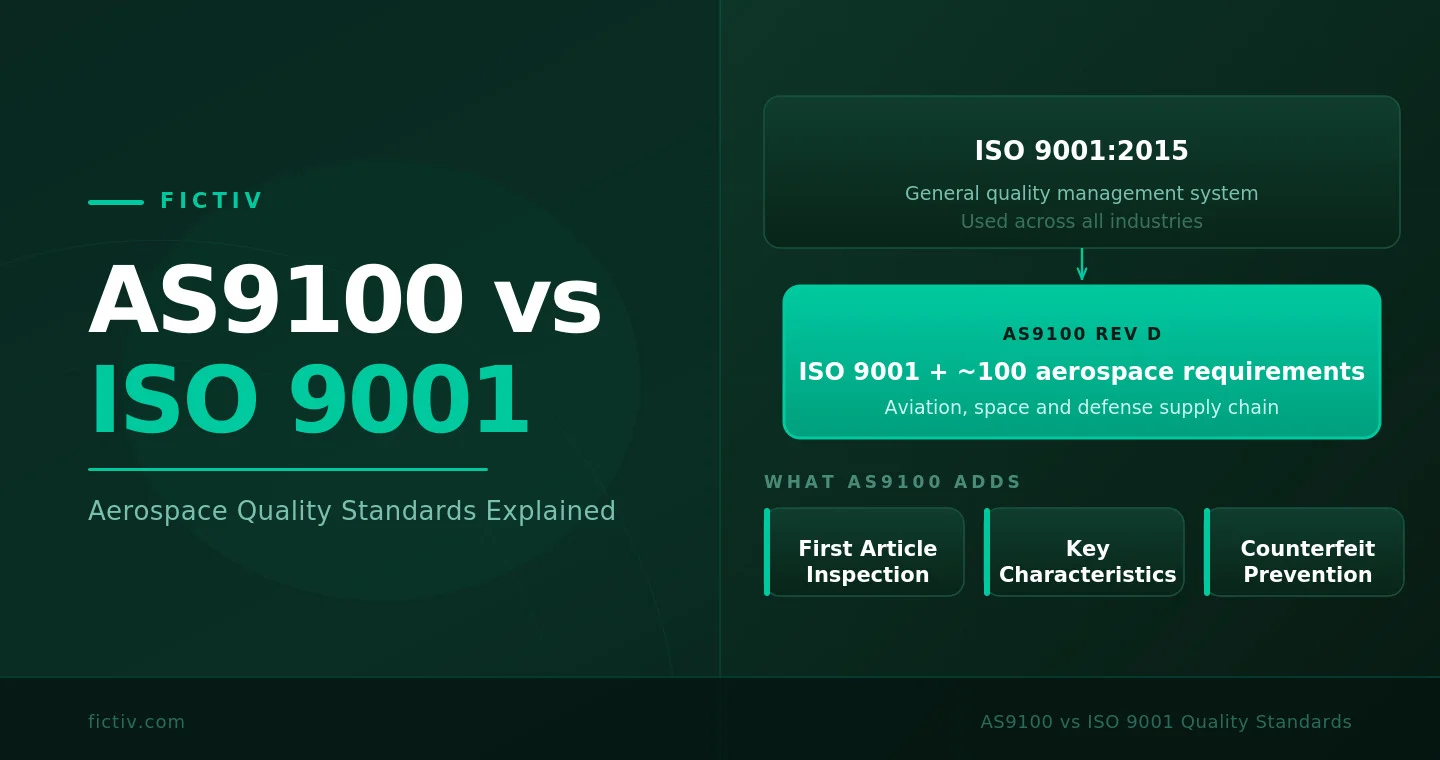
The short answer: ISO 9001 establishes general quality management practices; AS9100 builds on top of it with roughly 100 aerospace-specific requirements—including First Article Inspection, key characteristics tracking, and counterfeit part prevention—that ISO 9001 doesn’t address.
In the rest of this article, we’ll review what each standard covers, how they differ, when each is sufficient, and what to ask a supplier to confirm they’re not just certified on paper but genuinely compliant in their quality control.
What Is ISO 9001?
ISO 9001 is the world’s most widely adopted quality management system (QMS) standard, published by the International Organization for Standardization (ISO). The current version, ISO 9001:2015, has more than 1.3 million certificates issued to organizations in roughly 190 countries, according to the most recent ISO Survey. (A revised edition, expected to be published in September 2026, is currently in development—see note in the section below.)
At its core, ISO 9001 defines what a quality management system must do to consistently deliver products that satisfy customer and regulatory requirements:
- Document control—procedures and work instructions are documented and controlled
- Process management—key processes are defined, monitored, and measured
- Risk-based thinking—potential failures are identified and addressed proactively
- Continual improvement—non-conformances are tracked and corrective actions implemented
- Customer focus—customer requirements are understood and met
ISO 9001 is intentionally industry-agnostic—the same standard applies to a software company, a food manufacturer, and a CNC machine shop. That breadth is its strength globally, and its limitation in sectors with specific technical and safety requirements. Notably, it doesn’t address design verification, first article inspection, configuration management, counterfeit part prevention, or key characteristic tracking. For some commercial manufacturing, those gaps don’t matter as much, but for aerospace components, they matter enormously.
What Is AS9100?
AS9100 is the quality management standard specific to the aviation, space, and defense industries. Published by the International Aerospace Quality Group (IAQG), the current version (AS9100D:2016) is recognized by major aerospace OEMs globally and required by most tier-1 and tier-2 aerospace supply chains.
AS9100 is built on top of ISO 9001: it incorporates every ISO 9001:2015 requirement and adds roughly 100 more that are specific to aerospace. An organization cannot be AS9100 certified without also being ISO 9001 compliant.
Note: Both standards are mid-revision as of this writing. ISO 9001 is undergoing its first major revision since 2015, with publication expected in September 2026. IAQG has confirmed a parallel revision to AS9100—to be rebranded as IA9100—expected to follow in late 2026. Certified organizations typically get a multi-year transition window once a new edition publishes, so Rev D and ISO 9001:2015 remain the active, auditable standards for now.
What AS9100 Adds
Airworthiness requirements: Organizations must understand and maintain awareness of their contribution to product airworthiness, not just dimensional conformance. This includes traceability of parts to their intended application and configuration.
First Article Inspection (FAI): AS9100 Rev D, clause 8.5.1.3, requires organizations to verify that their production process can produce parts meeting requirements—usually satisfied through a First Article Inspection. AS9102 is the SAE-published standard format most organizations use to document this verification, covering part number accountability, materials and special processes, and characteristic accountability. ISO 9001 has no equivalent production process verification requirement.
Key Characteristics (KCs): Features that could significantly affect safety, performance, or fit if they are out of tolerance must be identified, documented, and inspected under controlled procedures distinct from standard dimensional checks.
Configuration management: Changes to design, process, or tooling must be formally controlled and documented with traceability that is more rigorous than ISO 9001’s general document control.
Supply chain flow-down: AS9100 requires certified organizations to flow quality requirements—key characteristics, traceability, right of access for customer and regulatory inspection—down through their own sub-tier suppliers. ISO 9001 has general supplier evaluation requirements but no equivalent aerospace-specific flow-down. Buying AS9100-certified parts means those requirements travel with the part through every tier of the supply chain, not just the main supplier.
Counterfeit part prevention: Active programs are required to keep counterfeit or fraudulent parts out of the supply chain, preventing real aerospace incidents with serious safety consequences.
Structured risk management: ISO 9001 broadly incorporates risk-based thinking; AS9100 requires a more structured approach to product, process, and operational safety risk.
Human factors and FOD prevention: Awareness of human performance limitations and foreign object damage prevention are explicit requirements with no direct ISO 9001 equivalent.
AS9100 vs ISO 9001 Requirements Comparison
| Requirement | ISO 9001:2015 | AS9100 Rev D |
| Quality management system | ✓ | ✓ |
| Process control and documentation | ✓ | ✓ (more rigorous) |
| Customer focus | ✓ | ✓ |
| Risk-based thinking | ✓ | ✓ (structured, aerospace-specific) |
| Continual improvement | ✓ | ✓ |
| First Article Inspection (AS9102) | — | ✓ |
| Key Characteristics identification | — | ✓ |
| Airworthiness awareness | — | ✓ |
| Configuration management | — | ✓ |
| Counterfeit part prevention | — | ✓ |
| FOD prevention | — | ✓ |
| Human factors awareness | — | ✓ |
FAI: The Requirement Buyers Often Underestimate
A complete first article inspection package (per AS9102) documents that part design, manufacturing process, documentation, and inspection records all conform to the engineering definition. It must be redone whenever there’s a significant process change, supplier change, or design revision. An AS9100-certified supplier will have a formal FAI process and records on hand; an ISO 9001-only supplier may or may not, depending on whether they’ve adopted the practice independently.
AS9100 demands stricter traceability: parts must be traceable to their raw material source, manufacturing process records, and inspection data across the supply chain. That traceability is what lets you investigate an in-service failure and withstand airworthiness audits. In practice, that traceability travels with the part as a Certificate of Conformance (CoC) and material test reports (MTRs) documenting heat/lot number, chemical composition, and mechanical properties—not just a pass/fail stamp at the end of the run.

When Is ISO 9001 Sufficient?
Not every aerospace-adjacent program needs AS9100. ISO 9001 is sufficient when:
- The application is non-flight-critical—ground support equipment, test fixtures, lab hardware, non-structural tooling
- The OEM explicitly accepts ISO 9001, sometimes with supplemental customer-specific requirements
- The program is in prototype or pre-production, with a planned transition to AS9100 suppliers for flight hardware
- The part has no key characteristics and isn’t installed in an aircraft or spacecraft
The key questions: does the end application require airworthiness, and does your customer’s supply chain require AS9100 flow-down? If yes to both, ISO 9001 alone isn’t sufficient.
Quality Questions to Ask Your Supplier
Holding a certificate isn’t the same as operating a functioning quality system. Audit cycles are typically annual or tri-annual, leaving windows where systems can erode between checks. Beyond the certificate itself, ask:
What’s the certified scope? AS9100 certificates define specific processes, product types, and sites covered. A shop certified for non-critical structural parts isn’t necessarily certified for flight-critical hydraulic components.
When was the last surveillance audit? If it’s been over 18 months, ask why.
Can I see a sample FAI package? A supplier who’s never executed a real AS9102 FAI isn’t genuinely aerospace-qualified, certificate or not.
How do you identify and track key characteristics? What inspection methods, and where are records stored, for how long?
What’s your counterfeit part prevention program? Where does raw material come from, and is incoming material tested or certified?
What’s your corrective action history? A supplier with no corrective actions ever is either perfect or not tracking non-conformances—neither is reassuring. Documented CARs with closed corrective actions show the system is actually working.
AS9100 vs. Other Aerospace Quality Standards
AS9100 is the standard most engineers encounter, but it’s part of a family:
- AS9100—manufacturers in the aviation, space, and defense supply chain
- AS9110—maintenance, repair, and overhaul (MRO) organizations
- AS9120—distributors of aerospace parts and materials
- NADCAP—not part of the ISO family; covers special processes (heat treatment, NDT, surface finishing, welding) that AS9100 doesn’t address on its own
For most part sourcing programs, AS9100 Rev D is the relevant standard. If parts undergo heat treatment, anodizing, plating, or NDT, verify the supplier holds NADCAP accreditation for those specific processes. Note that AS9100 itself doesn’t require NADCAP—it’s typically the OEM’s own quality clauses, flowed down through the purchase order, that mandate NADCAP accreditation for specific special processes.

Sourcing Certified Aerospace Parts
Fictiv operates with an ISO 9001:2015 Quality Management System and supports aerospace and defense programs through First Article Inspection documentation as a standard order option, material certifications and certificates of conformance, dimensional inspection reports. Our broader manufacturing network includes specialized partners that hold AS9100 Rev D certifications for aerospace and defense applications, and certification requirements can be specified at the part or program level during quoting.
Have an aerospace program that requires quality documentation?
Talk with Fictiv’s manufacturing engineers about your requirements, or upload your CAD file for an instant quote with quality options.

FAQs About AS9100 and ISO 9001
What’s the difference between ISO 9001 and AS9100?
ISO 9001 is a general quality management standard used across all industries. AS9100 is built on top of it, adding roughly 100 aerospace-specific requirements—First Article Inspection, key characteristics tracking, airworthiness awareness, configuration management, and counterfeit part prevention. Every AS9100-certified organization also meets ISO 9001.
Is AS9100 required for all aerospace parts?
No. Flight-critical hardware typically requires it; ground support equipment, test fixtures, and development hardware may be fine with ISO 9001 or customer-specific requirements. The application’s criticality and the customer’s flow-down requirements determine which standard applies.
What is AS9100 Rev D?
The current version of the standard, released in 2016—the fourth major revision, aligned with ISO 9001:2015 and updated for risk management, organizational context, and leadership commitment.
What is a First Article Inspection (FAI) and why does AS9100 require it?
A formal verification that the first production part conforms to the design documentation—geometry, material, process, and paperwork—before the full production run proceeds. AS9100 Rev D requires this production process verification under clause 8.5.1.3; AS9102 is the standard format most organizations use to document it. It catches design-to-production translation errors at the first part rather than after a full lot is built incorrectly. ISO 9001 has no equivalent.
Can a company be AS9100 certified without ISO 9001?
No. AS9100 is built directly on the ISO 9001:2015 framework and incorporates every one of its clauses, so AS9100 certification automatically confirms ISO 9001 compliance—there’s no path to one without the other.