





Time to read: 14 min
A certificate of conformance (CoC) shows up with a parts shipment, and most engineers glance at it, file it away, and move on. That works fine until it doesn’t—if a quality issue traces back to a lot with no traceability, or an auditor asks for evidence that parts were built to the drawing specs and your CoC doesn’t confirm it. At that point, the document that was supposed to protect you becomes a liability.
This guide equips engineers and sourcing managers who want to understand what a CoC actually is, what separates a valid one from a piece of paper, and how to specify it correctly on a purchase order before parts are in the door.
What Is a Certificate of Conformance?
A certificate of conformance (CoC) is a supplier-issued document declaring that a delivered product or lot meets all applicable specifications, drawings, and purchase order requirements.
That definition matters because of what a CoC is not. It is not a material certification, a mill cert, or raw material test report that documents chemical composition and mechanical properties as tested. It is not a dimensional inspection report, which records actual measured values against drawing callouts. It is not a first article inspection report (FAI) or PPAP, which provide objective evidence from measured inspections that a process is capable of producing conforming parts. A CoC is a declaration—not a data package. The supplier is asserting conformance; they are not proving it with measurement data.
Who issues a CoC?
The supplier—typically a quality engineer, quality manager, or authorized signatory with the authority to make conformance declarations on behalf of the manufacturing organization. In a two-tier supply chain, a distributor may issue its own CoC but should pass through or reference the original manufacturer’s CoC as well.
Why does a CoC matter?
It is the first document a receiving inspector should check before parts go to stock. In a supply chain context, a CoC is the minimum documentary evidence that a supplier acknowledged your requirements and is representing that parts were built to them. For regulated industries—aerospace, defense, medical devices—it is also a traceability record that can be called upon during an audit, a failure investigation, or a regulatory inquiry.

Certificate of Conformance vs. Certificate of Conformity—Is There a Difference?
In most commercial and industrial manufacturing contexts, “certificate of conformance” and “certificate of conformity” are used interchangeably. Both refer to the same document: a supplier’s declaration that the delivered product meets specified requirements. If you search for one and find the other, you are looking at the same thing.
There is one context where the distinction carries more weight: CE marking under EU product regulations. In that framework, a Declaration of Conformity (DoC) is a specific, legally defined document that the manufacturer must produce to self-certify that a product meets applicable EU directives. It has mandatory elements defined by regulation and is required for the CE mark to be valid. This is technically distinct from a general-purpose CoC in commercial manufacturing, though the underlying concept—declaring that a product meets requirements—is the same.
In aerospace and defense, some customers and quality management systems prefer one term over the other as a matter of convention, but the document requirements are the same. If you are working on a regulated program, check your contract and your customer’s quality requirements—but do not lose sleep over which term appears on the header of the document.
What a Valid CoC Must Include
The minimum required elements of a certificate of conformance are not arbitrary. Each one serves a specific traceability or verification function, and when one is missing, something downstream breaks.
Statement of conformance to the applicable specification or drawing. This is the core of the document. It should name the specific document or drawing the parts conform to—not a generic statement like “parts meet customer requirements.” The statement should reference your drawing number, the applicable specification, or the purchase order requirements by name.
Part number and revision level. The part number tells you what was ordered; the revision level tells you which version of the drawing or specification it was built to. A CoC with no revision level is nearly useless on any program where drawings are under change control, because you cannot confirm the supplier built to your current requirements rather than an outdated rev.
Purchase order number. This ties the CoC to a specific commercial transaction. Without it, you cannot match the document to a receiving record, an invoice, or a contract.
Quantity. The declared quantity should match the packing list and the purchase order. Discrepancies here are a red flag that the CoC was not issued against the actual shipment.
Lot or serial number. For traceability, particularly in failure investigation or recall scenarios, you need to be able to trace a nonconforming part back to the lot it came from and isolate other parts from that lot. If a CoC has no lot number, that traceability chain is broken.
Supplier name and address. Identifies the entity making the declaration. In a supply chain with brokers or distributors, this also clarifies who actually produced the parts.
Name and title of the authorized signatory. Someone with the authority to make conformance declarations on behalf of the supplier must sign or otherwise authenticate the CoC. A document with no identified signatory is an unsigned declaration.
Date. The date of issuance should align with or follow the ship date. A CoC dated after a known quality event is a significant red flag.
For regulated industries, additional elements are typically required. Aerospace customers commonly require reference to the applicable quality clause from the purchase order, the customer’s name, and in some cases the end-use article the parts will be incorporated into. Medical device supply chains governed by ISO 13485 often require reference to the specific regulatory requirements the product was manufactured under. If you are on a regulated program, do not rely on this baseline list—verify requirements with your quality team and flow them down on the PO.
Common CoC Problems and Red Flags
Lack of Specificity
The most common CoC problem is a document that looks complete but lacks the specificity to be useful. Be aware of a conformance statement that reads something like “this product conforms to all applicable specifications” with no specification named. That’s not a conformance statement—it’s more of a placeholder. At receiving inspection, the check is simple: does the document name the actual drawing number or specification? If not, send it back and request one that does.
Missing Revision Level
A missing rev number is the next most common issue. Suppliers working from outdated drawing files may sometimes produce parts to an older revision without realizing it. A CoC that references the drawing number but not the revision cannot be used to confirm the supplier was working from the right version.
Lack of Lot Traceability
No lot traceability is a problem that only surfaces when it does. If a part fails in the field and you cannot identify the lot, you cannot isolate the population. That turns a contained quality event into a full-inventory hold.
No Signature or Date
An unsigned or undated CoC should be rejected at receiving. A document without a signatory is not a declaration but a draft. A document without a date cannot be placed in time relative to the shipment or any quality event.
Issuance With Unclear Authorization
CoCs issued by someone without clear authority to make conformance declarations are also a risk. On a supplier audit, one of the first questions is whether the person signing the CoC is authorized to do so under the supplier’s quality management system. If you cannot answer that question, the document’s validity is uncertain.
Photocopied or Duplicate CoCs Applied to Multiple Lots
A CoC applied to multiple lots is a related problem. If the same document—same date, same lot number—appears on shipments arriving at different times or in different quantities than the original, it may be a copy applied across multiple lots rather than a document issued against your specific shipment. Cross-reference the lot number, quantity, and date against your receiving records.
Post-Dated Certificates
Finally, watch for post-dated documents—CoCs with issue dates after a known nonconformance or after a customer complaint was opened. This pattern suggests the document was created to close a paperwork gap rather than to document actual conformance at the time of shipment.
How to Specify a CoC on a Purchase Order
The most effective time to define your CoC requirements is before you place the order, not after parts arrive with inadequate documentation.
Start by including CoC as a line item or quality requirement on the PO itself—not a verbal instruction or assumption. Write the requirement explicitly: “A certificate of conformance is required with each shipment, referencing PO number, part number and revision, lot number, quantity, and a statement of conformance to [your drawing number or specification].”
If a specific standard governs your program, reference it. Aerospace programs operating under AS9100 or customer-specific quality requirements should specify which quality clauses are to be flowed down to the supplier. Medical device supply chains governed by ISO 13485 should specify that the CoC must reference the applicable regulatory requirements. If your customer has a specific CoC format requirement, pass it down.
Define the required elements upfront. If you need part lot traceability, say so explicitly. If you need the original manufacturer’s CoC in addition to the distributor’s, state it. If you need the CoC to reference a specific specification or standard by number, include that in the PO language. Suppliers who know exactly what you need are far more likely to provide it correctly than suppliers who are guessing.
Do not assume a supplier’s standard CoC will meet your needs. Many suppliers issue CoCs by default that meet their internal minimum, which may not match your program’s requirements. The gap between their default and your requirement is your problem to close, and the PO is the right place to close it.
When a CoC arrives that doesn’t meet your specified requirements—missing revision level, no lot number, vague conformance statement—reject it at receiving and request a corrected document before parts go to stock. Accepting a non-conforming CoC and filing it creates a documentation gap that cannot be retroactively corrected if a quality event occurs.
CoC vs. Other Quality Documents—When You Need More
A CoC is a declaration. The documents below are additional evidence that many regulated programs need.
| Document | What It Is | What It Contains | When It’s Required |
| Certificate of Conformance | Supplier declaration of conformance | Part number, PO, lot, conformance statement, signatory | Most commercial and regulated shipments |
| Material Certification (Mill Cert) | Test report for raw material | Chemical composition, mechanical properties, heat/lot number | When material traceability is required by spec or drawing |
| First Article Inspection Report (FAI) | Documented inspection of first production part | Measured values for all drawing characteristics, process documentation | New part introductions, drawing changes, AS9102 programs |
| Dimensional Inspection Report | Measured inspection of a sample from a lot | Actual vs. nominal for specified dimensions | When dimensional verification beyond supplier declaration is required |
When a program calls for a CoC, that’s a floor, not a ceiling. A CoC tells you the supplier says the parts are good. A dimensional inspection report, material certification, or FAI tells you what was measured and tested. For flight hardware, implantable medical devices, or any application where failure has serious consequences, the declaration alone is not sufficient—you need the data.
On an FAI or PPAP submission, the CoC is typically one element of a larger package that includes dimensional data, material certifications, and process records. The CoC does not replace those documents; it accompanies them.
Fictiv Manufacturing and Quality Documentation
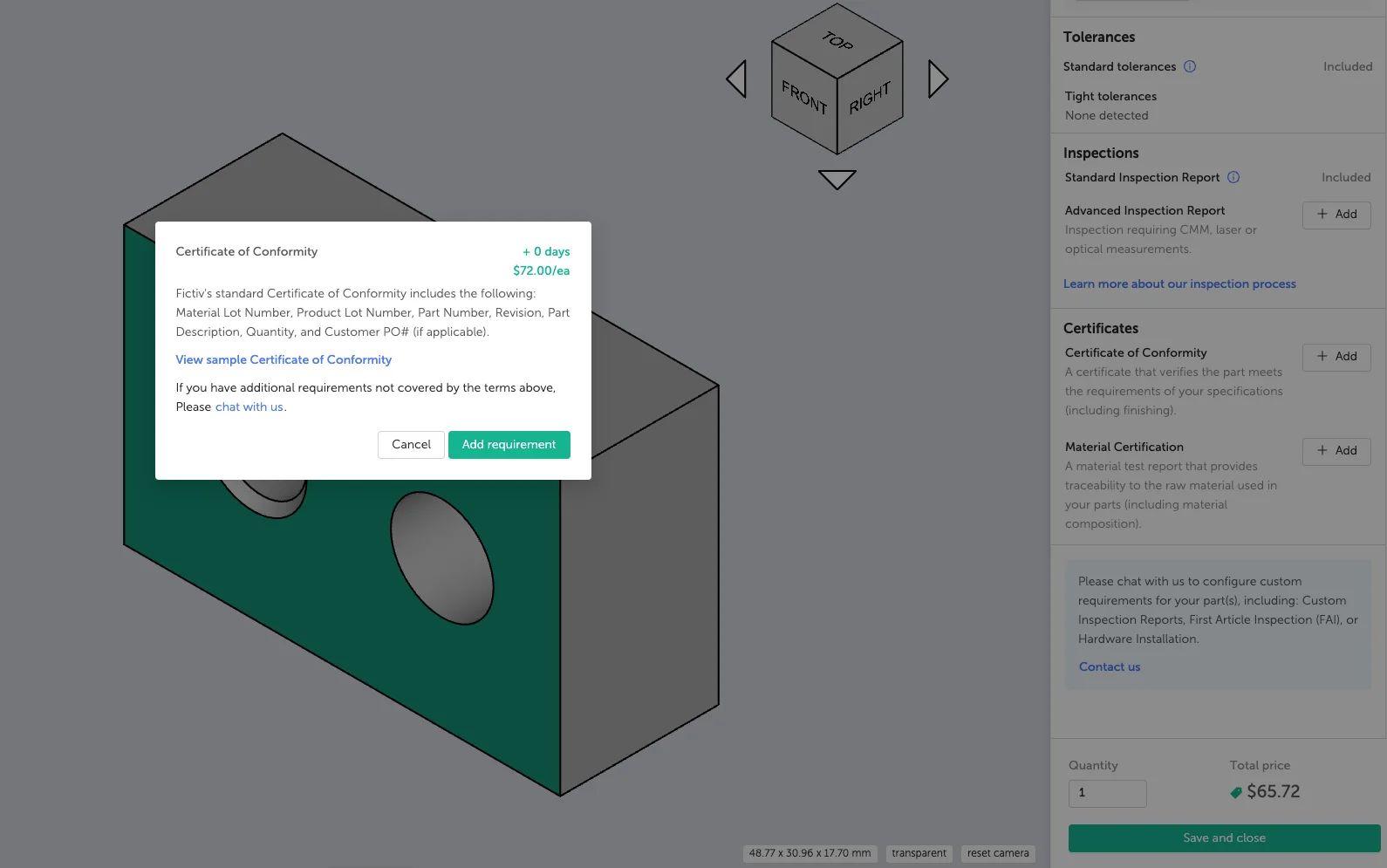
Fictiv’s manufacturing platform supports quality documentation as a standard part of the order workflow. When you order through Fictiv, you can request a certificate of conformance, material certifications, and first article inspection as options at the time of order. CoCs issued through Fictiv reference your part number, revision, PO, lot number, and a conformance statement tied to your drawing or specification. Best practice is to call out the CoC requirement on your drawing, speak with your account executive about your documentation requirements, and request it upfront—requesting after the order is placed may impact lead time.
For teams sourcing parts under ISO 9001 or AS9100 quality requirements, or sourcing components for medical devices, Fictiv’s network of vetted manufacturing partners is qualified to support the documentation requirements those programs demand. If you are evaluating a manufacturing partner and quality documentation is part of your qualification criteria, Fictiv provides visibility into supplier quality systems to support that evaluation.
Contact us about your program’s quality documentation requirements or get a free quote for your next part and configure your requirements at the time of order.
Talk to a Fictiv expert about your project, or upload your parts to start a free quote.
CoC FAQs
What is a certificate of conformance?
A certificate of conformance (CoC) is a supplier-issued document declaring that a delivered product meets all applicable specifications, drawings, and purchase order requirements. It is a declaration of conformance, not a measurement report or inspection record. CoCs are required on most commercial and regulated parts shipments as the baseline documentary evidence of supplier conformance.
What is the difference between a certificate of conformance and a certificate of conformity?
In most commercial manufacturing contexts, the two terms are used interchangeably and refer to the same document. The distinction matters primarily in the EU regulatory context, where a Declaration of Conformity is a specific, legally defined document required for CE marking under applicable EU directives. Outside that regulatory framework, a certificate of conformance and a certificate of conformity describe the same supplier declaration.
What should a certificate of conformance include?
A valid CoC should include the part number and revision level, purchase order number, quantity, lot or serial number, a specific statement of conformance referencing the applicable drawing or specification, the supplier’s name and address, the name and title of the authorized signatory, and the date of issuance. Regulated industries—aerospace, medical—typically require additional elements such as quality clause references or regulatory citations.
When is a certificate of conformance required?
A CoC is required whenever a purchase order or contract specifies it, which covers most commercial hardware procurement and virtually all regulated programs in aerospace, defense, and medical devices. Even when not contractually required, a CoC provides the minimum documentary evidence that a supplier acknowledged and represented conformance to your requirements at the time of shipment.
What is the difference between a CoC and a material certification?
A CoC is a supplier’s declaration that finished parts or assemblies conform to the applicable drawings and specifications. A material certification—often called a mill cert—is a test report documenting the chemical composition and mechanical properties of raw material as tested by the mill or material supplier. They are distinct documents serving different purposes; a CoC does not substitute for a material certification when the drawing or specification requires material traceability.