




Time to read: 12 min
Choosing between custom and configurable components affects product cost, development speed, manufacturability, and scalability. Configurable components offer fast sourcing and low upfront investment, while custom parts enable optimized performance, integration, and differentiation.
Whether you’re planning a new product or optimizing an existing bill of materials, this article explains when to use each approach, how to balance trade-offs across the product lifecycle, and why hybrid strategies can deliver the best outcome.
What Are Configurable Components?
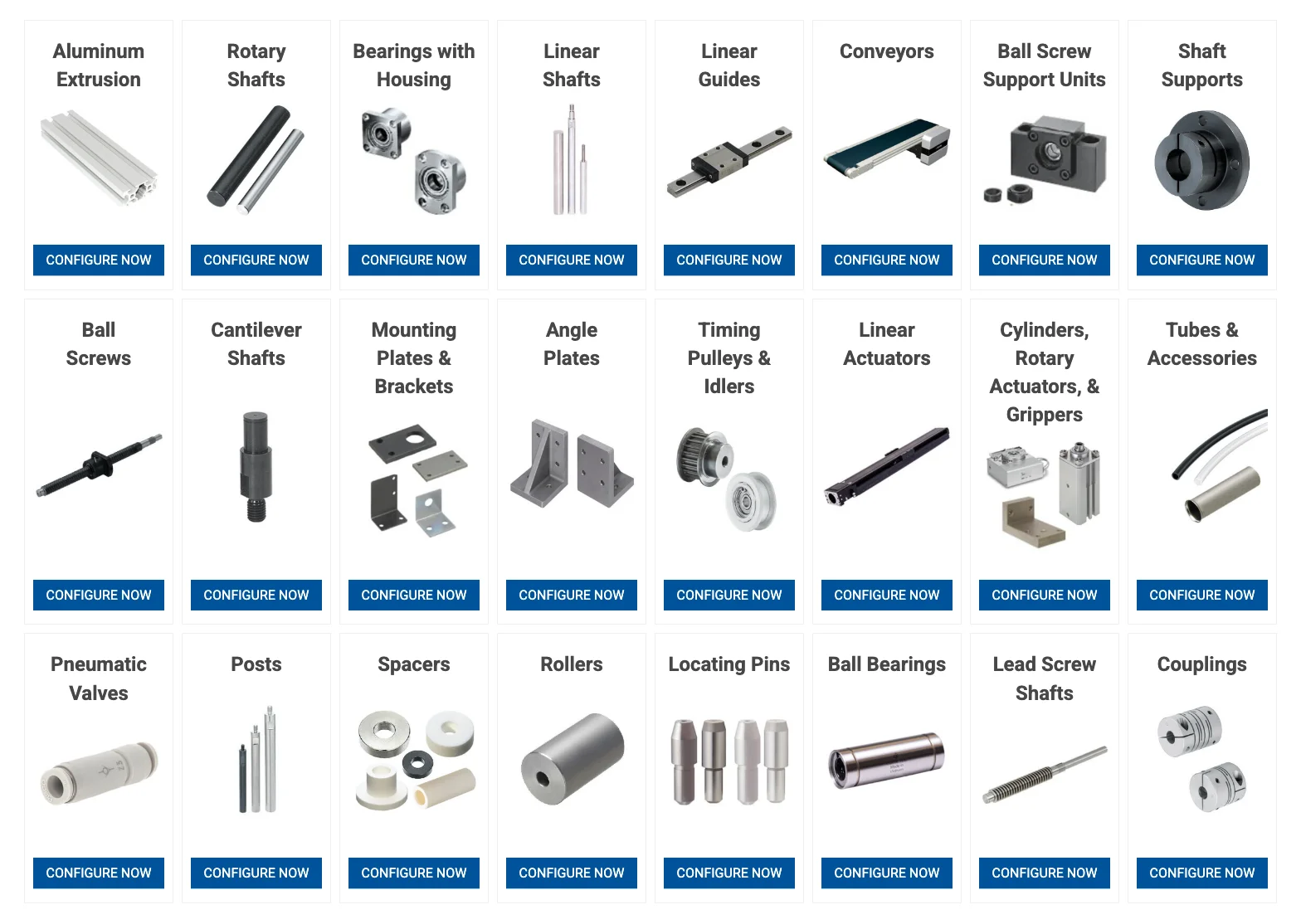
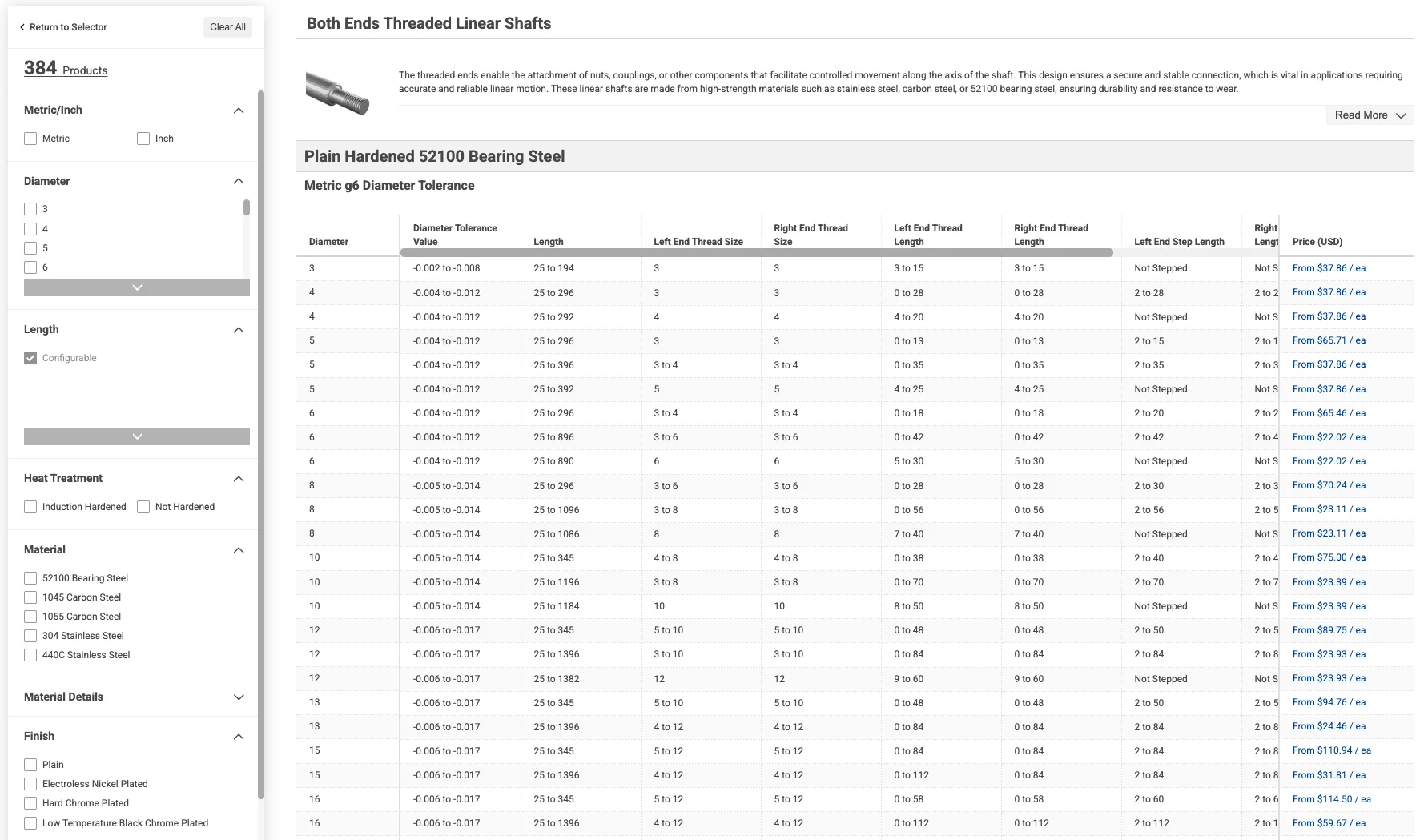
Configurable components are a subset of standard/off-the-shelf components. Unlike fixed catalog parts, configurable components allow engineers to select parameters such as dimensions, materials, finishes, or mounting features within predefined ranges.
Examples include:
- Shafts and fasteners (with selectable length/diameter, material, hardness, and finish)
- Plates with pre-defined hole patterns
- Linear slide-rails and bearings, carriage assemblies, sensor attachments, and trips
- Gearboxes and linkages
- Gears and couplings
- Chain and belt drive systems
What is the Difference Between Custom and Configurable Components?
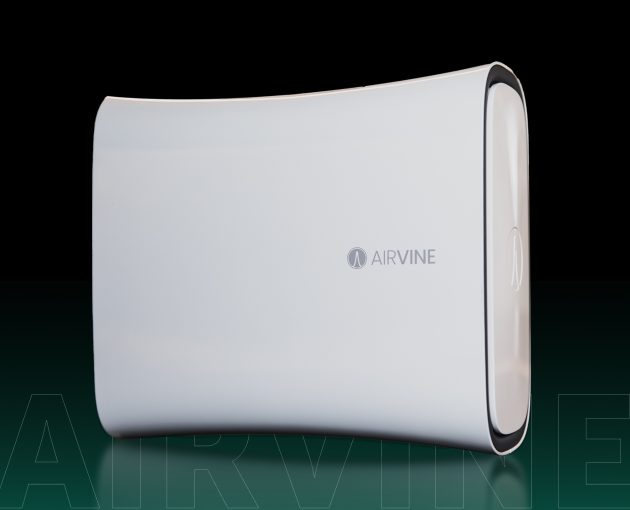
Configurable components are standardized parts with selectable parameters such as dimensions, materials, finishes, or mounting features. Custom components are designed specifically for a product’s unique performance, integration, or manufacturing requirements.
Engineering teams often use configurable components to accelerate prototyping and reduce upfront cost, while custom components are introduced later to optimize performance, simplify assembly, or improve scalability.
Custom components are produced to meet novel specifications—manufactured for your product only and optimized for performance, fit, cost, and part count reduction. They require more engineering effort, higher supplier collaboration, and commitment to tooling and/or non-recurring engineering (NRE).
The table below lists core decision factors between custom and configurable parts. The choice requires tradeoffs in speed vs. flexibility and upfront cost vs. long-term optimization.
Key Differences Between Custom and Configurable Components
| Factor | Configurable | Custom |
| Lead time | Fast (1 to 7 days) | Longer (days to weeks) |
| Cost (low volume) | Low | Higher |
| Design flexibility | Limited | High |
| NRE / tooling | None | Often required |
| Scalability | Moderate | High |
When to Use Configurable Components
Configurable components are most valuable when engineering speed, sourcing simplicity, and rapid iteration are more important than maximum optimization. They allow teams to move quickly without investing heavily in custom design, tooling, or supplier coordination.
Standardized Mechanical Functions
Configurable components work best for mechanical functions that already have proven, widely available solutions. These include linear motion systems, bearings, shafts, fasteners, brackets, gearboxes, and drive systems.
Because these functions are highly standardized across industries, configurable components can reduce unnecessary design effort while maintaining reliable performance.
Early-Stage Prototyping and Iteration
During Engineering Validation Testing (EVT) and early prototyping, engineering teams prioritize rapid testing and design flexibility over optimization. Configurable components allow engineers to evaluate multiple design directions quickly without committing to custom tooling or long manufacturing lead times.
This is especially useful when:
- Packaging constraints are still evolving
- Subsystem architectures remain fluid
- Multiple iterations are expected before validation
Reducing Design and Sourcing Complexity
Not every subsystem benefits from custom engineering. Configurable parts can simplify development by leveraging preexisting solutions with known performance characteristics and established supply chains.
Using configurable components for noncritical systems can:
- Reduce engineering overhead
- Shorten sourcing cycles
- Simplify maintenance
- Lower operational complexity throughout development
Faster Lead Times and Lower Upfront Cost
One of the biggest advantages of configurable components is speed. Most configurable parts require no tooling, minimal setup, and little supplier coordination.
This allows engineering teams to cut non-recurring engineering (NRE) costs while accelerating prototype builds and early validation efforts.
Proven Reliability and Supply Flexibility
Configurable components are often built around mature, well-tested product families with established durability and performance data. Many are also available through multiple suppliers, reducing supply-chain risk and improving sourcing flexibility as products scale.
Engineers choose configurable parts because:
- Minimal detailed design effort is required. This reduces design time and cost, potentially considerably.
- No tooling means no non-recurring engineering (NRE) costs and a much-reduced time to usable parts.
- Predictable, short lead times for both first test and mass production components reduce scaling risk.
- Proven product reliability results from the selection of tested solutions with well-understood function and durability characteristics.
- Simplified sourcing is intrinsic, as a limited supply-chain relationship is required, and many configurable and standard components are available from multiple sources.
When to Use Custom Components
Custom components become more valuable when product performance, integration requirements, or production scalability exceed the limitations of standardized solutions. While custom parts require more engineering effort and upfront investment, they can significantly improve system optimization and long-term manufacturability.
Unique Geometry and Integration Requirements
Custom components may be necessary when products require geometries or constraints that cannot be achieved with standard parts—including highly integrated enclosures, complex mounting brackets, nonorthogonal assemblies, and space-constrained mechanical systems. In these cases, custom designs allow engineers to optimize fit, functionality, and assembly integration simultaneously.
Product Differentiation and Performance Optimization
For many products, differentiation depends on mechanical performance, ergonomics, precision, or packaging efficiency that standardized components cannot fully support. Custom parts allow engineering teams to optimize weight, stiffness, strength, thermal behavior, and overall system integration—which is especially important in precision-dependent applications like robotics, aerospace, medical devices, and compact electromechanical products.
Reducing Part Count and Assembly Complexity
Custom components can consolidate multiple standard parts into a single integrated assembly. This may reduce the number of fasteners, alignment operations, tolerance stack-up, and overall assembly time. Lowering part count not only improves manufacturability but can also increase long-term reliability.
Improving Manufacturability at Scale
While configurable components may accelerate early development, custom parts become more cost-effective at higher production volumes. Tooling investment and engineering effort can be justified through lower unit costs, improved assembly efficiency, simplified supply chains, and better manufacturing repeatability. As production scales, custom components frequently help optimize overall product architecture—not just individual components.
Engineers choose custom parts when:
- Full design control can create integration, part count, and functional opportunities that improve the overall product.
- Optimized weight, strength, and space requirements necessitate highly optimized solutions.
- Reduced part count offers a significant benefit—fewer interconnects and simplified assembly mean fewer opportunities for error.
- Better system integration can improve performance, durability, serviceability, and usability.
Cost Considerations: Non-Recurring Engineering (NRE) Cost vs. Unit Cost
The cost difference between configurable and custom components is rarely limited to unit price alone. Engineering effort, tooling investment, assembly complexity, sourcing overhead, and production scalability all factor into total lifecycle cost.
Over-prioritizing low NRE and fast development can produce bulky, inefficient designs that hurt product quality and long-term cost. An obsessive focus on minute detail optimization, however, can delay the product for limited gain.
For configurable components, the absence of tooling and setup costs can help a product reach market faster and more profitably. Stable per-unit pricing and multi-supplier availability offer additional cost advantages—though higher costs at scale may eventually justify switching to custom manufacture of catalog parts.
Custom components carry higher upfront costs: tooling is expensive and schedule-intensive, setup takes longer, and design validation adds time and effort. Lower per-unit cost at volume is typically what justifies the investment.
Configurable vs. Custom Cost by Volume
| Volume | Configurable Cost | Custom Cost |
| 10 units | Low | Very high |
| 100 units | Moderate | Moderate |
| 10,000 units | High | Low |
Lead Time and Supply Chain Trade-offs
Lead time and sourcing strategy can heavily influence whether configurable or custom components are the better fit. The fastest solution early in development isn’t always the most scalable later in production.
Configurable Components Lower Lead Time Risk
Configurable components are often stocked, requalified, and immediately available through established suppliers, letting engineering teams accelerate prototype builds, simplify procurement, and avoid production delays early on. Because many configurable components are interchangeable across suppliers, they also help improve sourcing flexibility and reduce supply chain risk.
Custom Components Require More Coordination
Custom components typically involve longer lead times due to engineering reviews, tooling development, production setup, and supplier qualification.
Complex custom assemblies may also require tighter QA control and more detailed manufacturing oversight throughout production.
Balancing Supply Flexibility and Optimization
Configurable components provide sourcing flexibility and fast availability, while custom components often improve integration, manufacturability, and cost optimization at scale.
As products mature, engineering teams frequently transition from configurable solutions to custom-integrated assemblies that lower operational complexity and improve production efficiency. Single-source supply can introduce risk until volumes justify broader sourcing, but custom solutions can also enable vendor consolidation and reduce part count.
Product Life Cycle Considerations (EVT → Production)
Iteration speed is most critical in early-stage development, while later stages are dominated by cost and performance. Validation and low-volume production run faster and more smoothly with standard parts—locking in custom parts too early can increase risk and slow iteration.
Why Component Strategy Evolves Across the Product Lifecycle
The optimal component strategy changes as products move from prototyping to production. Engineering teams typically shift between configurable and custom components throughout the product lifecycle rather than relying exclusively on one approach.
- Engineering Validation Testing (EVT): Configurable off-the-shelf components prioritize rapid iteration while cutting design time, tooling costs, and sourcing friction. Custom parts are introduced only when critical functionality requires them.
- Design Validation Testing (DVT): A hybrid approach focusing on integration, reliability, and manufacturability. Teams use configurable components for standardized functions while introducing custom parts to improve packaging, simplify assembly, and optimize performance.
- Production Validation Testing (PVT): Manufacturing readiness becomes the priority as custom components are used to consolidate assemblies, reduce tolerance stack-up, improve repeatability, and lower long-term production cost.
- Production: An optimized mix for scale, component decisions must balance cost efficiency, supply continuity, and manufacturing stability. Custom components can cut total system cost by lowering part counts and simplifying assembly; configurable components remain valuable for sourcing flexibility and maintenance.
Hybrid Strategy: Custom + Configurable for Optimal Results
Most optimized products use a hybrid approach to balance cost, speed, and performance. This often means combining custom and standard components to produce a single product.
Configurable parts work well for structure, standard motion, and noncritical features. Custom parts make sense for core product function, differentiation, and integration. Used together, they support faster development cycles, lower overall cost, reduced technical risk, and better BOM optimization.
Many teams start EVT with configurable motion systems, brackets, and structural components to accelerate iteration. As production volumes increase and packaging constraints tighten, these parts are often redesigned into integrated custom assemblies.
Common Mistakes in Component Selection
- Overcustomizing too early: Slows development and adds engineering effort at the stage when failing fast is the point.
- Forcing standard parts into poor fits: Adds alignment risks, increases assembly complexity, and creates calibration overhead.
- Ignoring life cycle needs: Parts that work in EVT can fail in production—functionally and commercially.
- Disregarding supply chain risk: Single-source custom parts can create bottlenecks that early volumes rarely justify resolving through multiple sourcing.
Decision Framework: How to Choose the Right Approach
When deciding which components to use, these filtering questions can be useful to impose a structured approach to decision-making:
- Is the function standardized? Does it match existing and parallel-product solutions?
- Does the component/subsystem affect product differentiation?
- What is the expected volume and/or break-even point (10 vs. 10,000 units)?
- How stable and/or mature is the overall design or component?
As a rough guide: standard or low-volume applications favor configurable parts; unique functions at high volume favor custom; mixed requirements call for a hybrid approach. The matrix below provides a simplified framework for evaluating which strategy makes the most sense.
How to Source Custom and Configurable Components Efficiently
Efficient sourcing combines configurable component platforms like Misumi with custom component manufacturing networks like Fictiv. Familiarity with online and catalog sources across a range of standard component suppliers enables faster sourcing decisions and reduces time spent evaluating options.
A strong supply chain for custom parts, alongside well-developed additive and subtractive prototyping resources, supports fast testing and iteration. The key is connecting custom and configurable options into a single, adaptive design and evaluation strategy.
Use configurable suppliers for rapid iteration, early testing of functions that may later require custom designs, and standardized parts. Use custom manufacturing partners for complex, highly integrated parts and to ensure readiness for production scaling.
Choosing the Best Component for Your Product
There isn’t always an easy answer to the question of whether to use configurable or custom components. Configurable parts deliver speed and simplicity while custom parts deliver improved performance and differentiation. The best engineering approach will always be to adapt across the life cycle, use hybrid strategies, and optimize for both cost and speed.
The real advantage comes from making the most appropriate decision for your project’s needs and remaining resilient as strategy changes. Fictiv and Misumi provide custom and configurable components for any design.
Whether you need configurable components for rapid prototyping or custom manufacturing support for scaling production, choosing the right sourcing strategy early on can reduce risk and accelerate development.
Upload your CAD file today to explore manufacturing options with Fictiv.
Talk to a Fictiv expert about your project, or upload your parts to start a free quote.
Custom vs. Configurable Component FAQs
What is the difference between configurable and custom components?
Configurable components are standardized parts with selectable parameters such as dimensions, materials, or finishes. They are typically sourced from catalogs and used to accelerate development and reduce upfront costs. Custom components, on the other hand, are designed specifically for a product’s unique requirements and are optimized for integration, performance, manufacturability, or cost at scale.
When should engineers use configurable components instead of custom parts?
Configurable components are best suited for early-stage prototyping, low-volume production, and standardized mechanical functions such as bearings, shafts, linear motion systems, and brackets. They help reduce engineering effort, eliminate tooling costs, and shorten lead times, making them ideal when speed and flexibility are more important than optimization.
Are custom components more cost-effective at high production volumes?
In many cases, yes. While custom components often require upfront engineering, tooling, and validation costs, they can significantly reduce per-unit costs at higher production volumes. Custom parts can also improve assembly efficiency, reduce part count, and optimize product performance, which may lower total manufacturing costs over time.
Can configurable and custom components be used together in the same product?
Yes. Many products use a hybrid strategy that combines configurable and custom components. Engineers often rely on configurable parts during EVT and early prototyping to accelerate iteration, then introduce custom components later to improve integration, reduce assembly complexity, and optimize production costs. This approach balances speed, cost, and performance across the product lifecycle.