


Time to read: 11 min
When a customer came to Fictiv needing 3D-printed components for a shrimp sorting machine, their first instinct was to quote nylon (PA) parts with Multi Jet Fusion (MJF). MJF produces strong, accurate nylon parts quickly and at a reasonable cost, making it a common solution for functional production components. The problem is that MJF produces parts with inherent surface porosity. In a food processing application where parts contact product, that porosity traps bacteria, resists cleaning, and creates a food safety failure waiting to happen. The right answer was a different process entirely.
This scenario plays out regularly in food processing, packaging, laboratory, and agricultural equipment design. Engineers familiar with 3D printing for commercial and industrial applications encounter a new set of constraints when the part will contact food, beverage, pharmaceutical products, or the equipment that processes them. The process that works perfectly for a structural bracket may fail immediately when the requirement adds “must be cleanable to food safety standards.”
This guide covers what makes 3D printing for food-contact applications different, which processes and materials are appropriate, and how to specify food-grade requirements correctly on your drawings and purchase orders.
What “Food-Grade” Actually Means in a Manufacturing Context
Food-grade by definition is not a single certification or a material property—it’s a combination of requirements that determine whether a manufactured part is suitable for food contact applications. Food grade manufacturing is the practice of selecting processes and materials that satisfy food contact compliance requirements—accounting for surface porosity, cleanability, and resistance to cleaning chemicals, not just the raw material’s regulatory status. Assuming a food-safe material automatically produces a food-safe part is the most common mistake in this space.
No regulatory body certifies a 3D printing process itself as food-safe. The FDA certifies materials, not manufacturing methods or finished parts, and neither the FDA nor NSF currently has a certification pathway for additive manufacturing as a category. This means a filament, resin, or powder marketed as “food-safe” describes the raw material only. Whether the finished, as-printed part is actually suitable for food contact depends on the material, process, surface condition, post-processing, and cleaning regimen—all of which must be validated for your application.

Food-Grade Standards
FDA food contact compliance in the United States is governed by 21 CFR (Code of Federal Regulations, Title 21), which lists substances permitted for use in food contact articles. A material that is FDA food contact compliant has been evaluated for the substances it might transfer to food under specified conditions of use. Compliance is specific to the application—a material compliant for dry food contact at room temperature may not be compliant for wet food contact at elevated temperature.
NSF/ANSI standards are the relevant standards for food equipment components in commercial food service and processing. NSF/ANSI 51 covers food equipment materials. NSF certification requires testing of the specific part in the specific material—not just the raw material. For food processing equipment applications, specifying NSF 51 compliance is more meaningful than simply specifying “food-safe material.”
Physical Properties
Surface porosity most often disqualifies otherwise food-safe materials in 3D printing. Porous surfaces trap food particles, moisture, and microorganisms that resist standard cleaning and sanitation protocols. A part made from a compliant material but with significant surface porosity may still fail food safety requirements in practice.
Cleanability is a design requirement distinct from material compliance. Part geometry affects whether a surface can be effectively cleaned—internal cavities, blind holes, sharp internal corners, and surface texture all affect whether cleaning solutions reach contaminated surfaces and whether the part can be dried completely after cleaning.
Chemical resistance to cleaning agents is frequently overlooked. Commercial food processing equipment is cleaned with caustic alkalis (sodium hydroxide solutions), acids, and chlorine-based sanitisers at elevated temperatures. A material that is food-safe when in contact with food may be degraded by the cleaning chemicals used on the equipment.
Why Most Standard 3D Printing Processes Are Not Suitable for Food Contact
FDM is the most widely available process and the worst option for food contact. Layer lines and micro-gaps between deposited strands are essentially impossible to clean and sanitize fully, regardless of material—even food-safe filaments (PLA, PETG, food-safe ABS) don’t overcome this structural issue. FDM is fine for non-food-contact structural components, but not production food processing equipment.
PEEK printed via FDM is a case in point: the raw resin is FDA food-contact compliant, chemically resistant to caustic and chlorine-based sanitizers, and rated to ~250°C—but that compliance belongs to the resin, not the printed part. High-performance FDM systems (Stratasys Fortus, Markforged, Roboze) still build PEEK as extruded layers, carrying the same porosity risk as any FDM material. As-printed PEEK FDM isn’t acceptable for direct food contact; it becomes viable only once contact surfaces are CNC-machined after printing (see CNC-machined PEEK below).
MJF and SLS are the processes most often considered for functional food-contact parts—and most often disqualified. PA12, PA6, and PP are all potentially FDA compliant in raw form, but both processes fuse powder into a grainy, microscopically porous surface that traps food particles and microorganisms.
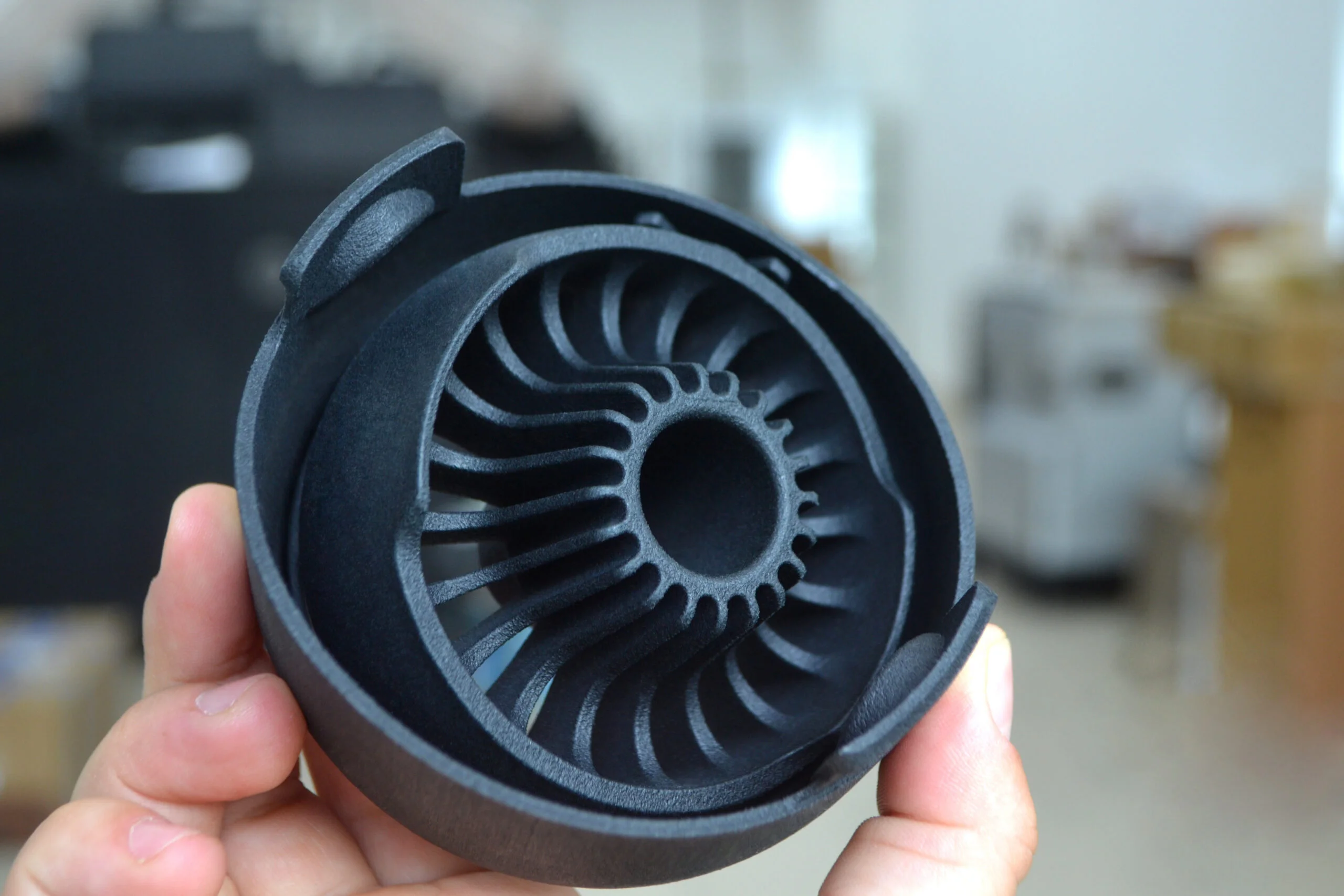
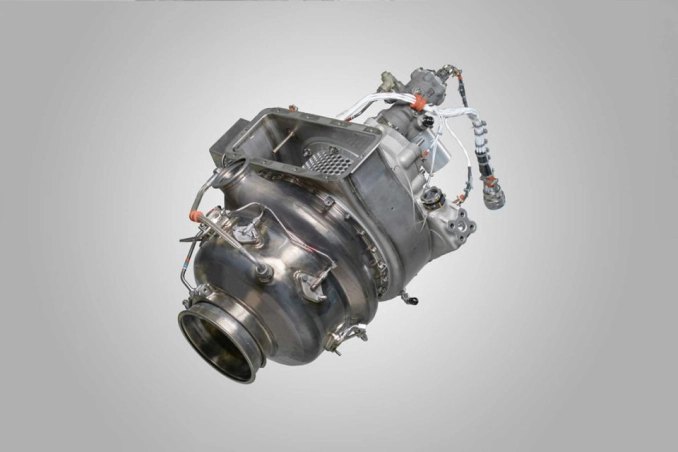
MJF 3D-printed part with porous surfaces
Vapor smoothing and an FDA-compliant epoxy or silicone sealant can reduce and seal that porosity, but the sealant must be validated for the specific contact type, temperature, and cleaning cycle, and abrasion re-exposes the porous substrate underneath. Reasonable for prototyping or low-frequency contact—not for production equipment under frequent caustic cleaning.
SLA and MSLA cure liquid resin with UV light, producing the smoothest surface finish of any polymer process (Ra 0.1–0.5 µm as-printed)—far less porous than MJF, SLS, or FDM. But smoothness solves the porosity problem, not the compliance problem: no SLA or MSLA resin on the market today is FDA-cleared for direct food contact. Formlabs is explicit that none of its resins—including the BioMed and Surgical Guide lines certified biocompatible under ISO 10993—are approved for food contact; biocompatibility and 21 CFR food-contact compliance are different standards. Cured resin can also retain trace unreacted monomer that migrates over time. Best for molds and tooling, or coated, low-frequency prototypes replaced on a schedule—not production parts.
Processes That Reliably Meet Food-Grade Requirements
Of everything in this guide, only one of the options below is actually a 3D printing process—CNC machining and molding solve the porosity and compliance problem by not printing the food-contact surface at all.
CNC-machined PEEK or Delrin avoids the porosity question entirely—no layer deposition or powder fusion, so no printing-driven porosity to engineer around. Delrin is FDA 21 CFR 177.2470 compliant, widely available as certified stock, and machines to an excellent finish; PEEK offers higher temperature and chemical resistance for tougher applications. 3D printing earns a place here mainly when geometry is too complex to machine economically from billet—which is also when printing PEEK and machining the contact surfaces (above) becomes the practical path.
Metal additive (316L stainless) with electropolishing works for high-temperature, high-pressure-cleaning, or acidic/abrasive applications. Metal AM parts are typically more than 99.5% dense in the bulk—the porosity concern is surface roughness from powder fusion, not the interconnected voids found in polymer powder-bed processes like MJF/SLS. Electropolishing removes that rough layer entirely, leaving a genuinely dense, corrosion-resistant surface.
Sequence: print → support removal → stress relief → CNC post-machining → electropolish → passivate, yielding Ra 0.1–0.4 µm post-electropolish. Best for complex stainless geometry that would otherwise need multiple machined parts; for simpler geometry, machined stainless is usually the better answer given the added cost and lead time.
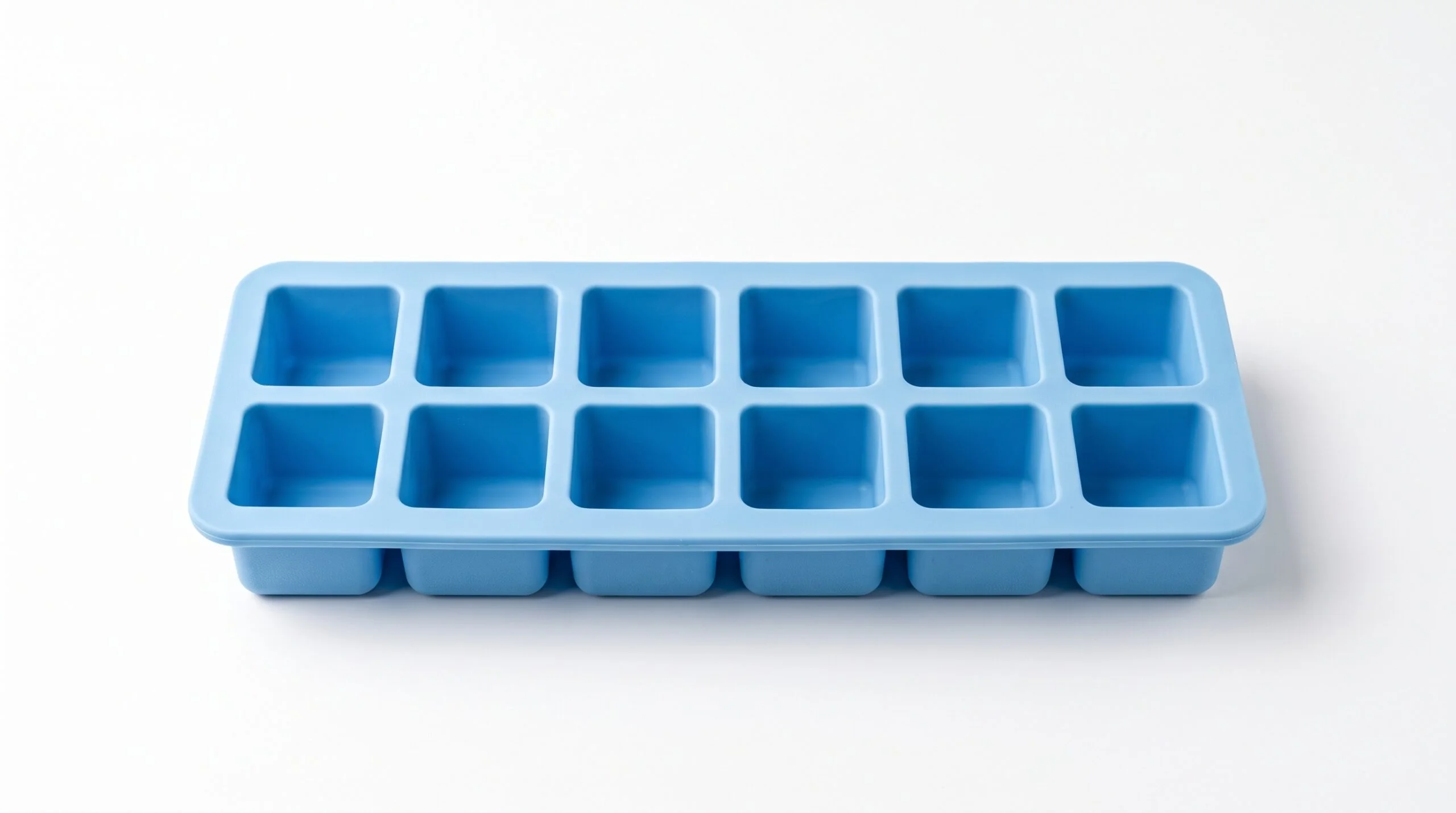
Injection molding is the most common, most established path to a production food-contact plastic part. FDA-approved food-grade resins exist across PP, HDPE, PC, PET, and POM (Delrin), all under 21 CFR 177—molded in a closed cavity from certified pellet, with no printing-driven porosity to manage.
The same logic covers elastomers: liquid silicone rubber (LSR) is FDA 21 CFR 177.2600 compliant and common in bakeware, seals, and gaskets, and food-grade TPU grades (BASF Elastollan FC, Covestro Texin) are compliant when injection molded—but not as standard 3D printing filament, which carries the same layer-porosity problem as FDM. Tooling cost and lead time are the usual objections, but low-volume injection molding with aluminum “bridge” tooling can produce 100–10,000 units at a fraction of the cost and lead time of steel production tooling.
Design Considerations for Food-Contact Parts
Avoid internal cavities that can’t be cleaned. Enclosed voids and blind passages that cleaning solutions can’t reach are design failures—every internal feature must be either fully sealed off from food contact or fully accessible for cleaning.
Specify surface finish as a requirement, not an afterthought. Ra 0.8 µm or better is the commonly cited food contact threshold—smoother surfaces clean more easily and resist biofilm formation. Put it on the drawing and verify it in the first article.
Eliminate sharp internal corners. Radii at internal corners reduce stress concentration and remove the tight spots that trap food particles. A minimum R1.5 mm is a practical starting point.
Design for disassembly where in-place cleaning isn’t possible. If the installed geometry doesn’t allow complete cleaning in place, the part should be removable—ideally without tools.
Specify cleaning agent compatibility explicitly. Identify the exact cleaning agents, concentrations, and temperatures the part will face, and verify material compatibility against those specific conditions before finalizing material selection.
Specifying Food-Grade Requirements at RFQ
At RFQ, specify food-grade before quoting begins, not after the part is manufactured. The supplier needs to confirm material availability, process suitability, and certification documentation up front. State it in the RFQ notes and require a material certificate demonstrating FDA 21 CFR compliance with delivery.
On drawings and POs. “Food-safe” or “food-grade” alone isn’t a complete spec. Include:
- The applicable regulatory standard: “FDA 21 CFR 177.xxxx compliant” for the specific material, or “NSF/ANSI 51 compliant” for food equipment applications
- The surface finish requirement: “Ra ≤ 0.8 µm on all food-contact surfaces” using the standard surface finish symbol
- The post-processing requirement where applicable: “Electropolish and passivate per ASTM A967—food contact surfaces”
- The cleaning agent compatibility requirement: note the specific cleaning agents and concentrations the part must resist
- The contact type and temperature: “direct food contact, aqueous, maximum 85°C”—this determines the applicable FDA regulation and testing requirements
Food-grade manufacturing fails most often at the process and specification stages: selecting the wrong process when the application requires a non-porous surface, or specifying “food-safe material” without documenting the surface finish, cleaning agent compatibility, and contact conditions. Fictiv’s network of experts helps establish these requirements upfront, providing feedback to select the right process for your specifications.
Get an instant quote with DFM feedback on the Fictiv platform, and contact us about our food-grade capabilities for prototyping or production.
Talk to a Fictiv expert about your project, or upload your parts to start a free quote.
FAQs About Food-Grade 3D Printing
Is MJF or SLS 3D printing food-safe?
Not for direct food contact in production use. PA12, PA6, and PP are potentially FDA compliant, but both processes fuse powder into a surface with microscopic porosity that traps bacteria. Vapor smoothing plus a sealant can work for prototyping, not for equipment under repeated caustic cleaning.
What’s the difference between a food-safe material and a food-grade part?
A food-safe material has been evaluated under FDA 21 CFR for what it might transfer to food. A food-grade part also accounts for surface porosity, cleanability, and resistance to specific cleaning chemicals—factors material certification alone doesn’t cover.
Which 3D printing process is best for food-contact parts?
For production plastic parts, injection molding with an FDA-compliant resin is usually most practical, including low-volume runs with aluminum bridge tooling. CNC-machined Delrin or PEEK and electropolished 316L stainless are the most reliable printed/machined options, since neither has an inherent porosity problem. PEEK FDM works only with post-machined contact surfaces; SLA/MSLA has no FDA-cleared resin for food contact, so it suits molds and tooling better than production parts.
Do FDA 21 CFR and NSF/ANSI 51 both apply to 3D printed food-contact parts?
FDA 21 CFR governs which substances a material may transfer to food. NSF/ANSI 51 applies to food equipment components and requires testing the actual part, not just the raw material—both can apply depending on the application.
Can a coating or sealant make a 3D printed part food-safe?
Conditionally. Vapor smoothing and an FDA-compliant sealant can seal porosity on MJF/SLS parts, but the sealant must be validated for the specific contact and cleaning conditions, and abrasion re-exposes the porous surface underneath—reasonable for prototypes, not a substitute for a non-porous material in production.
Are biocompatible or medical-grade 3D printing resins food-safe?
No, not automatically. Biocompatibility (ISO 10993, USP Class VI) evaluates skin or mucosal contact for medical use—a different standard than food-contact compliance under 21 CFR 177. A resin cleared for surgical guides or dental use hasn’t necessarily been evaluated for food contact.