




Time to read: 12 min
Artificial intelligence has been reshaping software for years. But a distinct category—one that matters far more to mechanical engineers and hardware companies—has quietly matured to the point where it’s changing how physical products are designed, manufactured, and operated. Physical AI is the category of artificial intelligence that must operate within the constraints of the physical world—Newton’s laws, material properties, thermodynamics— rather than predicting patterns in text or images alone. It’s a term worth understanding clearly— cutting through the hype and mixed terminology matters for anyone building hardware, now and in the future.
This article explains what physical AI means for manufacturing and engineering, how it differs from large language models (LLMs) and the generative AI tools most engineers already use, and where it’s delivering real results across design, production, and product operations.
What Is Physical AI?
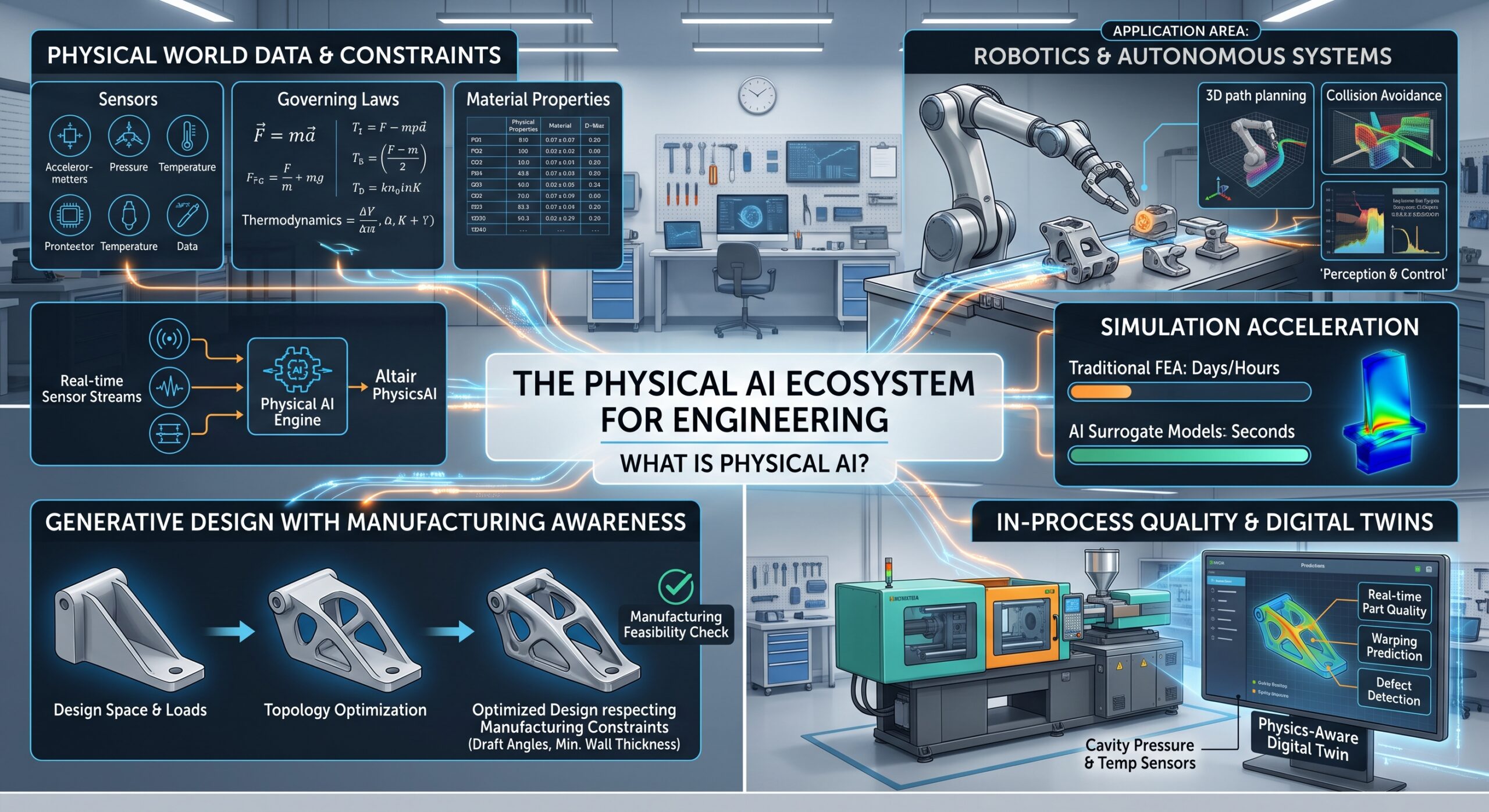
Physical AI is artificial intelligence grounded in the physical world—through sensors, actuators, or physics-based simulations—rather than operating purely on language data or image patterns.
NVIDIA, which popularized the term, defines physical AI as systems capable of sensing, understanding, and acting in real-world environments: the technology behind autonomous robots, humanoids, drones, and self-driving systems. In engineering and manufacturing, the term has expanded to cover any AI system that must respect physical law to be useful, whether or not it controls an actuator.
That’s the fundamental difference from LLMs and conventional generative AI: an LLM predicts the next token from patterns in training data, while a physical AI system is bounded by Newton’s laws, material properties, and thermodynamics.
Getting the physics wrong has immediate consequences: a robot drops and damages a part, a simulation predicts the wrong stress distribution leading to part failure, a manufactured component warps out of tolerance.
Physical AI use cases:
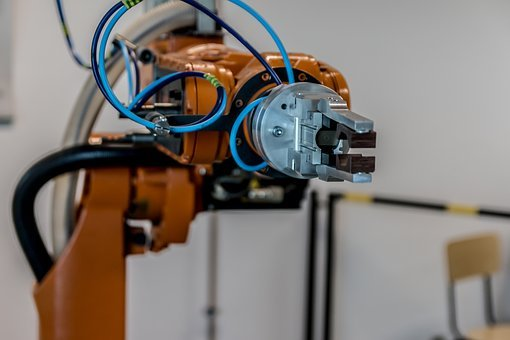
- Robotics and autonomous systems: AI that enables machines to perceive, navigate, and manipulate objects in unstructured environments
- Physics-informed simulation: AI models that incorporate governing physical equations or are trained on physics-based simulation data, enabling faster prediction of structural, thermal, and fluid behavior
- Generative design with manufacturing constraints: AI-driven topology optimization that accounts for real manufacturing limitations alongside structural and thermal requirements
- In-process quality and control: AI systems that monitor and adjust manufacturing processes in real time based on sensor data from the physical process
These categories overlap—a digital twin that combines real-time sensor data with physics-based prediction draws on several at once—but they’re worth distinguishing because the relevant capabilities and challenges differ significantly between them.
How Physical AI Differs from the AI Tools Engineers Are Already Using
Most engineers are already using AI tools: LLM-based assistants for documentation and code, AI-driven DFM analysis in manufacturing platforms, generative CAD tools, and materials selection assistants. These are genuinely useful and represent real productivity gains.
Physical AI goes deeper in a specific way: it operates to understand physical constraints, not just statistical patterns learned from data.
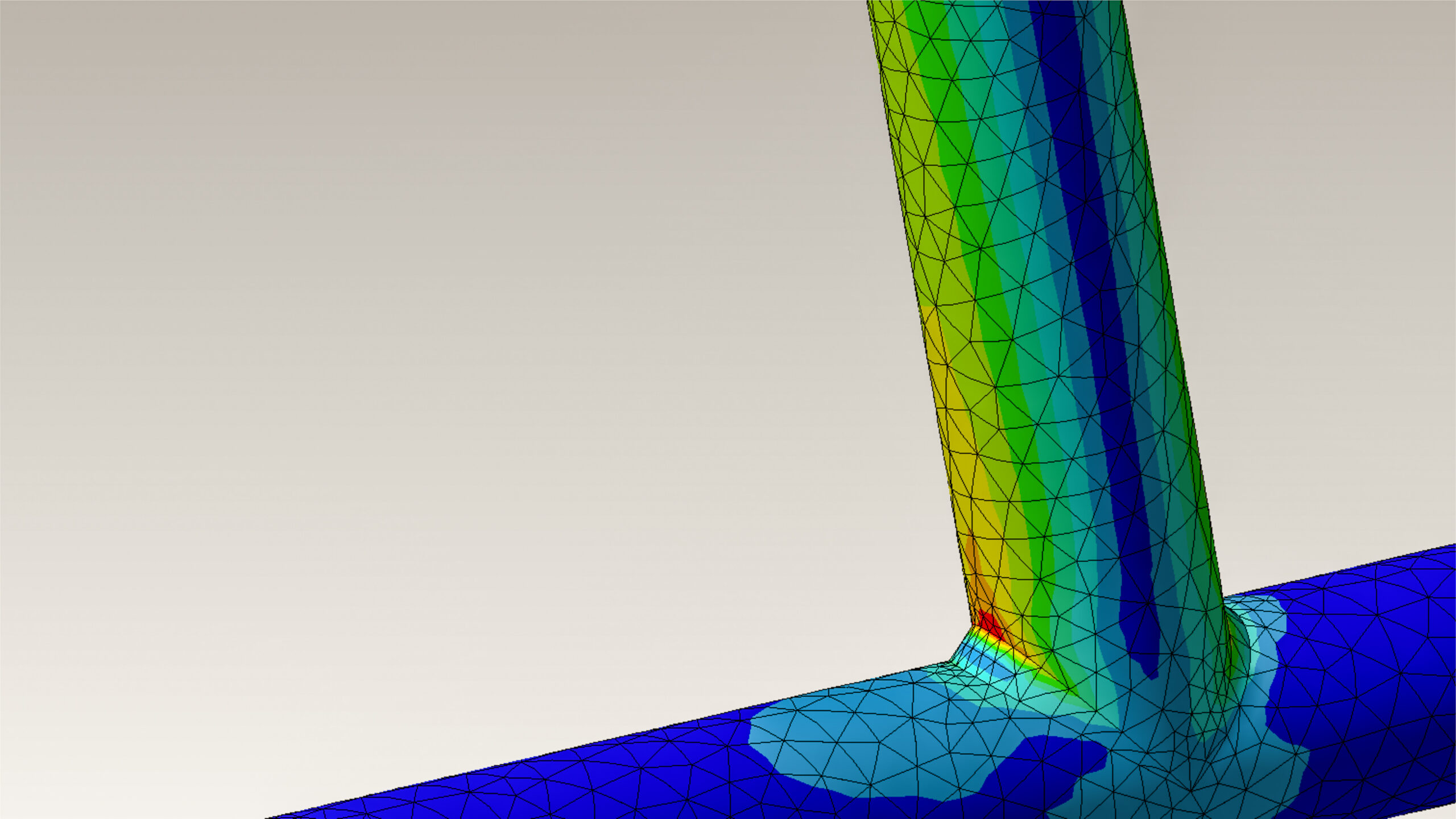
Consider the difference in practice. A standard neural network trained on thousands of CAD geometries can suggest a design that looks structurally plausible—similar in form to parts that have worked before. But alone, it doesn’t inherently understand stress concentration at a fillet, the relationship between wall thickness and thermal gradient, or the fatigue behavior of a specific alloy under cyclic loading. It may propose a geometry that would fail under real operating conditions because it has learned visual and geometric patterns without internalizing physical laws.
A distinction worth being precise about: there are two different ways AI models get “grounded” in physics, and the terms are often used interchangeably even though the underlying approaches differ.
Physics-informed neural networks (PINNs)
PINNs embed governing equations—conservation of mass, momentum, and energy —and constitutive material models directly into the model’s training loss, so the model is mathematically constrained to satisfy those equations. This is the most rigorous version of “physics-informed AI,” and it remains largely in research and pilot phases for complex, real-world 3D geometries, in part because of training instability and scalability challenges.
Physics-based surrogate models
Surrogate models are the approach behind most commercially deployed tools today, including Ansys SimAI, and are trained on large sets of outputs from validated physics-based simulations (FEA, CFD) rather than on the governing equations themselves. Simulations don’t guarantee physical consistency the way a true PINN does, but because their training data comes from physics-based solvers, their predictions tend to track physical behavior closely within the range of conditions they were trained on.
Either way, the practical implication is speed: a well-trained surrogate model can produce in seconds what would take hours of FEA. The tradeoff is that accuracy degrades outside the training distribution, so results still need validation against a full solver before informing a final decision.
Where Physical AI Is Having Real Impact in Design and Manufacturing
Accelerating Simulation and Design Iteration
The most immediate application for engineering teams is using AI surrogate models to replace expensive simulations. A high-fidelity CFD or FEA simulation of a complex assembly can take days of compute time, making it impractical to run hundreds of design variants within a normal schedule. Surrogate models trained on high-fidelity simulation outputs compress this cycle dramatically, letting engineers iterate on dozens of variants in the time one full simulation used to take.
This isn’t speculative. Researchers publishing in AIAA demonstrated a physics-constrained generative network (“physicsGAN”) that parameterizes eVTOL takeoff trajectories, ensuring that every generated flight profile automatically satisfies flight-dynamics constraints. In a case study on the Airbus A³ Vahana eVTOL, this reduced optimization time from roughly 22 seconds to about 2 seconds—a nearly 200x speedup—while over 98% of generated designs satisfied all constraints outright.
It’s just a single case study, not evidence of wide deployment, but it demonstrates the mechanism: constraining generation to physically feasible outputs, rather than filtering out infeasible ones afterward, changes what’s computationally possible.
Generative Topology Optimization With Manufacturing Awareness
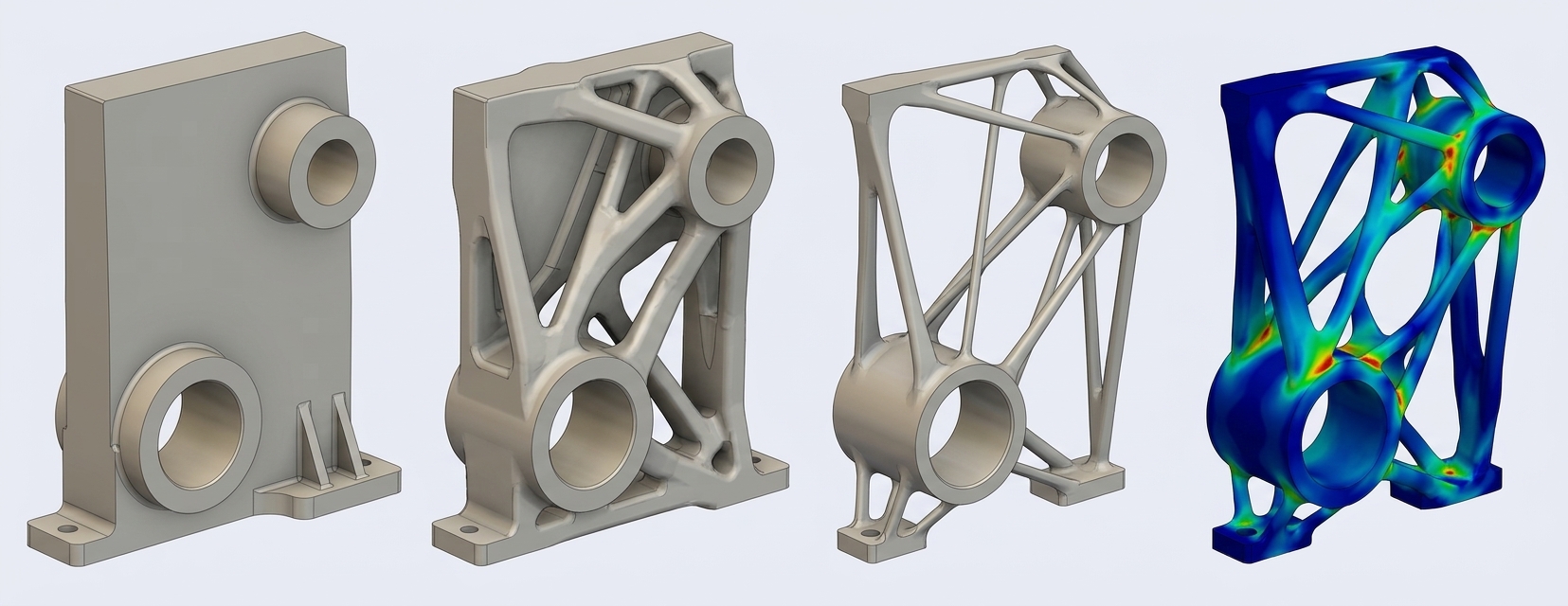
Topology optimization—removing material from a design space based on load cases—isn’t new; it’s been standard in aerospace and automotive design for decades. What physical AI adds is multi-objective optimization that accounts for structural performance, thermal behavior, and manufacturing constraints simultaneously, rather than optimizing structure in isolation.
Traditional topology optimization tends to produce organic geometries that are structurally optimal but difficult to manufacture, or that ignore thermal dissipation entirely. A physics-aware generative approach treats these as one problem—generating geometries where load paths double as thermal channels, or where the result respects the minimum feature size and draft angle of the intended process. For hardware teams, that manufacturing awareness is often the more useful capability. Commercial platforms in this space include nTop and Altair Inspire.
Digital Twins With Predictive Capability
A conventional digital twin is essentially a data dashboard—sensor data mapped onto a 3D model, telling you what is happening, not what will happen. A physics-informed digital twin adds predictive capability by combining sensor data with reduced-order physics models—commercial examples include Ansys TwinAI—to estimate behavior beyond what sensors directly measure. For a rotating machine, that means estimating fatigue accumulation and remaining useful life from actual loading history, rather than a conservative blanket maintenance schedule. For manufacturing programs, physics-informed digital twins of processes like injection molding or die casting let operators predict part quality before the part is even completed.
AI-Driven Process Control in Injection Molding
High-precision injection molding presents a physics challenge conventional process control struggles to address. As molten polymer cools and solidifies, it shrinks nonuniformly—thin sections cool faster than thick ones—driving warpage, sink marks, and dimensional variation that can render tight-tolerance parts nonconforming before ejection.
Physical AI addresses this at two points: before the mold is built and during production. During the pre-build mold flow simulation, it is grounded in polymer flow and heat transfer physics and predicts how a geometry will shrink and warp, so the mold or cavity can be pre-compensated before a tool is cut. During the process, cavity pressure and temperature sensors feed physics-aware models that detect defect precursors—incomplete fill, pressure anomalies, inconsistent packing—shot by shot, enabling real-time adjustment before a bad shot becomes a bad batch. The result is fewer scrapped first shots, less manual mold-tuning, and a more predictable path from CAD to a conforming part.
Where Physical AI Is in the Hype Cycle Right Now
Physical AI capabilities span a spectrum from mature and widely deployed to promising but not yet production-ready.
Mature and in-production: data-driven surrogate models for well-characterized simulation domains, computer vision inspection on production lines, autonomous mobile robot (AMR) navigation in structured logistics environments, and DFM tools combining geometric analysis with manufacturing constraint databases.
Emerging, moving into production: physics-informed digital twins for complex rotating machinery, multi-objective generative design with manufacturing constraint awareness, and closed-loop process control for high-precision injection molding.
Still primarily research-stage: true PINNs for complex, real-world 3D geometries, full sim-to-real transfer for dexterous manipulation in unstructured environments, physics-informed generative design for novel materials, and autonomous adaptive control of multi-stage manufacturing without human oversight.
For hardware teams, this distinction matters more than evaluating the category as a whole. A vendor claiming a “physics-informed” model is worth a direct question: is the physics in the training data, or the training loss? The answer changes what guarantees you can reasonably expect.
Terminology: Physical AI, Embodied AI, and Physics-Informed AI
These three terms are often used interchangeably but have different origins and emphases.
Physical AI is the broadest term, popularized by NVIDIA, to describe systems that understand physical reasoning—friction, inertia, cause and effect, and the consequences of acting in the real world.
Embodied AI is more specific to robotics and cognitive science: AI that learns through a body’s interaction with an environment, rather than from static datasets. Sources disagree on whether that body must be physical, so it’s worth confirming which sense a given source means.
Physics-informed AI (or physics-constrained AI) is the most technically specific term: models that embed governing equations as constraints during training or inference (true PINNs), distinct from models simply trained on physics-generated data.
Digital twin (conventional vs. physics-informed): A conventional digital twin maps sensor data onto a model—it describes current state. A physics-informed digital twin combines sensor data with reduced-order physics models to predict future state, including failure modes and remaining useful life. The term “digital twin” covers both; the word “physics-informed” is the signal that predictive capability is present.
A product described as “physical AI” may mean any of these—knowing which one applies helps cut through the terminology to the actual capability. Current commercial platforms include Ansys SimAI, Altair PhysicsAI, Siemens Simcenter, and the open-source NVIDIA PhysicsNeMo framework (formerly NVIDIA Modulus).
Physical AI for Hardware Teams
Physical AI is a useful category once you look past the hype. For many hardware teams, the practical value isn’t in building robots. It’s in the parts that shorten the distance between a CAD file and a producible, reliable product. That means using surrogate models that compress simulation cycles from days to seconds, generative design that respects manufacturing constraints, and digital twins that catch defects before they happen.
That’s also where manufacturing partners matter. As physical AI matures from research to production tooling, the manufacturing side has to keep pace, since none of the upstream design gains matter if the part still can’t be built reliably. Fictiv provides instant DFM feedback, mold flow simulation, and Materials.AI for material selection—capabilities aimed at the same manufacturability insights that physical AI is pushing the industry to deliver earlier in the design cycle, not after tooling is cut.
Talk to a Fictiv manufacturing engineer about getting DFM and process feedback earlier in your next program, or upload your part files to start a free quote.
Talk to a Fictiv expert about your project, or upload your parts to start a free quote.
FAQs About Physical AI
What is physical AI in simple terms?
Physical AI is artificial intelligence that has to work within the rules of the physical world—Newton’s laws, material properties, thermodynamics—rather than just predicting patterns in text or images. It’s the AI behind robots that manipulate objects, simulations that predict how a part will behave, and manufacturing systems that adjust themselves in real time based on physical sensor data.
How is physical AI different from generative AI or LLMs?
Large language models predict the next word based on statistical patterns in training data, with no built-in understanding of physical law. Physical AI systems are constrained by—or trained on—actual physics, so their outputs have to be physically plausible, not just statistically likely. Getting it wrong has a physical consequence: a dropped part, a wrong stress prediction, a warped component.
Is physical AI the same as physics-informed AI?
No, though the terms are often used loosely. Physical AI is the broad category (robotics, simulation, generative design, process control). Physics-informed AI is a technical subset: models that embed governing physical equations directly into training, most notably physics-informed neural networks (PINNs). Most commercial engineering tools today use physics-based surrogate models—trained on simulation outputs—rather than true PINNs.
What physical AI tools are available for mechanical engineers right now?
Commercially available tools include Ansys SimAI and Ansys TwinAI, Altair PhysicsAI, Siemens Simcenter, and the open-source NVIDIA PhysicsNeMo framework (formerly NVIDIA Modulus). DFM platforms with embedded manufacturing-physics constraints, rather than pure geometric rule-checking, are also a practical entry point.
Is physical AI ready for production use in hardware development?
It depends on the application. Surrogate models for well-characterized simulation domains, computer vision inspection, and DFM analysis are mature and in production today. Physics-informed digital twins and manufacturing-aware generative design are moving into production. Full sim-to-real transfer for dexterous robotic manipulation and true PINN-based generative design for novel materials remain largely research-stage.