

Time to read: 14 min
Picture a food mixing agitator that runs fine for a year. Then salty product and the daily sanitizing cycle find the crevice where a paddle meets the hub, and pitting starts under a surface that still looks clean. The drawing said “stainless.” It just didn’t say which one.
Stainless steel is a family of alloys that share a chromium content of at least 10.5%. The various grades differ in almost everything else: strength, machinability, corrosion resistance, and cost.
Specifying “stainless steel” on a drawing without a grade designation is like specifying “aluminum” without an alloy and temper. The supplier will pick something by default. It just might not be the right something.
So which grade should go on the drawing?
Short answer: Choose 304 for general-purpose parts with no meaningful chloride exposure. Choose 316 when the part is exposed to salt, coastal air, de-icing chemicals, or chlorinated cleaning agents. Choose 17-4 PH when the part must carry significantly more load than 304 or 316 can, with corrosion resistance similar to 304.
These three grades cover the majority of requirements you are likely to encounter for manufactured parts. Other grades matter in specific cases: 303 for free-machining, duplex and super duplex for severe chloride service, 420/440C for hardness and wear.
A wrong pick is rarely catastrophic, but it can lead to corrosion failures months into service, over-engineered parts that cost far more than necessary, or machining problems that inflate lead time and unit cost.
Want the full framework? Our Metal Material Selection Guide eBook covers stainless, aluminum alloys, carbon and alloy steels, and specialty metals.
Comparing Common Stainless Steel Grades: 304, 316, and 17-4 PH at a Glance
Here’s how the three most common grades stack up. The sections that follow focus on what the table doesn’t show: where each grade fails and what that means for manufacturing.
| 304 | 316 | 17-4 PH | |
| UNS | S30400 | S31600 | S17400 |
| Family | Austenitic | Austenitic (Mo-bearing) | Martensitic precipitation-hardening |
| Min. UTS | ~515 MPa (75 ksi) annealed | ~515 MPa (75 ksi) annealed | 1,070–1,310 MPa (155–190 ksi) aged, H1025–H900 |
| Approx. PREN | ~18–20 | ~23–26 | Comparable to 304 in most environments |
| Chloride tolerance in water, ambient* | Roughly 50–200 ppm | Roughly 1,000–2,000 ppm | Similar to or below 304 |
| Magnetic | Non-magnetic when annealed | Non-magnetic when annealed (less prone to turning magnetic when cold-worked) | Magnetic |
| Machinability (% of 1212 steel) | ~40–45% | ~40–45% | ~45–50% (Condition A); higher when over-aged |
| Typical cost vs. 304 | Baseline | Roughly +20–50% in bulk; higher in small quantities | Varies by form; confirm with quote |
*Rules of thumb only. Published limits vary by source and depend heavily on temperature, pH, crevices, and surface condition.
Shop note: Annealed 304 is non-magnetic, but cold work, including machining, can make it mildly magnetic. Plenty of parts with the correct material get flagged at incoming inspection because they fail a simple magnet test. But a magnet isn’t a reliable grade check in either direction. Verify material with the mill certificate or PMI/XRF.
Why Stainless Steel Resists Corrosion—and Where the Limits Are
Stainless steels resist corrosion because they have a passive chromium oxide layer on the surface. The layer is transparent and only a few nanometers thick. If you scratch it, it reforms on contact with oxygen. The catch is in that last clause: no oxygen, no repair. That dependence on a thin, oxygen-fed film is why stainless can fail where people don’t expect it to.
For information on how materials compare across chemical, corrosion, and heat exposure, see Environmental Resistance of Materials.
Crevice Corrosion: Where Oxygen Runs Out
Stainless steel’s protective layer depends on oxygen availability. In a crevice, under a gasket, or in a stagnant pocket of solution, oxygen is depleted—and the layer can’t maintain itself.
Crevice corrosion often progresses faster than general surface attack and is harder to detect. Prevention depends as much on part geometry and joint design as it does grade selection. A well-chosen alloy in a poor joint design can still fail.
Chloride Pitting: Small Pits, Deep Damage
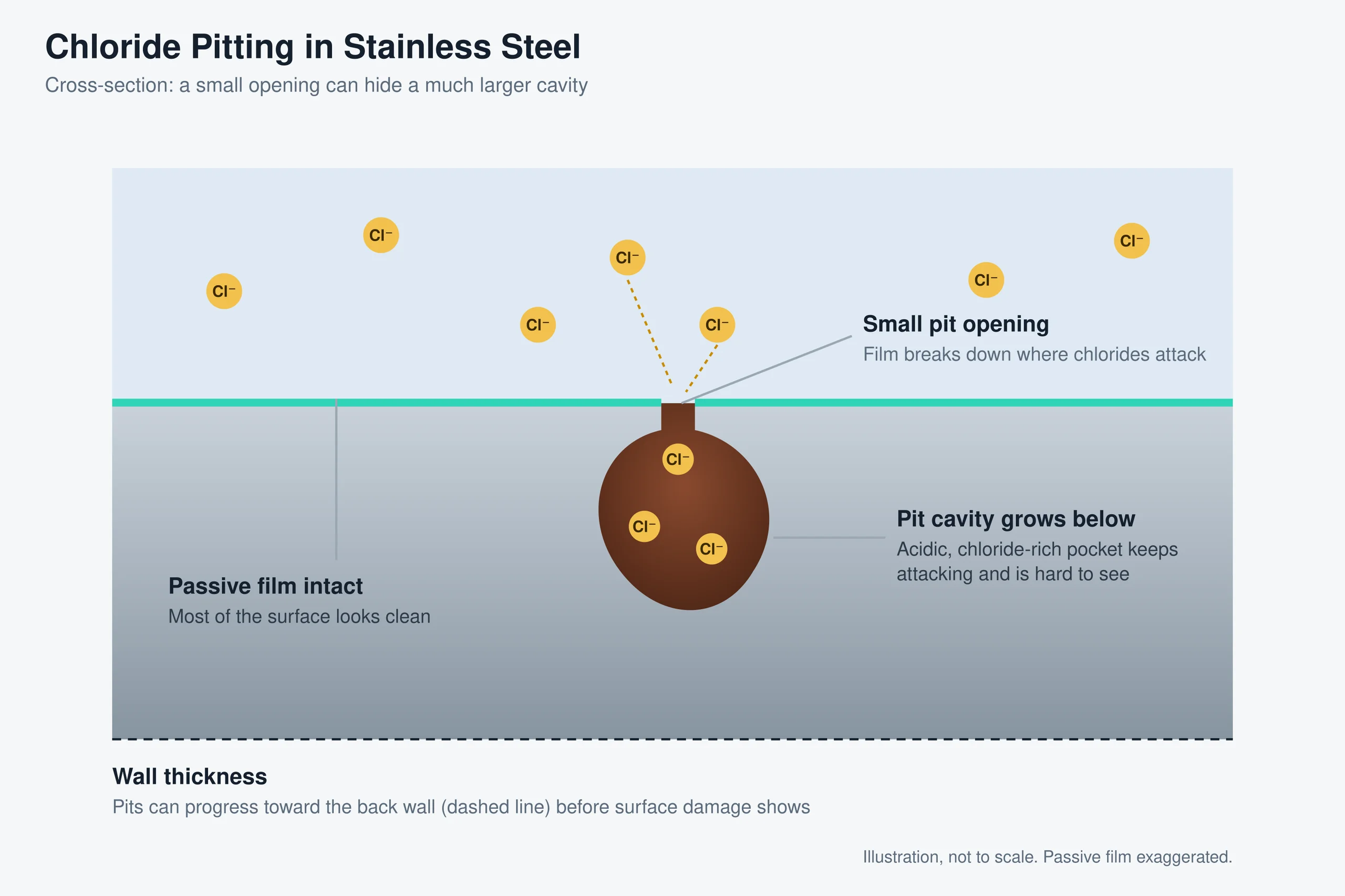
Chloride ions penetrate the passive layer and cause pitting, a localized attack that can progress through a wall while the rest of the surface looks clean. Published chloride limits for 304 in water range from roughly 50 to 200 ppm, depending on source and conditions, and roughly 1,000 to 2,000 ppm for 316. For scale, natural seawater typically contains around 19,000 ppm chloride—well beyond what standard austenitic grades can handle in sustained immersion.
Chloride concentration is only half the story. Temperature matters just as much, and critical pitting temperature (CPT, measured per ASTM G48) is the more reliable comparison.
Screening for Pitting with a PREN (Pitting Resistance Equivalent Number)
The Pitting Resistance Equivalent Number (PREN) ranks grades by composition:
PREN = %Cr + 3.3 × %Mo + 16 × %N
The results run roughly 18–20 for 304, 23–26 for 316, about 35 for 2205 duplex, and above 40 for 2507 super duplex and 6Mo austenitics. PREN is a screening index, not a test result. Use it to narrow the field, not to make a final call.
Choosing a Stainless Steel Grade: Start with the Environment
When considering stainless steel grades for a part, start with one question: will it be exposed to chlorides in service or cleaning? If the answer is no, 304 is the right pick. If yes, 316 is your go-to.
Many engineers choose 304 or 316 depending on the case, and mistakes can go both ways. They use 316 on indoor equipment that never sees chlorides (when 304 would do), and 304 on food equipment cleaned with chlorinated sanitizers, which leads to pitting after a year or two.
17-4 PH only enters the picture when there’s a need for much higher strength.
304: Your Default, Until Chlorides Show Up
304 is among the most widely used grades, and it’s your go-to choice for any part that won’t have meaningful chloride exposure in service or cleaning.
The catch shows up in manufacturing: work hardening. 304’s surface hardens under the tool, so dwell, light finishing passes, and dropped feed rates can cause tearing and rapid wear. Sharp tooling, consistent feeds, and flood coolant are the fix. Free-machining 303 cuts more easily but is less corrosion-resistant and generally unsuited for welding or food contact.
316: Upgrade When Chlorides Are Present
316 is the best choice for regular chloride exposure. It adds 2–3% molybdenum and more nickel, which improves pitting and crevice resistance in chlorides.
316 isn’t seawater-proof, either. Raw seawater service is commonly specified at a PREN of roughly 40 or higher, which points to super duplex 2507, 6Mo austenitics, or titanium.
For a head-to-head on composition and properties, see 316 vs 304 Steel: Choosing Between Two Great Metals.
17-4 PH: Choose It for Strength
Choose 17-4 PH for similar corrosion resistance to 304 and superior strength.
17-4 PH gains strength from an aging treatment instead of quench hardening. The condition (H900, H1025, H1150) is the aging temperature in °F: lower numbers mean higher strength and lower toughness. Per AMS 5643 minimums for bar, H900 gives about 1,310 MPa (190 ksi) UTS and 1,170 MPa (170 ksi) yield, roughly 2.5 times the UTS of annealed 304 or 316. H1025 gives about 1,070 MPa (155 ksi) UTS and 1,000 MPa (145 ksi) yield with better toughness. The tradeoff: H900 has the least toughness and stress corrosion cracking (SCC) margin, so it is generally avoided for load-bearing parts in corrosive service. Where chloride SCC is a risk, favor H1025 or higher. Confirm minimums against the governing spec.
Condition A machinability is roughly comparable to 304, not dramatically easier. The bigger planning issue is aging contraction, of roughly 0.05–0.1%. Parts are commonly rough-machined in Condition A, aged, then finish-machined or ground. Leave stock on tight-tolerance features and confirm allowances with your supplier. Machine 17-4 PH in Condition A before aging when possible. Machining at H900 hardness is feasible but significantly harder on tooling and slower on cycle time. See our Heat Treatment Guide for more details on the process.
Still not sure which grade fits? Try our Materials AI.
Custom Manufacturing Stainless Parts: CNC Machining vs Sheet Metal
The grade you pick narrows the manufacturing process, and each process has its own failure modes. Knowing those failure modes before you finalize your decision enables you to design around them—not encounter them later in the form of scrap, rework, or a part that fails in service.
| CNC machining | Sheet metal | |
| Stock form | Bar, plate | Flat sheet |
| Fictiv stainless options | 303, 304, 316, 17-4 PH, and others | 301, 304, 316, 430 |
| Best for | Thick, complex 3D parts; tight-tolerance features | Enclosures, brackets, panels, formed parts |
| Main risks | Work hardening, tool wear, 17-4 PH aging shrink | Springback, weld distortion, heat tint |
CNC Machining
Machining stainless from bar or plate goes smoothly when the design respects four things: geometry, heat, threads, and tolerances.
- Radii and pockets: Use the largest internal radius the part allows, and avoid deep pockets with small radii.
- Heat: Stainless conducts heat roughly a tenth as well as aluminum, so heat stays in the cut and thin walls can distort.
- Threads: Stainless-on-stainless threads can gall. Use anti-seize, mix dissimilar grades, or choose a galling-resistant alloy such as Nitronic 60.
- Tolerances: Specify tolerances for only the features that need them. Every tight dimension and extra setup adds cost.
Sheet Metal
Sheet metal stainless is formed, cut, and welded from flat stock, and each of those steps has its own pitfalls to design around.
- Forming: Stainless springs back more than mild steel and needs higher bending force and larger bend radii. Forming work-hardens it, and bent 301 or 304 can become mildly magnetic.
- Cutting and welding: Nitrogen-assist laser cutting leaves a cleaner, oxide-free edge than oxygen assist. Welding is where stainless gets temperamental. It distorts more in welding because it conducts heat poorly and expands roughly 40–50% more than carbon steel. Weld heat tint reduces corrosion resistance and should be removed by pickling, passivation, or mechanical cleaning.
- Contamination: Carbon-steel tooling can transfer iron to the surface, where it becomes a rust spot waiting to happen. Use protective film or dedicated tooling, and passivate after fabrication.
Post-Processing and Finishing
Passivation and electropolishing need fluid to reach and drain from every surface, so vent blind features. Electropolishing removes a small amount of material.
For more design details, see the Sheet Metal Design Guide and CNC Machining Design Guide.
Worked Example: Selecting a Stainless Grade for a Food-Mixing Agitator
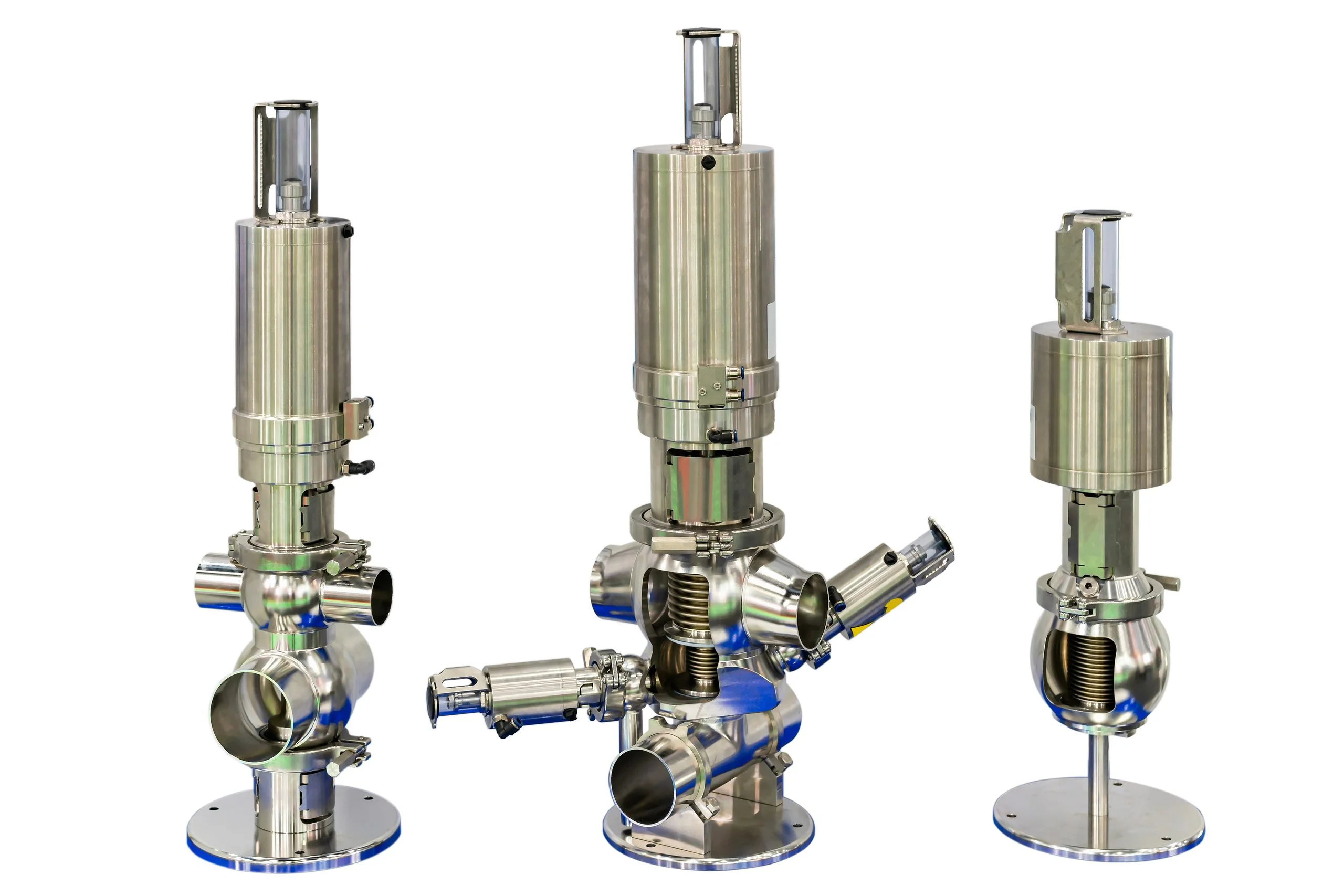
Consider the agitator in a sauce-mixing tank. A CNC-machined shaft and hub carry sheet metal paddles welded to the hub. The assembly turns through the product and is cleaned daily with a caustic wash, a rinse, and a sanitizing step.
Because the agitator contacts food, pitting isn’t just a durability problem—it’s a serious contamination risk. Chloride can come from salt in the food product itself or from the cleaning chemistry (such as a chlorine-based sanitizer or chlorinated alkaline cleaner). Many plants use non-chlorine sanitizers to protect equipment, but chlorine is still common.
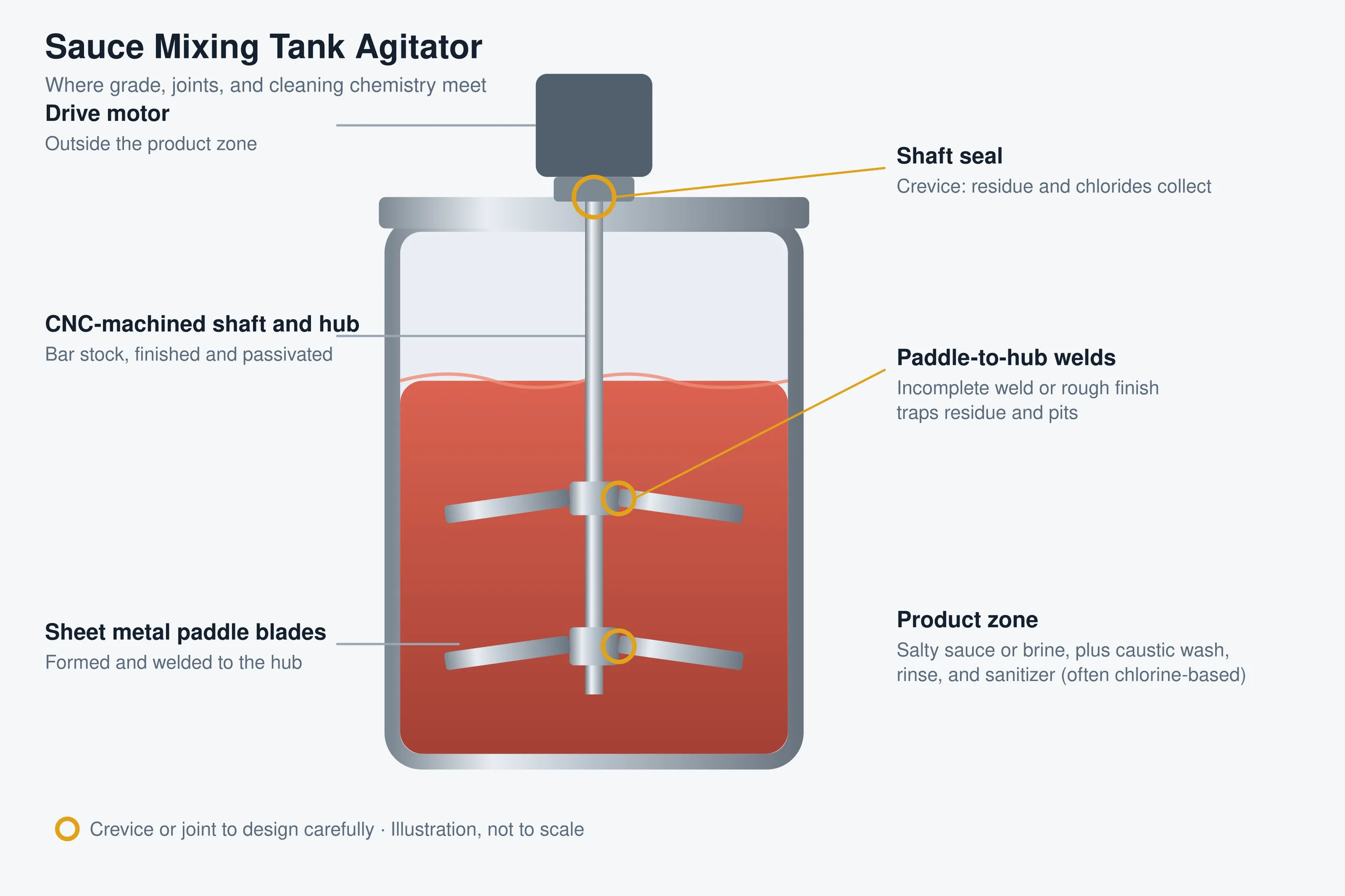
The shaft seal and the paddle-to-hub welds are the crevices where residue and chlorides collect.
304
304 may seem like the obvious first pick. It’s food-safe and cost-effective, making it a common choice for low-salt, mild products.
But Nickel Institute guidance for continuous ambient exposure is only about 2 ppm chlorine for 304 (about 5 ppm for 316), and salty product adds chloride on top.
With repeated cycles, pitting risk rises, especially at the seal and weld crevices.
316L
The L designation handles the welded paddle joints, and molybdenum improves pitting resistance. For intermittent, ambient sanitizer contact followed by rinsing, 316L is typically the best choice for the product zone.
Hypochlorite becomes more aggressive above roughly 40°C, so control contact time, temperature, and rinsing. Fully sealed, smooth welds and a passivated finish matter as much as the grade. For continuous, hot, or concentrated chlorine contact, evaluate 2205 duplex or a non-chlorine sanitizer.
17-4 PH
17-4 PH may be tempting for a high-torque drive shaft, but its corrosion resistance isn’t better than 304, so it doesn’t solve the sanitizer problem. If torque demands it, limit 17-4 PH to components outside the product zone and keep product-contact surfaces 316L. [SME to confirm]
Whichever constraint governs the part determines the alloy.
How to Specify Stainless Steel on Your Drawing
“Stainless” isn’t a specification, and grade alone is still an incomplete one. Add form, standard, condition, and finish.
- 304 and 316: Specify the form (bar, sheet, or plate), the standard (ASTM A276 for bar, A240 for plate, sheet, and strip), and the condition (annealed is standard for machined parts). For welded assemblies, specify 304L or 316L, low-carbon versions that limit carbide precipitation in the weld heat-affected zone.
- 17-4 PH: Specify the condition and spec, such as “17-4 PH, Condition H1025 per AMS 5643.” “17-4 PH” alone does not define properties. Note whether finish machining happens before or after aging.
- Sheet metal: Specify grade, thickness or gauge, ASTM A240, finish, and cosmetic faces.
- Finish and passivation: Specify finish based on your application. Ra ≤0.8 µm (32 µin) is commonly cited for food-contact surfaces. Passivation per ASTM A967, or AMS 2700 for aerospace, removes embedded iron from tooling. For 17-4 PH, discuss the method with your supplier, since citric passivation processes are often preferred.
Catch Problems on the Drawing, Not in the Field
Stainless steel selection decisions made at the drawing stage strongly influence whether a part performs in service. Catching grade, finish, and machining issues before manufacturing begins is cheaper than discovering them after the fact.
Fictiv’s prototyping-to-production platform helps you compare materials, and DFM feedback flags machining risks before manufacturing begins.
Ready to put a stainless part into production? Upload your CAD file for an instant quote on CNC machined or sheet metal stainless parts.
Talk to a Fictiv expert about your project, or upload your parts to start a free quote.
FAQs About Choosing Stainless Steel
Which stainless steel grades are used for CNC machining and sheet metal?
CNC machining commonly uses 303, 304, 316, and 17-4 PH from bar and plate. Sheet metal commonly uses 301, 304, 316, and 430. 17-4 PH is a machined-part grade for high strength. Start with the corrosion environment, then weigh strength and process.
Is 316 stainless steel good enough for seawater?
Not for sustained immersion. 316 handles splash, coastal air, and intermittent wetting, but it can pit and crevice-corrode in sustained immersion in seawater, which runs around 19,000 ppm chloride. Immersion service commonly calls for a PREN of roughly 40 or higher, such as super duplex 2507, 6Mo austenitics, or titanium.
Why would I choose 17-4 PH over 304 or 316?
Choose 17-4 PH when strength is the governing factor. Because it is aged to H1025, 17-4 PH reaches about 1,070 MPa (155 ksi) UTS, versus about 515 MPa (75 ksi) for annealed 304 or 316. Its corrosion resistance is comparable to 304, so it can’t stand in for 316 in chloride service.
When do I need 304L or 316L instead of 304 or 316?
Specify L grades for welded assemblies. Their low carbon content limits carbide precipitation in the heat-affected zone, which protects post-weld corrosion resistance. For machined parts that are not welded, standard 304 or 316 is typically fine.
What should a stainless steel drawing callout include?
Start with grade, product form, governing standard (such as ASTM A276 or A240), and condition. For 17-4 PH, add the aging condition and spec, such as “Condition H1025 per AMS 5643.” If corrosion resistance or food contact matters, add surface finish (Ra) and passivation (such as ASTM A967).