



Time to read: 10 min
Gas-assisted injection molding (GAIM) overcomes the challenges of thick-wall molding by using pressurized nitrogen gas to form hollow channels within the part and displace molten resin in its thick areas. This method can add integrity to the exterior surfaces while reducing material usage and cooling cycles.
Engineers designing thick-walled or structurally reinforced plastic parts are prone to common molding issues of sink marks, warpage, and long cycle times because molten plastic cools less efficiently in thicker areas. This causes uneven shrinkage and internal stresses.
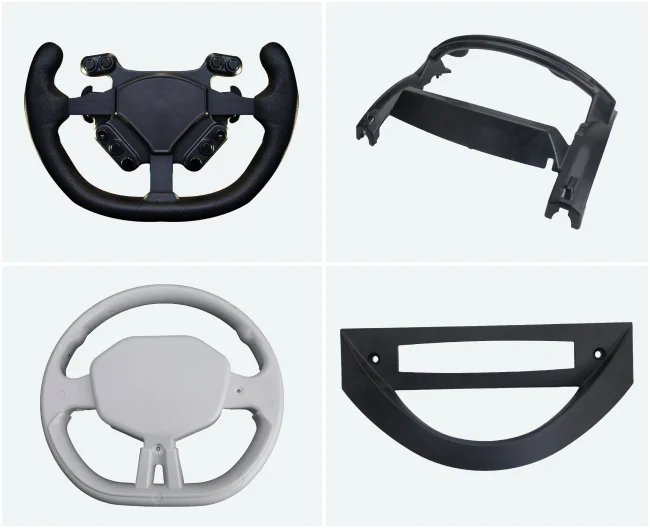
This article will discuss what gas-assisted injection molding is, how it works, its advantages, and its limitations.
What Is Gas-Assisted Injection Molding?
Gas-assisted injection molding (GAIM) is a hybrid process that enhances traditional injection molding by introducing controlled amounts of high-pressure nitrogen gas. In gas-assisted injection molding, before the polymer fills the part cavity, gas is introduced into the core of thicker sections. This creates a network of hollow channels inside the part to reduce sink marks and internal stresses while maintaining (or improving) the external surfaces.
How Gas-Assisted Injection Molding Works
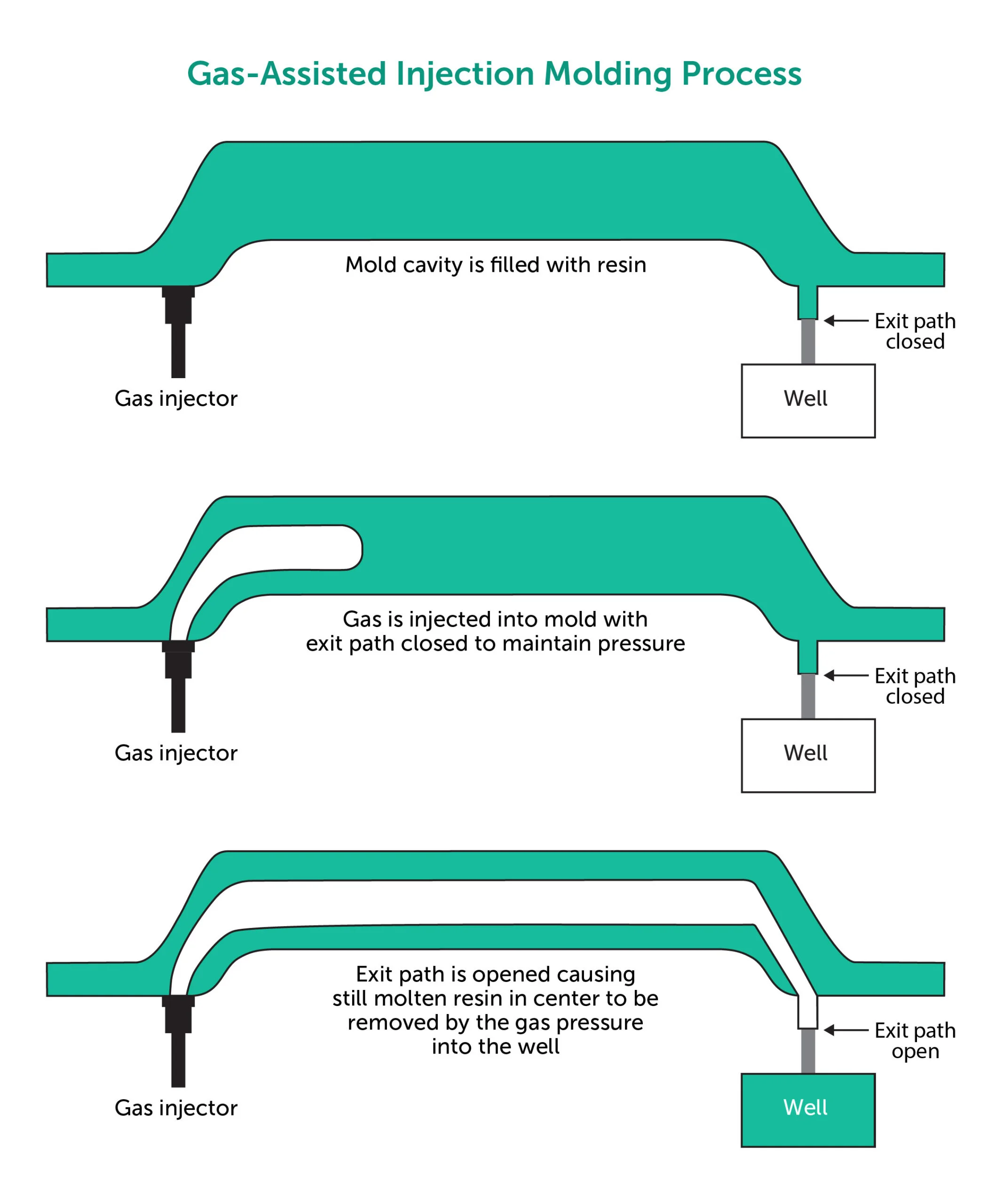
Gas-assisted injection molding begins by filling the mold cavity with molten thermoplastic up to 70–90% of capacity. An inert gas (usually nitrogen) is then injected through a nozzle or gas pin into the molten thermoplastic core. The gas displaces the thermoplastic, creating a hollow channel within the part that provides the additional volume required to ensure the mold cavity is filled. The gas pressure provides internal support while the plastic cools and solidifies. The gas is vented, the part is fully cooled, the mold is opened, and the part is ejected.
Key process parameters followed for gas-assisted molding:
- Gas Injection Pressure: Usually between 2,000 and 4,500 psi, depending on the viscosity of the polymer and the wall thickness.
- Timing: Gas should be introduced immediately once the fill is 70–90% complete; any delay can create incomplete channels.
- Gas hold time: 5–10 seconds for packing pressure during cooling.
- Penetration Depth: Controlled to 60–80% of the intended channel length to maintain channel stability.
- Gas Channel Diameter: 4–12mm is common for medium-sized parts; smaller channels may block, while larger channels could collapse. However, channels for small and large parts can be designed to range from approximately 2–4 mm and 8–16 mm, respectively. In all cases, the ratio of gas channel thickness to the surrounding wall thickness should be in the range of 2:1 to 4:1.
- Melt Temperature: Ensure temperature allows good flowability; a melt that is too cool will solidify prematurely.
Benefits of Gas-Assisted Injection Molding
GAIM offers notable mechanical and manufacturing benefits beyond part appearances. Injecting pressurized nitrogen into the thermoplastic affects the process flow, cooling, and solidification characteristics of the material. This unlocks significant engineering advantages leading to lighter, stronger, and more stable components.
Reduction of Material Usage
Because GAIM creates hollow channels in thick areas, it significantly reduces resin consumption while maintaining stiffness. Depending on part geometry, hollow-core designs can reduce material usage by 20–40%. This not only reduces the cost of raw material but also reduces the mass of material for cooling, thereby decreasing cycle times and improving thermal balance during molding.
Removal of Sink Marks
Sink marks are one of the most common cosmetic and structural failures in thick-wall molded parts. The internal regions of thick walls cool more slowly than the outer surfaces that are in contact with the metal mold; this differential cooling rate leads to internal stresses and warpage in some traditional injection-molded parts. In GAIM, the internal gas volume creates hollow (and therefore thinner-walled) part sections. Consequently, a smooth, sink-free surface is achieved even in ribbed designs or areas containing localized mass.
Less Warpage and Internal Stress
By introducing gas pressure uniformly across the cavity core, GAIM helps create balanced packing of the mold, reducing surface imperfections such as swirl patterns or shrinkage. This uniformity of packing also reduces the differential shrinkage between thick and thin sections, allowing for better control of dimensions and reducing the distortion after molding. The part maintains its shape and aligns better in assembly—this is especially beneficial when the components are large or complex.
Reduced Cycle Times
Because of the faster cooling of the hollow sections, cycle times can generally be reduced by 10–30% depending on the size and wall thickness of the part. Additionally, a reduction in cycle times combined with material savings provides significant productivity improvements when the main objective is a high volume of production.
Improved Stiffness-to-Weight Ratio
GAIM can create structures with internal ribs or beams that exhibit great stiffness while minimizing mass. These hollow sections act like structural tubing to resist bending and torsion with little weight. This is particularly beneficial when strength and lightness are required in automotive and appliance applications.
Better Appearance and Surface Finish
Since the process maintains more consistent surface pressures during solidification, visible depressions and waviness have been minimized. The resulting parts are aesthetically pleasing, which is especially beneficial for components destined for consumer interaction, such as bezels, handles, and decorative panels, where both performance and appearance matter.
Design Guidelines for Gas-Assisted Molding
When designing for GAIM, we need to consider the channel layout and geometry of all the components. Well-thought-out moFld components will provide not only clean, hollow channels but also sufficient stiffness and dimensional stability. The table below explains best practices in designing for GAIM.
Gas-Assisted Injection Molding Design Guidelines
| Design Feature | Recommendation/Rule of Thumb | Purpose/Notes |
| Wall Thickness | 2–6 mm typical | Uniform walls ensure balanced flow and predictable gas penetration |
| Gas Channel Diameter | 4–18 mm, typically 2-3 times wall thickness | Prevents clogging and allows stable hollow formation |
| Channel Placement | Adjacent to thick ribs or bosses | Reduces sink and core shrinkage |
| Gas Entry Point | Near flow end or via dedicated pin(s) | Controls gas direction and avoids blow-through |
| Venting | Opposite the gas entry, typically 180° | Ensures complete evacuation and consistent fill |
| Gas Volume Fraction | Commonly 10–30% of the total part volume | Retains rigidity while saving material |
| Boss Design | Hollow bosses preferred | Prevents sink marks and cracking |
Additional DfM guidelines for GAIM are as follows:
- Simulate gas flow early in the design stage using software such as Moldflow or Moldex3D to predict penetration and prevent fingering.
- Balance wall transitions to maintain consistent melt fronts.
- Integrate gas-injection pins during tool design, not as a retrofit, to avoid complex rework.
- Provide sufficient venting at the opposite end of the gas entry for full channel formation.
- Verify cooling balance, as hollow areas cool faster and may affect cycle consistency.
- Collaborate with molders early to align design intent with tooling capabilities.
Suitable Materials for Gas-Assisted Injection Molding
Selecting materials that maintain melt integrity under pressure ensures reliable hollow formation and repeatability across production cycles. Thermoplastics with good melt flow, thermal stability, and ductility have the best gas pressure performance. Brittle materials, or those that are heavily filled, may not form clean, hollow channels and may crack due to the gas pressure. The table below can be used for selecting the right material for GAIM:
Materials Suitable for GAIM
| Material | Suitability | Notes / Applications |
| ABS | Excellent | Common in automotive handles and interior trim |
| PC/ABS | Excellent | Ideal for consumer electronics and structural housings |
| Nylon (PA6, PA66) | Good | High-strength mechanical parts |
| Polypropylene (PP) | Very Good | Lightweight ducts and appliance housings |
| PBT | Moderate | Electrical connectors and casings |
| Polycarbonate (PC) | Excellent | Transparent or impact-resistant components |
| HDPE/LDPE | Limited | Low stiffness, potential for warpage |
Common GAIM Defects and How to Prevent Them
Gas-assisted injection molding, in part or in whole, can exhibit defects even when it is optimized if the design or processing is not properly controlled. By understanding the root causes of the defect(s), the engineer can take some corrective actions when necessary to restore some degree of quality and consistency.
Short Shots
A short shot is the failure of the cavity to be filled up to volume with the molten plastic, due to the fact that gas cannot push material into voids. This results in absent or incomplete sections, i.e., a portion of the final part.
Suppose the shot volume has filled approximately 85–90% of the cavity volume prior to injection of the gas assist, and nothing else was influencing counterproductive movement. In that case, the gas should create directional movement of material toward adequately vented voids.
Gas Fingering or Blow-Through
Altering gas pressure too high or commencing gas injections too soon can result in the gas moving through the molten front or breaking through to create voids—or blow-through—at the surface feed pendant in the cavity. In appearance, it can resemble finger-like voids extending toward the surface of the part. The remedy in this instance would be to reduce the gas-head pressure or postpone the injection of gas slightly to manage controlled melt penetration.
Sink Marks
If gas escapes the mold cavity during the cooling stage, it may not fully execute its function, leading to localized shrinkage and resulting in surface sink marks. Sink marks are usually due to gas channel location or premature gas escape from the cavity or the molding. Engineers should verify the gas channel location, lengthen the path of gas penetration, or adjust the gas release timing while maintaining internal pressure during cooling.
Gas Entrapment
Entrapped gas in the cavity typically leads to incomplete hollowness in an area of the part or localized voids. The primary reason for trapped gas is insufficient venting or inadequate vent channel geometry. Adding secondary vents or auxiliary gas pins at strategic locations in the mold can help ensure complete gas evacuation during the venting phase.
Surface Blisters
Surface blistering occurs as a result of overpressurization, which forces gas too close to the cavity surface or causes unbalanced cooling. Reducing the gas pressure and regulating the gas cooling characteristics on the mold surface, especially at thick regions of the part, can help prevent surface blistering.
Uneven Wall Thickness
If the gas channels are not installed at equal distances between walls, the gas does not penetrate evenly, which contributes to differential wall thickness and structural imbalance. The solution is to redesign the gas channels to allow fluids to flow symmetrically and evenly penetrate the part geometry.
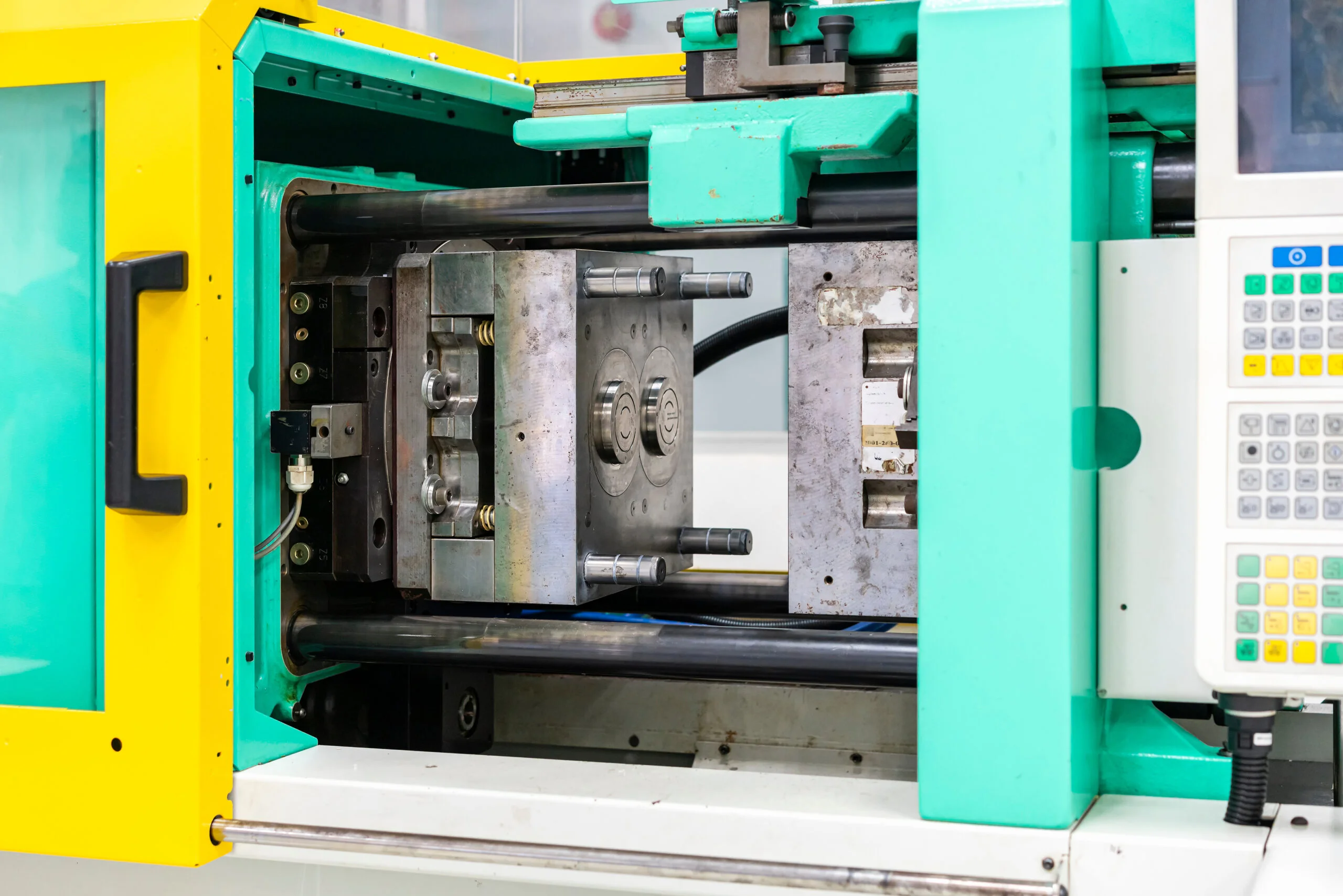
Gas-Assisted vs. Conventional Injection Molding
Gas-assisted injection molding offers advantages in terms of structure and production when compared directly with conventional injection molding. While the principles of the molding process are generally similar, the introduction of controllable nitrogen gas dramatically alters the material’s behavior during the packing and cooling process, allowing for enhanced performance and efficiency.
Wall Structure and Material Displacement
The solid cores produced by conventional molding fully pack the sections of the mold, apply internal stresses, require longer cooling times, and are heavy. The gas-assist process forms hollow, gas-filled channels in place of solid cores, allowing for “coring out” of thick sections without losing structural integrity. This hollow construction reduces mass and enhances performance in terms of stiffness-to-weight ratios. This allows engineers to design lighter parts while maintaining strength.
Surface Integrity and Sink Marks
Traditional molding is often associated with sink marks resulting from volumetric shrinkage during cooling; sink marks become virtually nonexistent in gas-assisted molding, because the walls themselves are thinner and cool more consistently. In addition, internal gas pressure maintains uniform and continuous compression against the mold walls throughout the cooling cycle. This aids in surface integrity while developing smooth, uniform surfaces suitable for fabricating aesthetically pleasing parts; essentially eliminating or minimizing secondary/finish processes.
Material and Weight Efficiency
Parts made with GAIM are generally 30–40% lighter than those molded conventionally. The hollow design decreases material levels and lowers the cost of resin per part, while the molded hollow form allows for increased manufacturability for large or complex geometries.
Cycle Time/Production Speed
The volume of material being cooled is reduced, allowing GAIM to achieve cycle time reductions of 10–30%. Faster cooling of the molded part and lower packing pressure requirements reduce cycle time and improve throughput. This is especially beneficial to automotive, appliance, and consumer goods manufacturing, which typically require high throughput and consistency.
Rigidity/Structural Performance
Although parts produced with GAIM are hollow, these components have comparable or even greater rigidity to solid molded designs. The gas channels act as integrated reinforcing structures, mitigating loads and increasing resistance to bending and torsion while keeping weight down.
Tooling Difficulty and Cost
The introduction of GAIM also necessitates specialty modifications to tooling, including integrated gas injection systems, venting channels, and additional control hardware. The base tooling cost is likely to be marginally higher than that of a standard mold. However, based on long-term production time savings, reduced material use, gains through shorter cycle times, and reduced cosmetic rejects, the initial tooling investment is usually recouped in the long term.
Surface Finish and Cosmetic Quality
Internal gas pressure helps balance out shrinkage internally, helping to increase the quality of the part’s surface finish. Since GAIM balances internal shrinkage forces, it is possible to achieve high levels of cosmetic uniformity across larger areas or thicker wall sections. This produces excellent smooth parts with aesthetic uniformity—ideal for consumer-facing components when both precision and appearance are important.
GAIM Limitations and Considerations
Gas-assisted injection molding offers considerable advantages, but it is not applicable for all uses. Parts with thin walls (<3 mm) or complicated flow paths may not produce stable hollow sections as a result of the process.
In addition, the process requires:
- Specific tooling for gas injection pins and gas venting.
- Control of the timing and pressure of the gas to prevent overpenetration.
- Correctly placed vents ensure the complete evacuation of the cavity.
- A higher operating cost, mostly applicable at medium to high production values.
Nevertheless, when used on the right part geometries, GAIM can greatly improve performance and visual appearance at scale.
Building Lighter, High-Integrity Parts with GAIM
Gas-assisted injection molding (GAIM) allows engineers to fabricate lightweight and strong parts that would otherwise be difficult or costly to mold through conventional means. By using nitrogen gas to strategically and partially core out thicker regions of the part, GAIM improves part integrity while eliminating sink marks, reducing cycle time, and increasing part stability—while maintaining part appearance and mechanical properties.
Need confirmation of your injection molding design? Fictiv provides expert design-for-manufacturability (DfM) analysis, process simulation, and full production tooling support for advanced processes such as gas-assisted injection molding. Whether you are designing lightweight automotive parts or specialized electronic housings, Fictiv’s established manufacturing network helps to ensure consistency and speed, from prototyping to production.