


Time to read: 15 min
The global race for physical AI dominance has officially moved from long-term research into a capital-intensive commercial sprint. The explosive growth of humanoid robotics manufacturing mirrors a classic hardware gold rush: venture capital is flooding the space, and the timeline to field a functional unit has compressed dramatically. The pressure on engineering and operations teams to get from a laboratory prototype to a production-ready humanoid robot has never been more intense.
However, accelerating hardware development is different from scaling software. In hardware, moving too fast without a structured design, manufacturing, and sourcing strategy can result in field failures, blown budgets, and missed market windows. To succeed in the rush to market, robotics innovators must balance speed with engineering discipline and smart sourcing strategies.
The State of the Humanoid Robotics Industry
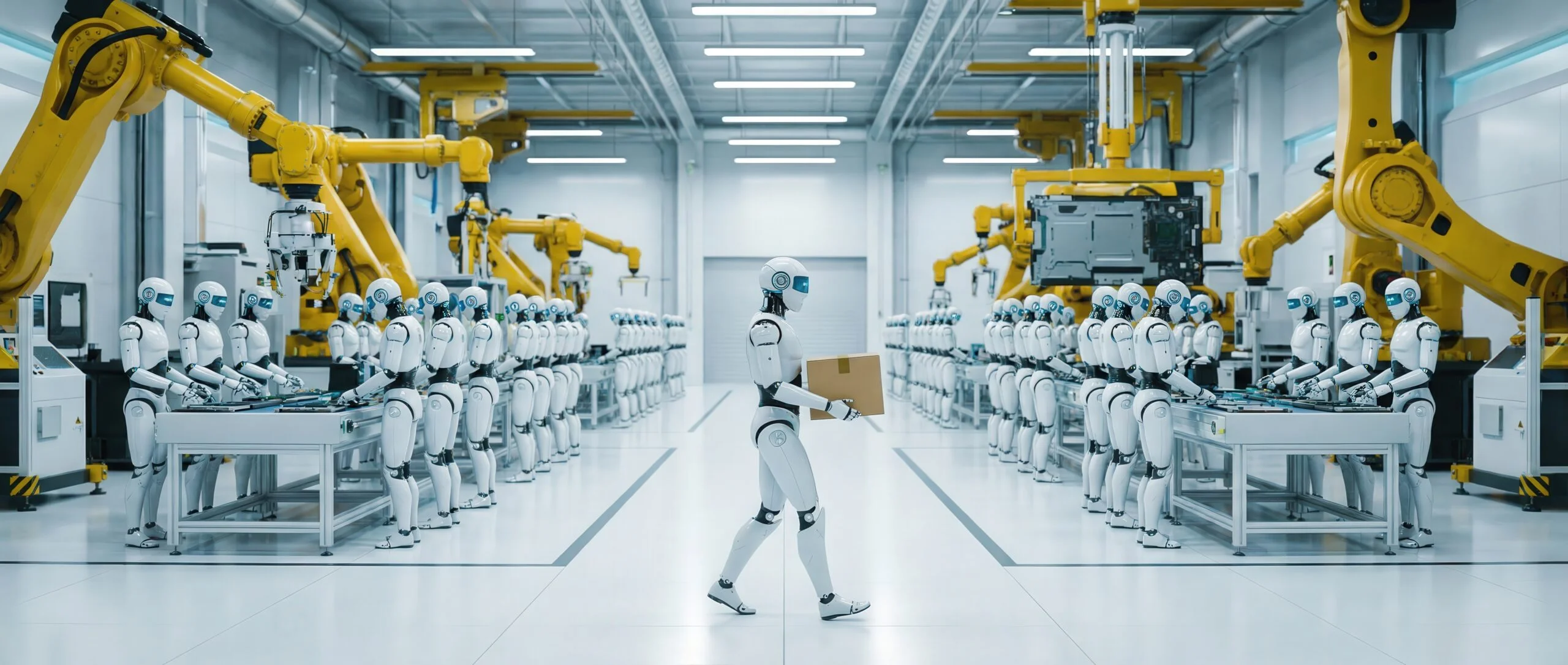
The humanoid robotics market is at an inflection point. Driven by breakthroughs in multimodal foundational AI models—such as vision-language-action (VLA) architectures—and massive capital injections from tech titans, humanoids are stepping out of tech demos and onto factory floors.
Industrial manufacturing, warehouse logistics, and commercial services are the primary beachheads for these machines. Companies have settled the question of feasibility. The focus is now on how fast they can be deployed at scale.
To win this race, engineering teams must overcome unique hardware challenges: maximizing power density in compact joints, minimizing weight to extend battery life, ensuring structural durability under cyclical loads, and doing it all while drastically reducing the total bill of materials (BOM) cost.
Navigating the Humanoid BOM: Custom vs. Off-the-Shelf Components
How to Optimize a Humanoid Robot BOM
A successful robotics sourcing strategy balances commercial off-the-shelf (COTS) components with parameter-customized configurable parts for joint packaging, reserving fully custom CNC machining or molding strictly for proprietary, weight-critical kinematic structures.
A humanoid robot is one of the most complex electromechanical systems ever devised, often requiring 20-50+ degrees of freedom (DoF). Managing the sourcing strategy for these platforms represents a delicate, ongoing trade-off between geometric optimization and lead-time suppression.
Engineers generally classify mechanical components into three distinct sourcing tiers:
Standard Off-the-Shelf (COTS) Components
These are fixed-dimension components readily available in manufacturer catalogs. They require zero custom engineering and can ship immediately. Examples include standard ball bearings, structural fasteners, linear guides, and basic timing belts. Relying heavily on COTS parts during early-stage prototyping keeps costs low and momentum high.
Configurable Components
Configurable parts occupy the critical middle ground between standard and fully custom. They allow engineers to modify specific parameters—such as the exact length of a precision linear shaft, the diameter of a rotary bore, or the material of a bracket—directly within a supplier’s catalog framework. This provides a tailored fit for tight robotic packaging without incurring the high costs or extended lead times of custom manufacturing.
Fully Custom Components
Custom parts feature unique geometries that cannot be sourced from a catalog. They’re essential for components where proprietary IP or extreme performance is required. Examples include topologically optimized kinematic linkages, intricate actuator housings machined from aerospace-grade aluminum, complex multi-axial hand assemblies, and custom molded structural fairings. These parts are typically produced via high-precision CNC machining, sheet metal fabrication, or plastic injection molding.
Talk to a Fictiv expert about your project, or upload your parts to start a free quote.
| Component Category | Typical Humanoid Examples | Sourcing Strategy | Impact on Lead Time & Cost |
| Standard (COTS) | Radial bearings, hex fasteners, dowel pins, electronic connectors | Maximize use in non-critical structural areas to reduce overhead. | Low cost; immediate availability. |
| Configurable | Precision shafts, customized linear guides, timing pulleys with specific bores | Use to optimize joint packaging and power transmission without custom tooling. | Moderate cost; short, predictable lead times. |
| Fully Custom | Harmonic drive housings, bipedal structural bones, tactile sensor brackets | Reserve for proprietary mechanisms, weight-critical parts, and unique aesthetic shells. | Higher cost; dependent on DFM and manufacturing method. |
De-Risking the Rush: The Hardware Stage-Gate Process
When rushing a product to market, the temptation to skip structured development phases is high. In hardware engineering, this approach can come back to haunt you. Implementing a strict stage gate process ensures that a design is thoroughly validated before a company commits capital to expensive production tooling or large-scale component batches.
[Gate 1: Concept & DFM] ──> [Gate 2: Alpha Prototype] ──> [Gate 3: Beta & Bridge] ──> [Gate 4: Mass Scale]
Gate 1: Conceptualization & Feasibility (EVT)
The goal of the Engineering Validation Testing (EVT) phase is to prove the core physics of the robot.
Manufacturing Focus: Rapid prototyping via additive manufacturing (3D printing) is heavily utilized here to verify form, fit, and basic spatial packaging.
Critical Action: Run comprehensive Design for Manufacturability (DFM) analyses early. If a custom joint housing cannot be machined efficiently, it must be redesigned before moving forward.
Gate 2: Prototyping & Functional Testing (DVT)
Design Validation Testing (DVT) focuses on building functional, rugged “Alpha” robots that can run initial kinematic algorithms and stress tests.
Manufacturing Focus: Quick-turn CNC machining and high-precision sheet metal fabrication are the structural workhorses of the DVT stage. To accurately evaluate high-cycle fatigue life, thermal dissipation profiles, and structural rigidity under dynamic torque loads, components must closely match final material properties and tight mechanical tolerances—often using aerospace-grade 7075-T6 aluminum or titanium alloys.
Gate 3: Beta Testing & Pilot Runs (PVT)
Production Validation Testing (PVT) bridges the gap between prototyping and mass assembly. Here, companies build “Beta” fleets (typically 10 to 100 units) for pilot deployments in real-world environments.
Manufacturing Focus: To avoid the massive upfront cost of permanent steel injection molds, engineers use bridge manufacturing processes like urethane casting or rapid tooling. This allows for low-volume production of high-quality plastic enclosures and specialized seals.
Gate 4: Production Scaling & Continuous Improvement
Once the design passes PVT, the gates open to full-scale manufacturing.
Manufacturing Focus: High-volume injection molding, progressive die stamping, and investment casting take center stage. Sourcing shifts from localized quick-turn shops to rigorous, multi-region supply chains governed by strict quality management systems (ISO 9001, AS9100, or IATF 16949).
The Competitive Landscape: Specifications and Strengths of Leading Humanoids
A look at the major players driving the humanoid revolution reveals that the market winners are those who successfully marry advanced AI with world-class manufacturing execution. The landscape has split into three distinct avenues: platforms optimized for brute-force warehouse logistics, hyper-dexterous manufacturing assembly, and agile industrial workloads.
To successfully navigate the market, engineering teams must evaluate their designs against the technical benchmarks established by these industry frontrunners.
Tesla (Optimus Gen 2)
The Strategic Play
Tesla is using its massive automotive manufacturing footprint and self-driving compute infrastructure to achieve unprecedented production scale. Currently deployed internally across Tesla’s gigafactories for battery cell sorting and material handling, Tesla treats Optimus as a tool to automate its own supply chain before scaling to external enterprise commercial sales.
Technical Benchmarks:
- Dimensions & Weight: 5’8″ (173 cm) | 125 lbs (57 kg)
- Payload Capacity: 44 lbs (20 kg)
- Degrees of Freedom (DoF): 28+ in the body, paired with an upgraded 22-DoF tactile hand assembly.
- Battery Strategy: ~4–5 hours of active runtime.
- AI Architecture: Tesla FSD (Full Self-Driving) Neural Network adapted for physical manipulation.
- Target Price: $20,000 – $30,000
Figure AI (Figure 03)
The Strategic Play
Figure has aggressively accelerated its engineering iteration cycles, advancing to the highly refined Figure 03 platform. Built entirely from the ground up for mass production scalability, Figure 03 is designed for both heavy industrial workloads and unpredictable home environments. Its competitive edge revolves around an ultra-fast dual-system AI architecture and completely wireless 24/7 fleet autonomy.
Technical Benchmarks
- Dimensions & Weight: 5’6″ (168 cm) | 134 lbs (61 kg)
- Payload Capacity: 44 lbs (20 kg)
- Degrees of Freedom (DoF): 40+ total DoF featuring completely redesigned tactile fingertips capable of sensing 3 grams of pressure.
- Battery Strategy: 5 hours of continuous runtime via a UN38.3 certified pack, featuring 2 kW wireless inductive foot charging for seamless continuous operation.
- AI Architecture: Figure AI Helix™ Vision-Language-Action (VLA) model utilizing a “fast and slow brain” dual-system framework, uploading terabytes of learning data via a 10 Gbps mmWave connection.
- Target Price: ~$20,000
Boston Dynamics (All-Electric Atlas)
The Strategic Play
Moving entirely away from its legacy hydraulic systems, the all-electric Atlas represents a rugged, enterprise-grade industrial workhorse. Engineered for heavy-duty factory workflows, its architecture relies on extreme joint torques and custom electromechanical actuators that move far beyond standard human ranges of motion.
Technical Benchmarks:
- Dimensions & Weight: 6’2″ (190 cm) | 198 lbs (90 kg)
- Payload Capacity: 110 lbs (50 kg) instant lift | 66 lbs (30 kg) sustained carry.
- Degrees of Freedom (DoF): 56 DoF whole-body articulation featuring 360-degree continuous joint rotation and a massive 2.3-meter reach.
- Battery Strategy: 4 hours of standard runtime (2 hours under heavy lifting) supported by an autonomous 3-minute battery-swapping dock.
- Industrial Resilience: Fully certified IP67 weather/dust rating with built-in fenceless guarding safety systems.
- Target Price: $150,000+
Apptronik (Apollo)
The Strategic Play
Apptronik’s Apollo is designed explicitly for gross manipulation tasks—such as moving boxes, totes, and assembly kits—within existing warehouse infrastructures. Apollo is human-proportioned to navigate human spaces without requiring retrofits, emphasizing friendly worker interaction and maximum daily operational uptime.
Technical Benchmarks:
- Dimensions & Weight: 5’8″ (173 cm) | 160 lbs (73 kg)
- Payload Capacity: 55 lbs (25 kg) gross payload capacity.
- Degrees of Freedom (DoF): 71 DoF across the entire body, delivering exceptional force control and compliant motion.
- Battery Strategy: 4 hours per pack, using a hot-swappable battery architecture allowing for up to 22 hours of daily uptime.
- AI Architecture: Apptronik AI Brain running on a dual NVIDIA compute setup (Jetson AGX Orin + Jetson Orin NX).
- Target Price: ~$50,000
Agility Robotics (Digit)
The Strategic Play
Digit remains laser-focused on backward-compatible logistics and material handling. Rather than engineering for hyper-complex human mimicry, Agility prioritizes multi-unit fleet management. Having secured long-term commercial agreements with logistics giants, Digit’s strength lies in its proven operational maturity in moving totes.
Technical Benchmarks
- Dimensions & Weight: 5’9″ (175 cm) | 141 lbs (64 kg)
- Payload Capacity: 35 lbs (16 kg)
- Degrees of Freedom (DoF): 28 DoF utilizing functional, adaptive end-effector grippers.
- Battery Strategy: 4 to 8 hours (depending on active workload).
- AI Architecture: Agility RoboBrain™ cloud and edge fleet intelligence.
Target Price: ~$50,000
Comprehensive 2026 Humanoid Benchmark Matrix
| Humanoid Platform | Weight / Height | Max Payload | Runtime / Battery Strategy | Primary AI Brain | Primary Hardware Competitive Advantage |
| Tesla Optimus Gen 2 | 125 lbs / 5’8″ | 45 lbs (20 kg) | ~4–5 hours estimated | Tesla FSD Stack | Vertically integrated automotive supply chain scaling; 22-DoF tactile hands. |
| Figure AI Figure 03 | ~140 lbs / 5’8″ | 44 lbs (20 kg) | Near-continuous via 2kW wireless inductive charging | Figure Helix™ | Engineered from the ground up for mass manufacturing; 2x faster torque-dense actuators. |
| Boston Dynamics Atlas | 198 lbs / 6’2″ | 110 lbs (50 kg) peak | 4 hours; 3-min autonomous swap | BD Control Stack | 56 DoF; 360° continuous joint rotation; IP67 industrial rating. |
| Apptronik Apollo | 160 lbs / 5’8″ | 55 lbs (25 kg) | 4 hours per pack; manual hot-swap | Apptronik AI Brain (Dual NVIDIA) | 71 DoF with high gross payload capacity; up to 22-hour daily uptime. |
| Agility Robotics Digit | 141 lbs / 5’9″ | 35 lbs (16 kg) | ~2–4 hours standard | Agility RoboBrain™ | Fleet deployment maturity; proven integration with multi-unit warehouse workflows. |
Winning the Sourcing War: Consolidating the Mechanical BOM
For any robotics enterprise aiming to compete with these industry giants, managing a fragmented supply chain is a massive liability. Sourcing standard parts from one vendor, modifying configurable parts through a machine shop, and ordering custom CNC components from a third-party broker creates massive operational friction, leading to delayed launches and compounding costs.
The solution is a unified mechanical sourcing platform. A prime example of this evolution is MISUMI Americas, which integrates Fictiv’s digital custom manufacturing platform with MISUMI’s legacy industrial precision infrastructure.
This integrated digital workflow directly addresses the bottlenecks of the humanoid rush to market:
A Single Source for the Entire Mechanical BOM
Instead of separating “make” and “buy” components across multiple purchase orders, engineering teams can source standard catalog parts, configure dimensions on predefined mechanical components, and upload proprietary CAD models for fully custom parts through a single digital platform.
Speed and Predictive Intelligence
By embedding AI-driven quoting tools and automated DFM feedback directly into the design phase, the platform allows engineers to instantly identify geometric features that drive up costs or extend lead times. Prototypes can be delivered in as fast as 24 hours, compressing hardware development cycles by an estimated 30% to 40%.
Scalability from Prototype to Production
As a humanoid program graduates through the stage gate process, the sourcing platform scales dynamically with it. It uses a vetted global network of manufacturers to transition seamlessly from low-volume, quick-turn CNC prototypes to ISO-certified, ITAR-compliant, or AS9100-grade low-volume bridge production and mass manufacturing.
Ultimately, surviving the humanoid robot rush to market requires engineering to rethink how they approach supply chain. The companies that succeed will treat their physical supply chain as an agile, optimized component of the technology itself. Using unified sourcing ecosystems allows innovators to minimize supply chain risk, reduce total BOM costs, and bring their robots to market ahead of the competition.
Ready to accelerate your hardware development cycle? Log in or create your free account today to upload your CAD models and recieve a quote with DFM feedback.
Facing complex scaling or supply chain bottlenecks for your humanoid robotics program? Contact our team of engineering experts today to build a resilient, custom manufacturing strategy tailored to your exact production timeline.
Talk to a Fictiv expert about your project, or upload your parts to start a free quote.
Humanoid Robotics Sourcing & Engineering FAQs
How should a humanoid robotics company balance custom vs. COTS parts during prototyping?
During the initial Engineering Validation Testing (EVT) stage, engineering teams should maximize the use of Commercial Off-The-Shelf (COTS) parts for non-proprietary elements like fasteners, bearings, and basic structural brackets to keep momentum high and costs low. Reserve fully custom manufacturing (such as precision CNC machining or 3D printing) strictly for components that house your proprietary IP, weight-critical elements like bipedal “bones,” or specialized actuator housings.
Does implementing a hardware stage-gate process slow down time-to-market?
While it may seem counterintuitive, a structured stage-gate process actually accelerates the overall time-to-market. Skipping phases like Design Validation Testing (DVT) to rush a robot into production often results in catastrophic field failures, expensive late-stage engineering change orders (ECOs), and scrapped tooling. Validating your design at each gate ensures that when you invest capital into mass scaling, the design is fully optimized and de-risked.
Why is sourcing for humanoid hands uniquely challenging compared to the rest of the chassis?
While bipedal locomotion (legs) has largely stabilized across the industry, human-like hand dexterity is the primary hardware battleground. Moving from basic 11-Degree-of-Freedom (DoF) grippers to 22-DoF tactile hand assemblies requires packing dozens of micro-actuators, tension cables, and sensors into a highly constrained physical envelope. Sourcing these intricate, high-tolerance micro-components demands ultra-precise manufacturing capabilities—such as simultaneous 5-axis CNC machining, micro-milling, and advanced wire EDM—where traditional catalog suppliers may lack the required geometric flexibility.
What are configurable components, and how do they benefit robotics packaging?
Configurable components occupy the critical middle ground between standard catalog parts and fully custom fabrications. They allow engineers to modify specific parameters—such as the exact length of a precision linear shaft, the diameter of a rotary bore, or the material of a mounting plate—directly within a supplier’s existing framework. This eliminates the need for ground-up custom CAD design and custom tooling, providing a tailored fit for tight robotic spaces while maintaining short, predictable lead times.
How do digital manufacturing platforms mitigate supply chain risks for robotics startups?
Managing a fragmented supply chain—where standard parts, configurable components, and custom fabrications are split across multiple disparate vendors—introduces massive operational friction and lead-time variability. A unified platform (like MISUMI Americas integrated with Fictiv) consolidates the entire mechanical Bill of Materials (BOM) into a single digital workflow. By providing instant, AI-driven Design for Manufacturability (DFM) feedback and access to a vetted global network of ISO-certified manufacturers, these platforms compress development cycles and eliminate single-source supply chain vulnerabilities.