


Time to read: 12 min
In high-volume manufacturing, repeatability determines success. Scaling projects from prototypes to hundreds of thousands of units requires a shift in production logic from manual, part-by-part fabrication to an automated, continuous flow.
Progressive stamping is an ideal solution for this transition to higher volumes. Integrating punching, coining, bending, and shearing into a single tool set eliminates the part-by-part handling and single-feature cycle logic inherent to CNC or turret punching. While other methods prioritize versatility, progressive stamping delivers speed, precision, and lower unit cost for complex, small- to medium-sized parts like electrical connectors and heat shields.
However, this efficiency requires a high upfront investment in “hard tooling” and a strict design freeze earlier in the process. This article explores the mechanics, economics, and constraints of progressive stamping to help you decide whether it’s the right engine for your production needs.
What Is Progressive Sheet Metal Stamping?
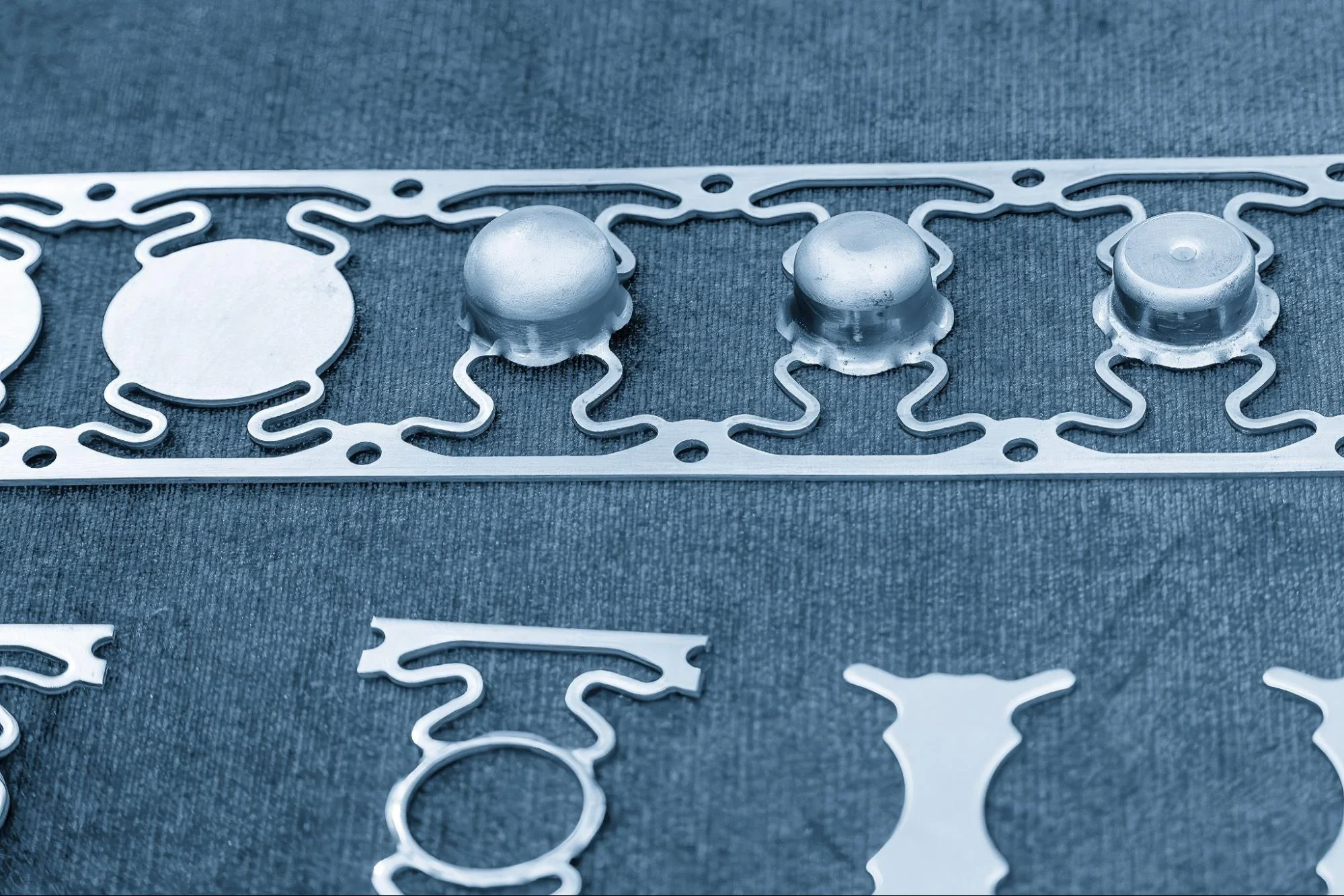
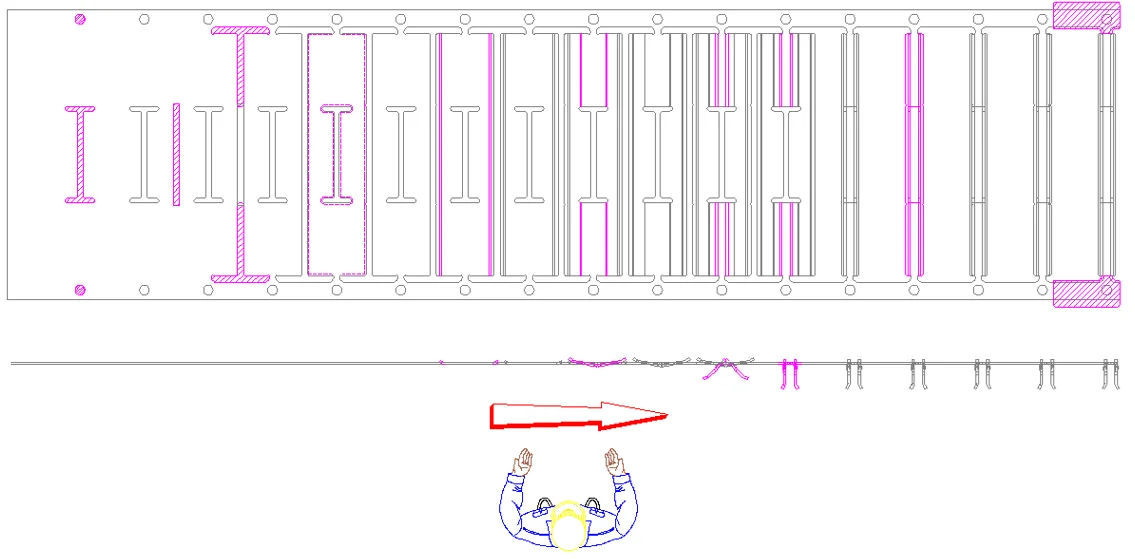
Progressive stamping is a metal forming process in which a continuous strip is fed through a single die set containing multiple sequential workstations. Each station performs a specific operation on the strip, and with every press stroke, the strip advances to the next station until a finished part is produced.
Unlike traditional sheet metal fabrication, where a part is cut from a sheet and then moved, progressive stamping keeps the part attached to a continuous “carrier strip” throughout the process.
The progressive sheet metal stamping process includes:
- Feed: A motorized decoiler feeds a metal coil into the press.
- Stroke: The press moves downward and engages the entire multi-station die simultaneously.
- Progression: Each station performs its task simultaneously. As the press opens, a feeder advances the strip.
- Result: With every stroke, a finished part is completed and ejected.
Below is a comparison between progressive stamping vs. single-stage stamping or transfer stamping:
Progressive vs. Single-Stage Stamping
Single-stage stamping uses one die per operation. While cost-effective for simple parts (like washers) or low-volume production, this method requires manual or robotic handling between setups—increasing labor costs and the risk of misalignment or damage.
Progressive vs. Transfer Stamping
In transfer stamping, the part is sheared from the strip at the first station and moved by mechanical “fingers.” This is necessary for large parts (e.g., car doors) or deep-drawn parts that would tear a carrier strip. However, the mechanical reset time makes this method slower than the continuous-flow logic of progressive stamping for small, high-speed parts.
Read our Metal Stamping Guide for a higher-level overview of the stamping process.
How Progressive Stamping Tooling Works
Progressive stamping tooling uses precision-ground, heat-treated steel components that function with synchronized timing—the key to the process’s efficiency. Described below is the anatomy of a progressive die and how its different components operate to create precise parts efficiently:
Anatomy of a Progressive Die
- Stations: Stations are the sequential stops in the tool for punching, notching, bending, etc.
- Pilots: Pilots are conical pins that enter previously punched holes in the carrier strip to ensure perfect alignment before punches hit. This registration is vital for maintaining tight tolerances across millions of parts.
- Punches and Dies: Punches are the upper components that penetrate the material into the lower die blocks to create shaped features and cut geometry.
- Strippers: Strippers are plates that hold the strip flat and strip the metal off punches as they retract to prevent jams.
The engineering required to time these stations is significant. If the strip advances slightly off-progression, it can chip punches, collapse die steel, or catastrophically damage the tool. While this complexity drives the high upfront tooling costs, the payoff is an automated factory system engineered for millions of cycles without failure.
When Progressive Stamping Makes Sense
Investing in a progressive die is an exercise in amortization logic. It is rarely suitable for short-run projects.
Volume Thresholds
Economic viability typically starts at 50,000 to 100,000 units per year, although some progressive tools are justified at 30,000 to 50,000 for ultra-simple parts. At these volumes, die costs ranging from $30,000 to over $250,000 are spread across the total program volume, reducing the tooling contribution to only a small fraction of the per-part cost.
The Cost Curve
Laser cutting has a near-zero initial cost but steep linear growth. Progressive stamping starts with a massive vertical spike for tooling, but the marginal cost of additional parts is just raw material and press time.
Part Geometry Characteristics
Beyond volume, the part’s physical design determines if it is suitable for the progressive process.
- Size & Scale: Best suited for small-to-medium parts. Very large components (e.g., floor pans) lack the structural integrity to remain attached to a carrier strip without sagging.
- Complexity: Ideal for parts requiring multiple features like simultaneous punching, coining, and complex bending.
- Flatness & Draw: Best for relatively shallow profiles. While some drawing is possible, deep-drawn “cup” shapes usually require transfer stamping to avoid tearing the carrier strip.
- Material Thickness: Most effective for gauge thicknesses at which the metal is rigid enough to be pushed through the die but pliable enough to be coil-fed.
Best-Fit Sheet Metal Fabrication Methods Per-Part Volume and Geometry
The table below compares progressive stamping to other common sheet metal fabrication methods based on cost, volume, and geometry.
| Feature | CNC Laser/Turret | CNC Punching (Turret) | Transfer Stamping | Progressive Stamping |
| Tooling Cost | Near Zero | Low (Standard Tools) | High | Very High |
| Setup Time | Minutes | Minutes to Hours | Hours | Days (Die troubleshooting) |
| Unit Cost | High | Medium | Low | Lowest |
| Ideal Volume | 1–5,000 units | 1,000–10,000 units | 25,000+ units | 50,000+ units |
| Part Size | Small to Large | Small to Medium | Large/Heavy | Small to Medium |
| Max Speed | Fast (Contouring) | Very Fast (Holes) | Moderate | Ultra-Fast (200-600+ SPM) |
Advantages and Limitations of Progressive Stamping
Advantages
- High Throughput: Presses can run at hundreds of strokes per minute (SPM) to produce thousands of parts per hour.
- Repeatability: Parts are locked into the carrier strip to ensure identical results across millions of units.
- Integrated Features: Advanced dies may incorporate “in-die” tapping or nut insertion for very high-volume programs, eliminating secondary assembly.
- Low Per-Part Cost at Scale: Efficiency makes it the cheapest way to produce complex metal parts at scale.
Limitations
- High Tooling Cost: Requires significant capital expenditure before production begins.
- Design Rigidity: Once the die is hardened, changing a feature is expensive and time-consuming.
- Long Lead Time: A high-quality die takes 12 to 20 weeks to fabricate and commission.
- Not Suitable for Revisions: Unsuitable for products in active design flux.
Design Constraints Unique to Progressive Stamping
Designing for a progressive die requires planning a sequence of events on a moving strip.
Strip Layout and Carrier Constraints
The part must remain attached to the carrier strip until the last station. Attachment points require enough strength to support movement through the die while remaining easy to trim cleanly at separation.
Minimum Feature Sizes
High-speed stamping stresses punches with hundreds of impact points per minute. If hole diameters are smaller than the material thickness, punch failure risk increases sharply. The 1:1 Rule—keeping hole diameters at or above material thickness—prevents breakage and extends tool life.
Tolerance Reality vs. CNC Expectations
Tight tolerances (under ±0.05 mm) are achievable but require frequent die sharpening, which increases costs significantly. Relaxing tolerances where function allows maximizes die life and reduces maintenance.
Design Guidelines for Stamped Sheet Metal Parts
| Design Rule | Typical Guideline | Tooling Impact | Risk if Violated |
| Hole Diameter | > 1.0x Material Thickness (1.2–1.5x for improved tool life) | Punch Strength | Frequent punch breakage |
| Bend Radii | > 1.0x Material Thickness | Stress Distribution | Cracking at the bend line |
| Grain Direction | When possible, orient bends perpendicular to the rolling (grain) direction | Material Integrity | Parts snapping |
| Spacing | > 2.0x Thickness | Die Wall Strength | Die steel collapsing over time |
Download our sheet metal design guide for more DFM guidance.
Tooling, Cost, Lead Time, and Economic Trade-offs
Successfully deploying a progressive stamping program requires a deep understanding of capital investment, the factors that drive costs, and the long-term maintenance required to protect that investment.
What Drives Progressive Die Cost?
- Station Count: Every feature adds at least one station, which increases the die block length and cost. Complex parts may require 20 or more stations.
- Material Toughness: Stainless steel requires expensive vanadium steels or carbide dies, which are more difficult to machine and maintain.
- Tolerance Requirements: Tight tolerances significantly add to the grinding and debugging time during the build process.
Lead Time and Design Changes
A late-stage design change after the die is mostly complete can cost as much as half the original tool price by requiring rework of machining, heat treatment, and grinding. Design changes can also significantly extend lead times. Before fabricating a progressive die, it’s imperative that the part design is fully locked.
Amortization
If a tool costs $50,000 for 500,000 parts, the tooling “tax” is $0.10 per part. At 5,000 parts, it is $10.00. Never move to progressive stamping until production volume justifies the investment and the design is fully validated.
How To Successfully Transition to Progressive Stamping
- Prototype with CNC/Laser: Never build a hard tool for a design that hasn’t been functionally tested.
- Validate Geometry: Ensure tolerances are necessary for the function. The relaxation of tolerances creates significant savings on maintenance.
- Engage DFM Early: Talk to stamping engineers while the design is still in flux to potentially incorporate changes that improve strip stability.
- Freeze Design Intentionally: Once the PO for the die is signed, all design changes must stop to meet lead times and budget.
Fictiv Helps You Scale Progressive Stamping with Confidence
Progressive stamping is an advantageous long-term strategy for scale—producing complex parts at a fraction of prototype costs. Success depends on respecting carrier strip constraints, understanding ROI, and freezing designs early. This allows you to tool once, then scale with confidence.
Fictiv guides your project from initial sketch through high-volume production, starting with early DFM feedback. Our engineers scrutinize your designs to identify “die-killers” and geometric flaws before you commit capital to steel.
As your design matures, we provide a clear prototype-to-production path, manage low-volume laser-cut prototypes for functional testing, and then scale those same designs into full progressive stamping runs. Our material expertise ensures you select alloys optimized for both end-use performance and high-speed stamping demands.
Logistically, Fictiv removes the burden of supplier coordination by managing qualified stamping partners and rigorous quality control protocols—ensuring that the millionth part off the press is as perfect as the first article.
Don’t navigate the leap to high-volume production alone. Whether you’re refining your final prototype or ready to cut steel, Fictiv’s experts are here to help you optimize your part geometry and de-risk your tooling investment.
Create a free account today to get a quote and expert DFM feedback on your next high-volume sheet metal project.
Talk to a Fictiv expert about your project, or upload your parts to start a free quote.
Frequently Asked Questions About Progressive Stamping
What volume justifies progressive stamping?
Progressive stamping generally becomes cost-effective at higher annual volumes — commonly cited thresholds range from around 50,000 units up to well over 100,000, though very simple parts can sometimes justify tooling at lower volumes. Below that range, CNC laser cutting or turret punching is often more economical because they require minimal upfront tooling investment. The right threshold depends heavily on part complexity, material, and total lifetime volume, so it’s best evaluated with a cost-per-part analysis for your specific program.
How much does a progressive stamping die cost?
Progressive die tooling costs vary widely, from roughly $10,000 for simple, low-station dies to $350,000 or more for complex, high-station tooling, depending on the number of stations, material type, tolerance requirements, and part complexity. High-tolerance stainless steel parts with many forming stations cost significantly more than simple carbon steel geometries. Because pricing varies so much by design and supplier, it’s best to get a quote for your specific part. Tooling costs are typically amortized over the total production volume.
What is the difference between progressive stamping and transfer stamping?
In progressive stamping, the part remains attached to a continuous carrier strip as it moves through multiple stations within a single die set. In transfer stamping, the part is separated from the strip early and mechanically transferred between stations. Transfer stamping is better suited for large or deep-drawn parts, while progressive stamping is ideal for small, high-speed, high-volume components.
What materials work best for progressive stamping?
Common materials for progressive stamping include carbon steel, stainless steel, aluminum, copper alloys, and brass. Material hardness and thickness directly affect tooling wear, station design, and die cost. Stainless steel and high-strength alloys often require specialized tool steels or carbide inserts to withstand high-speed operation.
How long does it take to build a progressive stamping die?
Progressive die build times vary widely with complexity: simple dies may be completed in as few as 8 weeks, while complex dies with many stations or tight tolerances can take 20 weeks or more to design, machine, heat treat, grind, assemble, and commission. Late-stage design changes and toolroom workload can significantly extend this timeline, so it’s best to confirm a lead time estimate directly with your toolmaker.
What tolerances can progressive stamping achieve?
Standard progressive stamping tolerances typically fall between ±0.05 mm and ±0.10 mm, depending on material thickness, feature type, and the capabilities of the specific die and press. Tighter tolerances are achievable but increase tooling cost, die maintenance frequency, and sharpening requirements. Functional tolerances should be defined carefully, and confirmed with your manufacturing partner, to balance performance and cost.