




Time to read: 12 min
In the design and production of structural metal components, one of the most important decisions the engineer must make is the choice of manufacturing process—and casting vs. forging is a common question. The two differ from each other not just in their approaches but also in terms of what that implies for part performance, costs, and lead times.
Pick up a forged connecting rod and a cast one made from the same alloy. They look similar, but the main difference is inside. The forged part has an oriented grain structure that followed the metal as it was compressed into shape, while the cast part solidified from liquid with no mechanical force applied. Because of this, forging produces higher strength, fatigue resistance, and toughness; casting produces more geometric freedom and lower tooling cost. That grain structure is why engineers specify forging for parts that will see cyclic loading, impact, or high fatigue cycles, and why casting wins when the geometry gets too complex, or the volume doesn’t justify the tooling cost.
For design engineers, this means trading off property requirements against geometric challenges and volume considerations. For buyers and procurement managers, the decision turns on issues like tooling cost amortization and economics of individual part production. This article walks through a practical evaluation of where each process actually earns its place.
Forging vs. Casting: Mechanical Properties and Grain Structure
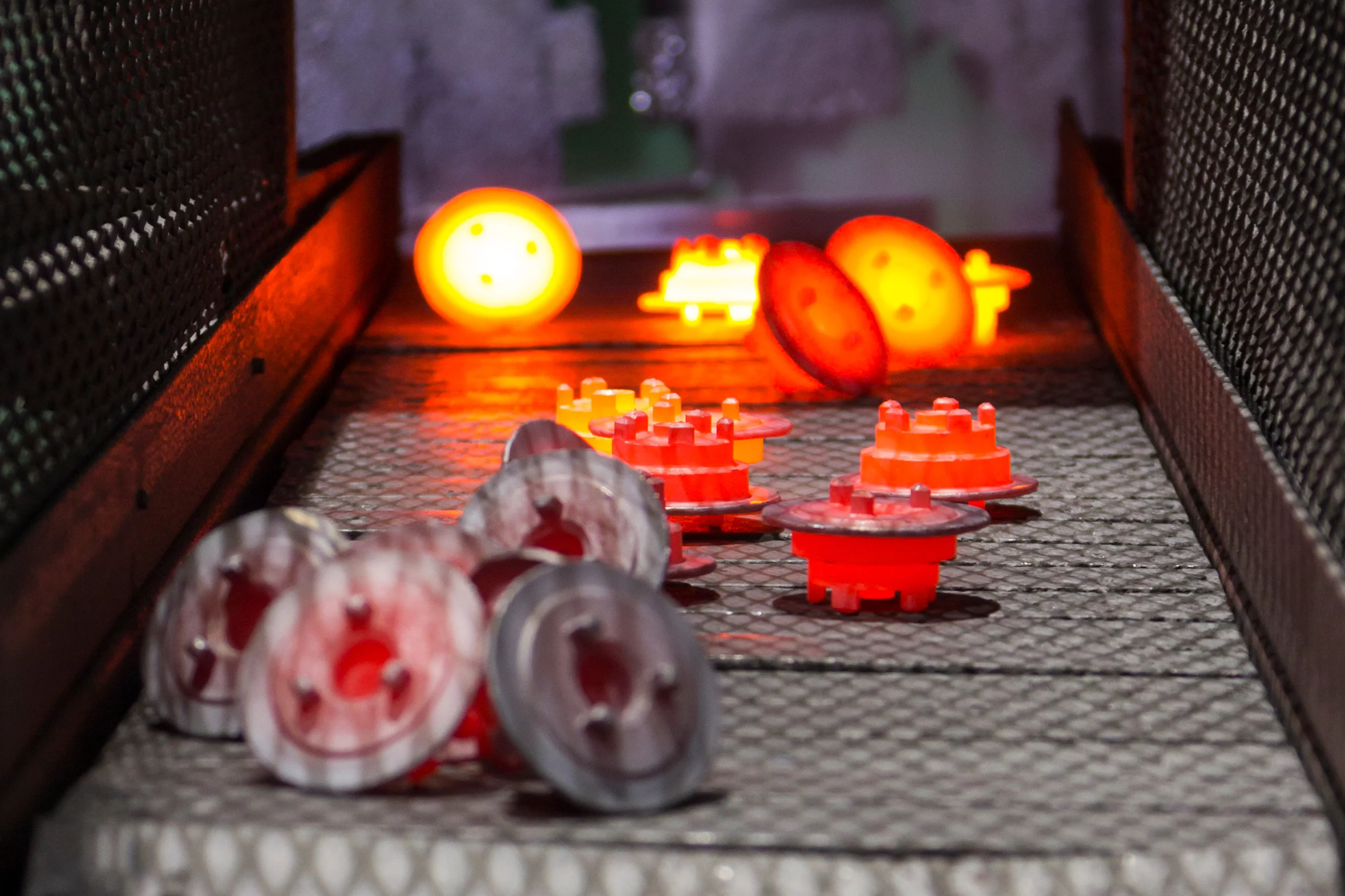
The forging process involves applying compressive forces to the metal to shape it. This can be done cold (at or just above room temperature) or hot (at approximately 50-80% of the material’s melting temperature, which translates to about 400 to 1200°C, depending on the alloy).
As the metal deforms under that compressive force, its grains elongate and align along the metal’s flow path, following the part’s geometry as the crystal structure stretches. Hot forging has the added advantage of (generally) being performed above the recrystallization temperature, allowing new, finer grains to form. Smaller grain size is one of the few ways to simultaneously strengthen and toughen a material. That benefit depends on tight temperature control, because forging too hot or holding too long can cause grains to coarsen instead of refine.
In casting, by contrast, a molten metal is poured or injected into a mold cavity where it hardens without being subjected to any mechanical forces. This creates an isotropic structure, where there is an almost uniform distribution of mechanical properties in all directions but no directional grain flow found in forging. Casting brings with it the potential problem of porosity, when gas is trapped during solidification, or shrinkage cavities develop due to cooling.
Forging vs. Casting Mechanical Properties
| Property | Forgings | Castings |
| Grain structure | Directional grain orientation can follow part geometry and load paths. | Generally isotropic, without the directional grain orientation produced by forging. |
| Strength and ductility | Typically higher tensile and yield strength, ductility, and impact toughness for equivalent alloys. | Properties can be limited by porosity, shrinkage, and other solidification-related discontinuities. |
| Fatigue resistance | Generally higher due to favorable grain orientation and fewer internal discontinuities. | Porosity and shrinkage voids can act as stress concentrators and reduce fatigue endurance. |
| Heat treatment | Can be used to further tailor hardness, strength, and toughness. | Can improve strength, toughness, and dimensional stability, although entrapped gas and porosity may increase the risk of blistering or distortion during heat treatment. |
| Hardness and wear resistance | Cold forging can produce substantial work hardening and high surface hardness while maintaining through-section wear resistance. | Hardness can be increased through alloy selection and heat treatment, but may not provide the same combination of surface hardness and wear resistance. |
| Typical application fit | Better suited to impact, cyclic loading, and high-stress applications. | Well suited to static or lighter loads and complex geometries where casting properties meet service requirements. |
Forging vs Casting: Capability of Each Process
The component shape that a process can make is often the first filter in the selection of a manufacturing process. This is where casting holds a clear advantage in terms of complexity.
The geometric breadth of forging is more limited. Although hot forging is carried out at higher temperatures that provide improved ductility and easier shaping of intricate parts, the process essentially consists of working on a solid part through the compressive forces applied by dies. This is why forging is best used when simple shapes are required. Examples of such shapes include shafts, connecting rods, gears, and similar components.
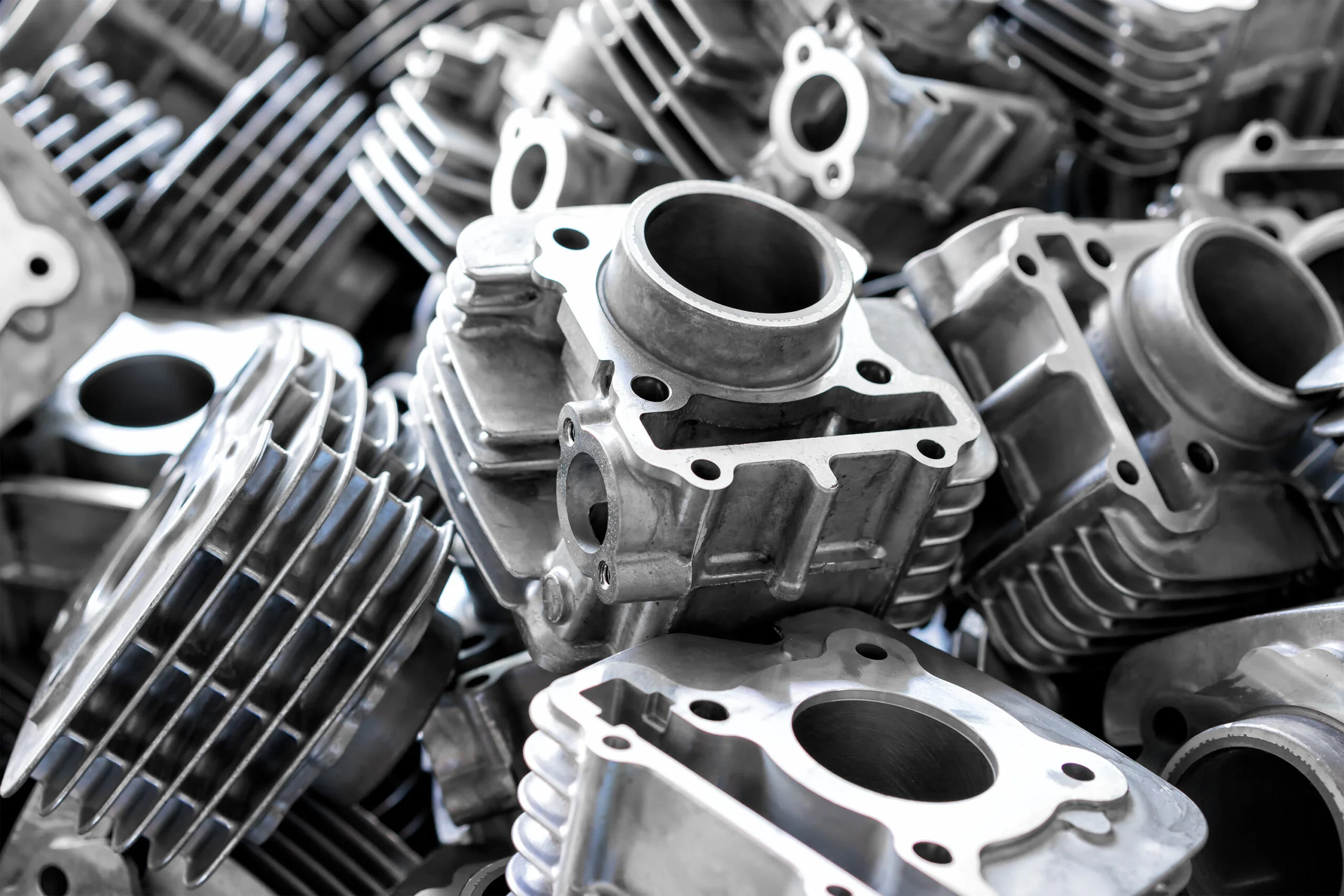
High-Pressure Die Casting (HPDC) injects liquid metal into a steel mold under high pressure, ranging from 10,000 to 20,000 psi. HPDC allows the manufacture of highly complex parts with thin walls, excellent surface finish, and precision dimensions.
For higher melting-point metals or even more complex casting geometries, investment casting (also known as lost wax casting) may be more appropriate. It can deliver intricate parts while maintaining excellent surface finishes (32–63 µin Ra) and dimensional accuracy of ±0.005″–0.015″.
Die casting, by contrast, offers the ability to make high-complexity parts with good surface finish (60–120 µin Ra) and ±0.004″–0.010″ accuracy. Parts can range in weight from less than a pound to over 30 lbs, and from a few inches to 60 inches long, with typical wall thicknesses of 0.08 to 0.16 inches.
Tooling, Volume, and Per-Part Economics
For sourcing managers evaluating suppliers, the cost structure of each process is often the deciding factor.
Die casting requires expensive hardened steel molds (dies) that allow repeated use, making the process ideal for mass production. The tooling cost is high, but the rapid cycle times, measured in seconds, significantly reduce labor and per-part costs at high volumes.
Investment casting occupies a middle ground. Tooling costs are medium, and the process is well-suited for volumes of 500 to 5,000 parts. The ability to cast multiple parts simultaneously on a “tree” structure reduces per-part costs by 20–30% for medium volumes. However, the process is more labor-intensive than die casting, with each ceramic shell requiring 6–8 dipping and drying cycles. Sand casting, by contrast, offers low tooling costs and suits volumes of 1 to 1,000 parts, but delivers only a fair surface finish (125–500 µin Ra) and only moderate dimensional accuracy (±0.030″–0.125″).
An economic factor related to hot forging is that, compared to casting, forging normally involves the use of relatively more material, and secondary operations are sometimes necessary to get the right size and finish. Cold forging uses less material than hot forging because of the lower amount of flash involved.
Scaling up to production volumes? Read our Scaling CNC to Casting Guide.
Which Alloys Are Best Forged or Cast
Not all alloys can be cast, nor can all be forged. Understanding which are which is essential for both engineers.
Best Alloys for High-Pressure Die Casting
- Aluminum Alloys: Prized for light weight, strength, and corrosion resistance.
- Zinc Alloys: Offer high dimensional stability, exceptional fluidity, and support high-speed production with longer tooling life.
- Magnesium Alloys: Valued for high strength-to-weight ratio in portable electronics and aerospace.
- Copper-Based Alloys: Provide excellent thermal and electrical conductivity and high strength for specialized applications, though less common due to their higher melting point and its effect on tool life.
Best Alloys for Investment Casting
- Stainless and Alloy Steels (e.g., 17-4 PH): Deliver high strength and corrosion resistance for structural and medical components.
- Superalloys (e.g., Inconel 718): Retain strength at high temperatures, the standard choice for turbine blades and other hot-section parts.
- Titanium Alloys (e.g., Ti-6Al-4V): Combine a high strength-to-weight ratio with biocompatibility, common in aerospace brackets and implants.
- Cobalt-Chrome: Biocompatible and wear-resistant, widely used for orthopedic implants and surgical instruments.
Best Alloys for Forging
- Steel: Typically hot forged, since its flow stress at room temperature is high; delivers the fatigue and impact strength forging is known for.
- Aluminum Alloys: Ductile with low flow stress at room temperature, so they’re usually cold forged into fasteners, brackets, and other precision components.
- Magnesium Alloys: Also well suited to cold forging, valued where weight savings matter most.
In general, whether a metal is hot or cold forged comes down to its flow stress and ductility at room temperature.
Part Geometry, Tooling, and Production Volume—The Practical Decision Factors
In practice, part geometry dictates tooling complexity and upfront capital expenditure, while production volume determines whether that investment can be justified within the program’s lifecycle.
If a design is highly contoured or has cavities or cores inside, then you will need an advanced die with slides and ejector pins. Tooling could cost anything from $ 50,000 to $ 100,000 for a high-pressure die casting and could take 12-20 weeks to manufacture. When considering whether forging might be a better option, think about whether that same design could even be forged at all, or whether it could take several progressive dies and preforms to complete. If so, forging that part could end up costing as much as making it by high-pressure die casting.
If your program requires 100,000 parts annually, amortizing a $75,000 die casting tool adds just $0.75 per part over the first year alone—a rounding error compared to the per-part material and cycle-time savings. At 1,000 parts annually, however, that same tool adds $75 per part, making forging’s simpler, lower-cost tooling (often $10,000–$30,000) far more attractive, despite higher per-part material usage and secondary machining costs.
There are also lead-time constraints to consider. Die casting tooling, due to its complexity and the need for hardened steel that can withstand millions of thermal cycles, typically requires longer lead times than forging dies. For sourcing managers expediting tight product launch schedules, the tooling lead time alone can tip the scale toward forging for low-to-medium volume programs or toward investment casting, which offers medium tooling lead times.
Download our Die Casting Design Guide for more tips.
The Forging vs. Casting Decision Matrix: A Side-by-Side Comparison
| Factor | Forging | Casting (Die) | Casting (Investment) |
| Strength/Fatigue Resistance | Excellent (oriented grain structure) | Good (isotropic, porosity risk) | Good (isotropic, porosity risk, improves with heat treatment) |
| Part Complexity | Low to moderate | High | Very High |
| Surface Finish | Good to excellent (32-120 µin Ra) | Good (60–120 µin Ra) | Excellent (32–63 µin Ra) |
| Dimensional Accuracy (Approx.) | ±0.012″–0.040″ | ±0.004″–0.010″ | ±0.005″–0.015″ |
| Tooling Cost | Low to medium | High | Medium |
| Tooling Lead Time | Short to medium | Long | Medium |
| Volume Suitability | 1-1,000 parts | 5,000–10,000+ parts | 500–5,000 parts |
| Material Options | Wide | Wide | Extensive |
A Strategic Framework for Selection
Choosing between forging and casting is not a matter of one process being “better” than the other. It is about aligning process capabilities with your specific application requirements.
A practical note from the field: the geometry filter tends to decide faster than engineers expect. A straight through-hole is often forged directly, but a blind bore, an internal pocket, or an undercut usually needs a separate piercing step, a two-piece forge-and-weld approach, or a post-forge machining setup that erodes the cost advantage. Running a rough tooling estimate for both processes before committing to the design geometry is worth doing early.
Forging is best suited to relatively simple parts where fatigue strength, impact resistance, and mechanical properties are critical. Die casting works well for high-volume production of complex parts, particularly in aluminum, zinc, or magnesium, while investment casting provides a balance of geometric complexity, dimensional accuracy, material flexibility, and surface finish.
In the end, the correct choice depends on balancing the demands of mechanical properties with geometry, production volume, materials, lead time, and costs. Early collaboration with Fictiv can help inform the choice.
If your part fits die casting or investment casting, upload your CAD files for a free quote and DFM review.
Talk to a Fictiv expert about your project, or upload your parts to start a free quote.
FAQs About Forging vs. Casting
What’s the main difference between forging and casting?
Forging shapes solid metal using compressive force, creating an oriented grain structure that follows the part’s geometry and improves strength, fatigue resistance, and toughness. Casting pours molten metal into a mold, where it solidifies without mechanical force, producing an isotropic structure with more design freedom for complex shapes but a higher risk of porosity and shrinkage defects.
Is casting strong enough to replace forging for high-stress parts?
It depends on the application. Casting’s isotropic properties and potential porosity make it better suited to static or lighter loads, while forging’s directional grain structure gives it higher fatigue resistance and impact toughness for cyclic or high-stress service. Heat treatment can improve cast properties, but parts under repeated impact or fatigue loading are usually still better forged.
What’s the difference between die casting and investment casting?
High-pressure die casting injects molten metal into a hardened steel mold at 10,000–20,000 psi, best suited to non-ferrous metals like aluminum, zinc, and magnesium at volumes of 5,000–10,000+ parts. Investment casting encases a wax pattern in ceramic before pouring metal, supporting a much wider range of alloys, including steels and superalloys, at 500–5,000 parts, with excellent surface finish and dimensional accuracy.
How much does forging tooling cost compared to die casting tooling?
Forging tooling typically runs $10,000–$30,000, while high-pressure die casting tooling costs $50,000–$100,000 and takes 12–20 weeks to build. That gap matters most at low-to-medium volumes: at 1,000 parts a year, a $75,000 die casting tool adds $75 to each part’s cost, but at 100,000 parts a year, it adds only $0.75 per part, which is often the deciding factor.
At what production volume should I switch from casting to forging, or vice versa?
There’s no fixed threshold. Forging tends to fit simpler geometries at lower volumes (roughly 1–1,000 parts), where tooling cost is lower and mechanical properties matter most. Die casting becomes more economical above about 5,000–10,000 parts a year once its higher tooling cost is amortized, while investment casting fits a middle range (500–5,000 parts) where complex geometry and material flexibility outweigh die casting’s speed.