





Time to read: 12 min
Dimensional drift and defects are the failure modes manufacturing engineers work hardest to minimize in injection molding. Initial sample parts measure accurately, the pilot run looks clean, and tooling is signed off for production. Months later, parts drift out of tolerance, or flash, sink marks, and short shots start appearing. Worse still is discovering that parts molded from cavity four fit the mating assembly cleanly, while parts from cavity seven bind.
Scientific molding defines the full range of settings that still produce a good part, then runs production well inside that range. The result is stable dimensions and fewer process-related defects such as short shots, flash, and sink marks.
When engineers ask, “Why does my injection-molded part have inconsistent dimensions or recurring defects?” the cause usually traces back to the original process development. Tool wear doesn’t matter until late in a tool’s life, but until then, a trial-and-error setup works only as long as conditions stay the same. If resin viscosity shifts between lots, shop temperatures swing, or machine pressures fluctuate, parts show unexpected variation.
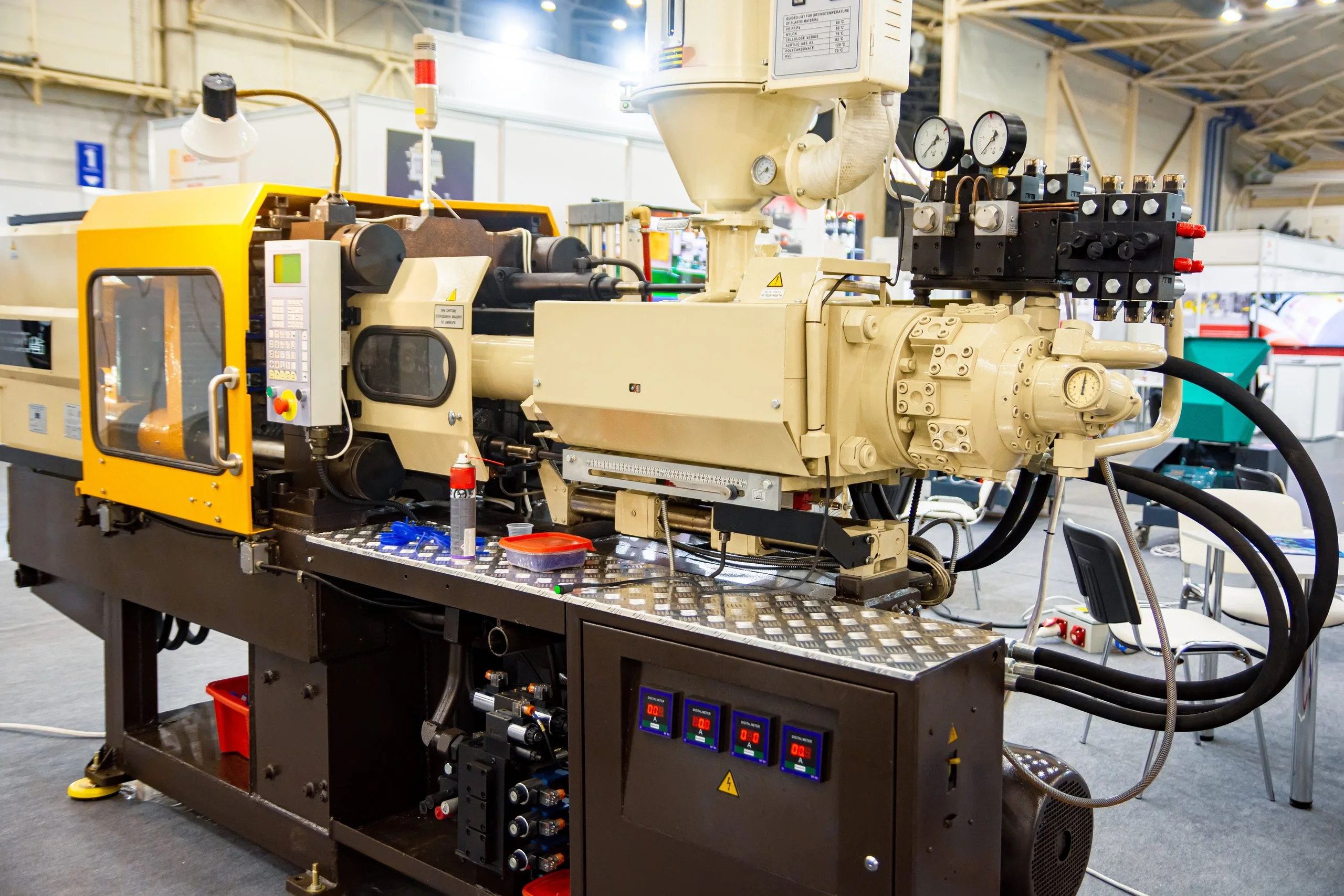
This guide explains scientific injection molding and how to use it when evaluating suppliers.
Scientific Molding Defined
The Scientific molding process is a data-driven approach to developing and qualifying injection molding processes rather than relying solely on intuitive machine adjustments. It separates the molding cycle into distinct, separately controlled stages.
Using designed experiments, it defines the full acceptable operating window and pinpoints the optimum setpoints within that window, rather than hunting for a single set of machine dials that happens to produce a passable part on setup day.
Decoupled Molding Tiers
RJG Inc. formalized implementation of this methodology under the registered trademark DECOUPLED MOLDING®, though the broader manufacturing sector generally refers to it as scientific injection molding. Industry practice classifies decoupled process development into three progressive tiers:
- Decoupled I: Separates the fast fill stage from the pack/hold stage based on machine stroke position, transferring from velocity control to pressure control at a set screw position.
- Decoupled II: Fills the cavity to 95% to 98% under velocity control, transfers to a separate pressure-controlled pack and hold phase to compensate for volumetric shrinkage, and maintains pressure until gate freeze-off using machine hydraulic or electric controls.
- Decoupled III (Advanced Cavity Control): Uses in-mold cavity pressure sensors to control process transitions directly from the plastic’s point of view, transferring and packing based on real-time cavity pressure rather than screw position or line pressure.
At its core, the scientific molding process focuses on polymer physics as the material enters, fills, packs, and cools within a specific tool. By evaluating melt viscosity under set injection conditions (accounting for shear rate and melt temperature) and mapping volumetric shrinkage until gate freeze-off, a manufacturing engineer establishes validated machine settings that keep parts inside a repeatable dimensional window. This documented approach anchors injection molding process parameters by providing data to detect and compensate for routine batch-to-batch variations in incoming raw resin, far more reliably than an unvalidated setup.
Conventional process development and scientific molding solve the same problem differently. A conventional setup finds settings that produce a good part and writes them down. Scientific molding finds the edges of the window that still produce a good part, documents where those edges sit, and sets the process comfortably inside them.
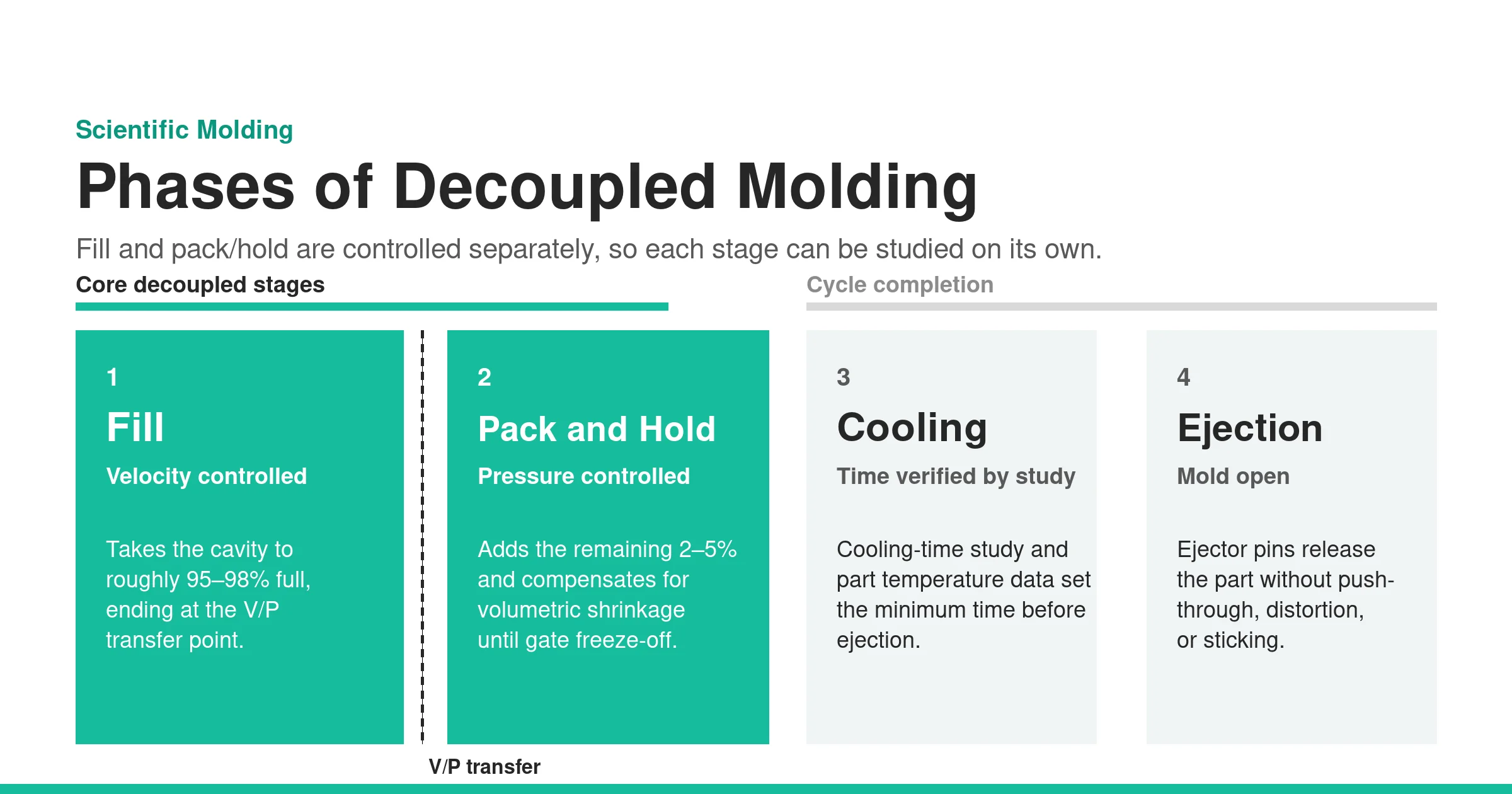
Phases of decouple molding showing the velocity-to-pressure (V/P) transfer point
The Phases of Decoupled Molding
Conventional molding often blends fill and pack into a single pressure-limited stage or transfers late. Decoupled molding isolates the fill, pack, and hold stages so changes in one stage do not mask or distort behavior in the others. The core decoupled stages focus on polymer delivery, and cooling and part ejection complete the overall machine cycle:
- Fill Phase
Velocity-controlled and takes the cavity to roughly 95 to 98 percent full, ending at the velocity-to-pressure transfer point.
- Pack and Hold Phase
Pressure-controlled. It fills the remaining 2 to 5 percent of the mold and adds material to compensate for volumetric shrinkage as the material solidifies. Pack pressure, time, and profile are set and studied separately from filling.
- Cooling Stage
The part solidifies in the mold until it reaches sufficient structural rigidity for ejection. In scientific molding, technicians establish optimal cooling duration through a cooling-time study and direct part temperature measurements, validating thermal stability rather than relying strictly on unverified estimates.
- Mold Open and Ejection
The tool opens, and ejector pins release the finished component smoothly without pin push-through, distortion, or sticking.
When each phase is measured directly, an engineer can change one variable and see its effect on the part more clearly, with less risk of a machine setting affecting several stages at once. Along with documentation and machine validation, this helps make the process window reproducible on a different shift or press.
Key Scientific Molding Tools and Studies
Before a tool is cleared for production and initial parts are approved, a qualified molder executes a structured series of characterization studies. A qualified supplier should be able to walk through how each study was conducted and provide the underlying data:
Short Shot Study
A short shot study maps cavity fill at incremental screw positions up to the velocity-to-pressure (V/P) transfer point. This confirms the mold fills to 95% to 98% under velocity control without packing, visually identifying hesitation or non-uniform multi-cavity fill patterns before pressure is applied.
Viscosity Curve
Also called a rheology study, a viscosity curve measures how melt viscosity changes across a range of injection speeds. It identifies the viscosity-insensitive range, where small swings in machine performance or material lot have less impact on how the material flows. Beyond injection velocity and shear rate, melt viscosity is also influenced by barrel temperature profiles, moisture content in hygroscopic resins, and regrind ratios. Identifying this stable processing plateau reduces sensitivity to minor machine variations that can disrupt cavity filling.
Gate Seal Study
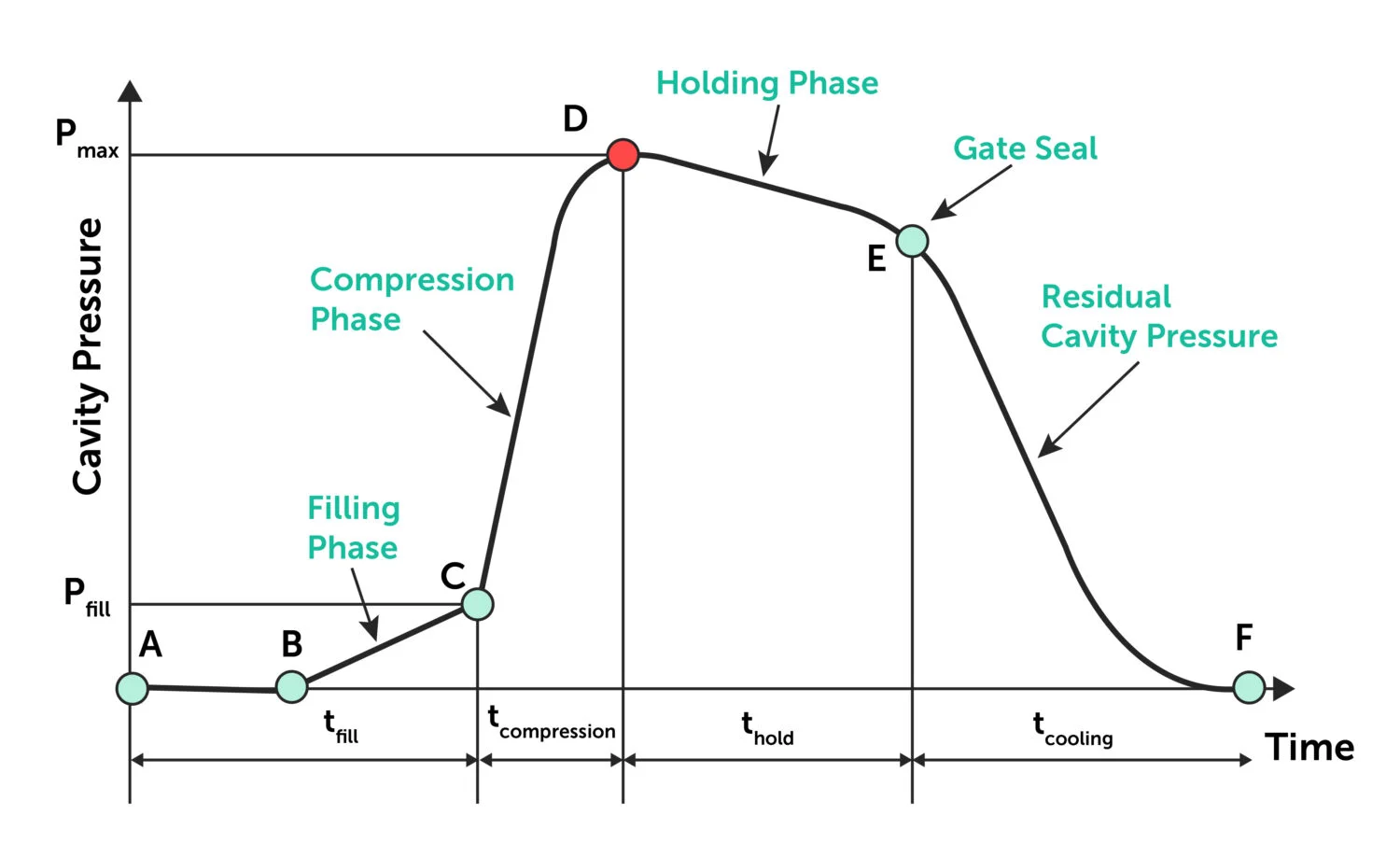
A gate seal study finds the gate-freeze time for a given mold, material, and set of process conditions by increasing pack time in steps and weighing the parts. Part weight rises with pack time until the gate seals, and then plateaus. The pack time at the plateau is the minimum needed to prevent backflow and keep part weight and dimensions stable.
Cooling Time Study
A cooling time study establishes the minimum time a part needs before ejection to stay dimensionally stable. Eject too early and parts warp; cool too long, and the supplier unnecessarily extends cycle time.
In-Mold Cavity Pressure Sensing
Distinguishable from pre-production setup studies, cavity pressure sensing is an active in-process monitoring and control technology. Piezoelectric transducers placed behind ejector pins or inside the cavity measure dynamic plastic pressure in real time. Rather than inferring fill dynamics from machine-side parameters, it verifies true cavity conditions and enables automated part sorting to reject out-of-spec shots immediately.
Design of Experiments (DOE)
DOE is the structured method behind most of this work. It tests how variables such as melt temperature, mold temperature, injection speed, and pack pressure interact, and identifies which ones actually move the needle on part quality.
What Scientific Molding Produces, and What It Prevents
A scientifically developed process gives a buyer several things a conventional process usually cannot.
A documented process window records the tested range of conditions that still produce an acceptable part, not just the nominal setpoint on the setup sheet. That documentation is what a quality engineer should ask to see directly: viscosity curve data, gate seal logs, cooling-time study results, and validated pack and hold pressure limits.
It is easier to reproduce on production runs, to detect drift, and to keep parts consistent on multiple molding machines if the process behind the approved first sample is documented and measured. Better insight into the process improves conformance to customer requirements over the life of a program, supporting clean transfer between presses without relying on machine-specific quirks.
Troubleshooting moves faster, too. A documented process window combined with cavity pressure data can quickly point an engineer to a root cause when something drifts.
None of this means that variation disappears entirely. Parts will still vary shot to shot and lot to lot. Scientific molding measures and controls that variation within an agreed tolerance band instead of discovering it after a customer complaint.
Questions to Ask an Injection Molding Supplier
Five questions to ask a supplier about scientific molding when evaluating a manufacturing partner:
- Do you run a viscosity curve study during process development?
Look for actual rheological data, documented injection speed increments, and an explanation of the stable viscosity-insensitive region for your specific resin.
- Do you determine gate seal time?
The right answer references a specific pack time study. The supplier should provide part-weighing logs plotted against incremental pack and hold times, identifying the exact point of gate freeze-off rather than estimating duration based on unmeasured historical habits.
- Do you use cavity pressure sensing in production?
It is not required for every application, but its use, especially tied to automatic shot rejection, signals real process control.
- Can you show samples of the documentation provided to customers for the process window?
If a supplier provides only a single nominal setpoint sheet without upper and lower operating boundaries, viscosity data, or gate seal curves from previous jobs, that’s a red flag.
- What happens when a material lot changes?
A supplier with a baseline viscosity curve can re-check the new lot against it and tell you whether the existing window still holds or needs adjustment.
When Scientific Molding Is Most Critical
Using the scientific molding process is not equally important for every program, and knowing when it matters most can save time and money.
Scientific molding is widely used in regulated industries, especially medical device manufacturing. For Class II and Class III medical programs, molded features that affect fit or function typically require a validated process under ISO 13485 and FDA QMSR. Scientific molding data gives that validation objective evidence. Automotive and aerospace customers often request FAI and PPAP to confirm conformance.
High-precision assemblies benefit from scientific molding because every bit of conventional dimensional drift narrows the allowable margin in multi-part tolerance stack-ups. A validated, narrow process window protects nominal mating clearances across production lots.
High-volume production raises the stakes of process drift. In a short 500-part run, undetected drift might scrap 25 parts. In a 50,000-part production program, that same percentage of scrap means roughly 2,500 non-conforming units, creating financial losses and supply chain disruption.
Multi-cavity tooling presents unique flow and pressure-balance challenges that can’t be resolved through visual assessment of finished parts or intermittent spot checks alone. Adding cavity pressure sensors and pairing them with scientific process development gives visibility into cavity-to-cavity balance, so imbalances can be found and corrected.
Scientific molding matters less for simple geometries, wide tolerances, and parts where cosmetic consistency, not dimensional precision, is the main concern. Reserve the added development time and cost for programs where dimensional drift carries real consequences.
Choosing a Supplier Who Gets Process Development Right
Fictiv pre-qualifies manufacturing partners across its global network, verifying documented molding capabilities before production ever begins rather than discovering limitations after a quality failure. Engineers sourcing precision injection-molded parts can specify scientific process development as a required qualification benchmark.
Get an injection molding quote or talk with a Fictiv manufacturing expert about your qualification requirements.
Talk to a Fictiv expert about your project, or upload your parts to start a free quote.
FAQs About Scientific Molding
What is scientific molding in injection molding?
Scientific molding is a data-driven approach to developing and qualifying injection molding processes instead of relying on intuitive machine adjustments. It separates the molding cycle into controlled stages and uses designed experiments to define the full acceptable operating window. The process is then set comfortably inside that window. RJG Inc. trademarked its version of the method as DECOUPLED MOLDING®.
How is scientific molding different from conventional process development?
A conventional setup finds settings that produce a good part and writes them down. Scientific molding finds the edges of the window that still produce a good part, documents where those edges sit, and sets the process inside them. It also controls fill, pack, and hold separately, so changing one variable shows its effect on the part more clearly.
Is scientific molding required for every injection molding project?
No. It matters most for medical devices, high-precision assemblies with tight tolerance stack-ups, high-volume production, and multi-cavity tooling. It matters less for simple geometries, wide tolerances, and parts where cosmetic consistency is the main concern. Reserve the added development time and cost for programs where dimensional drift carries real consequences.
What documentation should I ask a molder to provide?
Ask for the documented process window, not just a single setpoint sheet. That includes viscosity curve data, gate seal logs showing part weight against pack time, cooling-time study results, and validated pack and hold pressure limits. A supplier that offers only a nominal setpoint sheet, with no upper and lower operating boundaries, is a red flag.
Can scientific molding eliminate part-to-part variation?
No. Parts still vary shot to shot and lot to lot. Scientific molding measures and controls that variation within an agreed tolerance band, so drift is caught early rather than discovered after a customer complaint. Cavity pressure sensing can add real-time monitoring and automatic rejection of out-of-spec shots, though it isn’t needed for every application.