






Time to read: 8 min
In the product development process, testing and iteration are essential to ensure a design performs reliably and as intended. Rather than validating a design through isolated trials or ad hoc adjustments, engineers benefit from a structured approach that systematically evaluates how key variables influence performance. Design of Experiments (DOE) provides a disciplined framework for intentionally planning tests, controlling inputs, and solving complex engineering problems.
Data-driven design is essential in mechanical engineering. Shorter development cycles, tighter regulatory requirements, and higher customer expectations mean designs must be right the first time. Rather than relying on intuition or single-factor testing, engineers use statistically sound data to structure the DOE. This enables controlled causal inference within the defined experimental space, quantifies uncertainty, and validates performance early.
What Is Design of Experiments (DOE)?
DOE is a structured, statistical methodology for designing and executing controlled experiments, analyzing the resulting data, and drawing valid, objective conclusions efficiently. Its primary purpose is to understand how multiple input factors affect one or more output responses, and to use that understanding to optimize performance, improve robustness, and reduce variation.
DOE evaluates multiple input factors simultaneously and is superior to trial-and-error or one-factor-at-a-time (OFAT), which assesses only a single input factor while holding all others constant. In engineering applications, these factors may include design variables such as geometry and tolerances, material choices, or manufacturing process parameters.
The DOE Process: Step by Step
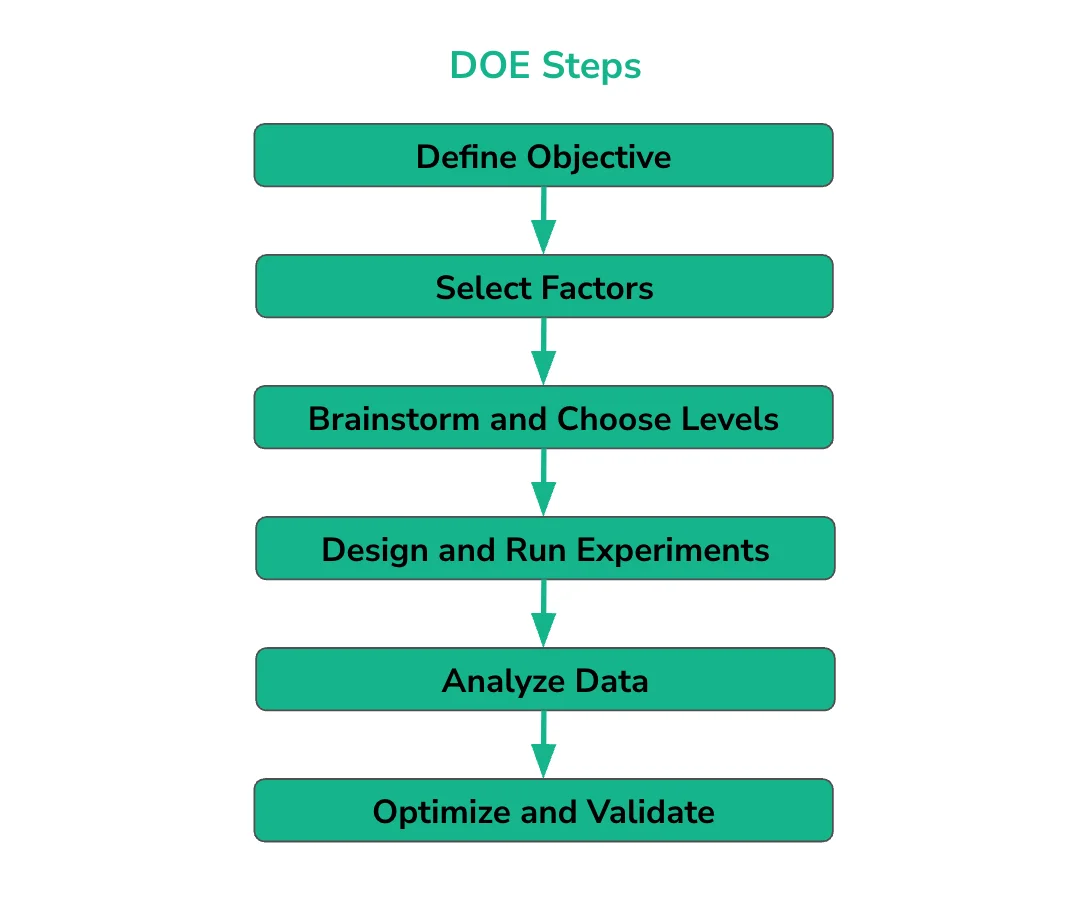
DOE provides a structured path from experimental planning to validated results:
- Define Objective: Identify the problem (minimize warpage in molded part)
- Select Factors: Choose input variables (wall thickness, gate location, melt temperature)
- Choose Levels: Assign settings (low, medium, high pressure)
- Design Experiment: Plan test matrix (RSM or 3-level factorial design)
- Run Experiments: Execute plan (run 8 trials per matrix)
- Analyze Data: Use statistical tools (ANOVA, main effects plot)
- Optimize/Validate: Implement best settings (reduce defects by 30%)
The Core Principles of DOE
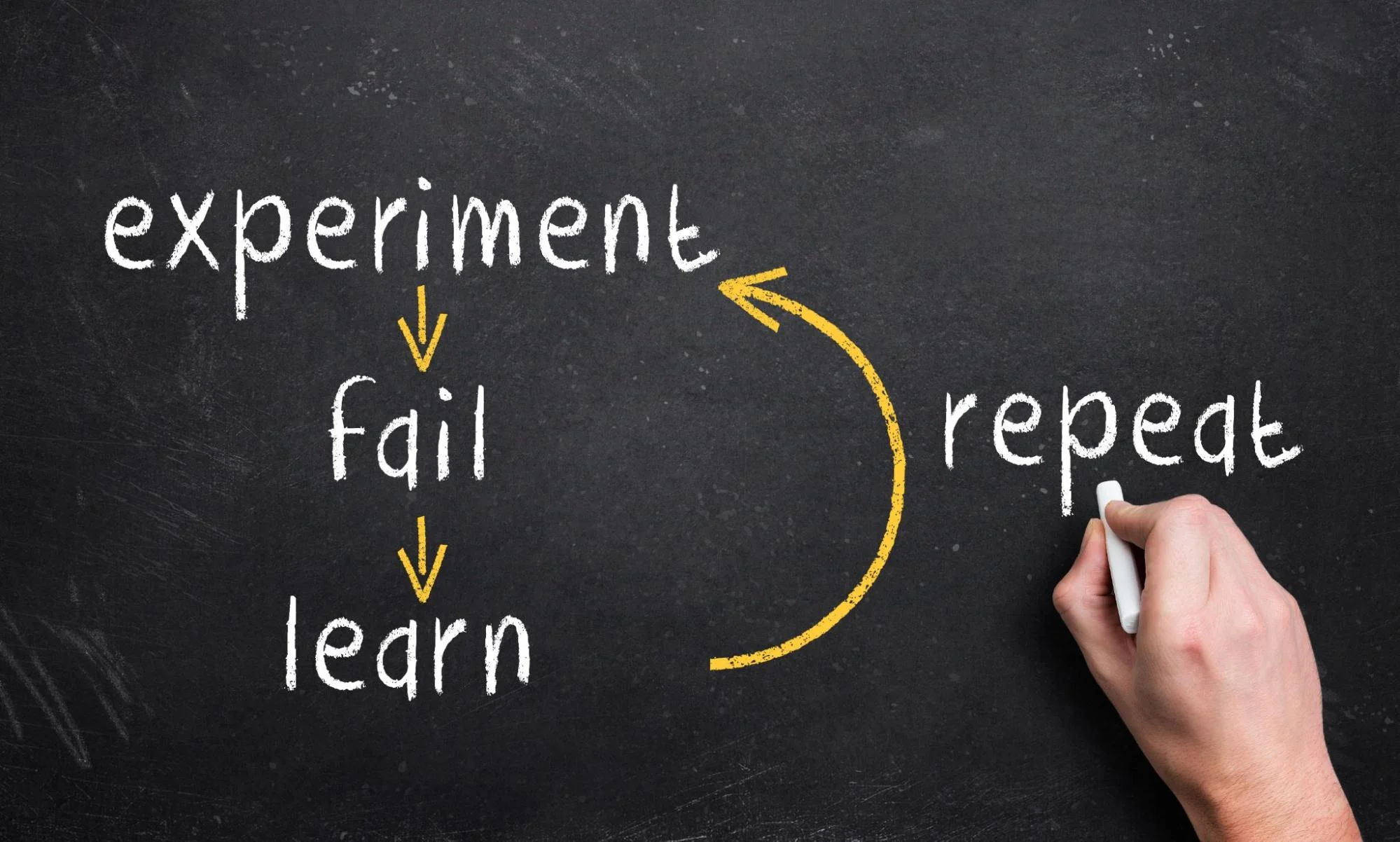
The core principles of DOE show how experiments are designed to reliably capture factor effects, interactions, and variations.
Randomization and Replication
In an experiment, randomization helps eliminate bias and limits the influence of uncontrolled or unknown variables. This is achieved (via humans or software) using chance selection and random ordering of input factors.
Replication produces a more accurate signal-to-noise ratio—a measure of how noticeable an effect is relative to random fluctuations or noise—allowing for statistical estimates of error that can be defended. Identification of genuine experimental effects requires the quantification of error and understanding the magnitude of random noise.
Blocking to Manage Known Sources of Variation
Blocking occurs when an experimenter knows about some factors—such as machinery, material types/batches, working shifts, and/or testing date—that will influence the response, but are not the researcher’s main interest.
Blocking (grouping) of experimental units helps isolate the effect of an extraneous source while maintaining the ability to compare the primary sources of variability being studied. This approach is particularly valuable in mechanical design and manufacturing, where it is impractical to maintain all other factors as constants. Blocking increases sensitivity to the factorial arrangement, reduces experimental error, and helps validate and generalize the factorial results.
Factorial Design and Interaction Effects
Factorial design is the backbone of DOE, enabling simultaneous investigation of multiple factors across defined levels and producing knowledge more efficiently than OFAT experiments. A key aspect of factorial design is its ability to identify and quantify interactions, where the effect of one factor depends on the level of another.
Interactions are also present in most mechanical and production systems and can have negative consequences if unrecognized. The design of the experiment provides engineers with visibility into—and a method for—quantifying interactions, enabling the optimization of total systems rather than just tuning individual parameters.
A commonly used introductory full factorial design is the 2³ design, in which one studies three factors, each with two settings. The 2³ DOE is useful for understanding which factors drive the response, identifying and estimating interactions, and assessing model sensitivity.
Types of DOE Designs
| DOE Type | Structure | When to Use | Example Application |
| Full Factorial | Tests all factor combinations | Small number of variables | Injection molding pressure/temp study |
| Fractional Factorial | Tests a subset of combinations | When resources are limited | CNC machining feed/speed optimization |
| Response Surface Methodology(RSM) | Curved (nonlinear) relationships between inputs and responses | Process tuning | Laser power optimization |
| Taguchi Design | Orthogonal arrays | Robust design with minimal runs | Noise tolerance in assemblies |
| Plackett-Burman | Screening design | Identify the critical few factors from many | Early-stage material testing |
Analyzing DOE Results
Once experimental data is collected, statistical analysis turns results into insight. The Analysis of Variance (ANOVA) test provides a method for assessing the impact of both individual and combined factors on dependent measures, or outcomes.
ANOVA compares the amount of variance attributable to the model with the variance that cannot be explained by the model due to random error, using the resulting p-value to assist in decision-making. Main-effects plots visualize how each factor influences the response on average, while interaction plots reveal whether the effect of one factor depends on the level of another—often the most critical insight in mechanical systems.
Visualization with Contour and Response Surface Plots
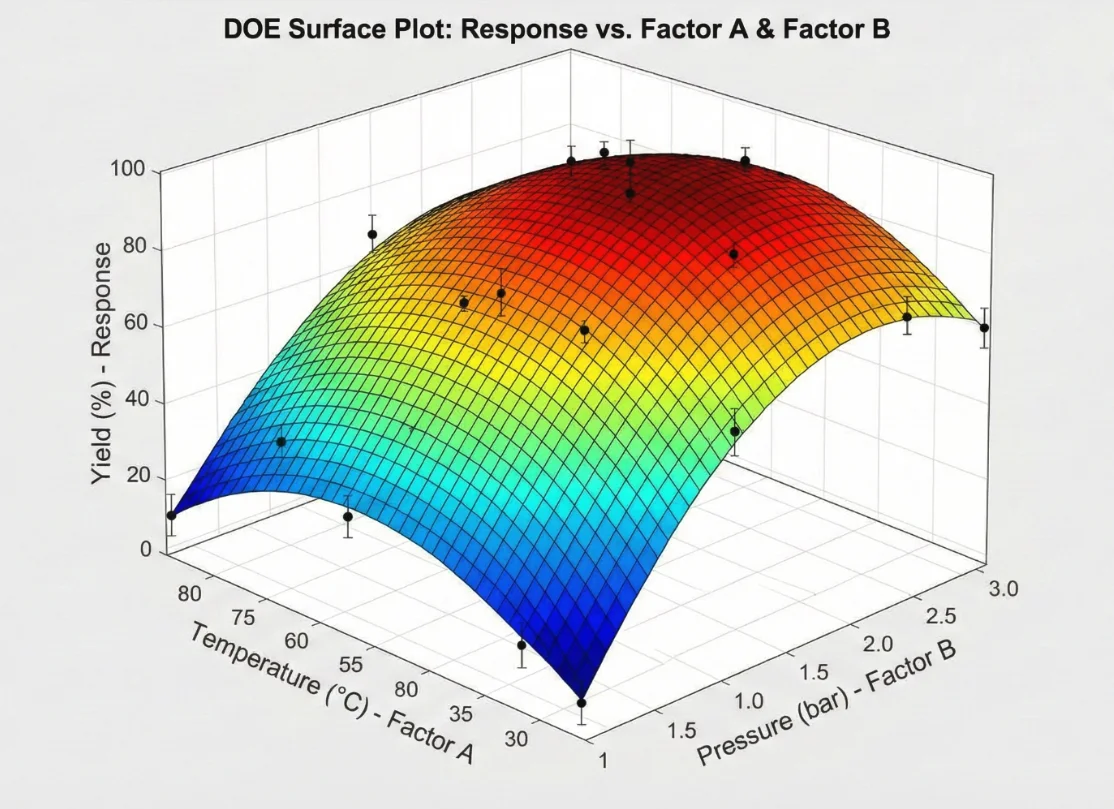
DOE analysis expands experimental insight by combining the effects of two or more factors on the response using contour plots and response surface plots. These plots are particularly valuable for optimization since they identify trends, ridges, and trade-offs that may not be apparent from tables alone.
In the DMADV and DMAIC Improve phases of Six Sigma, response surfaces allow engineers to find developing ranges rather than individual solutions, enabling the creation of more robust designs that meet performance targets while minimizing sensitivity to noise in mechanical processes.
DOE and Design for Reliability (DFR)
DOE supports reliable product and process design by revealing how key variables interact in real design and manufacturing environments.
Material Selection and Formulation Studies
Using DOE, engineers can systematically assess the effects of combinations of variables—such as resin type, filler percentage, and fiber content—on the mechanical properties (e.g., strength, stiffness, weight, and cost) of materials. Because the combination and interaction of various components may produce nonlinear effects on performance, DOE allows engineers to determine such effects by evaluating all possibilities.
By collecting data to inform material selection, engineers can develop products that meet customers’ specific needs, rather than relying on single-property comparisons and supplier and manufacturer marketing messages.
Prototyping and Iteration Using Design of Experiments
DOE is especially valuable during prototyping, where engineers can evaluate multiple design and process variations in parallel rather than relying on sequential trial-and-error builds. By planning prototype runs that intentionally vary key design parameters or manufacturing inputs, teams can generate meaningful performance data from a single iteration.
In CNC machining, this might include testing dimensional tolerances, surface finishes, or machining parameters across multiple parts in one batch. In injection molding, DOE-based prototyping can assess combinations of gate location, wall thickness, material selection, and processing conditions within a structured experimental plan. In 3D printing, this may mean creating multiple form factors for a user experience study.

This parallel approach to prototyping reduces development time while improving the quality of design decisions. Rather than converging slowly on a solution, DOE helps engineers identify which factors truly influence performance and define acceptable design windows early in the development process. When combined with rapid manufacturing, DOE-driven prototyping enables faster learning, fewer prototype cycles, and greater confidence before transitioning to production.
Injection Molding and CNC Machining Applications
Through DOE, engineers can optimize their injection molding processes by controlling factors such as melt temperature, injection pressure, and cooling time, while minimizing defects such as sink marks, warping, and short shots. DOE utilizes either a factorial design or a response surface design to determine which parameters are critical and how they interact. For example, increasing pressure will yield lower sink marks only if the cooling time is set correctly.
Engineers also use DOE to evaluate their CNC machining processes with respect to spindle speed, feed rate, and tool life. DOE helps engineers identify parameter ranges that deliver consistent results during prototyping and production, while meeting surface finish and productivity requirements. By combining experimental evidence and historical data, engineers create stable operational windows for their manufacturing processes that maximize quality and increase throughput.
Assembly Process Optimization
DOE in assembly processes improves consistency in joint strength and durability for adhesive bonding, welding, and fastening operations. In adhesive bonding, DOE facilitates a simultaneous comprehensive analysis of cure temperature, cure time, surface treatment/preparation, and adhesive thickness. This allows engineers to reduce cycle time or cost while developing assembly processes that are more predictable, require less rework, and deliver long-term reliability, which aligns with Six Sigma objectives.
Common DOE Mistakes and How to Avoid Them
| Mistake | Problem | Solution |
| Too many variables | Excessive complexity | Start with screening DoE |
| Poor randomization | Biased data | Use random run order |
| Ignoring interactions | Misleading conclusions | Use factorial design |
| Small sample size | Low confidence | Increase replication |
| Misaligned objectives | Irrelevant output | Define goal first |
| Treating prototypes as single tests | Limited learning | Plan prototypes as structured DOE runs |
Tools and Software for DOE
Several software tools assist in the design of experiments, each suited to different levels of complexity and user expertise.
- JMP and Minitab: Widely used in Six Sigma environments because they provide decent DOE workflows, integrated analyses (ANOVA, regression, response surfaces), and good visualizations.
- MATLAB: Allows for much more flexibility and scripting power, making it well-suited for advanced modeling and custom optimization. Although more limited, Excel can be used effectively for basic screening DOEs when combined with a disciplined setup and add-ins.
- Design-Expert: Specifically tailored for DOE and response surface methodology, making it a good option for teams focused on optimization in engineering.
Design Of Experiments FAQs
What is Design of Experiments (DOE) in engineering?
Design of Experiments (DOE) is a statistical method engineers use to plan and run controlled tests that evaluate how multiple input factors affect performance outcomes. It replaces trial-and-error testing with structured, data-driven experimentation.
How does DOE help improve product design?
DOE helps improve product design by determining how design variables and process parameters influence performance. This allows engineers to optimize designs faster, reduce rework, and validate decisions early in development.
What are the steps in the DOE process?
The DOE process includes defining the objective, selecting factors and levels, choosing an experimental design, running the tests, analyzing the data, and validating or optimizing the results. Each step ensures statistically meaningful and efficient experimentation.
What is the difference between full factorial and fractional factorial design?
A full factorial design tests all possible combinations of factors and levels, providing complete insight but requiring more runs. A fractional factorial design uses fewer experiments to identify key factors, trading some interaction detail for efficiency.
How do engineers use DOE in manufacturing?
Engineers use DOE in manufacturing to optimize processes like injection molding, CNC machining, and 3D printing by systematically varying parameters. This reduces defects, improves consistency, and establishes ideal operating ranges.

DOE Within the Fictiv Digital Manufacturing Ecosystem
Design of Experiments (DOE) should not be viewed as an “academic” option or a last resort, but as a pragmatic means of enabling product developers to manage complexity effectively. When used appropriately, DOE replaces speculation and debate with substantive data, enabling design and process decisions to be made with confidence and not intuition.
By systematically designing and conducting quantifiable experiments to evaluate cause-and-effect relationships, engineers can deliver products of superior quality, greater reliability, and improved manufacturability with fewer design iterations.
Fictiv’s digital manufacturing platform helps engineers prototype, test, and optimize through expert DFM feedback and rapid production with expert manufacturing support.
Want to validate your designs faster? Upload your CAD to get started.