
Time to read: 14 min
Most prototyping conversations center on CNC machining and 3D printing, and for good reason: both provide parts fast, which is a real advantage for early design work. Once a metal component is headed toward production casting, however, these prototyping methods don’t fully represent the manufacturing conditions and final product. Using the same process for prototypes and production parts gives engineers a better read on the manufacturability and performance earlier in development.
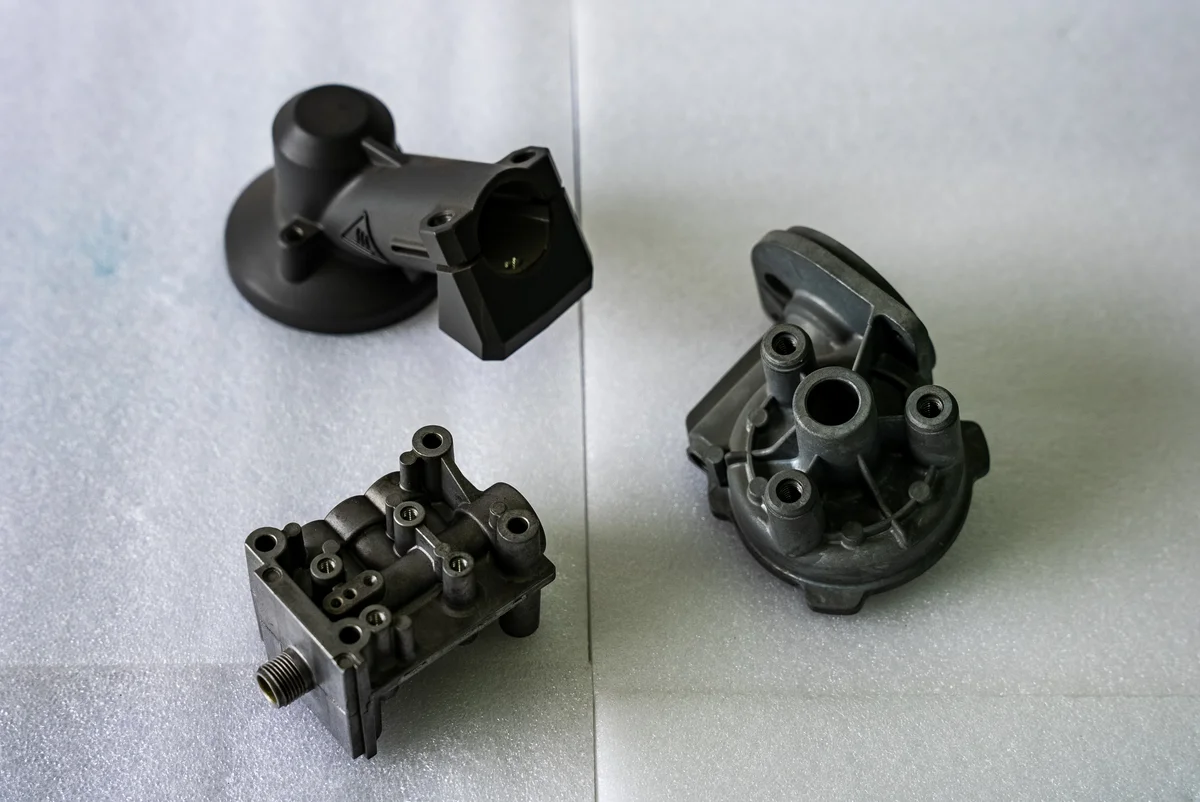
Casting prototypes produced using die casting, investment casting, or gravity mold casting give engineering teams production-representative material properties, geometry, and process behavior that CNC-machined or 3D-printed stand-ins cannot replicate.
This article covers three of the main methods for metal prototypes and low-volume work: die casting, investment casting, and gravity (permanent mold) casting.
Why Consider Casting for Prototyping?
For one-off proof-of-concept parts, CNC machining or additive manufacturing is usually the fastest path. If you’re weighing casting vs CNC machining, our comparison guide explains when each process makes the most sense. The case for casting strengthens as you move down the product design path toward final production intent, material validation, and process confirmation.
Material Properties That Match Production
A CNC prototype is machined from a solid metal stock—typically wrought billet, bar, or plate. A cast part solidifies from molten metal. That difference shows up in grain structure, porosity, residual stress, high-cycle fatigue life, pressure tightness, and how the part responds to heat treatment.
If your structural fatigue, pressure, or regulatory tests need to reflect production conditions, build the prototype using the same casting process family as the final part. A cast prototype will provide more useful results than a machined or printed stand-in.
Geometry You Can Actually Produce
Casting can produce internal passages, thin walls, ribs, and complex contours that would require multiple CNC setups or wire EDM, or that simply cannot be machined. A design refined only through CNC-machine prototypes still requires redesign and decisions on draft, wall thickness, shrinkage, gating, and parting lines for production casting.
Fewer Surprises at Production
A cast prototype can reveal fill problems, hot spots, and distortion before production tooling is cut. Addressing these issues during prototype development reduces engineering changes later, when production tooling is complete.
Cast parts have longer lead times and higher upfront costs than a single CNC-machined or printed part. But casting begins to earn its keep when volume rises, or when the production process itself needs validation.
The Three Primary Metal Casting Methods for Prototyping
The right choice of prototype casting method depends on production volume, alloy, geometry, tooling budget, and how closely the prototype process needs to match the eventual production process.
Die Casting: Production-Like Parts Require a Tooling Investment
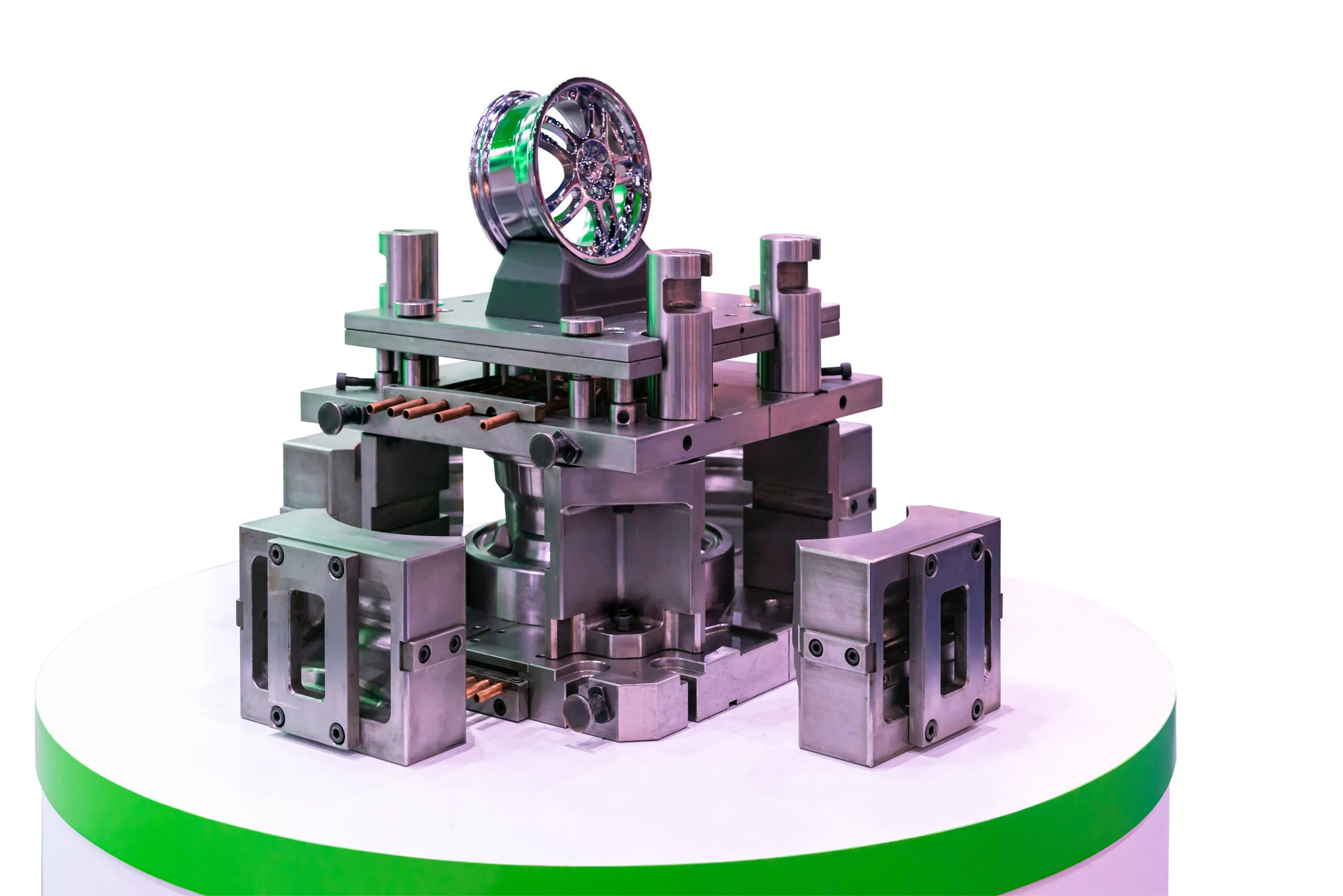
Die casting injects molten metal under high pressure into a reusable steel mold. For production programs that will run high-pressure die casting (HPDC), it is the only process that can deliver the same alloy family, fill dynamics, solidification history, and residual stress state, provided the process parameters stay comparable.
Common HPDC materials include aluminum alloys such as A380, A383, A360, and ADC12 as well as zinc. These alloys generally cannot be heat treated to T6 because the high-pressure mold fill can trap gas in the molten metal, causing surface blisters during the solution phase of T6 heat treatment. If you do not yet need that production microstructure, or the design is still changing, investment casting or gravity casting will usually cost less and move faster.
Investment Casting: Complex Geometry at Low Volume
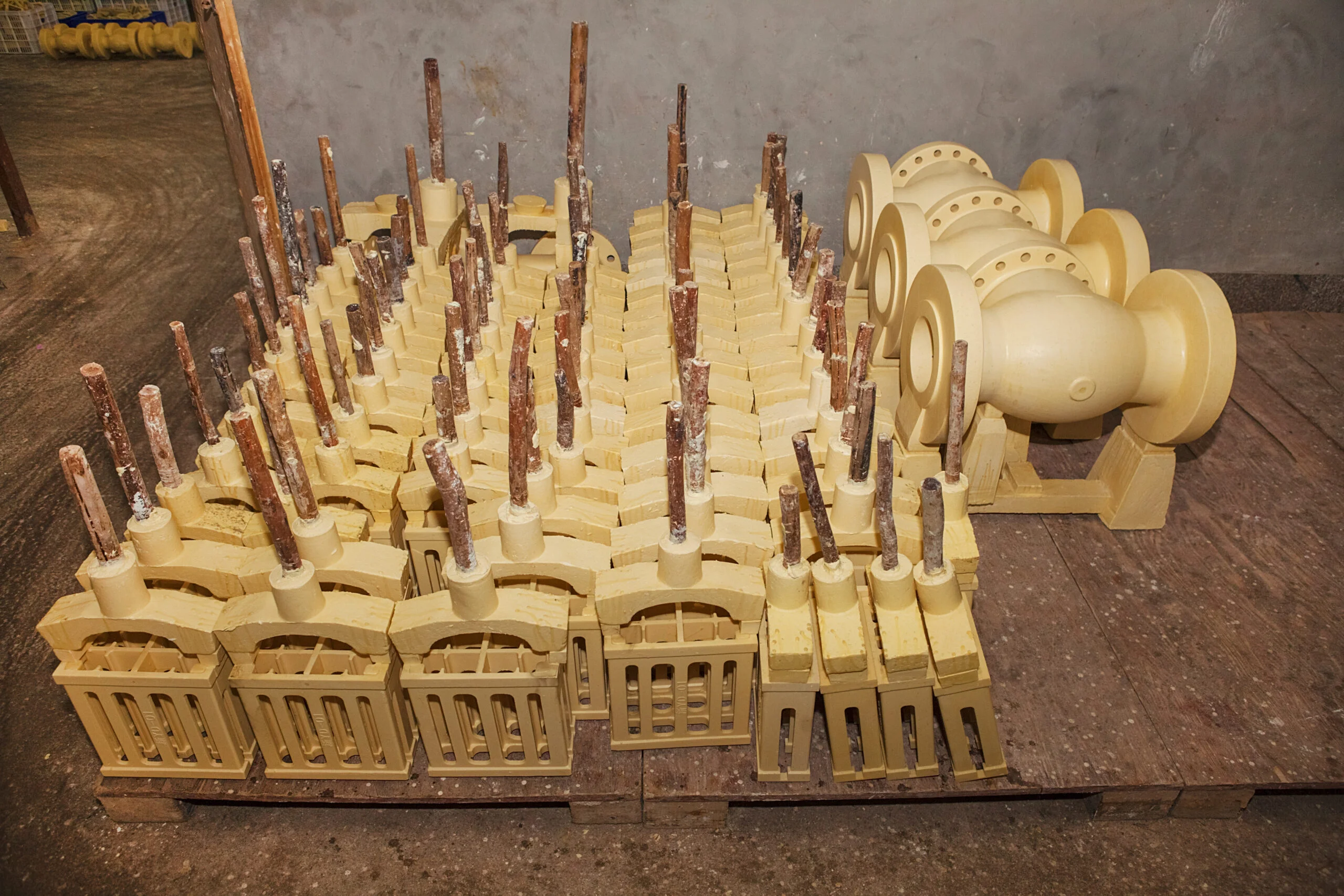
Investment casting (lost wax casting) uses a ceramic shell built around a wax pattern. The wax is burned out, and molten metal is poured into the shell. For prototypes, the wax patterns can be 3D printed, eliminating the need for hard tooling. First parts typically arrive in 1 to 3 weeks, making investment casting one of the most practical metal casting routes for low-volume work.
Investment casting accommodates a broad alloy range: stainless, tool steels, aluminum, titanium, Inconel, cobalt chrome, and many specialty alloys. The surface finish of investment-cast parts is usually Ra 1.6 to 3.2 μm as-cast, with dimensional accuracy around ±0.1 to 0.25 mm on most features. Undercuts, internal passages, and thin walls are routine.
One practical caveat: thin sections cool faster than thick ones in the same part, so local microstructure and mechanical properties can vary with section thickness. Test results from one section may therefore not represent another.
Investment casting is best suited for small- to medium-complexity parts (aerospace and medical components) and projects with too low a volume to justify die casting (1 to 500 pieces). Cycle times are slower for investment casting than for die casting, cost per part rises at higher volumes, and critical interfaces still need CNC finishing. Investment-cast aluminum behaves differently from die-cast aluminum and is not a valid stand-in when HPDC is the intended production process.
Gravity/Permanent Mold Casting: Structural Aluminum at Mid-Volumes
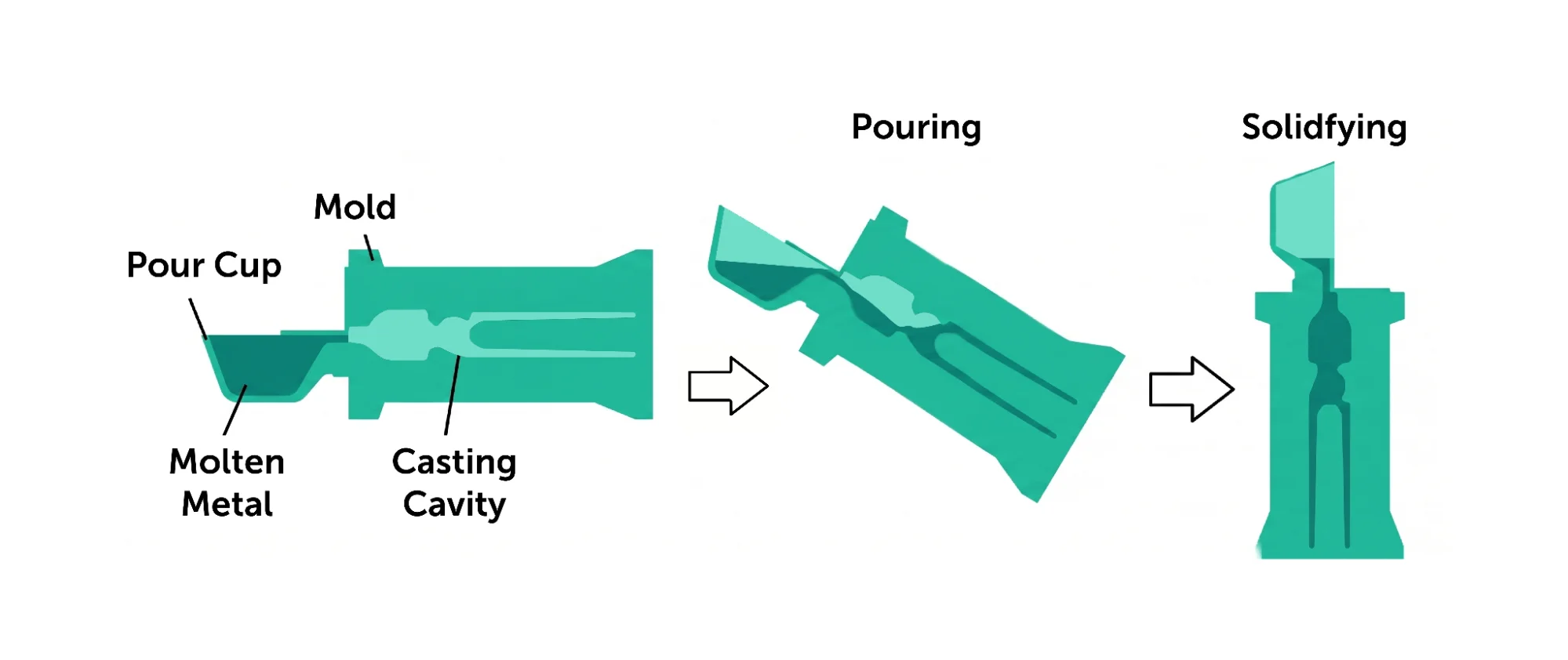
Gravity casting (permanent mold casting) pours molten metal into a reusable steel or iron mold under gravity rather than pressure. It sits between die casting and sand casting in terms of cast part quality: better surface finish and dimensional consistency than sand casting, lower tooling cost, and lower porosity than HPDC. It is a common route for the production of heat-treatable aluminum castings at moderate volumes.
Using only the force (pressure) of gravity to fill a mold produces less turbulence and less trapped gas in the resulting casting than high-pressure injection. That lower porosity lets alloys such as A356 reach T6 without blistering. Tooling for gravity mold casting is simpler than that for HPDC, and is typically less expensive. Tooling lead time is in the 3 to 5 week range: less than for HPDC, but longer than it takes to get started with investment casting. Surface finish of gravity mold castings is typically Ra 2 to 6 μm, and tolerances land around ±0.2 to 0.5 mm depending on part complexity.
Permanent mold casting prototypes are best for mid-complexity aluminum housings, structural parts, pressure-tight enclosures, and any project where porosity or heat treatability matters. Compared to HPDC, gravity fill castings are restricted to higher minimum wall thickness (around 3 to 4 mm for reliable fill and feeding), more limited undercut geometry options, and slower production cycle time.
Other Prototype Casting Methods Worth Knowing About
Sand casting has the lowest tooling cost and the most flexibility for large parts or single-piece quantities, but surface finish and dimensional accuracy lag the three primary methods.
Urethane casting is another prototyping process, but not for metals. It is used to produce polyurethane parts from silicone molds, and works well for appearance-quality plastic prototypes (roughly 5 to 150 pieces) when injection mold tooling is not yet justified.
How to Choose the Right Casting Method for Your Prototype
No single process is the best for every set of project requirements. The decision about which one to select turns on how closely the prototype needs to match the production process, which alloy you need, how much tooling budget you have, and how many parts you expect to run.
Die Casting vs Investment Casting vs Gravity Casting
| Factor | Die Casting | Investment Casting | Gravity / Permanent Mold Casting |
| Best suited for | HPDC production validation | Complex, low-volume metal parts | Structural aluminum parts |
| Tooling | Required (prototype or production tooling) | None (3D-printed wax patterns) | Required |
| Typical lead time | 2–8 weeks | 1–3 weeks | 3–5 weeks |
| Typical volume | 50–5,000+ parts | 1–500 parts | 50–3,000 parts |
| Material options | Primarily aluminum-, magnesium-, and zinc-based alloys | Very broad (stainless steel, titanium, aluminum alloys, tool steels, nickel alloys, and more) | Primarily aluminum alloys (A356, A319, A360); Zinc, copper, and magnesium also used |
| Heat treatable | Generally not for HPDC aluminum alloys | Yes | Yes |
| Typical surface finish | Ra 0.8–3.2 μm as-cast | Ra 1.6–6.3 μm as-cast | Ra 2–6.3 μm as-cast |
| Best prototype choice when… | Production validation is the priority | Design flexibility and alloy selection matter most | Heat-treatable aluminum is required or HPDC tooling isn’t yet justified |
Design Considerations for Cast Metal Prototypes
Addressing the following design considerations early helps reduce tooling revisions, improves part quality, and shortens the path to production.
Wall Thickness
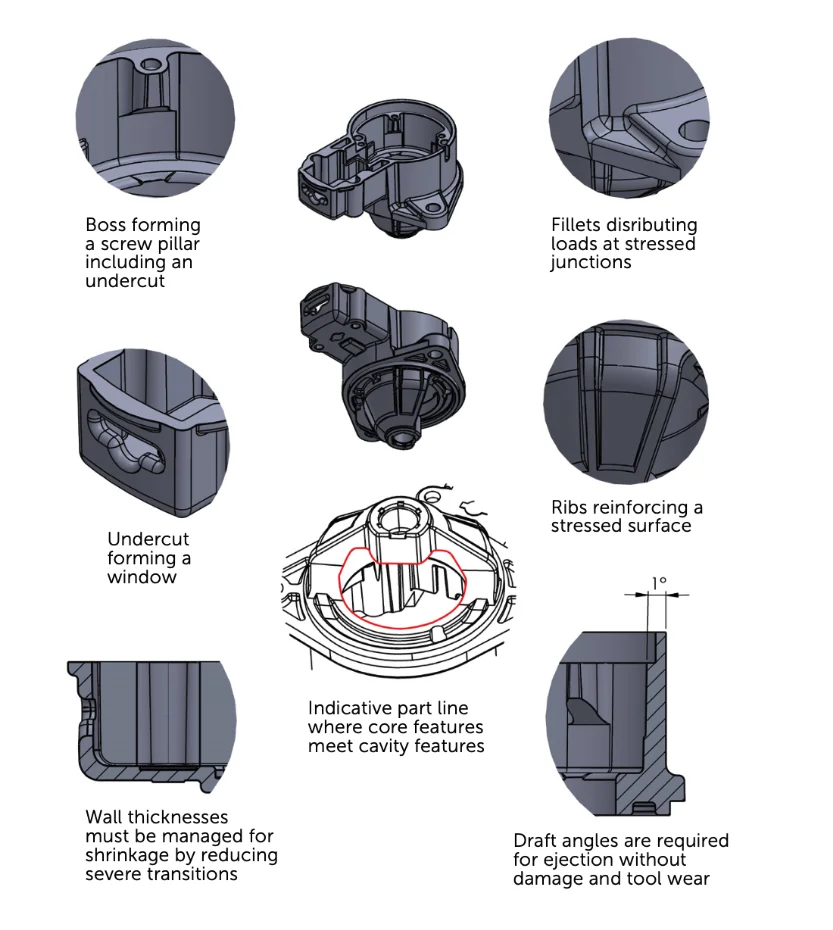
Minimum wall thickness depends on the casting process. High-pressure die casting (HPDC) can typically achieve aluminum alloy wall sections of 1.5 to 2 mm. Investment casting generally supports 1 to 2 mm, depending on the alloy and geometry. Gravity casting usually requires 3 to 4 mm minimum to ensure reliable mold filling and feeding.
Design to the wall thickness your strength requirements demand, then choose a casting process that can reliably produce it. Unnecessary thickness creates hot spots that cool more slowly, increasing the risk of shrinkage porosity while also extending cycle times and raising material costs. When additional stiffness is required, use ribs or gussets instead of thickening the entire wall.
Draft Angles
Every casting process benefits from proper mold draft angles to facilitate part or pattern removal.
Die casting typically requires 1° to 3° of draft, while gravity casting generally needs 2° to 5°. Investment casting is more forgiving because the ceramic shell is destroyed after solidification, but incorporating modest draft still improves dimensional consistency and helps reduce residual stress caused by mold constraint.
Post-Casting Machining Allowances
Almost every cast prototype requires CNC machining on critical features such as sealing surfaces, precision bores, bearing seats, and mating interfaces. Cast in 0.5-1.5 mm of machining stock on these surfaces and clearly identify the allowance on the engineering drawing.
Parting Lines, Gates, and Shrinkage
Parting line and gate locations should be reviewed with your manufacturing partner before tooling begins. These decisions influence how molten metal fills the cavity, affect cosmetic appearance, and determine where porosity is most likely to occur.
Design parts to their nominal dimensions and let the foundry apply the appropriate shrinkage compensation during tooling design. Typical linear shrinkage is approximately 0.5 to 0.6% for HPDC, 0.8 to 1.2% for gravity casting, and 1.0 to 1.5% for investment casting, depending on the alloy and section thickness.
Shrinkage is never perfectly uniform. Thick sections cool and contract differently from thin sections, which can introduce distortion across the part. For that reason, critical interfaces should be machined to their final dimensions rather than relying on as-cast tolerances.
Learn more about DFM for metal casting in our Scaling CNC to Casting Guide.
How Fictiv Supports Casting for Prototyping and Low-Volume Production
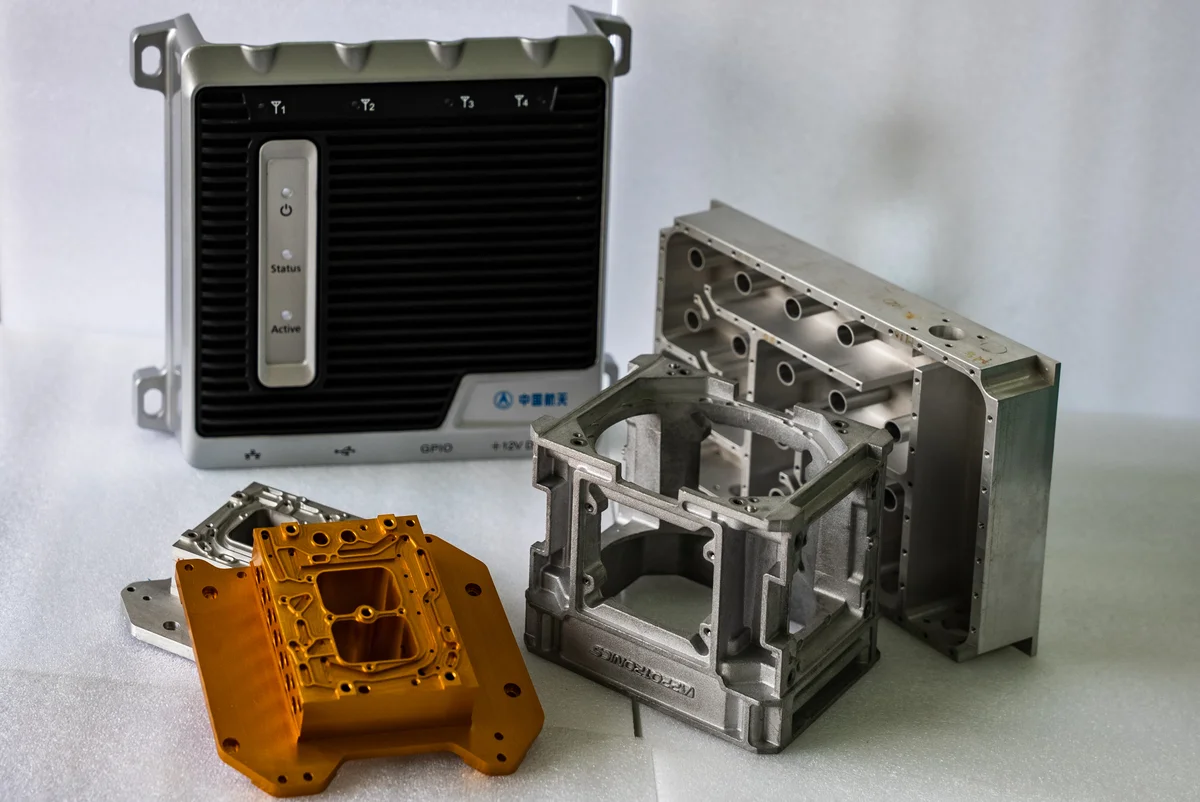
Fictiv supports cast metal parts from prototyping through low-volume production, with manufacturing guidance and casting-specific DFM feedback along the way. DFM feedback for casting identifies issues with draft, wall thickness, parting lines, and machining allowances while they’re still inexpensive to correct.
Need cast metal prototypes? Get a quote for die casting, investment casting, and gravity casting options for prototype builds through Fictiv’s manufacturing network.
Talk to a Fictiv expert about your project, or upload your parts to start a free quote.
FAQs About Prototyping With Casting
What’s the difference between die casting and investment casting for prototypes?
Die casting injects molten metal under pressure into a reusable steel mold and is the only process that replicates the fill dynamics and residual stress of high-pressure die casting (HPDC) production. Investment casting pours metal into a ceramic shell built from a 3D-printed wax pattern, requires no hard tooling, and supports a much broader range of alloys and more complex geometry — but it isn’t a valid stand-in for HPDC-specific production, since die-cast and investment-cast aluminum behave differently.
Which casting process is fastest and cheapest for low-volume prototypes?
Investment casting is typically the fastest and lowest-cost option for low-volume metal prototypes, since 3D-printed wax patterns eliminate the need for hard tooling and first parts can arrive in 1 to 3 weeks. It’s best suited for runs of roughly 1 to 500 parts; higher volumes shift the cost advantage toward die casting or gravity casting.
Can die-cast aluminum prototypes be heat treated to T6?
Generally, no. Most HPDC aluminum alloys (such as A380, A383, A360, and ADC12) trap gas during high-pressure mold fill, which can cause surface blistering when the part undergoes the solution phase of T6 heat treatment. Alloys that need T6 heat treatment are usually better suited to gravity/permanent mold casting, where lower-turbulence filling reduces trapped gas.
What is gravity casting (permanent mold casting) used for?
Gravity (permanent mold) casting pours molten metal into a reusable steel or iron mold using only gravity, rather than injection pressure, which produces less turbulence and trapped gas than die casting. This makes it a common choice for heat-treatable structural aluminum parts, pressure-tight enclosures, and mid-complexity aluminum housings at volumes of roughly 50 to 3,000 parts.
How much does tooling cost and lead time vary between casting methods?
Investment casting requires no tooling since patterns are 3D-printed, giving it the shortest lead time (1–3 weeks). Gravity/permanent mold casting requires reusable metal tooling with a 3–5 week lead time, while die casting tooling — especially hardened production tooling rather than soft tooling — takes the longest at roughly 2–8 weeks and carries the highest upfront cost.
How does prototyping with casting help with the transition to full production?
Prototyping with the same casting process family as production means the design, tooling decisions, alloy behavior, and DFM constraints carry forward directly. A die-cast prototype validates fill dynamics and residual stress under conditions comparable to production; an investment-cast prototype confirms alloy behavior and geometry feasibility before production quantities are committed. The closer the prototype process matches production, the fewer engineering changes are required during the production qualification phase — and the more useful the prototype test data is for predicting production part performance.