




Time to read: 12 min
4-axis CNC machining is a subtractive manufacturing process that moves a cutting tool and workpiece along four axes of motion—the standard X, Y, and Z linear axes, plus a fourth rotational axis (the A-axis) that rotates the workpiece around the X-axis. That additional degree of freedom is what separates 4-axis from conventional 3-axis machining. The machine can access multiple faces of a part in a single setup, produce helical and wrapped features, and hold tighter inter-feature tolerances without manual repositioning.
The result is a process that sits between the simplicity of 3-axis work and the capability of 5-axis machining—and for a wide range of cylindrical, multi-face, and rotationally symmetric parts, it’s often the most efficient and cost-effective choice.
How 4-Axis CNC Machining Works
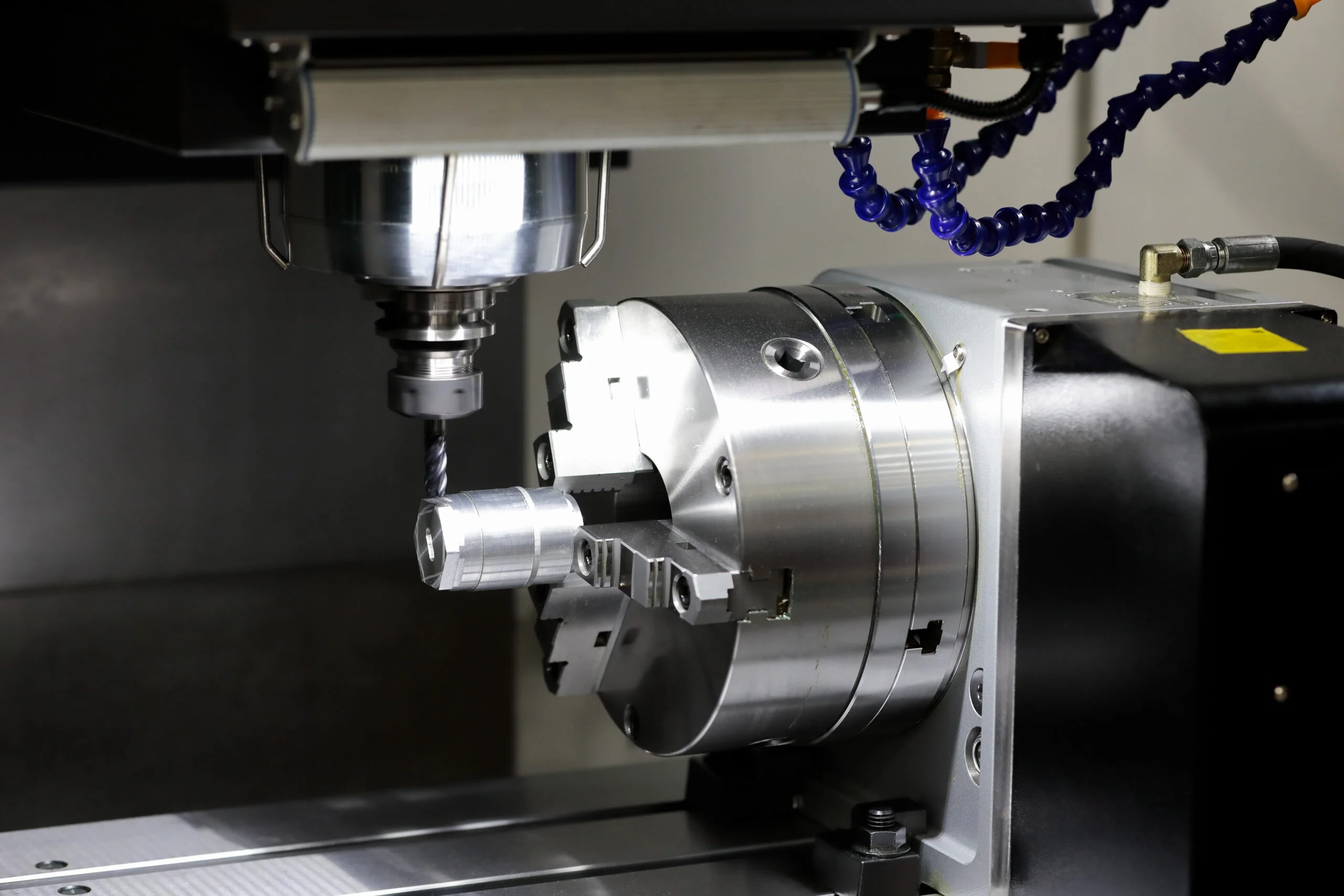
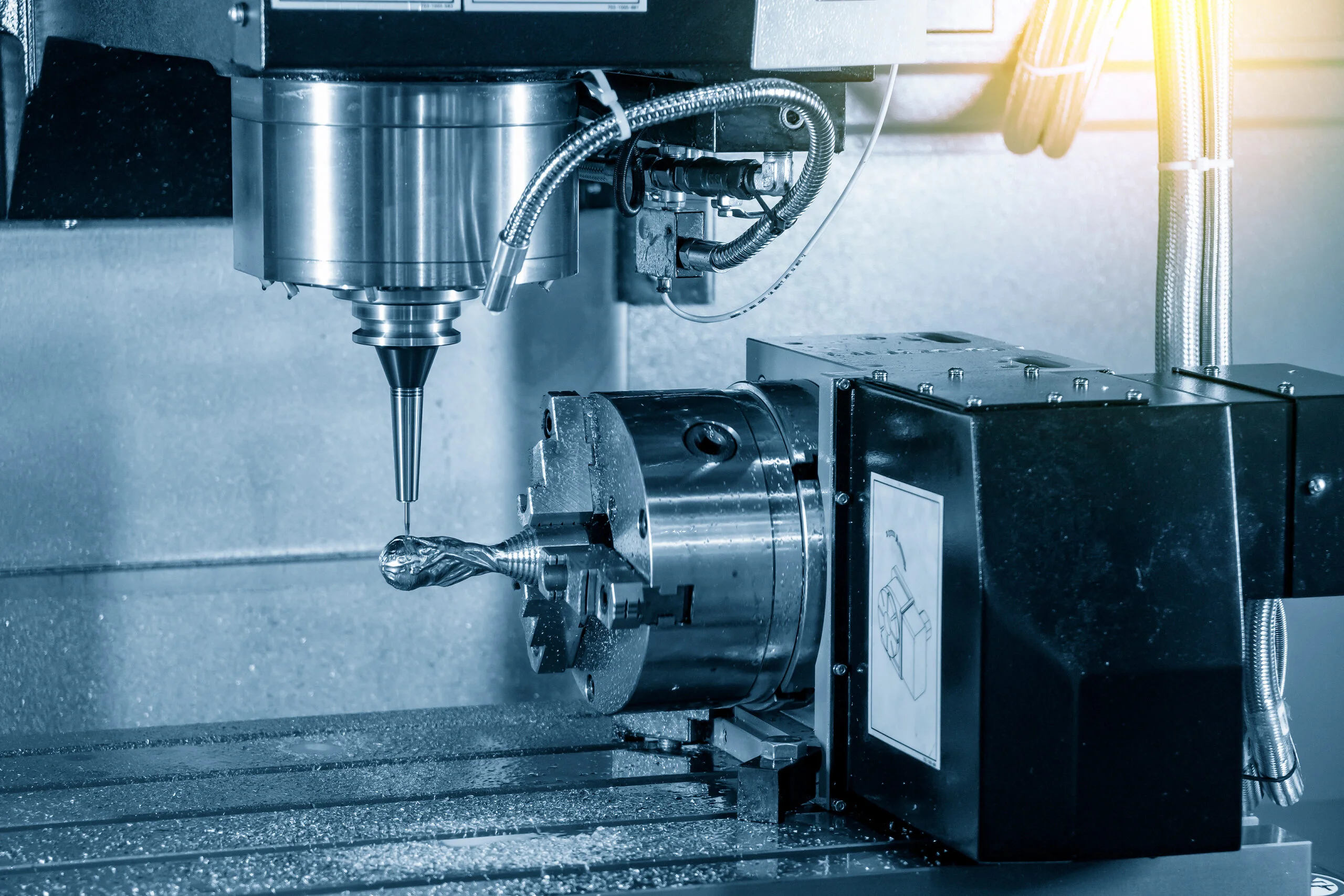
In a standard 4-axis setup, the workpiece is clamped in a rotary table or trunnion mounted on the machine bed. The CNC controller can rotate this table to a programmed angular position and either lock it in place before cutting or keep it in continuous motion while the spindle cuts.
Indexed 4-Axis Machining (3+1)
Indexed 4-axis machining, commonly referred to as 3+1 milling, treats the rotational axis as an indexer rather than a continuous cutting path. The machine uses the A-axis to rotate the workpiece to a predetermined angular position, engages a mechanical brake to rigidly lock the rotary table or trunnion, and then executes standard 3-axis linear toolpaths (X, Y, Z).
This is the most cost-effective configuration for complex, prismatic components with features distributed across multiple orthogonal or angular faces—including radial bolt patterns, off-axis cross-drilled fluid ports, and keyway flats on a shaft. By locking the rotational axis during heavy material removal, indexed machining maximizes setup rigidity, enabling deeper cuts and higher feed rates without the severe tool chatter an unbraked rotational axis would otherwise induce.
Continuous 4-Axis Machining
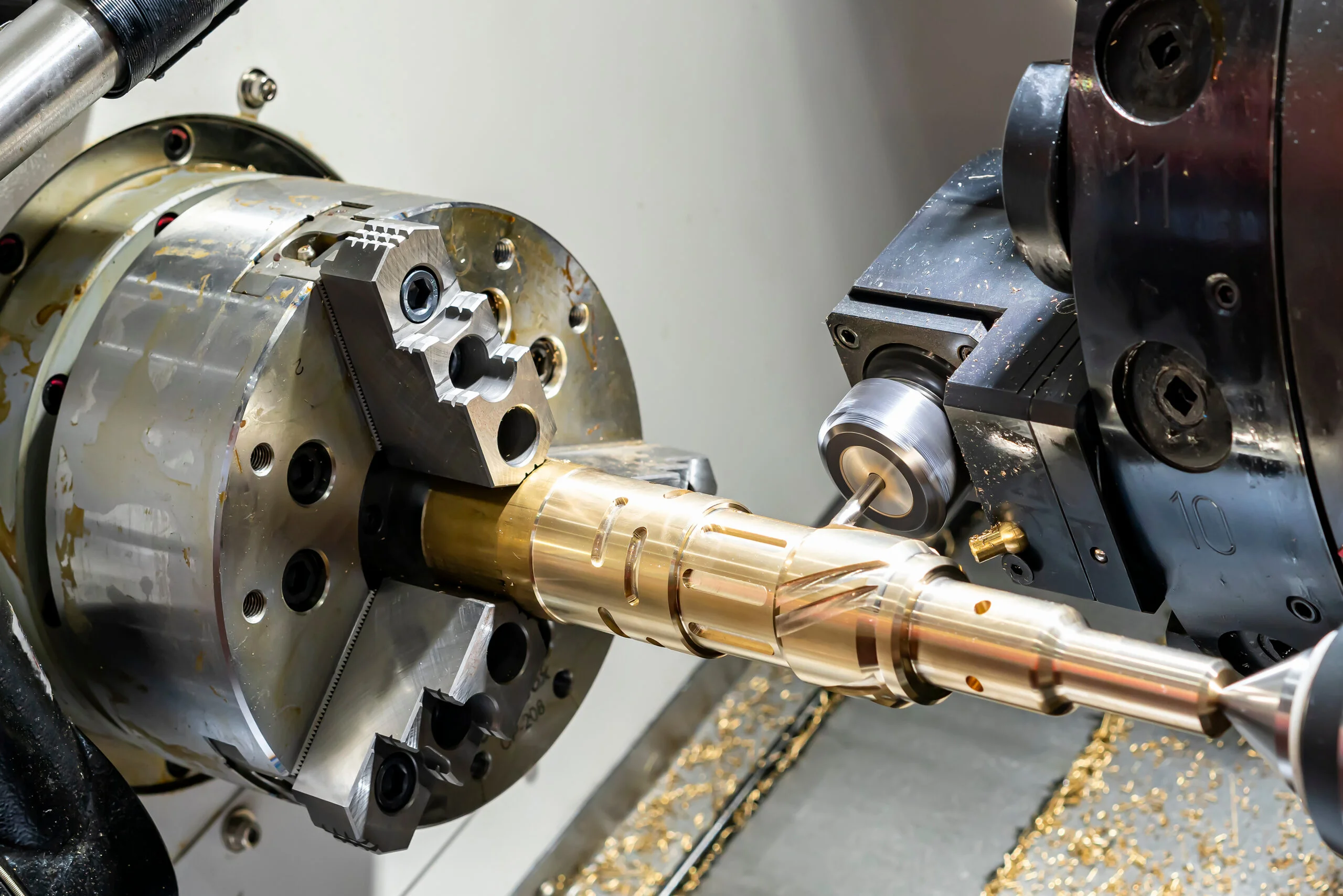
Continuous 4-axis milling keeps the A-axis interpolating in real time during the cut, coordinated with the X, Y, and Z axes simultaneously. This is required for geometry that wraps around the part, such as cam lobes, helical flutes, spiral grooves, and similar features where the tool must follow a path that continuously changes in both angle and position. However, it falls short in producing complex compound 3D contours, variable-pitch overlapping impellers, or undercuts that require a fifth tilting axis (B or C) to keep the tool normal to a sculpted surface.
Both modes rely on G-code programs generated by CAM software such as Mastercam, Fusion 360, or Siemens NX. The CAM system translates a 3D CAD model into the coordinated axis movements, feed rates, spindle speeds, and tool changes the machine needs to create the part.
3-Axis vs. 4-Axis vs. 5-Axis Machining
Understanding where 4-axis fits in the machining spectrum is useful context—though it’s worth noting that this topic is worth exploring in depth on its own. For the complete picture of how every CNC axis configuration compares, see our guide on 3-Axis to 12-Axis CNC Milling Machine Capabilities.
3-axis machining is the industry standard for prismatic parts like pockets, slots, drilled holes, and flat profiles. It’s cost-effective, widely available, and the best choice for simpler geometries. The limitation is that the tool orientation stays fixed. When features occur on more than one face, 3-axis requires multiple setups and manual repositioning, which adds time and introduces the risk of a datum-shift error between operations.
4-axis machining adds one rotational axis to the 3-axis foundation. A single setup can reach up to four orthogonal faces and any angular position in between, eliminating inter-setup errors and significantly reducing setup time for multi-face and cylindrical parts.
5-axis machining adds a second rotational axis (B or C), enabling the spindle or table to tilt as well as rotate. This is required for compound angles, deep undercuts, and highly sculptured surfaces—but it comes with higher machine costs, more complex CAM programming, and a steeper operator skill requirement. For parts that don’t need the second rotational degree of freedom, 4-axis delivers most of the setup efficiency at a meaningfully lower cost.
3-Axis, 4-Axis, and 5-Axis CNC Comparison
| 3-Axis | 4-Axis | 5-Axis | |
| Movement | X, Y, Z | X, Y, Z + A | X, Y, Z + A, B or C |
| Setups for multi-face parts | Multiple | Single or fewer | Single or fewer |
| Helical/wrapped features | No | Yes | Yes |
| Compound angle features | No | No | Yes |
| Programming complexity | Lower | Moderate | Higher |
| Machine cost | Lower | Moderate | Higher |
| Best use case | Prismatic parts, flat faces, pockets | Cylindrical parts, multi-face parts, helical features | Complex contours, undercuts, compound angles |
The optimal approach is always to match the part’s complexity to the minimum number of axes required. Using a more capable machine than the geometry demands adds cost without adding value.
Advantages of 4-Axis CNC Machining (Over 3-Axis)
Fewer setups, less labor: Consolidating multiple 3-axis operations into a single 4-axis setup eliminates the time spent unclamping, repositioning, re-indicating, and re-probing the part. For medium-complexity components, this can reduce total setup time by 30–60%.
Better geometric accuracy: Every repositioning event introduces the opportunity for datum-shift error—small misalignments between features machined in different setups. Single-setup 4-axis machining eliminates those inter-setup errors and makes it far easier to hold tight positional tolerances on different faces of the same part.
Access to geometries 3-axis can’t reach: Simple helical grooves, wrapped engravings, cam profiles, and any feature that requires an angular approach from multiple orientations are straightforward 4-axis toolpaths. Producing them on a 3-axis machine requires expensive custom fixturing, when it’s possible at all.
Shorter lead times: Fewer operations mean less time in the setup queue. For prototyping or urgent production orders, that throughput advantage compounds fast.
Lower fixture costs: Custom fixtures that hold a part in multiple orientations are expensive to design and build. A 4-axis rotary table often replaces several dedicated fixtures, offering meaningful cost savings on low-volume or prototype work where non-recurring tooling costs hit hardest.
Consistent surface quality on cylindrical features: In continuous mode, the A-axis maintains constant tool-to-surface engagement as the part rotates. This produces more uniform surface finishes on curved and cylindrical features than the step-over passes of a 3-axis toolpath can achieve.
Limitations of 4-Axis CNC Machining
Can’t machine compound angles: If a feature requires the cutting tool to tilt and rotate simultaneously, a 4-axis machine can’t produce it. Parts with undercuts that require B-axis tilt, or surfaces with compound angular geometry, need a 5-axis solution.
Continuous mode adds programming complexity: Indexed 4-axis toolpaths are relatively straightforward. Continuous 4-axis interpolation is more challenging to program correctly, and not every shop has the CAM expertise to do it well. Confirm your supplier’s experience with your specific geometry type before committing.
Workpiece geometry matters: The part should be centered on the A-axis wherever possible. Eccentric mass causes vibration during continuous rotation and may limit feed rates, eroding the cycle-time advantage. Long, slender parts can also present rigidity challenges at the limits of the rotary table’s capacity.
Machine availability is narrower than 3-axis: 4-axis machines are generally more common than 5-axis, but less ubiquitous than standard 3-axis mills. Depending on your supplier network, machine availability and lead times may be a factor.
Key Industry Applications of 4-Axis Machining
Aerospace and Defense: Structural brackets, actuator housings, and turbine blade roots combine flat faces with cylindrical features. 4-axis machining lets these parts be completed in one or two setups rather than four or five, which matters on flight-critical hardware where every handling event introduces risk.
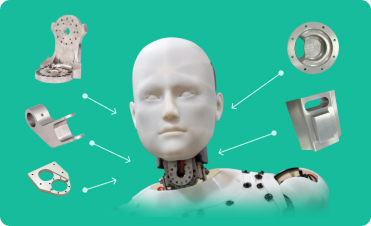
Robotics: Robotic arm links, end effectors, joint housings, and actuator bodies frequently combine cylindrical bores, precision mounting faces, and features distributed around a central axis—a geometry profile that maps directly to 4-axis machining strengths. Single-setup production minimizes the datum-shift errors that would otherwise compromise the tight bore-to-face tolerances these components require for accurate, repeatable motion.
Automotive and Motorsport: Camshafts, crankshaft journals, intake manifolds, and differential housings are natural candidates. In motorsport applications, where one-off or short-run components are common, a single-setup workflow can compress development cycles significantly.
Medical Devices: Orthopedic implants (bone screws, spinal cages, femoral stems) require tight tolerances on complex curved surfaces. Continuous 4-axis machining produces the smooth, burr-free finishes required by biocompatibility standards, while indexed 4-axis machining handles the cross-holes and flats that facilitate surgical assembly.
Electronics and Semiconductor Equipment: Precision housings, heat sinks with fin arrays on multiple faces, and fixture plates with feature patterns distributed around a central bore are efficient, repeatable 4-axis jobs.
Oil and Gas: Downhole tool components like drill collars, stabilizer blades, and sub-assemblies are typically long, cylindrical, and feature-dense. Continuous 4-axis turning and milling centers machine these parts from raw bar stock to finished geometry with minimal handling.
Design Guidelines for 4-Axis CNC Machining
Getting the most from a 4-axis process starts at the design stage. A few principles go a long way.
Center features on the A-axis: Geometry should be distributed symmetrically around the rotational centerline wherever possible. Eccentric mass causes vibration during continuous rotation and can force feed rate reductions that eliminate the cycle-time advantage.
Minimize tool reach: Long-reach tooling is less rigid. Designs that allow features to be machined with short, stubby tools will deliver better surface finish, tighter tolerances, and longer tool life. Minimize the depth of pockets and slots to reduce the necessary tool reach.
Check for 5-axis requirements before committing: Review your model for any features that require simultaneous tilt and rotation—undercuts, compound-angle holes, or sculptured surfaces that change angular orientation as they sweep. If those features are present, a 4-axis machine can’t produce them.
Tolerances and precision: 4-axis machining routinely holds positional tolerances of ±0.001 inch (±0.025 mm) on well-fixtured parts. Tighter tolerances as low as are achievable with in-process probing and careful setup, but they carry a cost premium. Always communicate your GD&T requirements upfront so the process engineer can confirm feasibility before quoting.
Download our CNC Design Guide to learn more tips.
Materials Used in 4-Axis CNC Machining
4-axis machines handle the full spectrum of machinable materials: aluminum alloys (6061, 7075, 2024), stainless steels (303, 304, 316, 17-4 PH), titanium alloys (Ti-6Al-4V), carbon and alloy steels, copper and brass, engineering plastics (Delrin, PEEK, nylon), and high-temperature alloys such as Inconel and Hastelloy. Material selection drives cutting speeds, tooling geometry, coolant strategy, and fixture load limits—all factors the process engineer must account for when programming the operation.
How to Choose Between 3-Axis, 4-Axis, and 5-Axis for Your Part
If you’re evaluating which process is right for an upcoming part, a few practical questions will point you in the right direction.
Start with part geometry: Does your part have features on more than two faces? Does it include helical, wrapped, or cylindrical features? If yes, 4-axis is worth evaluating. If it also has compound angles, undercuts, or organic sculptured surfaces, step up to 5-axis.
Consider tolerance requirements: If inter-feature positional tolerances are tight and features exist on multiple faces, eliminating repositioning errors with a 4-axis setup is often the cleaner path to hitting print.
Factor in volume and cost: For high-volume runs of simple prismatic parts, 3-axis machining is almost always the more economical choice. For low-to-medium volumes of multi-face or cylindrical parts, 4-axis reduces setup time and increases repeatability in a way that typically pays for itself quickly.
Match machine complexity to part complexity: The highest-capability machine isn’t automatically the best choice. The goal is to use the minimum number of axes required by the geometry to reduce costs and programming complexity.
Partner With Fictiv for CNC-Machined Parts
Fictiv’s manufacturing network includes suppliers with multi-axis CNC capability across a wide range of materials and industries. Our platform provides instant quoting based on the best-fit machine, automated DFM feedback, and complete order visibility so your parts move from CAD to finished components as quickly as possible.
Frequently Asked Questions About 4-Axis CNC Machining
What is the difference between indexed and continuous 4-axis machining?
Indexed 4-axis machining (sometimes called 3+1 axis) rotates the A-axis to a fixed angular position, locks it, and then runs a standard 3-axis toolpath on that face. Continuous 4-axis machining keeps the A-axis interpolating in real time throughout the cut, coordinated with the X, Y, and Z axes simultaneously. Indexed operation is more widely available and covers most multi-face part applications. Continuous operation is required for helical, spiral, or wrapped features where the geometry changes angle as it progresses around the part.
When should I choose 4-axis machining over 3-axis?
Choose 4-axis when your part has features on more than two faces, when positional tolerances between features on different faces are tight, or when your geometry includes helical or wrapped features that can’t be approached from a fixed tool orientation. If multiple 3-axis setups are already in your process plan, 4-axis is almost always worth evaluating for both cost and accuracy reasons.
Can 4-axis machining produce the same parts as 5-axis?
For many parts, yes. 4-axis handles the vast majority of multi-face and cylindrical work efficiently. The gap appears when a part requires the cutting tool to tilt and rotate simultaneously — compound angles, deep undercuts, and freeform sculptured surfaces. Those features require the B or C axis that only a 5-axis machine provides.
What tolerances can 4-axis CNC machining hold?
4-axis machining routinely achieves positional tolerances of ±0.001 inch (±0.025 mm) on well-fixtured parts. Tighter tolerances, down to ±0.0005 inch in favorable conditions, are possible with in-process probing, but they carry a cost premium. Always communicate your full GD&T requirements at the quoting stage so the process engineer can confirm feasibility and flag any features that may require additional operations.
What industries use 4-axis CNC machining most?
Aerospace, defense, automotive, medical devices, oil and gas, and semiconductor equipment manufacturing are the heaviest users, primarily because those industries produce complex cylindrical and multi-face parts in demanding materials with tight tolerance and quality system requirements. That said, any job shop producing parts with features on more than two faces — regardless of industry — benefits from 4-axis capability.