





Time to read: 14 min
Request a quote for a single CNC-machined part, then request one for 50 of the same part. The per-unit price will look different—often as much as 70% lower at the higher quantity. The total spend goes up, but the cost per part drops sharply.
This happens across every custom manufacturing process—CNC machining, 3D printing, sheet metal fabrication, injection molding—the mechanism is the same in each case, even if the scale varies.
Per-part cost decreases at higher quantities because every job carries fixed costs, such as programming, setup, and tooling qualification, that divide across the number of parts produced. The more parts in a run, the smaller each part’s share of those one-time expenses. Most engineers understand this inherently from experience, but may not fully understand why.
This pricing structure is a lever that engineers and procurement buyers can deliberately pull to reduce per-part cost without changing the design, material, or tolerances. Not by negotiating a better rate. By understanding what drives costs in a quote, and planning around that.
Get a multi-quantity quote on the Fictiv platform to compare pricing.
Fixed Costs vs. Variable Costs: The Framework That Governs Every Quote
Every custom manufacturing job has two distinct categories of cost, regardless of process.
Fixed costs are incurred once per job, no matter how many parts come out of it:
- Programming and process planning—writing and verifying the CAM toolpath for CNC, preparing and orienting files for 3D printing, nesting layouts and bend sequences for sheet metal, mold design, and qualification for injection molding. This work takes the same amount of time whether you’re making 1 part or 500.
- Machine or process setup and qualification—physically configuring the equipment and workpiece, setting offsets, proving fixtures, running qualification cuts or test shots. Typically done once per job run.
- First article inspection (FAI)—verifying the first part off the machine or out of the build is within spec before the full run proceeds. One inspection qualifies the entire run.
- Finishing and post-process setup—anodizing, powder coating, heat treatment, and secondary operations each carry their own setup event.
Variable costs scale directly with parts produced:
- Raw material per part—billet or bar stock for CNC, sheet and plate for sheet metal, filament or resin for 3D printing, plastic pellets for injection molding
- Machine or process cycle time per part
- Per-part finishing, post-processing, and inspection
Fixed costs don’t shrink when you order more—they divide. Every part in the run absorbs an equal share. At QTY 1, one part carries 100% of the setup cost. At QTY 50, each part carries 1/50th. The per-part price drop isn’t a discount—it’s a mathematical result of these cost factors.
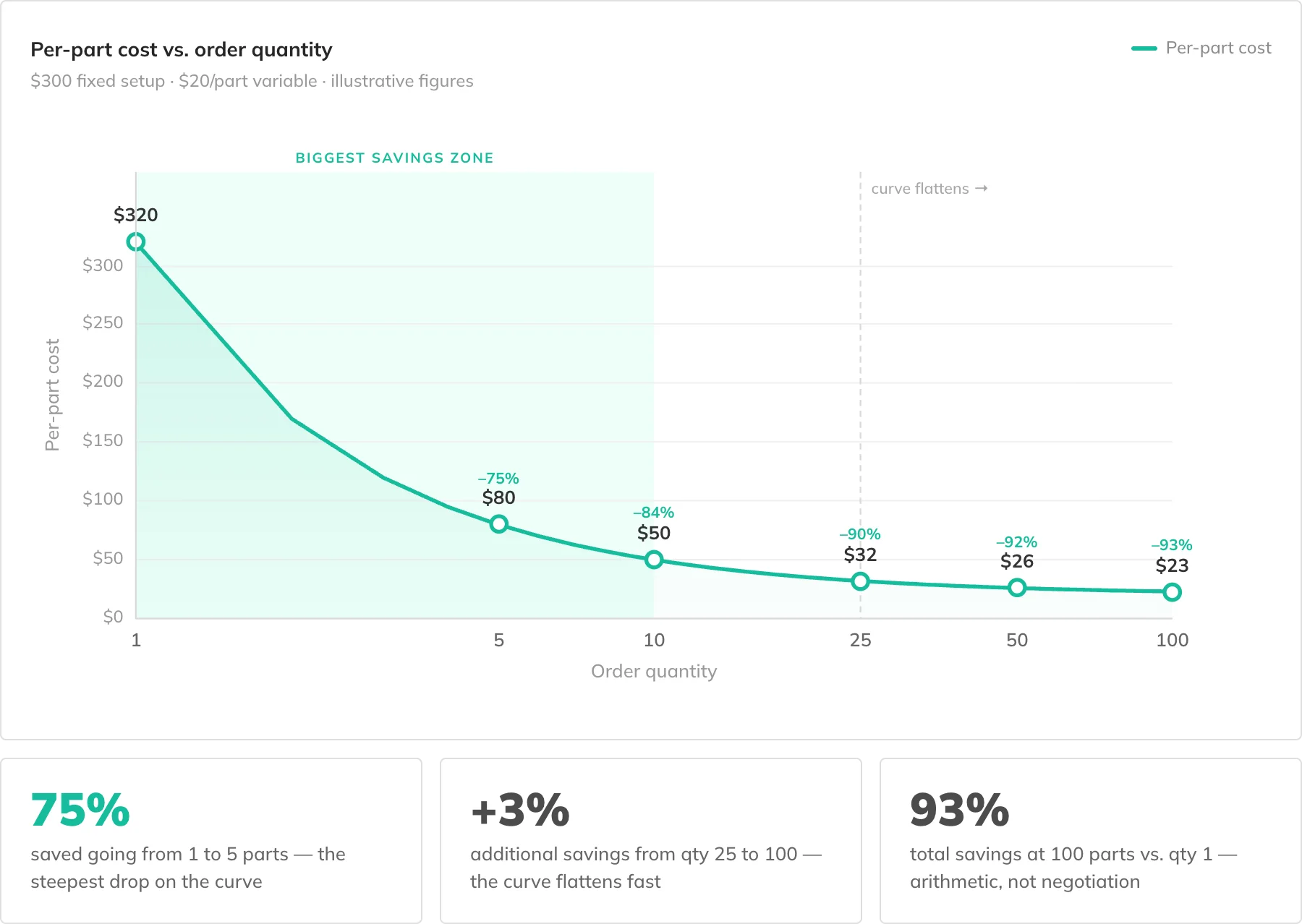
That arithmetic plays out using simplified illustrative figures:
| Quantity | Fixed Setup | Variable/Part | Total Cost | Per-Part Cost | % Savings vs. Qty 1 |
| 1 | $300 | $20 | $320 | $320 | — |
| 5 | $300 | $20 | $400 | $80 | 75% |
| 10 | $300 | $20 | $500 | $50 | 84% |
| 25 | $300 | $20 | $800 | $32 | 90% |
| 50 | $300 | $20 | $1,300 | $26 | 92% |
| 100 | $300 | $20 | $2,300 | $23 | 93% |
Illustrative figures only. Actual costs vary significantly by part, process, material, tolerances, and supplier.
Two things stand out. The savings are dramatic—going from 1 to 5 parts cuts per-part cost by 75%. And the curve flattens fast—going from 25 to 100 parts saves only an additional 3% per unit. The biggest opportunity is always at the low end of the quantity range, which is exactly where most engineers are operating during prototyping and early production.
The Manufacturing Cost Curve Model
Every manufacturing job carries fixed costs that are divided across all parts produced. The more parts, the smaller each part’s share—and the cheaper each part becomes.
Why Fixed Costs Are Truly Fixed: The NRE Principle
Fixed manufacturing costs are truly fixed because they represent one-time intellectual and physical work—not effort that scales with volume. An example is a CAM program written for a part once, which the machine runs as many times as needed.
Engineers who’ve worked in hardware development already have a mental model for non-recurring engineering costs (NRE). When a company develops a new product, certain investments happen once—tooling design, test fixture fabrication, software qualification—and those costs get amortized across the production volume that follows. Manufacturing job setup works on exactly the same principle, at the job level rather than the product level.
The CAM program written for a part is written once. The machine runs it as many times as needed without rewriting. The fixture is built and qualified once—it holds every subsequent part identically. The first article is inspected once, establishing that the process is capable. After that, every additional part is cycle time, material, and machine time or labor. That additional work is either done or it isn’t.
This is also why a hidden cost catches many engineers off guard: every time a job is re-quoted and re-run from scratch, the fixed cost clock resets—even for an identical part. A supplier receiving a new purchase order for the same part they made six months ago doesn’t inherit the previous setup. Two separate orders of 5 parts almost always cost more in aggregate than one order of 10, because setup is paid twice. For stable parts ordered on a regular cadence, this hidden re-setup tax is one of the most underused cost levers available.
How the Cost Curve Varies Across Processes
The fixed vs. variable cost principle is universal. What varies across manufacturing processes is the magnitude of the fixed cost—and therefore the steepness of the curve and the volume range over which a given process makes economic sense.
CNC Machining: The Highest Fixed Cost Among Non-Tooled Processes
CNC machining carries the highest fixed cost of non-tooled processes. CAM programming for a complex 5-axis part can take several hours of skilled programmer time; a simple 2.5-axis part might take thirty minutes. Either way, that time doesn’t change with quantity. Fixture design and qualification, workholding setup, tool offset verification, and FAI all add to the fixed cost before a single production part is cut.
Secondary operations multiply the effect. A part requiring a flip for backside machining, a separate anodizing lot, or a post-machining inspection protocol carries multiple setup events—each fixed, each amortizing across quantity. Complex multi-setup parts have steeper quantity curves than simple single-setup parts.
Material matters too. In easy-to-machine materials like 6061 aluminum, cycle times are short, and fixed costs dominate the per-part price at low quantities, making the quantity lever especially powerful. In difficult-to-machine materials like titanium or Inconel, longer cycle times shift the fixed/variable balance and flatten the curve.
3D Printing: Lower Setup Cost, But Not Zero
3D printing is often perceived as setup-free. In practice, fixed costs are real—just lower than CNC for most parts. File preparation and print orientation decisions affect support structure, surface finish, and mechanical properties. Build plate setup and machine qualification add further fixed cost. Post-processing protocols are established once per job type.
For powder-bed fusion processes (SLS, MJF), the per-build fixed cost is particularly high. Build setup, warm-up, and post-process depowdering are charged per build regardless of how many parts are nested in it. An engineer ordering 2 SLS parts pays the same build overhead as one ordering 20. This makes build plate utilization a unique efficiency lever—a full build plate of 20 well-oriented parts is dramatically more cost-efficient per part than a near-empty plate with 3.
Sheet Metal Fabrication: Fixed Costs Tied to Nesting and Forming
Sheet metal sits between CNC and 3D printing in a fixed cost profile. Laser cutting nesting setup, bend program qualification, and tooling qualification are all fixed per job. For complex formed parts with multiple bend operations, each distinct bend setup contributes to the fixed cost. Material represents a larger share of variable cost in sheet metal than in CNC, which shifts the fixed/variable ratio—but the curve and re-setup dynamics are the same.
Injection Molding: Fixed Cost at a Different Order of Magnitude
Injection molding is where the NRE principle reaches its most extreme. The mold itself is a one-time engineering investment—a precision tool designed, fabricated, and qualified to produce a specific geometry. A simple single-cavity mold typically runs $10,000–$50,000; a complex multi-cavity or family mold can reach $100,000 or more. That is the main fixed cost. Every shot produced after qualification is essentially just material and machine time.
The result is a quantity curve that is nearly vertical at low volumes and drops steeply as the mold investment amortizes. At 100 units, the per-part mold cost contribution can exceed the value of the part itself. At 100,000 units, it’s negligible. Injection molding isn’t economically viable below roughly 1,000–5,000 units for most plastic parts, and that threshold rises for complex molds. The same logic applies to stamping dies, die casting tooling, and thermoforming molds.
Tooled processes aren’t always more expensive overall—they serve a different volume range. Injection molding’s per-part cost at 50,000 units is dramatically lower than what CNC machining could achieve at that volume. The question isn’t which process is better; it’s which one matches the economics of your actual production volume.
| Process | Typical Fixed Cost Per Job | Volume Sweet Spot | Per-Part Cost Driver at Low Volume |
| CNC Machining | $50–$500 (setup + programming) | 1–500 parts | Fixed cost dominant |
| 3D Printing | $20–$200 (file prep + build setup) | 1–200 parts | Fixed cost + build utilization |
| Sheet Metal | $50–$400 (nesting + bend setup) | 5–1,000+ parts | Fixed cost + material |
| Injection Molding | $10,000–$100,000+ (mold) | 1,000–100,000+ parts | Mold amortization dominant |
Figures are illustrative and vary significantly by part complexity, geometry, material, and supplier.
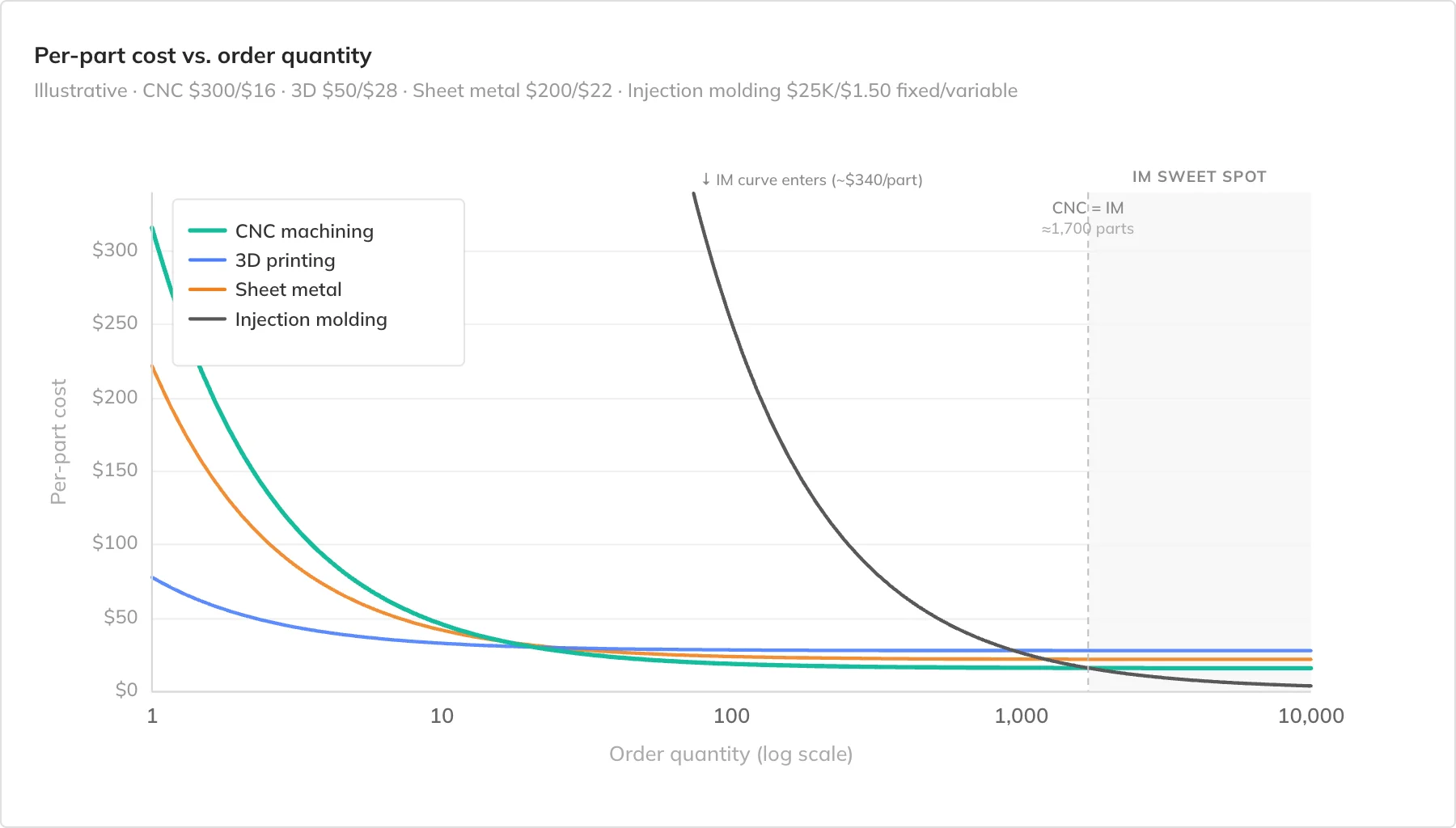
Process Cost Curves: Side by Side
Each process has a different fixed-to-variable cost ratio, which determines its sweet spot. Injection molding’s mold cost (~25K illustrative) places it off-chart at low volumes—it only becomes cost-competitive above ~1,700 parts.
Volume Break Points: Where the Curve Changes the Decision
A volume break point is the order quantity at which per-part cost drops enough to meaningfully change the economics of a sourcing decision—the inflection on the cost curve where marginal savings from ordering more stop justifying the additional upfront spend. Every part has one, determined by its fixed-to-variable cost ratio for a given process.
The break point for a simple aluminum CNC part is different from a complex 5-axis titanium part requiring multiple setups and extensive FAI. For SLS 3D printing, build utilization shapes it as much as programming cost. For injection molding, it’s less about a single job and more about total production volume over the mold’s lifetime.
Volume break points involve lead time too, not just unit cost. Larger runs often benefit from post-process batching efficiencies—a full anodizing lot costs less per part than a partial lot and moves through the queue faster. A real production decision weighs unit cost, total cost, and lead time together.
Six Ways to Apply Cost Curve Thinking
Consolidate prototype orders. If a design is stable—or close enough—ordering 5 or 10 parts instead of 1 or 2 costs more in total but can cut per-part cost by 50% or more. For functional test units, integration spares, or parts going to multiple team members, consolidating into one run almost always wins economically.
Plan re-order cadence deliberately. For proven, stable parts, four orders of 5 over a year is almost certainly more expensive than two orders of 10. Setup cost is paid four times instead of twice. The carrying cost of a small buffer stock is often lower than the hidden re-setup tax on repeated small orders.
Communicate future volume early. If a part is headed toward production volume, giving a supplier that context upfront changes how they invest in fixturing and process optimization—and that flows back in unit economics, sometimes starting on the first production run.
Design for fewer setups. Every additional setup event—a flip, a secondary operation, a separate finishing lot—adds fixed cost that must be amortized. Parts that machine in a single setup, share fixturing geometry with other assembly components, or avoid secondary operations carry lower fixed costs at every quantity tier.
Match the process to your actual production volume. Using CNC for a 50,000-unit run leaves substantial cost on the table compared to injection molding. Using injection molding for a 50-unit pilot means paying for a mold that will never amortize. Process selection is as much a cost decision as a geometry decision, and should be made early.
Run the prototype-to-production crossover calculation before the roadmap is locked. The quantity at which a tooled process becomes cheaper per part than CNC is a real break-even calculation. That crossover—determined by mold cost, per-part variable savings, and projected volume—should inform launch volume targets and production planning timelines before tooling investment decisions are made.
This is the core logic behind economic order quantity (EOQ)—the principle that there’s an optimal order size that balances setup cost against holding cost. For custom parts, the math is rarely run formally, but the intuition should drive how you think about re-order cadence.
Compare Multiple Manufacturing Costs With One Quote
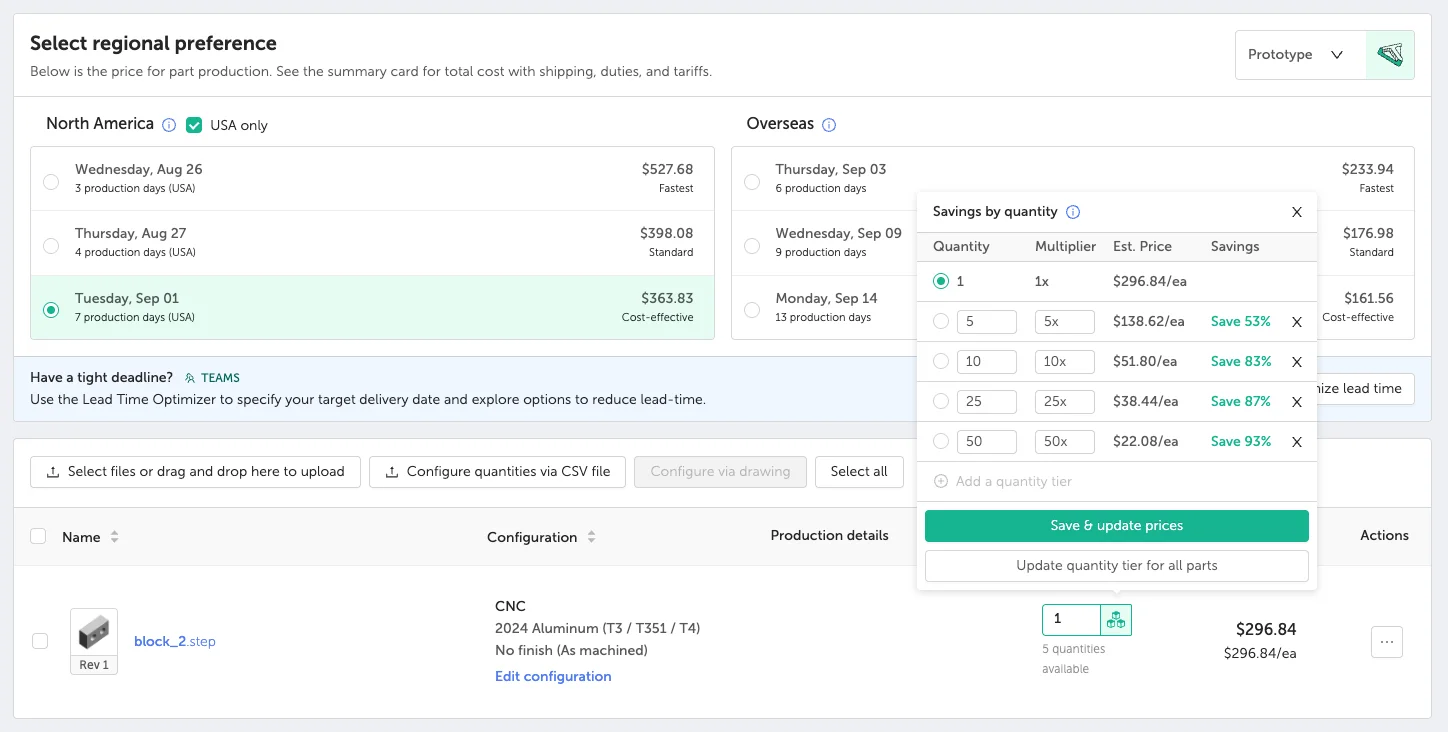
Multi-quantity quoting puts pricing across up to five quantity tiers side by side, with lead time at each tier, from a single submission. For auto-quoted CNC, 3DP, or sheet metal orders, you can now see this comparison instantly. For parts requiring manual review, all tiers are priced and returned together. The decision—which quantity to order, whether to consolidate, where the volume break point is—becomes data-driven rather than a guess and check.
Numbers and figures are approximated and are intended as directional guidance only. Actual savings depend on your specific part, process, material, tolerances, and supplier.
Ready to see your part’s full pricing curve? Request a multi-quantity quote and compare up to five quantity tiers in a single submission—instantly for auto-quoted parts, or through one streamlined RFQ for parts requiring manual review.
Talk to a Fictiv expert about your project, or upload your parts to start a free quote.
Frequently Asked Questions About Manufacturing Cost Per Quantity
Why does per-part cost decrease when I order more parts?
Every manufacturing job has fixed costs—programming, machine setup, first article inspection—that are incurred once regardless of how many parts are produced. At qty 1, one part absorbs 100% of those costs. At qty 50, each part absorbs 1/50th. The per-part savings are steepest at low quantities, where fixed costs represent the largest share of total job cost.
What is a volume break point in manufacturing?
A volume break point is the order quantity at which per-part cost drops enough to meaningfully change the economics of a sourcing decision. It’s the inflection on the cost curve—the point where marginal savings from ordering more stop justifying the additional upfront spend. Every part has one, determined by the ratio of fixed to variable costs for that specific part and process.
What is NRE cost in manufacturing?
NRE stands for non-recurring engineering cost—expenses incurred once per job that are then amortized across output volume. In manufacturing, setup cost (programming, fixturing, first article inspection) functions as NRE at the job level: paid once, divided across every part produced in that run.
When does injection molding become cheaper per part than CNC machining?
The crossover varies by part complexity and mold cost, but injection molding typically becomes cost-competitive above 1,000–5,000 units for simple plastic parts. Below that threshold, mold amortization at low volumes makes injection molding significantly more expensive per part than CNC or 3D printing. Complex molds push the crossover higher.
Does 3D printing have setup costs like CNC machining?
Yes, though typically lower. File preparation, print orientation, build plate setup, and post-process qualification are all fixed per build. For powder-bed processes like SLS and MJF, build setup and depowdering are charged per build regardless of part count—making build plate utilization a key cost efficiency lever unique to those processes.
What happens to the cost when I re-order the same part later?
Every re-run resets the fixed cost clock, even for identical parts. A supplier receiving a new order for a previously made part re-qualifies the setup from scratch. Two separate orders of 5 parts almost always cost more in aggregate than one order of 10. For stable parts ordered regularly, batching orders or holding a small buffer inventory is often more economical than repeated small re-orders.