







Time to read: 8 min
In mechanical and manufacturing design, tolerances are the unsung heroes (or villains) of product quality, cost, manufacturability, and design intent. Not the ability to tolerate scope creep, schedule changes, or miscommunication in DFM collaboration—though that helps too. We’re talking dimensional and geometric tolerances.
Every part, whether a simple bracket or a complex aerospace component, is subject to natural variation due to machines, materials, the environment, and human error. Specifying tolerances is a balancing act: too loose, and parts won’t fit or function. Too tight, and costs, lead times, and scrap rates surge.
Tolerance errors are among the most frequent and costly mistakes in engineering—causing assembly failures, higher manufacturing costs, inspection bottlenecks, and product failures in the field. The stakes are even higher in aerospace, automotive, medical devices, and consumer electronics, with high‑volume production, strict regulatory requirements, and interconnected global supply chains leaving little room for error.
Upload your design with 2D drawings to quote tight-tolerance parts

What Are Engineering Tolerances?
Engineering tolerances define how much a part’s dimensions or geometry can vary and still fit, function, and interchange properly in an assembly. They communicate which features drive performance (often using GD&T) and directly influence inspection effort, manufacturing complexity, cost, and lead time.
Tighter tolerances mean slower machining, more setups, secondary operations, and more time-consuming inspections. Because tolerances stack up in assemblies, a quick stack‑up analysis—for example, worst-case, or statistical—reveals which dimensions need tight control and which can be loosened to save money and shorten schedules.
Dimensional vs. Geometric Tolerances
Dimensional tolerances cover the basics: length, width, thickness, and diameter. Dimensional tolerances specify the allowable variation of a given feature while still enabling the part to be assembled. These types of tolerances are easy to measure and understand, and are used daily by machine shops.
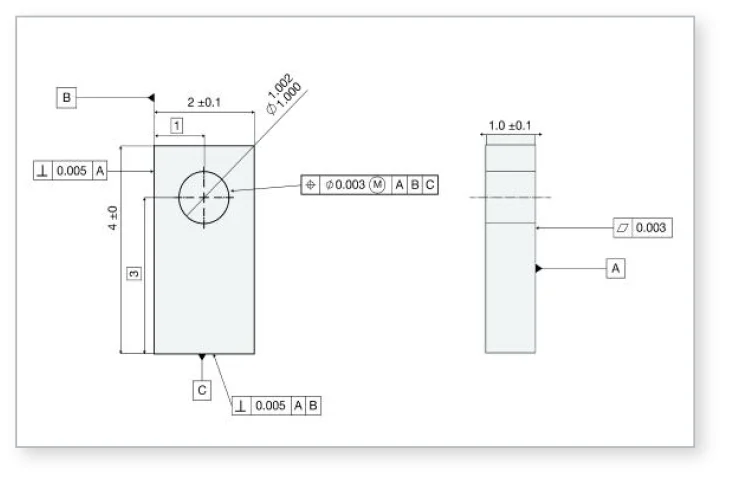
Geometric tolerances (GD&T) control the shape, orientation, and location of a part’s features. They may refer to specific characteristics of parts such as flatness, perpendicularity, position, and concentricity. Rather than controlling a single dimension, geometric tolerances define how features functionally relate to each other.
By focusing your control on what really matters for assembly and performance, you can often loosen size tolerances of other features. This results in savings where it counts, while allowing for tighter control of the functions you need.
Why Tolerances Drive Cost, Quality, and Yield
Tighter tolerances require slower machining, sharper tools, more setups, and often custom fixturing. Tighter dimensional control requires reduced feed rates, tighter management of tool deflection, and closer control of heat and vibration—all of which translate to longer cycle times, higher scrap rates, and significantly higher costs. When you apply tight tolerances only where performance truly requires them and let other dimensions breathe, production speeds up, yields climb, and function stays intact.
Every tolerance choice ripples outward. It shapes tooling decisions (standard cutters or precision fixtures?) and inspection requirements (a quick go/no‑go gauge or hours on a CMM?). These choices also shift your supplier pool. Many shops quote standard tolerances competitively; far fewer can consistently hold ultra‑tight specs. A single decimal place on a drawing can quietly multiply cost, stretch lead times, and add complexity across manufacturing.
The 7 Most Common Tolerance Mistakes Engineers Make
When tolerances are assigned without regard for process capability, datum strategy, or actual functional need, the result is avoidable delays, cost overruns, and fit‑up failures.
1. Overtightening Tolerances “Just to Be Safe.”
It’s a familiar instinct: tighten a dimension because you’re not sure, because it feels rigorous, or because you figure a more accurate part can’t hurt. But arbitrary tightening has real costs: slower machining, special tooling, and more rejects.
A better approach:
- Ask yourself: Does this dimension actually affect function? If not, relax it to a standard tolerance.
- Tighten only the features that demand precision; leave everything else at default.
- Add a note to the drawings: “Critical features only; noncritical dimensions per ISO/ASME standard tolerances.”
- Reserve FAI callouts or requests for critical-to-quality (CTQ) dimensions with proper notation.
2. Relying Only on Title‑Block Defaults
Title‑block tolerances (general/blanket values) are convenient, but they’re not a substitute for thinking through each feature. When shops see blanket tolerances, they commonly either overprocess to meet unnecessary precision or send the drawing back for clarification.
A better approach:
- Call out exceptions inline wherever a feature needs different control.
- Once per project, revisit the title block and update it to reflect realistic shop capabilities.
- Flag critical features with a symbol or note so suppliers don’t default to the tightest spec across the board.
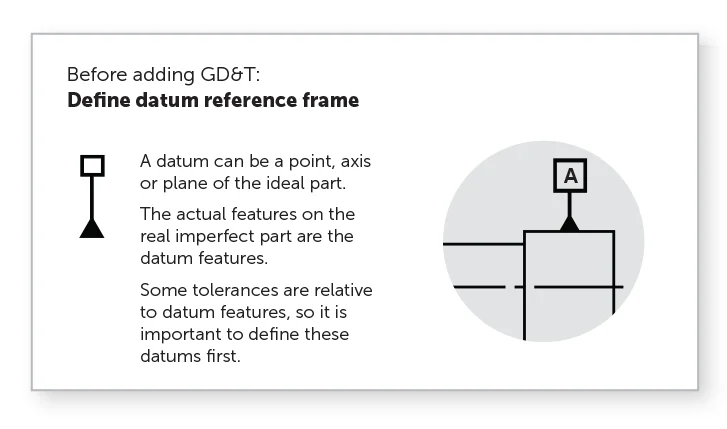
3. Poor Datum Selection
Datum choices ripple far beyond the drawing board. They dictate how a part is fixtured, how it’s measured, and whether two mating parts agree on what “aligned” means. A poorly chosen datum invites ambiguity, rework, and scrap.
A better approach:
- Pick datums that mirror assembly interfaces—surfaces the part touches or locates from.
- Sketch a datum reference frame on the drawing and label primary, secondary, and tertiary.
- Run a quick mental tolerance stack to verify the datum scheme holds up in real‑world assembly.
4. Misusing or Skipping Position Tolerances
Using basic dimensions without proper position controls—or skipping GD&T entirely in favor of loose notes—creates ambiguous acceptance criteria and leaves interpretation up to whoever reads the print next.
A better approach:
- Replace vague notes with a clean GD&T position callout, especially for hole patterns.
- Add a basic dimension frame and, where it helps, an MMC or LMC modifier.
- Include a short inspection instruction: “Measure position relative to datums A, B, C.”
5. Ignoring Process Variation
One standard tolerance doesn’t fit all processes. What’s routine for CNC machining may be impractical for sheet metal fabrication or injection molding. Applying the same ±0.1 mm across the board signals that process capability hasn’t been considered.
A better approach:
- Annotate process‑specific expectations: “For molded parts, use ±0.25 mm unless otherwise noted.”
- Flag features with the intended process so suppliers can quote appropriately.
- Use standard tolerance tables per process rather than a single global default.
6. Over‑Tolerancing Nonfunctional Surfaces
It’s easy to carry tight tolerances across the whole model, even on faces that never see a mating part or affect performance. That stringency costs time and money at every machining and inspection step.
A better approach:
- Mark nonfunctional surfaces as “reference” or “no tolerance required.”
- Apply broader, standard tolerances to secondary faces.
- If a cosmetic surface genuinely needs tight control, add a short justification line so it doesn’t read as an oversight.
- Talk with your manufacturing partner about functionality early.
7. Unclear Tolerancing Documents for Suppliers
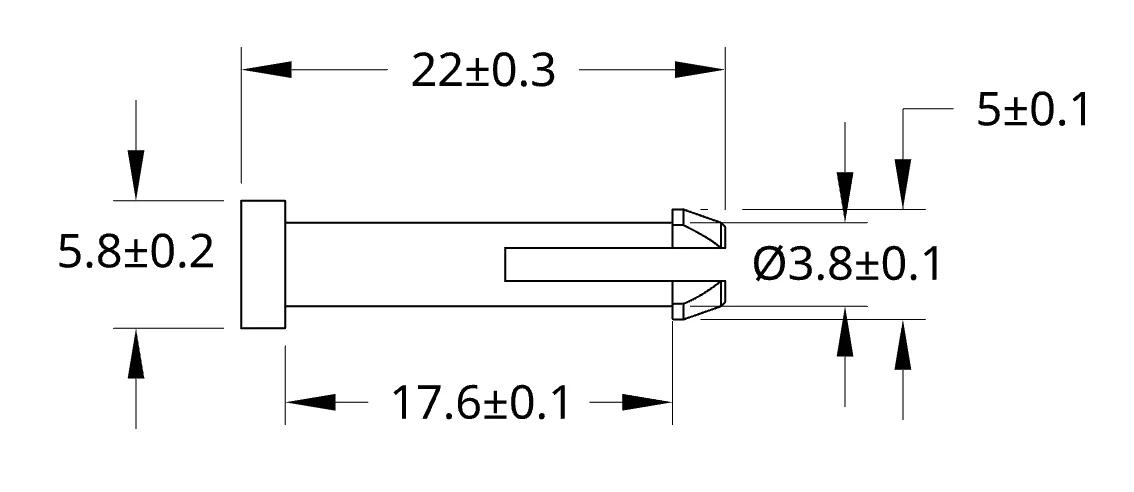
Ambiguous notes, missing inspection criteria, or inconsistent symbols force suppliers to guess—or worse, to stop work and wait for clarification. That drags out quoting, planning, and production.
A better approach:
- Add one clear inspection sentence: tooling type (CMM, go/no‑go, hard gauge) and sample size.
- Attach a short supplier note: “Contact engineer for tolerance questions; default to ASME Y14.5.”
- Keep a change log on the drawing revision so suppliers can see exactly what shifted.
How to Choose the Right Tolerance
Choosing the right tolerance can be done effectively using the 3‑step rule of thumb:
- First, ask what actually needs to work. Identify the one functional requirement that matters: fit, seal, motion, alignment, load transfer. If the feature doesn’t influence that, it probably doesn’t need a tight tolerance.
- Next, figure out what controls it. Choose datums that reflect how the part is held or how it mates in the real assembly. Your datum scheme should point directly to the surfaces that establish that functional relationship, not just convenient faces on the model.
- Finally, check if the process can hold it repeatedly. Match the tolerance to the manufacturing process you’re actually using. If the process can’t hold that number reliably, loosen the spec or change the process.
A simple decision flow to guide you:
- Does it affect fit, seal, motion, or alignment?
- Yes → treat it as critical.
- No → let it breathe; use standard tolerances.
- Is it machined, molded, or formed?
- Each process has its own tolerance bands. Assign accordingly instead of pastingone global number everywhere.
- Will this feature be inspected on every part?
- 100% inspection can justify tighter control. If you’re sampling, lean on looser, process‑capable tolerances.
Quick rule:
Critical + machinable + inspected → tighter tolerance
Noncritical + formed/molded + sampled → relax to standard process tolerances
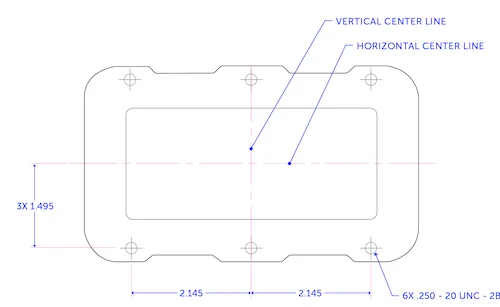
Consider a blanket ±0.1 mm positional tolerance applied to every hole in a pattern. The shop has to dial in each hole individually, often in multiple setups, then run it through CMM inspection. Cycle time creeps up; scrap follows.
To fix this, identify the one or two holes that actually locate the assembly and give those a tight position callout relative to the functional datums. The rest revert to ISO or ASME general tolerances. The machinist roughs the pattern in one pass, hits the critical holes precisely, and moves on. Cycle time drops. Scrap drops. And the parts still assemble perfectly.
Cut Cost and Lead Time With Smarter DFM
Most tolerance problems stem more from communication breakdowns than engineering failures. The engineer expects it one way, the technician reads it another way, and somewhere in between, the part becomes unmakeable or unaffordable.
You don’t need to memorize every tolerance rule or keep a stack of tolerance handbooks at hand. What you need is fast, manufacturing‑aware feedback—a quick DFM pass, a clear datum callout, and a sentence of inspection guidance. A five‑minute sanity check with a supplier or someone on the floor alone catches the vast majority of expensive surprises.
Build a short pre‑release checklist. Better yet, build a habit: specify function, flag only what’s critical, and match the tolerance to the process. It sounds simple, but this helps keep projects on budget, without late-night calls or emails about why nothing fits.
Upload your CAD files to the Fictiv platform to get instant DFM and tolerance feedback from our team. See how small tolerance changes translate to lower machining time, less scrap, and faster lead times.
Talk to a Fictiv expert about your project, or upload your parts to start a free quote.