





Time to read: 10 min
Low-pressure die casting (LPDC) is a permanent-mold process commonly used for casting high-quality aluminum products. It sits between gravity-fed and high-pressure die casting in terms of tooling cost, process speed, and mechanical and metallurgical quality.
What Is Low-Pressure Die Casting?
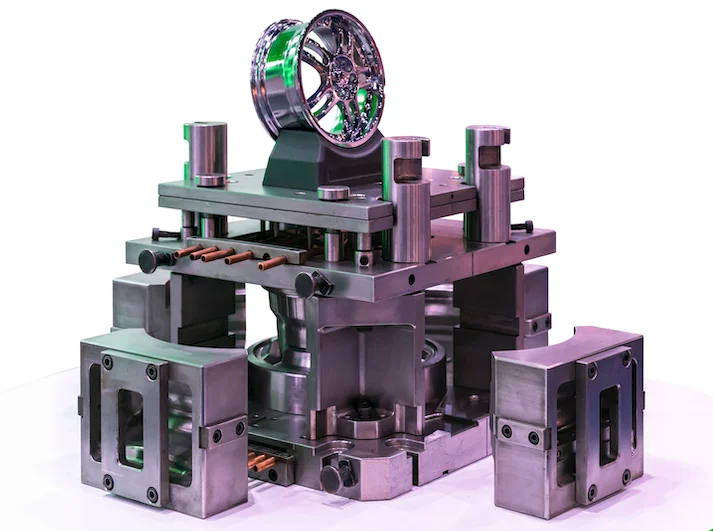
Low-pressure die casting uses permanent molds (dies) and applies a low positive pressure of 0.3–1.5 bar to push molten metal slowly into the dies. The controlled pressure minimizes turbulence and air entrapment as the metal fills the mold, producing cast components with minimal porosity and heat-treatable properties.
The process is most commonly used with aluminum alloys, since LPDC suits metals with relatively low melting points. This is because it’s easier to keep a low-melting-point alloy from solidifying in the crucible as the mold fills. Permanent molds can be manufactured with multiple cavities to increase the number of parts made per injection, and reusable tooling decreases the potential for part-to-part and run-to-run variation. The higher metallurgical quality of LPDC castings outweighs the additional cycle time compared to HPDC, making it a viable production method.
How the Low-Pressure Die-Casting Process Works
Step 1: Melt Preparation and Mold Preheat
The first step in the LPDC process is to prepare the molten alloy (e.g., A356). The metal is heated in a crucible to about 150°C above its melting point, then degassed to release trapped hydrogen, which would cause porosity in the finished casting. Rotary degassing, or bubbling an inert gas (such as argon or nitrogen) through the molten metal, allows hydrogen to diffuse out and be released.
Temperature control of both the molten metal and the receiving molds is important. If the melt temperature is too low, the die may not fill completely before the metal begins to solidify; if it’s too high, there may be shrinkage after casting. The melt needs to be held to a particular temperature, usually within the range of 700-730°C for alloys like A356, and the dies are typically preheated to 200-350°C.
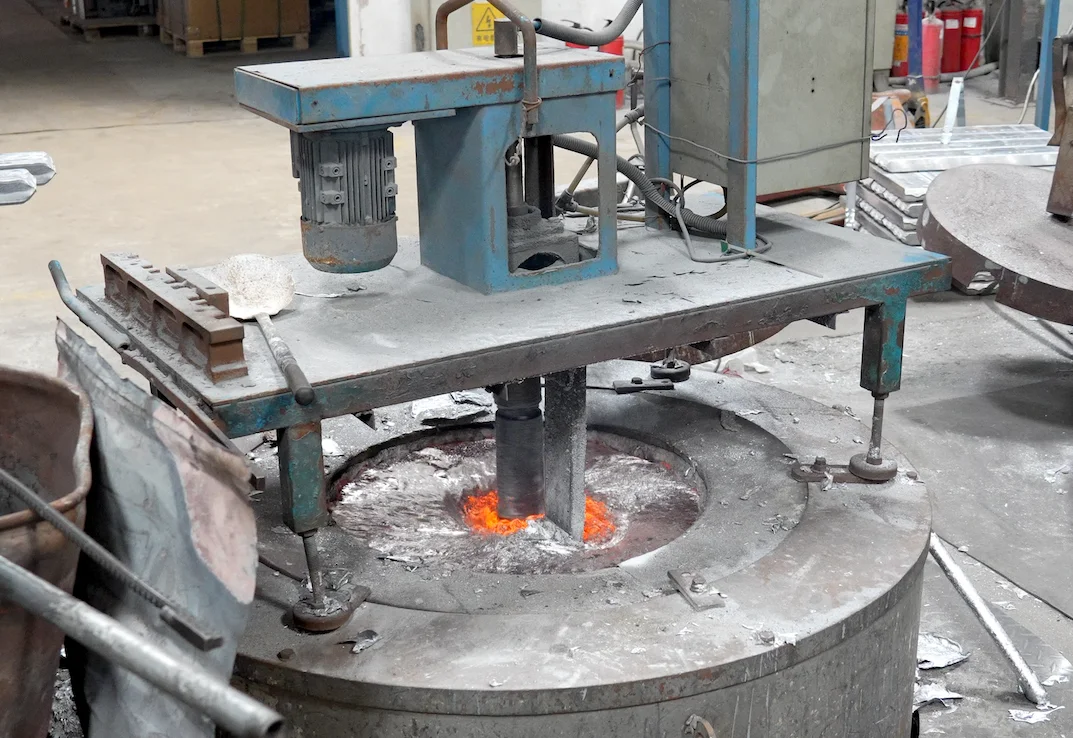
Molten metal degassing
Step 2: Pressurized Filling
The next step is to fill the mold (die) by applying pressure to the holding chamber below, using nitrogen gas to push the molten aluminum up through the riser tube and into the mold. The low gas pressure allows the filling to be done slowly with little turbulence, limiting the potential for trapped air, oxide formation, and porosity.
Step 3: Solidification Under Pressure
Once the die is filled, the pressure in the holding chamber is maintained during cooling. This sustained pressure helps to reduce porosity caused by shrinkage.
Step 4: Ejection and Finishing
Once cooling is complete, the part is ejected from the dies and finishing steps can be carried out. Usually, this includes trimming excess material at the die interface and vents, as well as some machining.
A key aspect of LPDC is that the resulting castings can be heat-treated to improve mechanical properties. Low-pressure die casting provides parts with much lower porosity than high-pressure die casting. LPDC parts can be heat-treated, whereas HPDC parts have larger volumes of trapped gas that make them riskier to heat-treat.
Advantages of Low-Pressure Die Casting
LPDC’s primary advantage is the low volume of gas trapped as the die is slowly filled. Less trapped gas means improved mechanical properties.
Why LPDC Improves Mechanical Properties
Parts produced with LPDC tend to have better mechanical properties than those produced with HPDC because the lower applied pressure and slow, controlled fill produce less turbulence as the molten metal flows in. The result is less gas entrapment than in high-pressure die casting, which comes with benefits including:
- Lower rate of defects
- Improved surface finish
- Better mechanical properties
- Ability to heat treat parts to improve mechanical properties
- Good dimensional accuracy
Lower porosity is the primary advantage that underpins the other benefits. The parts have higher density and better, more consistent mechanical properties, which improves fatigue resistance and overall performance. It also makes LPDC castings more suitable for heat treatment for stress relief or microstructure improvement.
Low-Pressure Die Casting (LPDC) vs. High-Pressure Die Casting (HPDC)
The table below compares the two die-casting processes, LPDC and HPDC, across several performance and production metrics.
| Feature | LPDC | HPDC |
| Filling pressure | Low | Very high |
| Porosity | Lower | Higher* |
| Mechanical properties | Better | Moderate |
| Cycle time | Slower | Faster |
| Thin-wall capability | Moderate | Excellent |
| Heat treatability | Often suitable | Often limited* |
| Production speed | Medium | Very high |
LPDC is the ideal choice for high-quality parts with good mechanical performance; HPDC is better suited for high-volume production. Both have distinct strengths when used in the right applications. LPDC can have a higher percent yield than HPDC, but this varies depending on the design and processing.
*Vacuum-assisted HPDC is becoming increasingly common and improves heat treatability by reducing internal porosity, which can cause blistering and distortion under high temperature.
Limitations of LPDC
LPDC does have limitations. Cycle time is relatively slow, making it less ideal for high-volume commodity production. Minimum wall thickness runs thicker than HPDC allows. Equipment and tooling are more involved than gravity casting requires, though costs remain lower than HPDC.
Materials Used in Low-Pressure Die Casting
LPDC is most commonly used when casting aluminum alloys. Aluminum alloys offer a high strength-to-weight ratio and natural corrosion resistance, forming a natural oxide layer that can be further enhanced by anodization. These alloys are easily castable because of their low melting point and viscosity. Many aluminum alloys, depending on their composition, can also be heat-treated.
Common Alloys Used in LPDC
| Alloy | Relative Properties | Typical Uses |
| A356 | Most common (~7% Si, 0.35% Mg) | Wheels and housings |
| A357 | Higher magnesium, higher strength, lower ductility | Higher-strength structural and safety-critical parts such as suspension components |
| AlSi10Mg | Higher silicon, better flowability for complex parts | Structural applications and complex geometries such as engine components |
Other alloys with relatively low melting points can also be cast using LPDC—magnesium alloys (such as AM 50 and AM60) and copper alloys (tin bronzes), for example.
Design Guidelines for LPDC Parts
There are a few simple principles that should be kept in mind when designing parts for LPDC:
- Minimize abrupt thickness changes that can create uneven cooling and shrinkage defects.
- Plan for uniform wall thicknesses throughout.
- Consider how to control cooling and solidification to avoid isolated hot spots. LPDC favors bottom-up solidification.
- Use sufficient draft angles for ejection from the die, and include ribs for structural stiffness.
- Include fillets and smooth transitions to avoid stress concentrations, with machining allowances built in where needed.
Learn more DFM tips in our Die Casting Design Guide.
When to Choose Low-Pressure Die Casting
LPDC is a strong fit for your project when:
- Mechanical performance is important, such as for automotive wheels, suspension knuckles, and control arms.
- Heat treatments are needed to improve mechanical properties.
- Low porosity is required for pressure-tight and leak-sensitive applications, such as pump housings and fluid containment systems.
- Surface finish is important.
- Dimensional accuracy and consistent density are required, such as in rotating components and structural automotive parts.
- Production volumes are medium-to-high.
Do you need help determining whether LPDC is right for your part? Talk with Fictiv’s manufacturing experts.
If your project doesn’t meet these requirements, you could consider alternative manufacturing processes:
- HPDC if mechanical performance, porosity, and heat treatment are not as critical.
- Gravity casting if the parts have thick walls, with a medium volume production run
- CNC machining if production volumes are low or higher precision is needed.
- Sand casting if the product is very large and requires less precision.
Learn more about other casting methods and how to transition from low-volume machining in our Scaling CNC to Casting Guide.
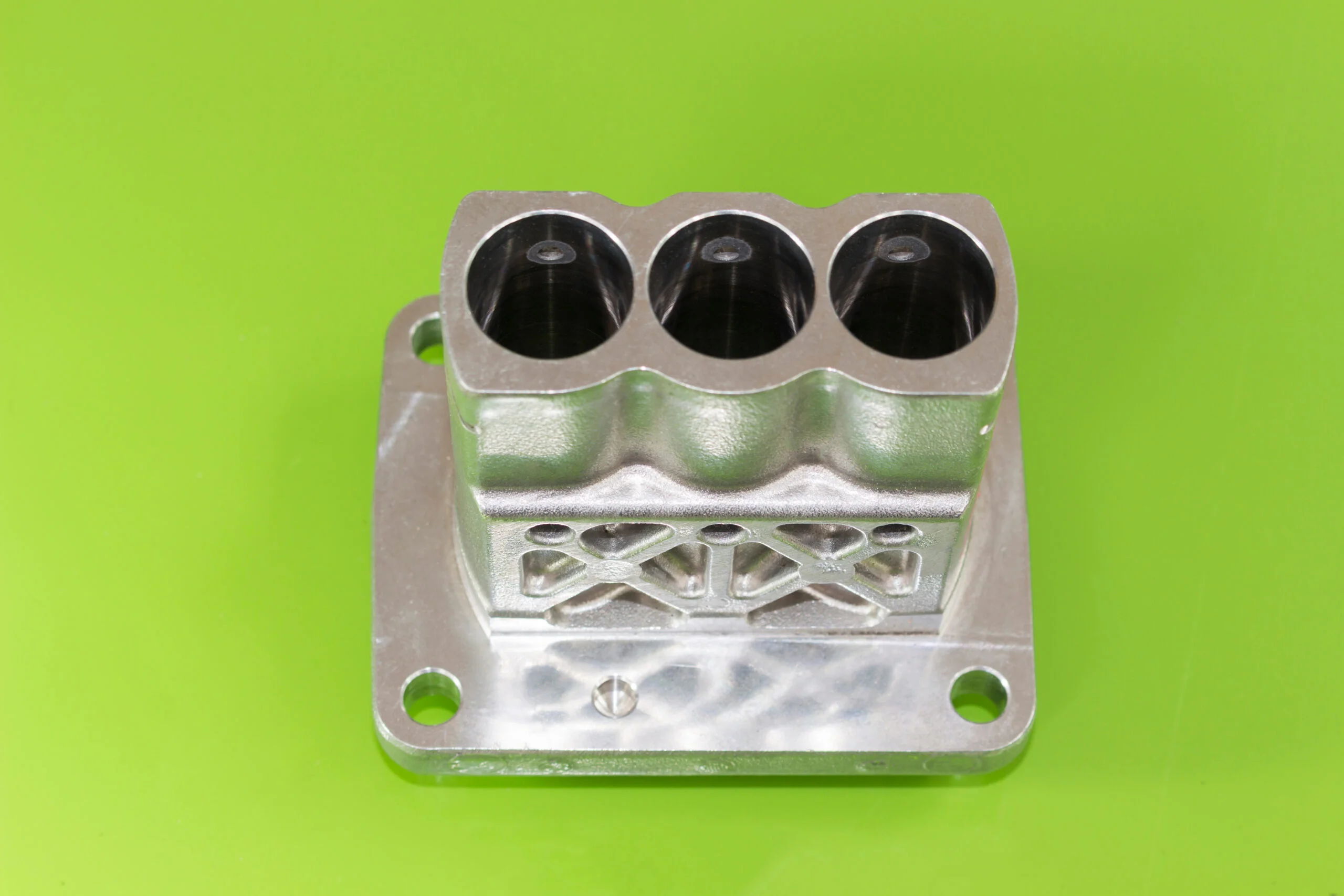
How Fictiv Supports Die Casting
Beyond experience with the die casting process, Fictiv offers DFM support and materials knowledge. Fictiv partners with you from the beginning, with prototype-to-production scaling experience and a manufacturing partner network that can assist at each stage—including secondary machining.
Ready to start casting parts? Log in to get a free quote and DFM feedback.
LPDC FAQs
What is low-pressure die casting used for?
Low-pressure die casting is most commonly used to produce structural aluminum components where mechanical performance, low porosity, and dimensional accuracy are critical. Typical applications include automotive wheels, suspension knuckles, control arms, pump housings, and other fluid-containment parts. Its ability to produce heat-treatable, near-net-shape castings makes it well suited to safety-critical and pressure-tight components.
What is the difference between low-pressure and high-pressure die casting?
The key difference is the filling pressure and the resulting part quality. LPDC uses 0.3–1.5 bar to fill the mold slowly from below, minimizing turbulence and gas entrapment, which produces lower porosity and better mechanical properties. HPDC injects metal at very high pressure and much faster speeds, enabling thinner walls and higher production rates, but at the cost of higher porosity and limited heat treatability. LPDC is preferred when part quality matters most; HPDC is preferred when production volume and speed are the priority.
Can low-pressure die castings be heat treated?
Yes — and this is one of LPDC’s most important advantages over conventional HPDC. Because LPDC produces castings with significantly lower porosity, they can undergo T5 or T6 heat treatment without the risk of blistering or internal cracking caused by expanding trapped gas. Heat treatment allows LPDC parts to achieve higher tensile strength, improved fatigue resistance, and better dimensional stability, making it particularly valuable for structural and safety-critical applications.
What aluminum alloys are used in low-pressure die casting?
The most common alloy is A356 (an Al-Si-Mg alloy with ~7% silicon), widely used for wheels and housings. A357 offers higher magnesium content and greater strength at the cost of some ductility, making it suitable for suspension and safety-critical components. AlSi10Mg, with its higher silicon content (~10%) and good fluidity, is used for complex geometries and structural parts. Magnesium alloys such as AM50 and AM60 can also be cast using LPDC for weight-critical applications.
What are the main design considerations for low-pressure die casting?
The most important design principles for LPDC are: maintaining uniform wall thickness to avoid uneven cooling and shrinkage defects; designing for bottom-up solidification directionality, which is inherent to the LPDC process; avoiding abrupt section changes; incorporating adequate draft angles for clean ejection; and using fillets and smooth transitions to minimize stress concentrations. Because LPDC parts are often heat treated and finish-machined, designs should also include appropriate machining stock and dimensional tolerances for post-cast operations.