




Time to read: 12 min
Many fulfillment centers run 24 hours a day, 7 days a week, at throughput rates measured in thousands of units per hour. Equipment including autonomous mobile robots (AMRs), high-speed conveyor matrices, automated storage and retrieval systems (ASRS), and robotic picking stations make this possible.
Because of this constant use, warehouse automation equipment must be designed and manufactured to different standards than machinery built with scheduled downtimes. A component that fails unexpectedly during peak season does not just cost repair time; it backs up an entire order pipeline, chokes upstream pick paths, and halts sortation matrices. Building reliable fulfillment equipment requires matching custom hardware geometry, material selection, precision tolerances, and design for manufacturability (DFM) with the rigorous demands of continuous 24/7 operations.
This guide covers the hardware that makes warehouse automation work and the manufacturing decisions that determine its reliability.
The Hardware Systems That Make Up Modern Warehouse Automation
Warehouse automation equipment is the robotic, conveyor, storage, and picking hardware that moves and sorts inventory with minimal manual handling. Because it runs near-continuously, its custom parts (chassis, frames, carriages, and end-of-arm tooling) must be designed for rigid geometry, wear resistance, and fast field repair.
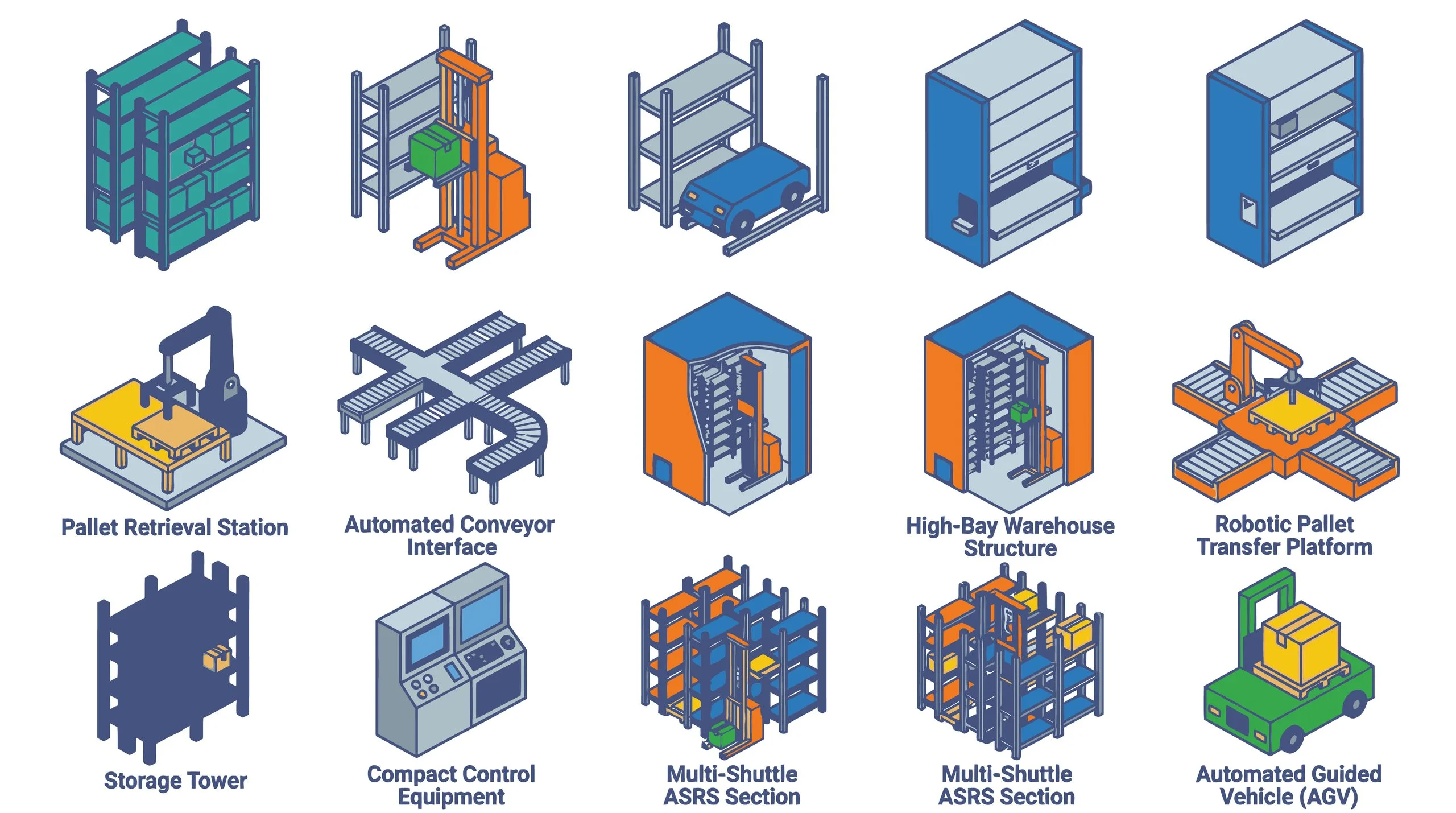
Warehouse automation systems rely on four primary equipment categories: Autonomous Mobile Robots (AMRs) and Automated Guided Vehicles (AGVs), conveyor and sortation systems, Automated Storage and Retrieval Systems (ASRS), and robotic picking/packing stations. Each system relies on custom-fabricated structural elements, precision interfaces, and specialized wear hardware to maintain high throughput and continuous operation.
Autonomous Mobile Robots (AMRs) and AGVs
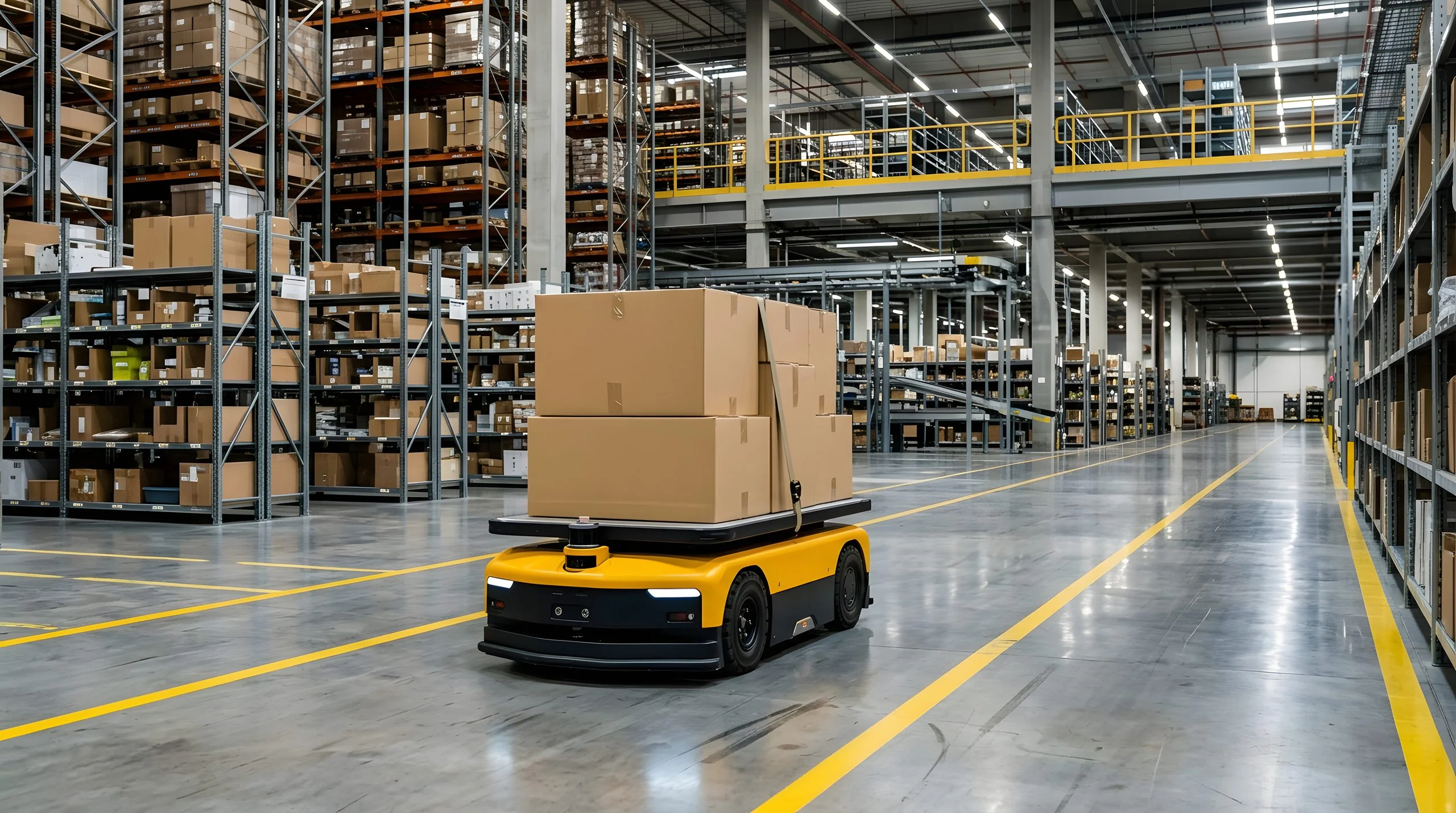
AGVs follow fixed paths using guidance such as magnetic tape, embedded wire, laser reflectors, QR-code floor grids or, in newer systems, natural-feature navigation. AMRs use onboard LiDAR, 3D cameras, and SLAM (simultaneous localization and mapping) to plan their own routes and navigate around obstacles. In hardware terms, both types of vehicles demand robust welded steel or structural aluminum chassis fabrications, precision drive wheel hubs, battery compartment enclosures, and docking interface plates. Any vehicle that navigates by LiDAR or camera, including AMRs and many modern AGVs, must also integrate rigid sensor mounting frames designed to tight field-of-view tolerances.
Conveyor and Sortation Systems
As the primary arterial network of a fulfillment facility, conveyor and sortation systems require structural durability and low-friction wear surfaces. Custom components include conveyor frame sections and cross-members, drive roller mounting brackets, belt tensioner assemblies, diverts and merges for sortation, accumulation zone sensor mounts, and junction plates where conveyor segments connect. The core conveyor structure is often fabricated from steel or aluminum, while a conveyor’s other components are a mix of standard catalog items (rollers, bearings, drives) and custom mounting geometry.
Automated Storage and Retrieval Systems (ASRS)
ASRS structures provide high-density vertical storage served by automated retrieval mechanisms operating in narrow aisles. Custom components include base plate and anchor interfaces, shuttle vehicle chassis and carriage structures, lift mechanism frames and guide rails, pick/place interfaces, and precision linear motion mounting surfaces. Rack uprights and beams are typically standardized sections.
Robotic Picking and Packing Stations
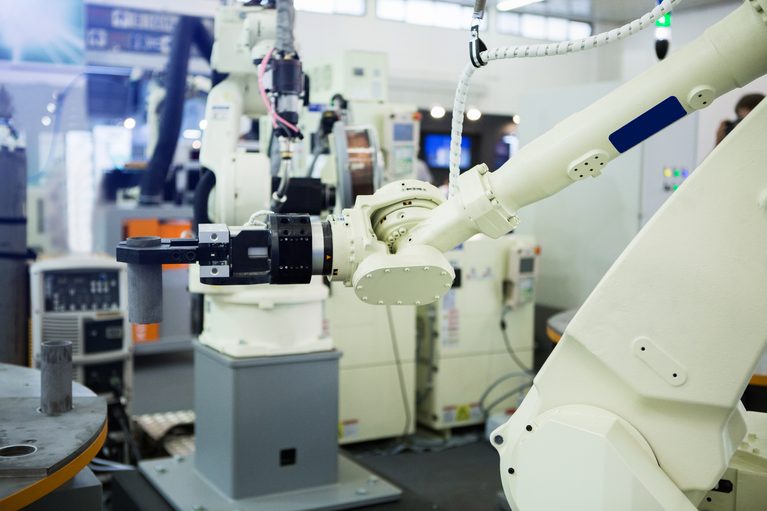
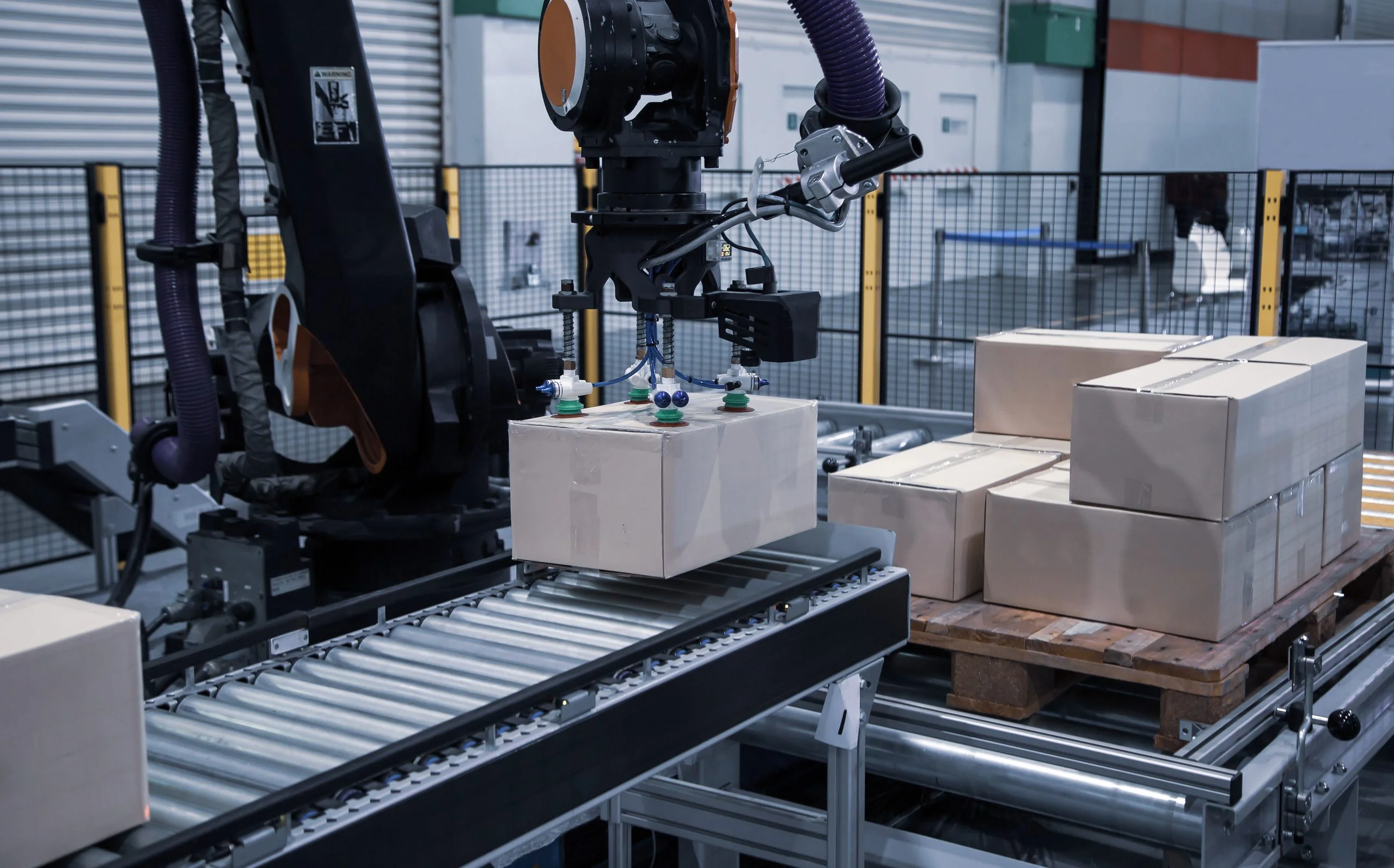
Fixed and mobile robot cells automate core processes including order picking, item handling, and packing. Custom-engineered elements in these systems typically include mounting bases and pedestals rated for dynamic tipping moments, SKU-specific End-of-Arm Tooling (EOAT), conveyor interfaces, vision-system mounting frames, and human-robot collaboration (HRC) safety barriers. Among these, EOAT requires the highest degree of customization and frequently undergoes redesign as product mixes evolve.

Materials for Warehouse Automation Hardware
Selecting the right material requires balancing structural stiffness, moving mass, wear resistance, corrosion protection, and manufacturing costs across fulfillment micro-environments.
Structural Steel (A36, A500)
Carbon steel tubing and plate (ASTM A36, A500) serve as the foundation for heavy load-bearing frames. With a high modulus of elasticity, steel provides maximum stiffness per dollar, making it ideal for tall ASRS storage racks, main conveyor structures, and heavy mobile robot bases. Because untreated steel corrodes quickly in humid or cold-storage environments, all steel fabrications require protective finishes like industrial powder coating or electrodeposition (e-coating).
6061-T6 Aluminum
6061-T6 aluminum is the standard material choice for moving assemblies in which payload capacity, rapid acceleration, and battery life drive performance such as AMR chassis, high-speed ASRS shuttles, and robotic grippers. Weighing roughly one-third as much as steel, aluminum lowers moving mass, shrinking drive motor requirements and extending battery runtime.
Type II clear or colored anodizing protects standard structural surfaces. For high-wear components like drive hubs, linear slide mounts, or hard mechanical stops, specify Type III (hardcoat anodizing) to reach surface hardness levels of ~60–70 HRC.
Engineering Plastics (UHMWPE, Acetal)
Ultra-High Molecular Weight Polyethylene (UHMWPE) and acetal (POM) manage sliding contact and friction surfaces. UHMWPE exhibits an exceptionally low coefficient of friction and high impact strength, making it the preferred material for conveyor wear strips, side guide rails, and chute liners. Because UHMWPE is self-lubricating, it prevents grease contamination on corrugated packaging.
Acetal (POM) is specified for parts requiring tighter machining tolerances (+0.05–0.1mm) and higher mechanical stiffness, such as star wheels, small gears, and precision chain guides.
Stainless Steel (304 and 316L)
In pharmaceutical, grocery, and cold-chain fulfillment operations, equipment is subjected to periodic washdown procedures, harsh sanitizing chemicals, or low temperatures. Structural frames, product contact surfaces, and fastener hardware in these zones should be specified in 304 or 316L stainless steel.
Components meant for hygienic zones must minimize hardware crevices, sharp interior corners, and flat horizontal surfaces where liquids can pool. Frame tubing should be angled to promote liquid runoff, and surfaces should be electropolished to reduce microbial adhesion and corrosion.
Custom vs. Standard Components in Warehouse Automation
As in most custom machinery design, warehouse automation bills of materials (BOMs) rely heavily on standard off-the-shelf parts that can be sourced directly from supplier catalogs. Knowing where to draw the line between custom fabrication and standard configuration cuts costs, shortens lead times, and simplifies procurement.
In Fictiv’s 2027 state of manufacturing and supply chain report, 100% of leaders in the warehouse automation industry agreed that fast, reliable access to both standard and custom parts is essential to the pace of innovation.
Custom-Manufactured Components
Reserve custom fabrication for parts dictated by unique geometry or extreme duty cycles, including chassis and frames tailored to facility layouts or robot kinematics, SKU-specific end-of-arm tooling (EOAT), application-specific sensor and vision mounts, dock interfaces and battery-swap hardware, and high-wear components where catalog parts fall short on load, cycle life, or geometry restrictions.
Standard and Configurable Components
Source off-the-shelf items wherever possible, such as linear guide rails and carriages (e.g., THK, Hiwin, MISUMI), structural aluminum extrusions for secondary framing and guarding (e.g., 80/20, MISUMI), precision shafts and couplings, roller bearings and housed units, standard conveyor rollers and drives, and common fasteners.
The Custom or Standard Decision Rule: If a part’s geometry and performance are completely satisfied by a supplier’s catalog offering, choose standard or configurable components. If its dimensions are dictated by custom facility layouts, robot kinematics, unique SKU handling surfaces, or integrated mounting points, specify custom manufacturing.
Designing Warehouse Automation Hardware for 24/7 Serviceability
24/7 warehouse automation hardware requires modular wear components, standardized fasteners, and accessible service points designed for minimum mean time to repair (MTTR). These continuous operational demands are what set warehouse automation apart from conventional machine design. Because unplanned downtime costs thousands of dollars per hour, component-level engineering choices directly dictate how quickly a system can be brought back online.
Modular Wear Components
Always engineer high-wear parts such as conveyor wear strips, AMR drive wheels, and EOAT fingertips as self-contained, replaceable modules. Technicians should be able to swap them in the field using a standard hex key set or no tools at all.
Fastener Standardization
Limit assemblies across the entire system to only a few standard fastener sizes (e.g., M5, M8, M10) if possible. A technician responding to a breakdown should need minimal tooling; nonstandard hardware only compounds delays during emergency repairs.
Accessible Service Points
All components requiring routine maintenance such as lubrication, adjustment, or replacement must be directly accessible without dismantling adjacent assemblies. Engineers should integrate access panels and service pathways into the initial architecture rather than adding them later.
- Spare Parts Strategy: Parts expected to wear out during standard shift operations must be engineered for on-demand manufacturing. Long lead times for custom components are a major operational liability, and spares should be held in on-site inventory.
- Designing for MTTR: Mean Time to Repair (MTTR) is a core requirement for warehouse automation hardware. Systems engineered to hit specific MTTR targets are vastly easier and faster to service than those optimized strictly for upfront performance.
Tolerances and Quality Requirements for Automation Hardware
Specifying appropriate manufacturing tolerances prevents unnecessary machining costs while ensuring seamless assembly and operational reliability in the field.
AMR Chassis
General noncritical envelope dimensions for welded or bolted AMR chassis fabrications specify +0.5 mm to +1.0 mm, whereas mounting pads for LiDAR sensors, tracking cameras, and wheel drives require tight tolerances of +0.1 mm to +0.25 mm. To overcome weld distortion, steel chassis weldments should be stress-relieved before receiving a final post-weld CNC milling pass on mounting faces to ensure coplanarity and true position.
ASRS Shuttle and Carriage Structures
ASRS shuttle carriage structures demand strict geometric control to ensure reliable tote engagement. Profile rail mounting pads require flatness within 0.1– 0.2 mm across the carriage length. Dual guide tracks must maintain parallelism to within 0.1 mm to prevent bearing binding during acceleration. Axle bearings call for ISO H7 bores with k6/p6 shafts to minimize mechanical lash. Achieving these specs requires precision CNC milling of all mounting faces in a single machine setup after frame welding.
Conveyor Frame Sections
Conveyor side channels tolerate broader overall manufacturing bands because installers adjust alignment on-site via slotted connection plates. However, local feature patterns demand higher accuracy: hex-bore roller hole pitch must hold +0.25 mm to maintain smooth belt tracking, and drive motor mounting faces require +0.15 mm squareness relative to the drive axis to protect shaft seals and couplers from premature failure.
Finish Requirements
Surface finishes are chosen to prevent oxidation and wear based on the operating environment. Structural carbon steel parts require powder coat to a dry film thickness of 60–80 micrometers, or e-coat (15-25 micrometers) after deburring sharp edges. Aluminum components specify MIL-A-8625 Type II anodizing (10–15 micrometers) for basic protection or Type III hardcoat anodizing (50 micrometers) on high-friction wear tracks. Stainless steel hardware for hygienic or cold-storage zones requires electropolishing (Ra < 0.4 micrometers) to reduce microbial trap sites.
Build Reliable Warehouse Hardware with Fictiv
Fictiv provides high-precision CNC machining, sheet metal fabrication, injection molding, and 3D printing capabilities engineered for warehouse automation OEMs and logistics operators. Whether scaling production of custom AMR chassis fabrications, precision ASRS shuttle carriages, or specialized end-of-arm tooling, Fictiv delivers production-grade custom parts with instant DFM feedback and fast lead times. Combined with MISUMI’s catalog of standard and configurable motion components, engineering teams can streamline their complete hardware BOM from prototype through high-volume deployment.
👉 Upload your part file to get a quote with DFM feedback.
Talk to a Fictiv expert about your project, or upload your parts to start a free quote.
FAQs About Warehouse Automation Equipment
What is warehouse automation equipment?
Warehouse automation equipment is the robotic, conveyor, storage, and picking hardware that moves, sorts, and stores inventory with minimal manual handling. The main categories are autonomous mobile robots (AMRs) and automated guided vehicles (AGVs), conveyor and sortation systems, automated storage and retrieval systems (ASRS), and robotic picking and packing stations.
What is the difference between an AMR and an AGV?
Both are mobile robots that move loads, but they differ in how they choose a path. An AGV (automated guided vehicle) follows a predefined route using guidance such as magnetic tape, wires, reflectors, or QR codes. An AMR (autonomous mobile robot) uses onboard LiDAR, cameras, and SLAM to plan its own route and navigate around obstacles. Both need rigid chassis, drive hubs, and battery enclosures, and any vehicle using LiDAR or cameras needs precisely aligned sensor mounts.
What materials are used in warehouse automation hardware?
Common materials include structural steel (ASTM A36, A500) for heavy frames, 6061-T6 aluminum for lightweight moving assemblies, UHMWPE and acetal for wear and sliding surfaces, and 304 or 316L stainless steel for washdown and cold-chain zones. Material choice balances stiffness, moving mass, wear resistance, corrosion protection, and cost.
Which warehouse automation components should be custom-manufactured?
Custom manufacturing makes sense for parts defined by unique geometry or extreme duty cycles: chassis and frames matched to robot kinematics or facility layouts, SKU-specific end-of-arm tooling (EOAT), sensor and vision mounts, battery-swap and dock interfaces, and high-wear parts where catalog options fall short. Standard items such as linear guides, bearings, rollers, and extrusions should be sourced from catalogs.
How do you design warehouse automation hardware for 24/7 serviceability?
Design high-wear parts as tool-free or hex-key-replaceable modules, standardize on a small set of fastener sizes, and place service points where they can be reached without removing adjacent assemblies. Set a mean time to repair (MTTR) target early, and keep critical wear parts in on-site inventory, with on-demand manufacturing for low-frequency parts.