







Time to read: 15 min
Aerospace manufacturing operates under a different standard than commercial manufacturing: the finished part, the process that made it, and the paperwork proving both are correct all need to hold up together. Standard industrial production optimizes for cost per unit and throughput. Aerospace production is built around a zero-defect standard for delivered hardware, meaning nothing nonconforming reaches flight-critical service without documented engineering disposition, because component failure can be catastrophic.
For engineers, sourcing teams, quality managers, and program leaders, that distinction affects nearly every manufacturing decision. Material selection influences the process used to make the part. Part geometry influences inspection and qualification. Supplier selection affects documentation, lead time, and export controls. Even a seemingly simple change to a production process can trigger additional inspection or first-article requirements.

Aerospace manufacturing is the controlled production of components for aviation, space, and defense programs, where the product, the process used to make it, and the documentation proving both conform to requirements are all part of what gets delivered.
This guide explains the fundamentals of aerospace manufacturing, including market segments, materials, finishing, manufacturing processes, quality standards, regulatory constraints, and supply-chain strategy. It also provides a practical checklist for moving an aerospace component from design and prototyping into controlled production.
Why Aerospace Manufacturing Is Different
Aerospace manufacturing requires more than producing a dimensionally correct component. Manufacturers must demonstrate that it was made from the specified material, using controlled processes, by qualified organizations, and provide objective evidence that it conforms to the requirements. Described below are some of the features of aerospace manufacturing that make it different from traditional, commercial manufacturing applications.
Extreme Tolerance Requirements
Aerospace tolerances exist because components often interface with flight structures, engines, actuation systems, bearings, seals, and precision fasteners. Dimensional variation can affect alignment, load distribution, fatigue life, sealing, aerodynamic performance, or assembly.
Not every feature requires an extremely tight tolerance. Effective aerospace manufacturing identifies the characteristics that actually affect function and applies tighter process controls, inspection, or statistical monitoring where necessary. Over-tolerancing every feature is a common mistake that increases machining time, inspection burden, and cost without necessarily improving the finished product.
Material Traceability
Aerospace parts commonly require traceability from the finished component back to a material heat, lot, batch, or other defined source. Material certification is therefore part of the product record.
A machined component may need to be traceable through its part number and drawing revision to raw-material certification, heat treatment, machining operations, inspection, finishing, and final release documentation.
Comprehensive Documentation
The manufacturing record can include drawings and revisions, material certifications, inspection reports, special-process certifications, first-article documentation, nonconformance records, and serialization, which is a lot of information.
The records must also agree with one another. A part can meet its dimensional requirements while still creating a program problem if its material, process, or inspection history cannot be demonstrated.
Conservative Qualification Culture
Aerospace programs are cautious about changing qualified materials, suppliers, processes, or inspection methods because each change can introduce technical risk and take time to validate. New technology is adopted, but typically through rigorous engineering validation, qualification, documented approval, and controlled implementation rather than informal substitution.
Aerospace Market Segments and Their Manufacturing Requirements
Aerospace manufacturing requirements vary with the aircraft or vehicle, operating environment, certification basis, production volume, mission, and consequences of failure.
Commercial Aviation
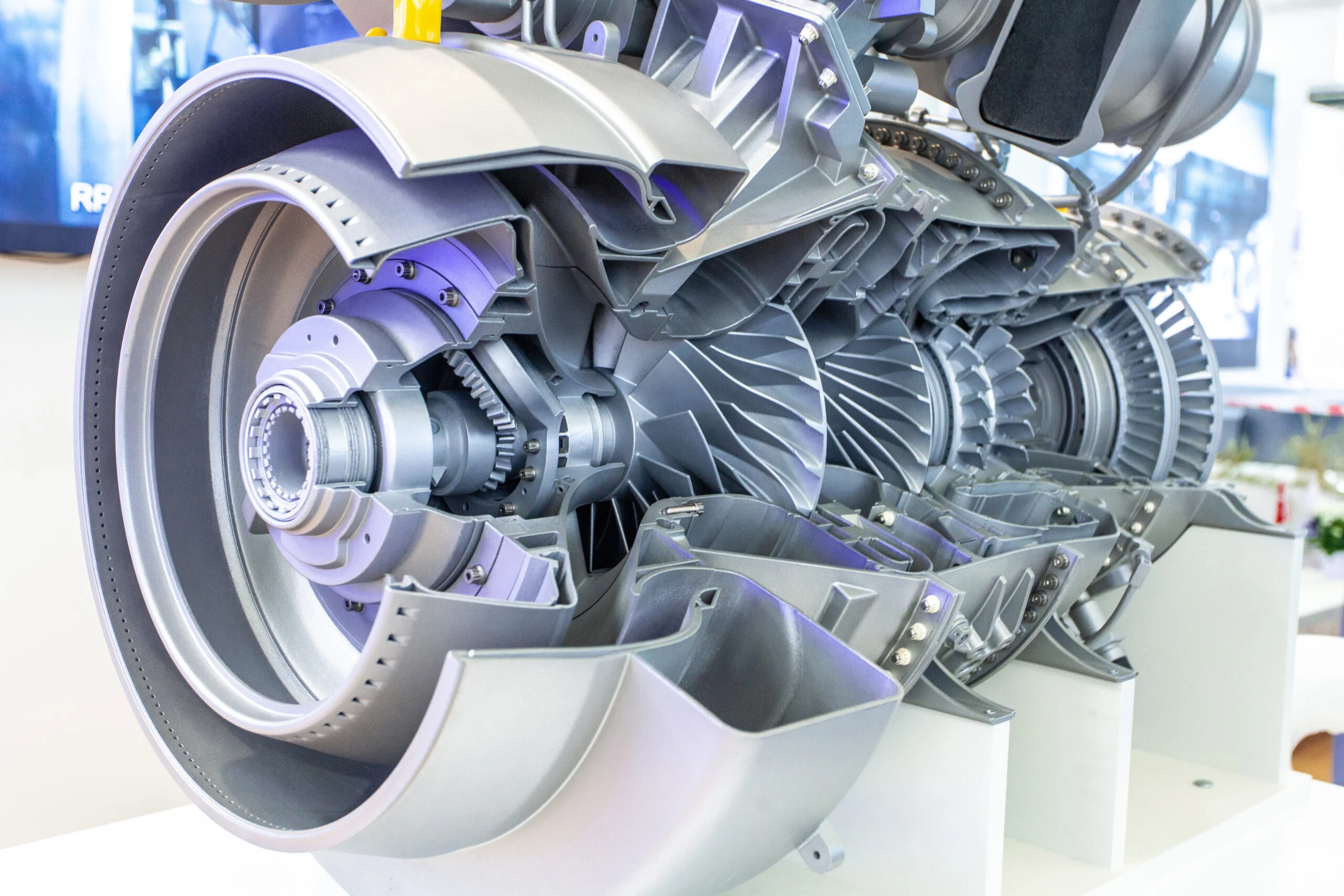
Commercial aircraft combine high production volumes with long service lives and extensive certification requirements. Manufacturing therefore emphasizes repeatability, supplier qualification, configuration control, production consistency, and documented inspection.
Defense
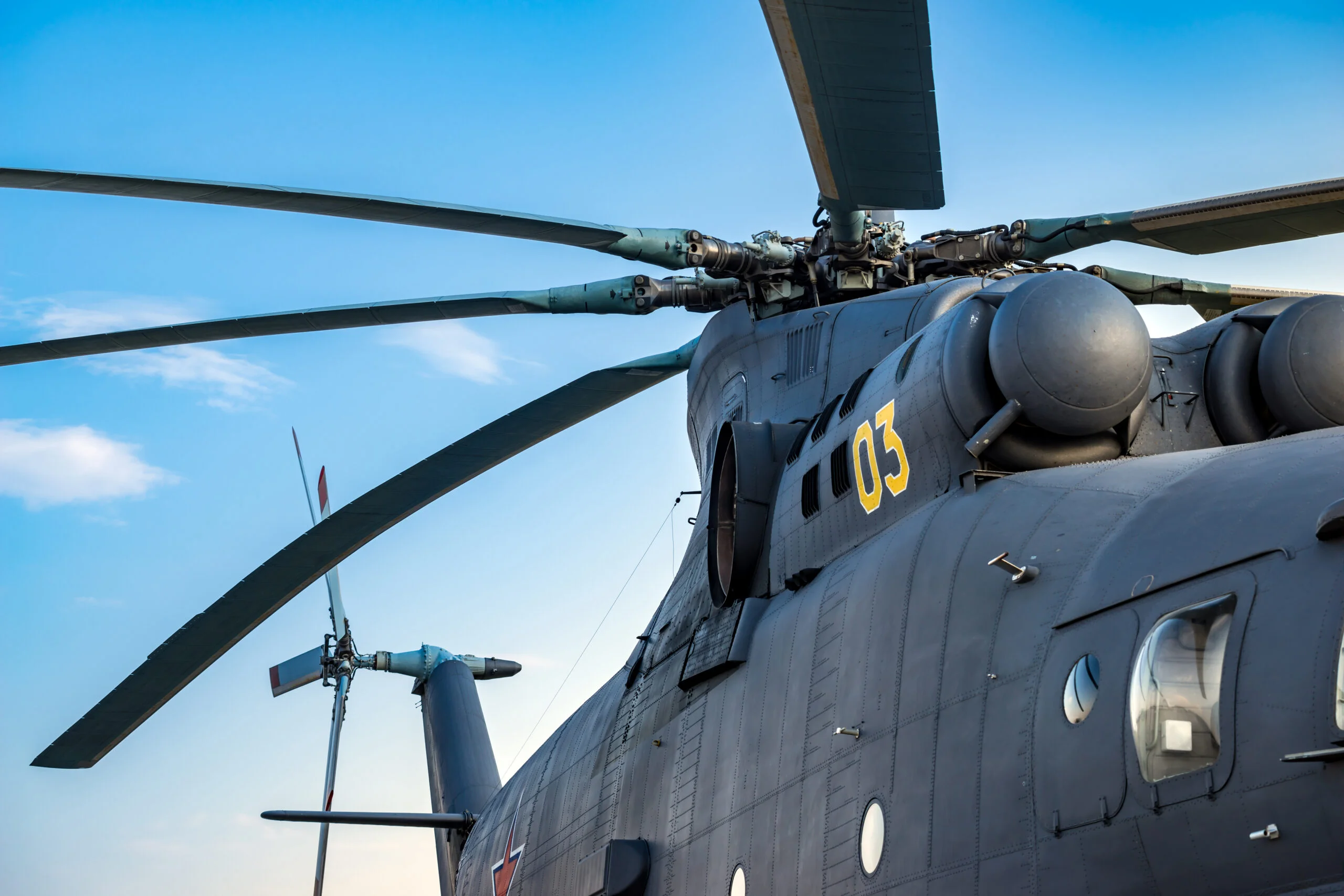
Defense manufacturing can involve lower volumes, changing configurations, classified or export-controlled information, government-specific contract requirements, and long sustainment periods. The key difference between defense aerospace applications and others is often configuration, data, security, and life-cycle control rather than simply greater dimensional precision and quality control.
Space and Satellites
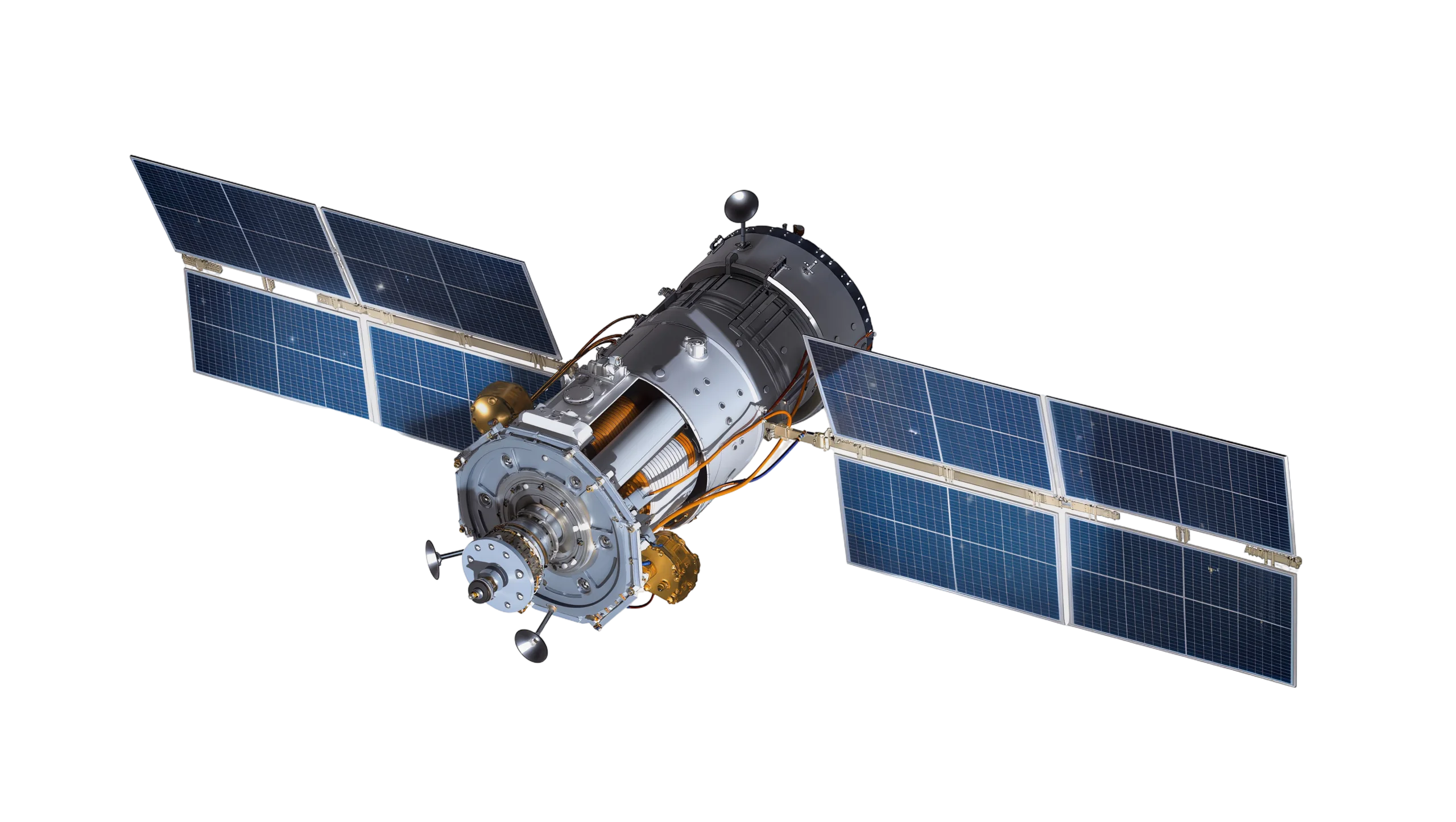
Space hardware must withstand launch vibration and shock, vacuum, thermal cycling, radiation, and extreme environmental conditions while often having no opportunity for maintenance after launch. This makes material and finish selection for space applications extremely important. Manufacturing consequently emphasizes cleanliness, contamination control, material behavior in vacuum, dimensional stability, non-destructive testing (NDT), and extensive qualification and environmental testing.

eVTOL
eVTOL programs combine aerospace certification requirements with rapid design iteration and ambitions for scalable production. Electric propulsion, batteries, distributed propulsion, lightweight structures, and composite components can introduce manufacturing requirements that differ from traditional aircraft. The challenge is maintaining aerospace configuration control while scaling newer production technologies and properly integrating both custom and standard parts.
Materials
Aerospace material selection balances strength-to-weight ratio, fatigue performance, corrosion resistance, temperature capability, manufacturability, availability, and qualification requirements.
Aluminum Alloys
- 2024-T3 is widely used for aircraft sheet structures because of its strength, fatigue performance, and formability.
- 7075-T6 provides very high strength, while 7075-T73 trades some strength for improved resistance to stress-corrosion cracking. The temper is an engineering requirement, not an interchangeable suffix.
- 6061-T6 provides good corrosion resistance, weldability, and machinability for many machined or structural applications. However, 6061-T6 is not suitable for formed sheet-metal work where significant bending is required, because its T6 condition can crack during forming. For formed sheets, 5052-H32 is a common choice because of its combination of corrosion resistance and formability.
Titanium
Ti-6Al-4V Grade 5 is the most widely used general-purpose aerospace titanium alloy. Ti-6Al-4V Grade 23 ELI provides enhanced ductility and fracture toughness where those properties justify its use.
Titanium has excellent strength-to-weight performance and corrosion resistance but carries a machining cost premium. Low thermal conductivity concentrates heat at the cutting zone, while its strength and chemical reactivity contribute to tool wear. Rigid setups, controlled cutting parameters, appropriate tooling, and effective chip evacuation are essential.
Titanium machining cost surprises come more from tool life than from setup time. A machining center running aluminum might see a tool through several hundred parts. The same operation in Ti-6Al-4V can wear through a tool in a fraction of that. Engineers specifying titanium for the first time often underestimate how that affects both cost and schedule when tool changes weren’t planned into the cycle time.
High-Strength Steels
Aerospace applications use 300M, 4340, 15-5 PH, and 17-4 PH where high strength, toughness, wear resistance, or corrosion resistance is required.
Heat treatment, residual stress, dimensional distortion, and surface finishing must be controlled carefully. High-strength steels also require attention to hydrogen embrittlement, particularly where processing can introduce hydrogen into susceptible material.
Superalloys
Inconel 718 and Waspaloy are nickel-based superalloys used when strength and environmental resistance at elevated temperatures are more important than ease of machining. They are particularly relevant to demanding engine and hot-section applications.
Their high strength and tendency to work harden make machining significantly more difficult than aluminum. Tooling, rigidity, cutting parameters, and heat management can become major cost drivers.
CFRP
Carbon-fiber-reinforced polymer (CFRP) is prevalent in modern aircraft structures. Airbus currently identifies 53% CFRP in the A350’s fuselage, wings, and tail, while Boeing has described the 787 as approximately 50% composite by weight. These figures use different bases and should not be treated as directly interchangeable aircraft-wide measurements.
CFRP structures are commonly manufactured using prepreg layup followed by controlled curing, with autoclave processing remaining important for highly qualified primary structures. Because laminate defects may be internal and invisible, composite manufacturing commonly incorporates non-destructive testing such as ultrasonic inspection.
Surface Finishing and Corrosion Protection
Surface finishing protects aerospace components against corrosion, wear, environmental exposure, and galvanic interactions.
Aluminum Anodizing
MIL-PRF-8625 defines anodic coatings for aluminum. Type I and Type IB are chromic acid processes; Type II uses conventional sulfuric acid; and Type III provides a harder, more wear-resistant anodized layer.
Chromic acid processes face ongoing environmental restrictions, with Type I slowly being phased out as of 2026. However, Type I has not simply disappeared from the specification. Current requirements and approved alternatives must be checked against the applicable drawing, customer specification, and qualified process rather than assuming any non-chromate coating is interchangeable.
Chromate Conversion Coatings
MIL-DTL-5541 chromate conversion coatings provide corrosion protection while maintaining electrical conductivity and adding little dimensional change. Trivalent-chromium and other alternatives may be used where hexavalent-chromium restrictions apply, subject to engineering and qualification requirements.
Passivation
Stainless steel and other applicable components may be passivated per ASTM A967/A967M, which covers nitric acid, citric acid, and electrochemical treatments.
Primers and Topcoats
Aerospace structural components frequently use qualified primer and topcoat systems selected for corrosion resistance, adhesion, chemical exposure, and environmental durability. The complete coating system must match the engineering specification.
Galvanic Corrosion
Dissimilar-material interfaces require particular attention. Aluminum next to conductive CFRP can create a galvanic couple, while steel fasteners in aluminum structures present another common risk.
Isolation, sealants, compatible finishes, appropriate fastener materials, and controlled installation practices can reduce or, where properly designed and maintained, prevent galvanic corrosion.
Manufacturing Processes
CNC Machining
CNC machining is well suited to aerospace components requiring complex geometry, tight tolerances, repeatable features, and controlled surface finishes.
Aerospace machining adds requirements beyond conventional CNC work. Material certification and traceability must be maintained, critical characteristics must be identified, and first-article requirements may apply before production approval. 5-axis machining is especially useful for complex geometry because it can reduce setups and improve tool access.
Critical interfaces may require tightly controlled surface finish, positional accuracy, and specialized inspection.
Aerospace Fastener Holes
Fastener holes require control of diameter, location, perpendicularity, and, where specified, cylindricity and surface finish. Burrs, scratches, or damaged hole walls can affect joint performance and fatigue life.
At dissimilar-metal interfaces, wet installation with an approved sealant or corrosion-inhibiting compound may be required by the engineering specification.
Sheet Metal
Sheet-metal production depends heavily on material and temper. 5052-H32 is commonly selected for formed parts, while 6061-T6 should generally be used for flat or machined applications where its temper is appropriate.
Grain direction can influence forming and fatigue performance. Designs should also account for bend radius, springback, fastener locations, and machining allowances. Where welded assemblies will be machined afterward, provide adequate material to correct weld distortion.
Composite Manufacturing
Composite (CFRP) manufacturing typically uses a controlled layup process followed by vacuum consolidation and curing. Autoclave processing offers tightly controlled temperature and pressure for highly qualified structures, while OOA processes can support appropriate applications without an autoclave.
Drilling and trimming must prevent delamination, fiber pullout, and heat damage. NDT, commonly ultrasonic inspection, detects internal defects.
Additive Manufacturing (AM)
Metal additive processes such as DMLS and SLM are used for applications involving complex internal channels, topology optimization, part consolidation, and difficult-to-machine geometry.
AM is an established aerospace production technology, but its application remains targeted rather than universal. The business case is strongest where geometry, weight reduction, part consolidation, lower-volume production, or supply-chain considerations justify it.
Aerospace AM programs must control feedstock, process parameters, build orientation, heat treatment, dimensional inspection, surface finishing, and applicable AS9100 and NDT requirements. The build process itself becomes part of the qualification strategy.
Quality Standards
Aerospace quality management frameworks leave no room for ambiguity. Below are standalone summaries of the four governing standards, followed by technical execution requirements.
AS9100 Rev D
AS9100 Rev D is the aerospace quality management system standard for aviation, space, and defense organizations. It builds on ISO 9001 with additional aerospace-focused controls addressing areas such as operational risk, product safety, configuration management, counterfeit-product prevention, and production controls.
When qualifying a supplier, verify the actual certificate, issuing body, facility, certification scope, and activities covered rather than relying on an “AS9100 certified” statement alone. AS9100 requirements are periodically revised; verify you’re working to the current released version with your certification body.
AS9102
AS9102 is the aerospace First Article Inspection (FAI) standard, not a quality management system standard. It standardizes the FAI process and documentation used to verify aviation, space, and defense products.
FAI typically applies to a new part or when required by the applicable customer or quality system. It may need to be partially or fully repeated after significant changes, such as design revisions, manufacturing-process changes, or other events affecting conformity.
NADCAP
NADCAP (National Aerospace and Defense Contractors Accreditation Program) is an industry-managed accreditation program for critical aerospace processes and is distinct from AS9100 certification. Process categories include chemical processing, heat treating, NDT, welding, composites, materials testing, and measurement and inspection.
AS9100 evaluates the broader quality management system, while NADCAP accreditation evaluates specific critical processes.
ITAR
International Traffic in Arms Regulations (ITAR) governs the export, temporary import, and brokering of covered defense articles, services, and technical data. Depending on the circumstances, disclosure of controlled technical data to foreign persons or export of that data may require authorization from the U.S. Department of State and DDTC. Covered U.S. suppliers may also have DDTC registration obligations.
ITAR applicability is fact-specific. Organizations should obtain guidance from their legal and export-compliance teams for ITAR-specific determinations.

Supply Chain Strategy
Supplier Qualification Investment
Aerospace supplier qualification is front-loaded because it can involve audits, QMS verification, process qualification, sample production, FAI, special-process approval, and documentation review. Qualification time should therefore be included in the program schedule from the beginning.
Single-Source vs. Dual-Source
Single sourcing can simplify technical control but increases exposure to capacity disruptions or supplier failure. Dual sourcing can improve resilience but may require additional qualification and configuration control.
For flight-critical parts, the sourcing decision should consider the consequences of failure, demand, lead time, qualification cost, and the practical ability to approve an alternate source.
DMSMS
Diminishing Manufacturing Sources and Material Shortages (DMSMS) describes the loss or impending loss of manufacturers, suppliers, materials, or parts needed to sustain a product.
For long-life aerospace programs, DMSMS management can require early identification of vulnerable materials, suppliers, processes, and components.
International Sourcing
International sourcing can introduce ITAR, EAR (Export Administration Regulations), customs, sanctions, technical data, and country-specific constraints. The issue is not necessarily limited to where a supplier is located; access to controlled technical information can also matter.
Counterfeit Parts Prevention
AS9100 Rev D includes counterfeit-product controls. Defense contracts may add requirements through DFARS clauses and applicable flow-down provisions.
Practical controls include approved suppliers, traceable purchasing, authentication and inspection where appropriate, control of suspect material, and records establishing product provenance.
Check out our State of Manufacturing & Supply Chain Report to learn more.
The Aerospace Manufacturing Checklist
Design Documentation
- Confirm drawing, model, specification, and revision alignment.
- Identify key characteristics and other critical features.
- Confirm material grade, temper, thickness, and specification.
- Define required surface finishes and corrosion protection.
- Identify special processes and approved specifications.
- Confirm fastener-hole requirements.
- Define NDT requirements and acceptance criteria.
Supplier Qualification
- Verify AS9100 certification and applicable scope.
- Confirm required NADCAP or customer-specific approvals.
- Verify special-process subcontractors where applicable.
- Assess supplier capacity, equipment, inspection capability, and aerospace experience.
- Establish approved material and process sources.
- Evaluate single-source exposure and alternate-source feasibility.
Quality Planning
- Determine whether AS9102 FAI is required.
- Define inspection methods for critical dimensions.
- Confirm calibration and measurement capability.
- Establish material and lot traceability.
- Define nonconformance and deviation procedures.
- Establish serialization and record-retention requirements.
Program Controls
- Establish configuration-control procedures before changes occur.
- Determine ITAR/EAR requirements with qualified personnel.
- Identify DMSMS risks for long-life programs.
- Establish counterfeit-part prevention controls.
- Define packaging, preservation, storage, and transportation requirements.
- Establish engineering and supplier-change approval procedures.
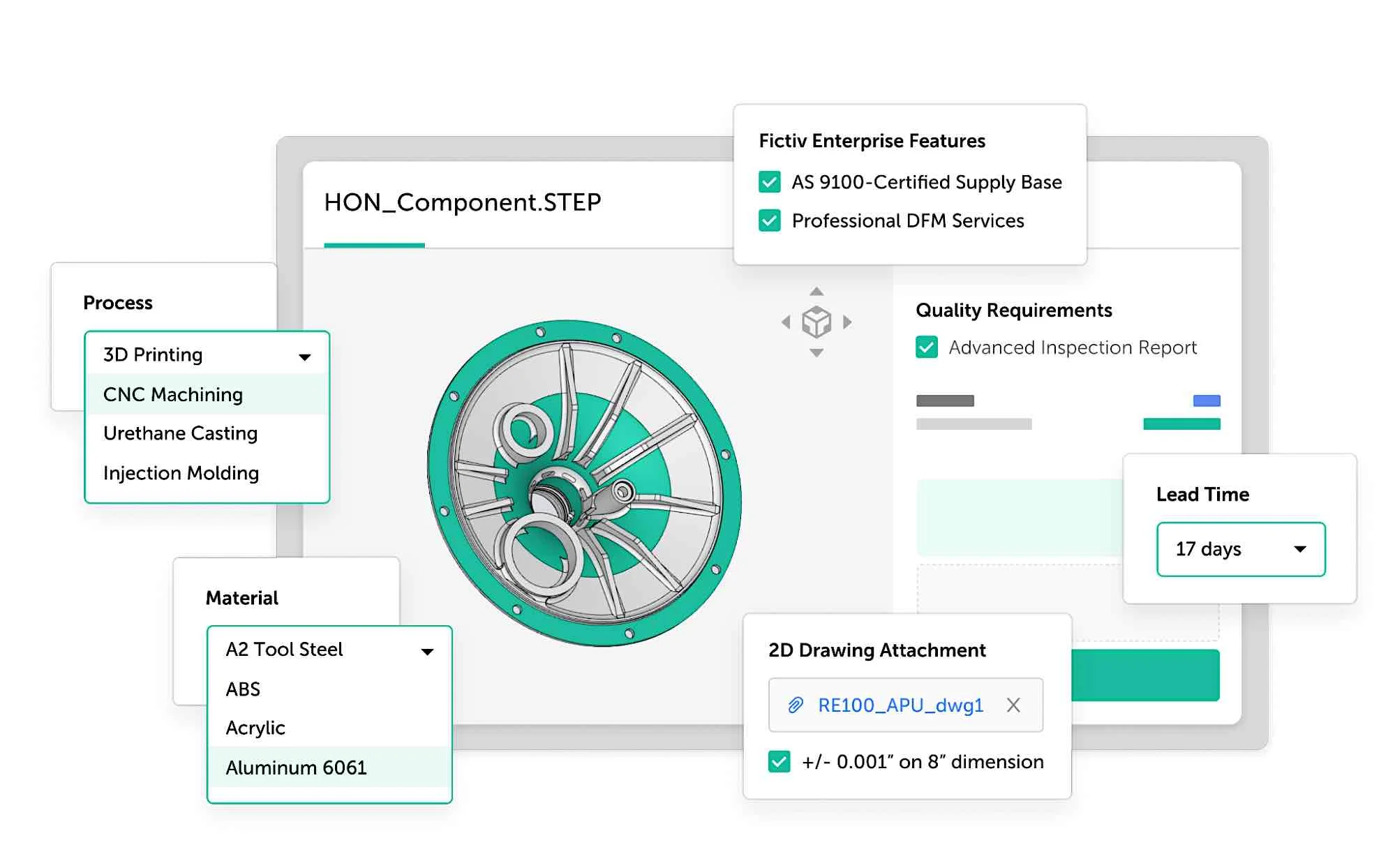
See how Honeywell worked with Fictiv to accelerate their product development.
Simplify Your Aerospace Supply Chain with Fictiv
Navigating aerospace manufacturing compliance, material specifications, and quality controls can quickly stretch internal procurement and engineering bandwidth. Fictiv simplifies this complexity by serving as your single, reliable partner for flight-ready precision components.
Through our network of AS9100-certified and NADCAP-accredited manufacturing partners, Fictiv delivers precision 5-axis CNC machining, custom sheet metal fabrication, 3D printing, and composite processing—backed by rigorous digital quality systems. We handle full AS9102 First Article Inspections, complete MTR material traceability, CMM inspection reports, and ITAR-compliant data security, allowing your team to move from design to flight-certified hardware with speed and confidence.
Ready to accelerate your aerospace program? Upload your CAD models to Fictiv today to receive instant DFM feedback and transparent lead times for your next production run.
Talk to a Fictiv expert about your project, or upload your parts to start a free quote.
FAQs About Aerospace Manufacturing
What makes aerospace manufacturing different from commercial manufacturing?
Aerospace manufacturing requires controlling the product, process, and evidence of conformity together, not just producing a dimensionally correct part. Manufacturers must show a component was made from the specified material, using controlled processes, by qualified organizations, with objective evidence of conformity. This level of control exists because component failure can have catastrophic consequences, unlike most commercial applications.
What is the difference between AS9100 and NADCAP?
AS9100 and NADCAP evaluate different things. AS9100 Rev D is a quality management system standard covering an organization’s overall processes, controls, and documentation. NADCAP accreditation evaluates specific critical processes instead, such as heat treating, chemical processing, NDT, welding, and composites. A supplier can hold AS9100 certification without NADCAP accreditation for every process it performs, so both should be verified against the actual scope of work.
Is metal additive manufacturing reliable enough for flight-critical aerospace parts?
Metal AM is an established aerospace production technology, but it isn’t a universal replacement for machining. Processes like DMLS and SLM are used where geometry, weight reduction, part consolidation, or difficult-to-machine features justify it. Aerospace AM programs must control feedstock, process parameters, build orientation, heat treatment, and inspection, with the build process itself forming part of the qualification strategy under AS9100 and NDT requirements.
What should be verified before qualifying an aerospace supplier?
Verify the actual AS9100 certificate, issuing body, facility, and certification scope rather than accepting a general “AS9100 certified” claim. Confirm any required NADCAP or customer-specific approvals for special processes, and assess capacity, equipment, and inspection capability. Qualification is front-loaded, involving audits, process qualification, sample production, and FAI, so that timeline should be built into the program schedule from the start.
Does ITAR apply to every aerospace manufacturing program?
No. ITAR applicability is fact-specific and isn’t determined solely by where a supplier is located. Depending on the circumstances, disclosure of controlled technical data to foreign persons, or export of that data, may require State Department/DDTC authorization, and covered U.S. suppliers may have registration obligations. Because the analysis is fact-specific, engineering and sourcing teams should confirm requirements with legal and export-compliance specialists.