






Time to read: 11 min
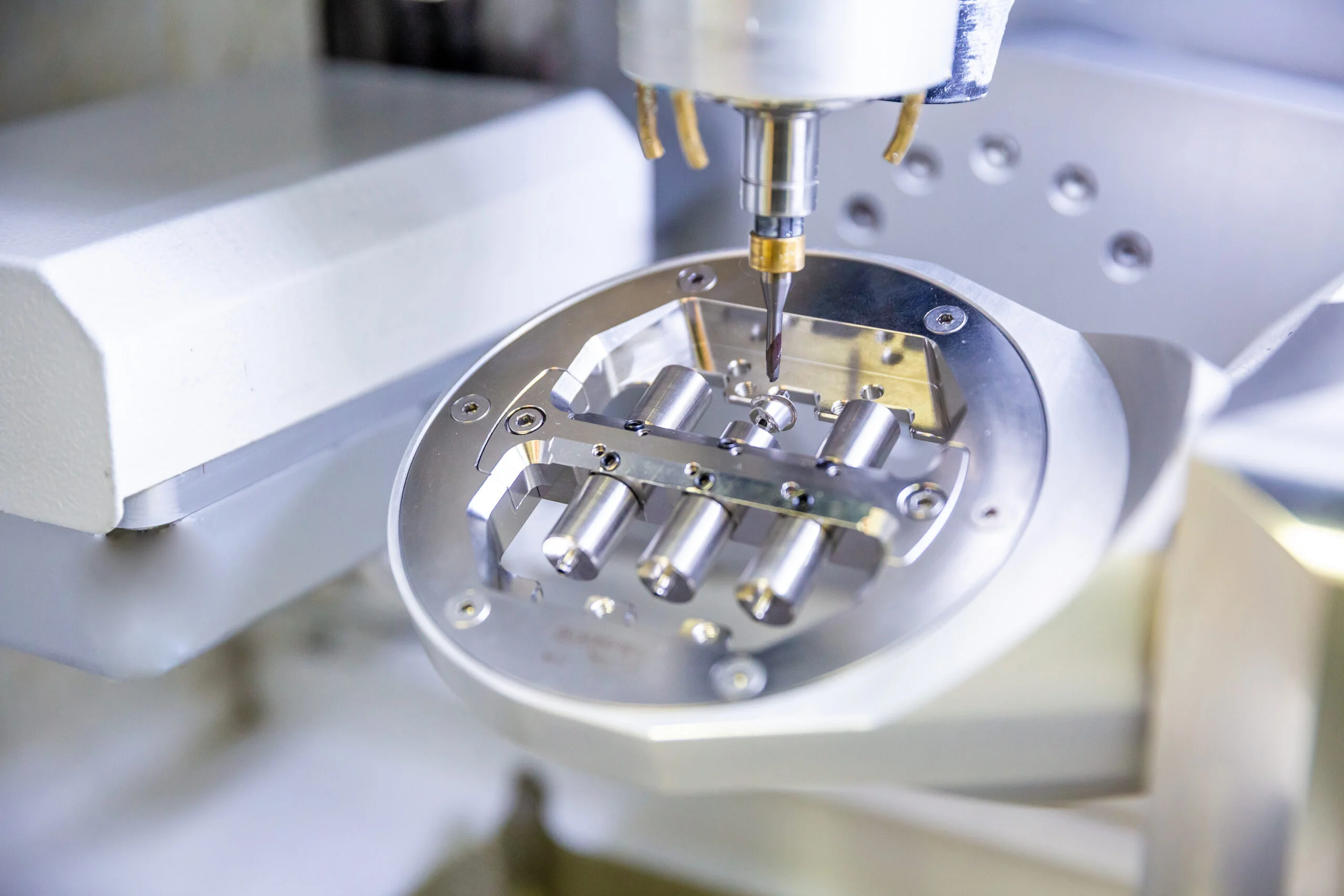
CNC machining is commonly used to manufacture various medical devices—surgical instruments, fixtures, structural elements, fluid-handling parts, and components that attach to or form part of a tissue-contacting implant. The machining operations themselves are familiar shop-floor work. The practical difference in medical device machining is that material definition, surface condition, traceability, inspection, and documentation aren’t just quality measures; they’re part of the product specification.
Material grade affects biocompatibility and sterilization compatibility. Surface treatment can change part dimensions, even if only slightly. Tolerances that are easy enough to machine can still demand extensive inspection and documentation. For engineers sourcing machining for medical devices, the 2D drawing, manufacturing route, inspection plan, and quality records all need to describe the same finished component consistently, with no gaps between them.
This article looks at the practical side of material selection, tolerancing, surface finish, documentation, and supplier selection for machining medical device components.
Materials Used for Machining Medical Device Components
Medical CNC components are commonly cut from titanium, stainless steel, PEEK, acetal, and PTFE. The mechanical requirements and operating environment drive most material decisions, but medical work adds its own material demands: biocompatibility, sterilization, corrosion resistance, cleaning, and traceability all factor in.
Titanium
For titanium machining, Ti-6Al-4V Grade 5 is the go-to alloy whenever high specific strength, corrosion resistance, and biocompatibility outweigh cost. Grade 23 (Ti-6Al-4V ELI) is chemically the same alloy as standard Ti-6Al-4V, but with tighter limits on interstitial elements. Grade 2, on the other hand, is commercially pure titanium, a different material entirely. These grades are simply not interchangeable, and must be selected carefully.
Grade 23 ELI is typically reserved for implant applications, while Grade 5 covers structural and instrument components that will not remain implanted. Titanium’s low thermal conductivity makes it hard to machine, since heat concentrates around the cutting zone instead of dissipating through the part. Tooling choice, cutting parameters, coolant delivery, and toolpath strategy all shape tool life and the final surface condition.
Stainless Steel
For machined stainless, 316L is the standard pick for corrosion-resistant medical parts, including fluid-contact components and housings. 17-4 PH offers substantially more strength and suits surgical instruments and structural components. Grade 303 machines more easily, and its weaker corrosion performance is often an acceptable trade-off, depending on the application.
Treat “stainless steel” as a starting point, not a full specification. If passivation is required, say so explicitly on the drawing.
PEEK
PEEK pairs solid mechanical properties with excellent chemical resistance, sterilization compatibility, and radiolucency—a real advantage in components where metal would interfere with imaging.
Simply writing “PEEK” on a drawing is not sufficiently precise for controlled medical production. The resin manufacturer and grade need to be specified, since property differences between grades can be part of the qualification basis—for example, Victrex 450G versus a Solvay KetaSpire grade.
Acetal and PTFE
Acetal types POM-C (copolymer) and POM-H (homopolymer) work well for lower-cost structural parts that don’t need PEEK-level performance. PTFE suits seals, gaskets, and low-friction interfaces better than structural parts. It looks easy to machine, but its softness and tendency to deform under clamping make both machining and dimensional inspection trickier than they first appear.
Summary Comparison of Machinable Medical Materials
| Material | Typical grades/types | Typical Applications | Main Design Considerations |
| Titanium | Grade 5, Grade 23 ELI, Grade 2 (pure) | Structural parts, implants, implant-adjacent, and load-bearing components | Difficult machining; grade must be explicit |
| Stainless steel | 316L, 17-4 PH, 303 | Instruments, housings, fluid-contact parts | Corrosion performance, strength, and passivation |
| PEEK | Medical grade, specified by brand/grade | Structural plastic parts, imaging-related components | High material cost and grade-specific properties |
| Acetal | POM-C, POM-H | Noncritical structural plastic components | Sterilization and load limitations |
| PTFE | Virgin unfilled PTFE | Seals, gaskets, and low-friction surfaces | Soft and difficult to hold dimensionally |
Sterilization and Biocompatibility
Sterilization resilience needs to be considered during material selection, not after the part is machined. Material identity alone doesn’t establish biocompatibility either. Surface condition, processing residues, sterilization history, and the nature and duration of patient contact all play a role. ISO 10993 lays out the framework for biological evaluation, but the final call sits with the medical device manufacturer and its regulatory team rather than the machine shop.
Biocompatibility testing under ISO 10993 applies to the finished part in its final surface state and sterilization condition. Material grade, surface treatment, and intended sterilization method should all be specified explicitly on the drawing, since these factors are each part of the biocompatibility determination.
Sterilization Compatibility Table for Common Medical Device Materials
| Material | Steam Autoclave | EtO | Gamma | E-beam |
| Titanium | Yes | Yes | Yes | Yes |
| 316L Stainless | Yes | Yes | Yes | Yes |
| PEEK | Yes (grade-dependent) | Yes | Yes | Yes (grade-dependent) |
| Acetal (POM) | No above ~90°C | Yes | Limited | Confirm with supplier |
| PTFE | Yes | Yes | No | No |
Surface Finish Requirements for Machined Medical Parts
What a surface finish needs depends on what it does. An internal structural face can usually stay as-machined, while a fluid-contact surface, a repeatedly sterilized instrument, or a corrosion-sensitive stainless part usually needs additional processing.
As-Machined Surfaces
Ra 1.6–3.2 μm is a practical as-machined range for most noncontact structural surfaces. Anything tighter needs a functional reason behind it, since getting there means different cutting conditions, extra passes, polishing, grinding, or another finishing step. Blanketing the whole part with a tight Ra callout just adds cost for no functional gain.
Passivation
Passivation is a chemical treatment for stainless steel, not a mechanical finishing step defined by Ra. It strips free iron and other surface contamination that would otherwise compromise corrosion resistance.
Passivation should come after machining, welding, and any other operation that could contaminate the surface. ASTM A967 and ASTM A380 are the standards typically referenced for stainless steel passivation and cleaning, respectively.
Electropolishing
Electropolishing removes a controlled layer of material electrochemically, smoothing the microscopic peaks of surface roughness in the process. Finishes in the Ra 0.1–0.4 μm range are achievable, though the exact result depends on the starting surface, material, geometry, and process parameters.
It’s especially useful on stainless surfaces intended for fluid-contact or repeated sterilization. Electropolishing precedes passivation when both are called for.
Anodizing
Titanium color anodizing gives surgical instruments identification without meaningfully changing dimensions. This process falls under SAE AMS 2488, not the aluminum anodizing spec (MIL-A-8625). Hard anodizing (MIL-A-8625 Type III) adds wear resistance to non-implantable aluminum parts, with a coating thick enough to matter for tolerance stacks.
Drawings should call out the specific anodizing process rather than a generic “anodize” note. Coating thickness and dimensional growth matter for precision fits, threads, and mating surfaces, and need to be factored into the tolerance stack.
Finished dimensions aren’t independent of surface processing. Electropolishing removes native material, anodizing adds an oxide layer, and aggressive polishing can wear down edges and fine features unevenly. Where any of these effects are significant relative to the tolerance, the drawing and process plan need to distinguish the as-machined condition from the final acceptance condition.
Learn more about finishing options for CNC parts in our product guide.

Tolerances for Medical CNC Parts
General CNC tolerances for medical components typically range from ±0.025 to ±0.12 mm, with looser tolerances acceptable in noncritical areas. Functional and critical features often need ±0.005 to ±0.01 mm. The correct tolerance for any given feature comes from what that feature actually does, not from the fact that the part happens to be medical.
A bearing seat, precision shaft, press fit, sealing interface, or controlled moving clearance is a different story. Pulling every dimension on a drawing to the tightest tolerance just drives up machining and inspection cost, and it can shrink the pool of suppliers capable of making the part reliably, without adding any real benefit.
GD&T earns its keep where function depends on predictable relationships between features. An orifice might carry a fairly loose size or cylindricity tolerance but a tight position callout relative to a datum structure. A sealing face may depend more on flatness than on absolute thickness. Datum schemes, position, perpendicularity, profile, flatness, and runout communicate these requirements far better than a page of aggressive bilateral dimensions.
Plan inspection requirements at the same stage as tolerancing. Depending on the component and the production program, this could mean first-article dimensional reporting, 100% inspection on selected critical characteristics, AQL-based sampling, or Cpk/Ppk capability monitoring. Give the supplier this information before they quote—inspection scope creep is one of the easiest ways to blow a budget after the fact.
Quality Standards and Documentation for Medical CNC Parts
The right documentation package varies by program, customer requirement, and quality agreement, so it’s worth nailing down on the drawing, purchase order, or quality documentation before production starts. For metal parts, material certification provides alloy, heat, and lot traceability. Medical plastics often need equivalent rigor: resin manufacturer, grade, and lot traceability. These records carry extra weight when a specific material grade is part of the device’s qualification basis.
First Article Inspection (FAI) provides dimensional evidence before full production gets the green light. Ongoing inspection records can then cover selected critical characteristics, or the full drawing where that makes sense. A Certificate of Conformance (CoC) is the supplier’s declaration that delivered parts meet spec.
Special processes generate their own paper trail. If stainless parts get passivated or electropolished, the batch documentation needs to name the applicable spec and link the processed lot back to the production parts.
Across repeat production runs, this builds a traceability chain from material lot through to CoC and shipped lot, with records connecting every stage in between. Keeping that chain intact is what makes it possible to actually investigate a material, dimensional, or process problem later and get a useful answer.
ISO 13485:2016 (incorporated by the FDA’s QMSR) provides insight when evaluating a supplier’s quality system for medical-device work, though certification still needs to line up with whatever requirements the device manufacturer imposes on top of it.

Choosing a CNC Supplier for Medical Programs
Supplier qualification comes down to two main questions:
- Can the shop repeatedly produce a conforming part?
- Can it generate the records the quality management program requires?
Material experience matters just as much. A shop that’s great with aluminum isn’t automatically equipped with tooling, process knowledge, and inspection experience to handle thin-walled PEEK, Ti-6Al-4V, or a demanding 316L component.
Before placing a production order, find out how the supplier controls material lots, what a typical FAI package looks like, how inspection gets specified and performed, and how outsourced special processes and their suppliers are qualified and traced.
For programs with domestic content requirements or where FDA inspection access matters, confirm whether manufacturing is domestic and whether the full documentation chain can be traced accordingly. This includes subcontracted special processes such as passivation and electropolishing, which need to tie back to the same production lot through qualified suppliers.
Fictiv supports medical-device CNC programs through ISO 9001-certified manufacturing and access to ISO 13485:2016-certified machining partners, with quality documentation built into the sourcing process.
Start a free quote for your next medical device component.
Talk to a Fictiv expert about your project, or upload your parts to start a free quote.
FAQs About Medical Device Machining
What tolerance is achievable for CNC-machined medical device parts?
General CNC tolerances for medical components typically run ±0.025 to ±0.12 mm, with looser tolerances acceptable on noncritical features. Functional or critical features—bearing seats, press fits, sealing interfaces—often need ±0.005 to ±0.01 mm. The right tolerance depends on what the feature does, not on the fact that the part is medical.
Does PEEK need sterilization validation for medical devices?
PEEK generally tolerates steam, EtO, and gamma sterilization, but compatibility varies by grade. Check the specific resin manufacturer’s data (Victrex 450G vs. a Solvay KetaSpire grade, for example) before assuming a given sterilization method is compatible—grade differences are often part of the qualification basis.
What’s the difference between passivation and electropolishing for stainless steel?
Passivation is a chemical treatment (per ASTM A967) that strips free iron and surface contamination to restore corrosion resistance—it doesn’t change surface roughness. Electropolishing is an electrochemical process that removes a controlled layer of material to smooth the surface, typically down to Ra 0.1–0.4 µm. When both are specified, electropolishing comes first, followed by passivation.
Which titanium grade should be used for an implant versus a non-implant component?
Grade 23 (Ti-6Al-4V ELI) is typically reserved for implant applications because of its tighter limits on interstitial elements. Grade 5 (standard Ti-6Al-4V) covers structural and instrument components that won’t remain implanted. Grade 2 is commercially pure titanium—a different material entirely, not interchangeable with either.
How does QMSR affect quality documentation for medical device CNC machining?
FDA’s Quality Management System Regulation (QMSR), effective February 2026, replaced 21 CFR Part 820 and incorporates ISO 13485:2016 by reference. For sourcing, this means a supplier’s ISO 13485:2016 certification is a stronger signal of regulatory alignment than before, but device manufacturers still need to confirm any FDA-specific documentation requirements on top of that certification.